
Agentic Commerce - Preparing Your Business for a World Where AI Buys
Preparing Your Business for a World Where AI Buys
For the last thirty years, digital business has been built around a single assumption: humans are the primary decision-makers. We designed websites to persuade them, funnels to guide them, interfaces to delight them, and metrics to track their clicks. Even as automation increased, the mental model stayed the same. Machines assisted. Humans decided.
That assumption is now breaking.
We are entering a world where AI systems do not merely influence purchasing decisions — they increasingly make them. Sometimes explicitly, as autonomous agents that reorder supplies, compare vendors, or execute transactions. Sometimes implicitly, as reasoning engines that determine which brands are cited, recommended, or excluded before a human ever sees a choice. In both cases, the result is the same: the decisive moment in commerce is shifting upstream, away from human interfaces and into machine judgment.
This is not a distant future. It is already happening.
Large language models answer product questions directly instead of sending traffic. Digital assistants recommend options instead of listing results. Enterprise procurement bots evaluate vendors against constraints humans never see. Retail platforms increasingly mediate discovery, pricing, availability, and compliance through automated systems. The buyer still exists — but they are no longer alone, and often they are no longer first.
The uncomfortable truth is this: most businesses are completely unprepared for this shift.
They are optimized for persuasion, not reasoning. For presentation, not proof. For marketing language, not machine-legible truth. Their data is fragmented, their claims are absolute, their logic is implicit, and their governance is reactive. These weaknesses were survivable when humans could fill in gaps, forgive ambiguity, and “read between the lines.” Machines do not do this. When faced with ambiguity, they infer. When faced with missing data, they interpolate. When faced with conflicting claims, they exclude.
In a world where AI buys, exclusion is the new failure mode.
To prepare for this world, organizations must abandon a set of deeply ingrained but increasingly dangerous assumptions.
The first is the belief that interfaces are the primary asset. Websites, apps, and dashboards matter far less when decisions are made before the interface is reached. What matters instead is how your business is represented inside the reasoning systems that sit between you and the buyer. If an AI agent cannot clearly determine what your product is, what constraints it satisfies, what risks it carries, and where its claims come from, it will simply choose something else.
The second assumption to discard is that more content equals more visibility. In human-centric marketing, volume and repetition can compensate for clarity. In AI-mediated environments, the opposite is true. Excess language without structure increases uncertainty. Marketing claims that lack evidence are treated as risk. Absolute statements without bounds are flagged as unreliable. The winners in AI-mediated commerce are not the loudest brands, but the most legible ones.
This leads to the third and most profound shift: truth becomes an architectural concern.
In traditional commerce, truth was a legal or ethical requirement — important, but often downstream from growth. In AI-mediated commerce, truth is operational. It must be encoded, structured, versioned, and auditable. Facts must be separated from inference. Opinion must be labeled as such. Uncertainty must be expressed, not hidden. The system must be able to answer not just what is true, but why, according to whom, and within what limits.
This is not because AI is inherently skeptical. It is because AI is inherently accountable. Every decision it makes can be traced, challenged, replayed, and audited. When something goes wrong — a safety issue, a compliance failure, a misrecommendation — the question is no longer “Who wrote this copy?” but “What did the system know at the moment it acted?”
Businesses that cannot answer that question will not scale in an agentic world.
Preparing for AI buyers therefore requires a fundamental reorientation: from experience design to reasoning design. From optimizing for clicks to optimizing for judgment. From storytelling to evidence engineering. From static content to living knowledge systems.
It also requires new forms of governance. Conversational interfaces feel fluid, but transactions are not. Autonomous agents cannot be allowed to skip steps, assume prerequisites, or act on partial confidence. Safe systems must enforce stages: information gathering, validation, confirmation, execution. They must be able to refuse. They must degrade gracefully when data drifts or rules change. And they must leave behind a defensible trail explaining why an action was permitted or denied.
Crucially, this is not a purely technical challenge. It is an organizational one.
Marketing teams must learn to collaborate with data architects. Legal teams must engage earlier, not later. Product teams must think in terms of constraints and capabilities, not just features. Leadership must accept that control no longer comes from owning the interface, but from owning the structure, evidence, and logic that intermediaries rely on.
The good news is that this shift, while profound, is also an opportunity.
When machines buy, they are not swayed by aesthetics or habit. They reward clarity. They prefer consistency. They choose sources that admit uncertainty over those that project false confidence. They favor systems that make reasoning easy, not ones that force interpretation. In other words, they reward well-designed reality.
Businesses that invest now in becoming machine-legible, trust-safe, and action-ready will not just survive this transition — they will define the categories in which others compete. They will be cited when others are summarized. Chosen when others are listed. Acted upon when others are merely described.
I am building a course to prepare you for that world.
Not by teaching you how to “use AI,” but by teaching you how to build systems AI can use. Systems that reason instead of guess. That act only when safe. That can explain themselves under scrutiny. And that remain competitive when the buyer is no longer human alone.
The age of AI-mediated commerce is not coming. It is here.
The only remaining question is whether your business will be understood, trusted, and chosen — or quietly skipped by a machine that could not afford to guess.
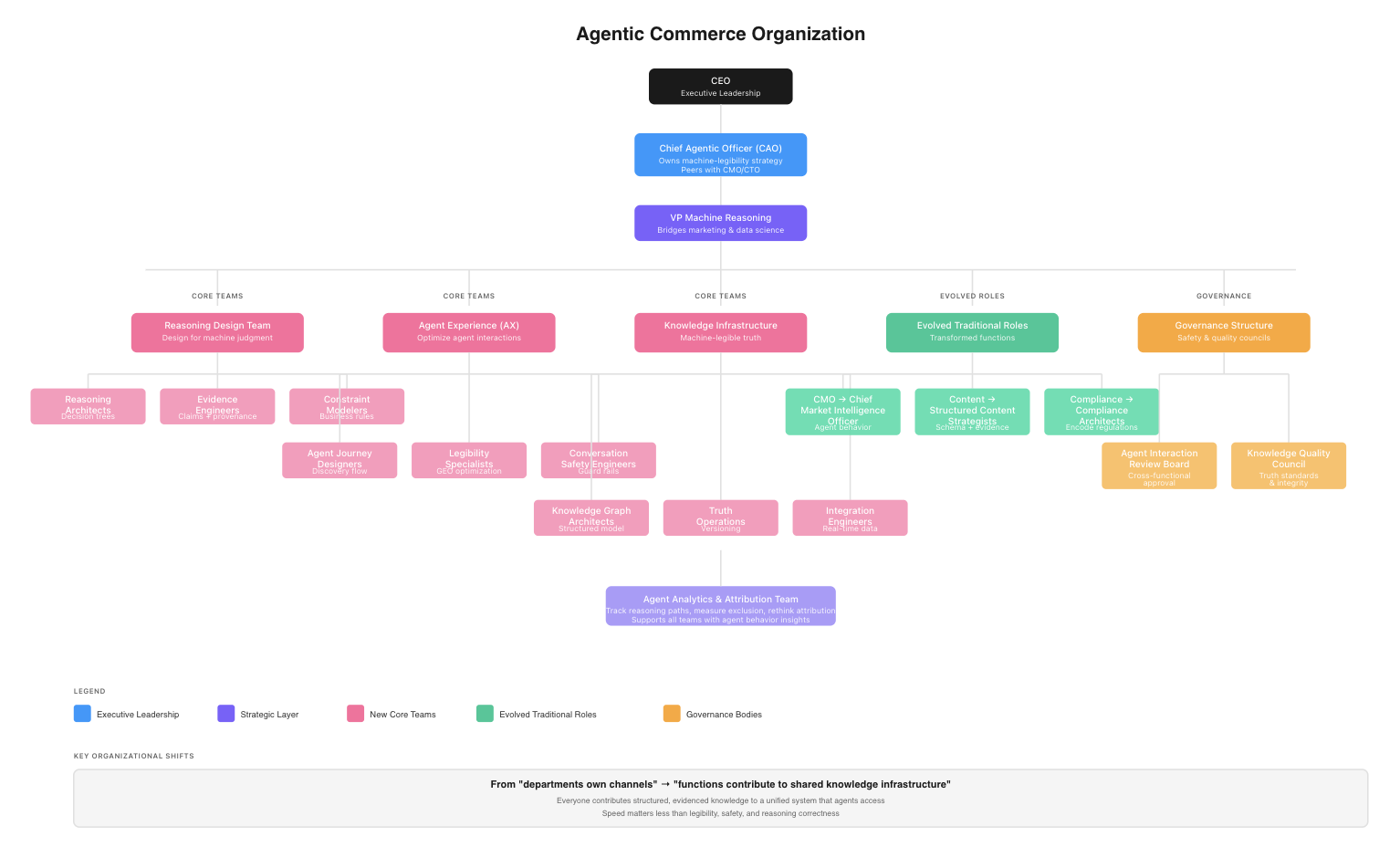
Agentic Commerce Organization Design
Based on the fundamental shift from persuasion to reasoning, here's how organizations need to restructure:
Core Strategic Layer
Chief Agentic Officer (CAO) Reports to CEO, peers with CMO/CTO. Owns the organization's machine-legibility strategy and agent-readiness across all business functions. Accountable for ensuring the company can be discovered, understood, and transacted with by autonomous systems.
VP of Machine Reasoning Bridges marketing and data science. Ensures all customer-facing information is structured for machine judgment, not just human persuasion. Owns the transition from content volume to content legibility.
New Cross-Functional Teams
Reasoning Design Team
The evolution of UX design for agentic interfaces.
Reasoning Architects Design how AI systems should understand and evaluate your business. Create decision trees, constraint models, and evidence hierarchies that machines navigate. Traditional background: information architecture, ontology design, decision science.
Evidence Engineers Structure claims with provenance. Transform marketing statements into verifiable, bounded assertions. Link every claim to its source, validity period, and confidence level. Background: data journalism, fact-checking, compliance.
Constraint Modelers Map all business rules, prerequisites, and limitations into machine-readable formats. Ensure agents understand what's possible, what's prohibited, and what requires human intervention. Background: business analysis, regulatory compliance, systems thinking.
Agent Experience (AX) Team
Replaces parts of traditional CX and marketing.
Agent Journey Designers Map how autonomous systems discover, evaluate, and transact with your business. Identify friction points where agents abandon or exclude you. Background: service design, API product management.
Legibility Specialists Audit and optimize how your business appears inside LLM reasoning chains, knowledge graphs, and agent memory systems. The SEO role evolved for generative engines. Background: SEO, computational linguistics, search quality.
Conversation Safety Engineers Design guard rails, confirmation flows, and degradation strategies for agent-mediated transactions. Ensure systems refuse gracefully and escalate appropriately. Background: conversational AI, risk management, customer service operations.
Knowledge Infrastructure Team
The technical foundation for machine-legible truth.
Knowledge Graph Architects Build and maintain the structured representation of your business—products, relationships, constraints, evidence. This is your "source of truth" for agent reasoning. Background: semantic web, database architecture, taxonomy.
Truth Operations Managers Manage the lifecycle of facts: versioning, deprecation, conflict resolution, provenance tracking. Ensure knowledge stays current and contradictions are resolved. Background: data governance, content operations, editorial.
Integration Engineers Connect internal systems (CRM, ERP, inventory) to agent-facing knowledge layers. Ensure real-time data flows to keep agent interactions grounded in reality. Background: API development, data engineering, systems integration.
Transformed Traditional Roles
Marketing Evolution
Traditional CMO → Chief Market Intelligence Officer Shifts from message creation to market understanding. Ensures the organization knows what agents are asking, how they're reasoning, and where the business is being excluded.
Content Marketers → Structured Content Strategists Learn to write with schema, evidence, and bounded claims. Collaborate closely with data teams to ensure every statement can be verified and versioned.
Brand Managers → Brand Ontology Managers Define what the brand is in machine-readable terms—its category relationships, differentiators, and semantic boundaries. Move from storytelling to structured positioning.
Legal & Compliance Evolution
Legal Counsel embeds earlier in product development. Every agent-facing capability needs legal review at design time, not launch time.
Compliance Officers → Compliance Architects Encode regulations directly into agent guard rails. Transform legal constraints into executable logic that systems enforce automatically.
Product Evolution
Product Managers → Capability Architects Define products as structured sets of constraints, prerequisites, and outcomes that agents can reason about. Move from feature lists to capability models.
Technical Product Managers Specialize in agent-to-business APIs. Design how autonomous systems authenticate, negotiate, transact, and escalate with your organization.
New Governance Structure
Agent Interaction Review Board
Cross-functional body that approves any new agent-facing capability. Membership: Reasoning Design, Legal, Risk, Product, Customer Success. Ensures safety, compliance, and brand consistency.
Knowledge Quality Council
Owns truth standards. Defines evidence levels, conflict resolution protocols, and versioning policies. Ensures machine-legible claims maintain integrity under pressure to grow fast.
Metrics & Analytics Evolution
Agent Analytics Team Tracks agent behavior separately from human behavior. Measures: reasoning path dropout, evidence sufficiency, constraint satisfaction rates, exclusion reasons.
Attribution Analysts Rethink attribution for a world where the "first touch" happens inside an LLM's reasoning chain, not on your website.
The Organizational Mindset Shift
From "departments own channels" → "functions contribute to shared knowledge infrastructure"
Marketing doesn't own "the website." Legal doesn't own "compliance docs." Everyone contributes structured, evidenced knowledge to a unified system that agents access.
From "ship fast, iterate" → "reason correctly, then act"
In agentic commerce, a reasoning error can cause automated exclusion at scale. Speed matters less than legibility and safety.
From "customer empathy" → "machine + human empathy"
Teams must understand both how humans feel about decisions and how machines reason through them. These are different disciplines requiring different skills.