
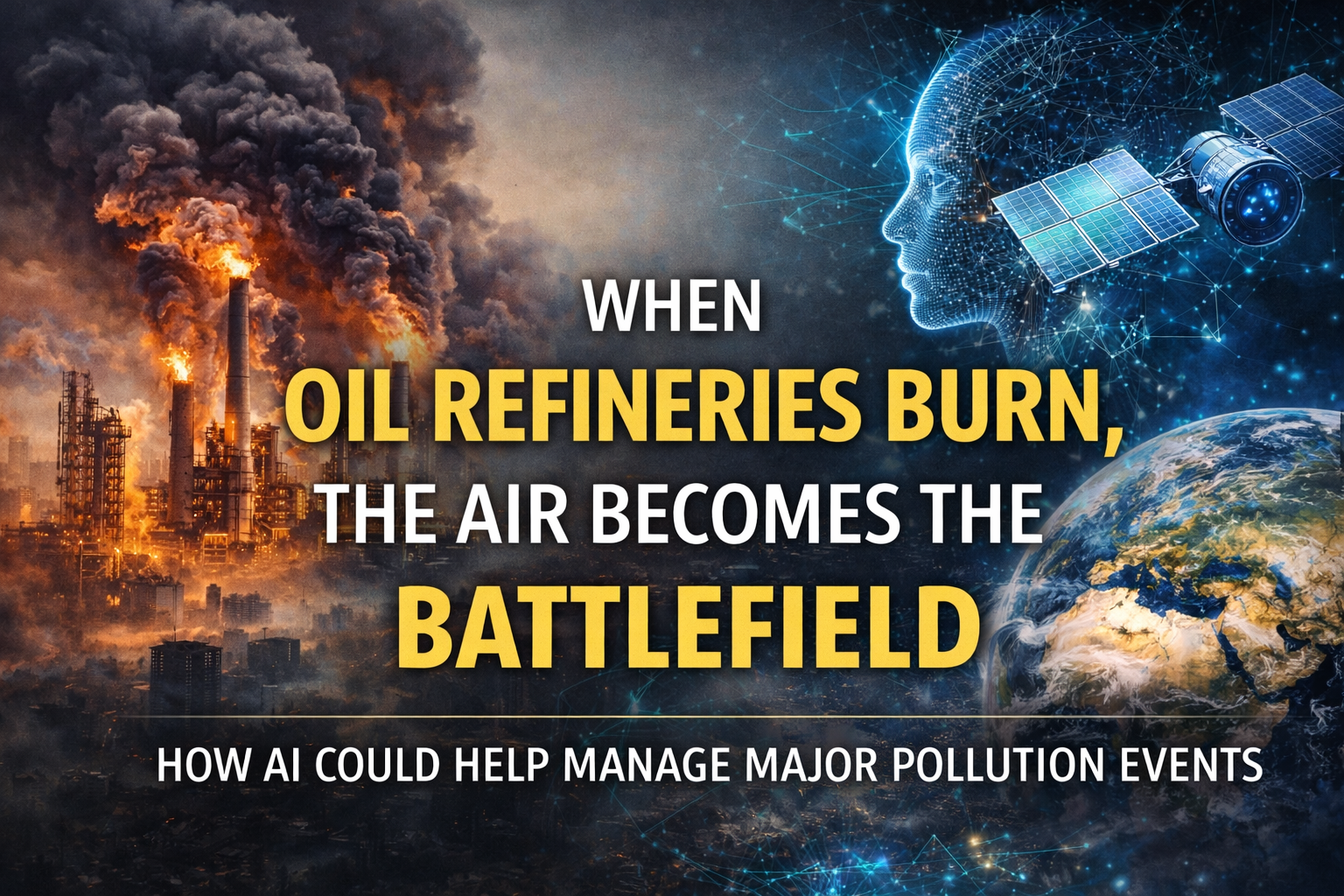
When Oil Refineries Burn, the Air Becomes the Battlefield — Why AI May Be the Next Climate Technology
Over the past week, satellite images and videos from Tehran have shown something extraordinary — and disturbing.
After strikes on Iranian oil depots and refineries, massive fires released thick clouds of soot, hydrocarbons, sulfur dioxide, and nitrogen compounds into the atmosphere. Residents reported “black rain” falling over parts of the city, carrying oily residue and toxic particles.
The smoke from burning oil facilities has created toxic clouds over Tehran, raising concerns about respiratory illnesses, acid rain, and long-term contamination of soil and water.
This is not just a geopolitical story.
It’s a global environmental one.
Because events like this expose a fundamental truth:
When energy infrastructure burns, the atmosphere becomes the immediate casualty.
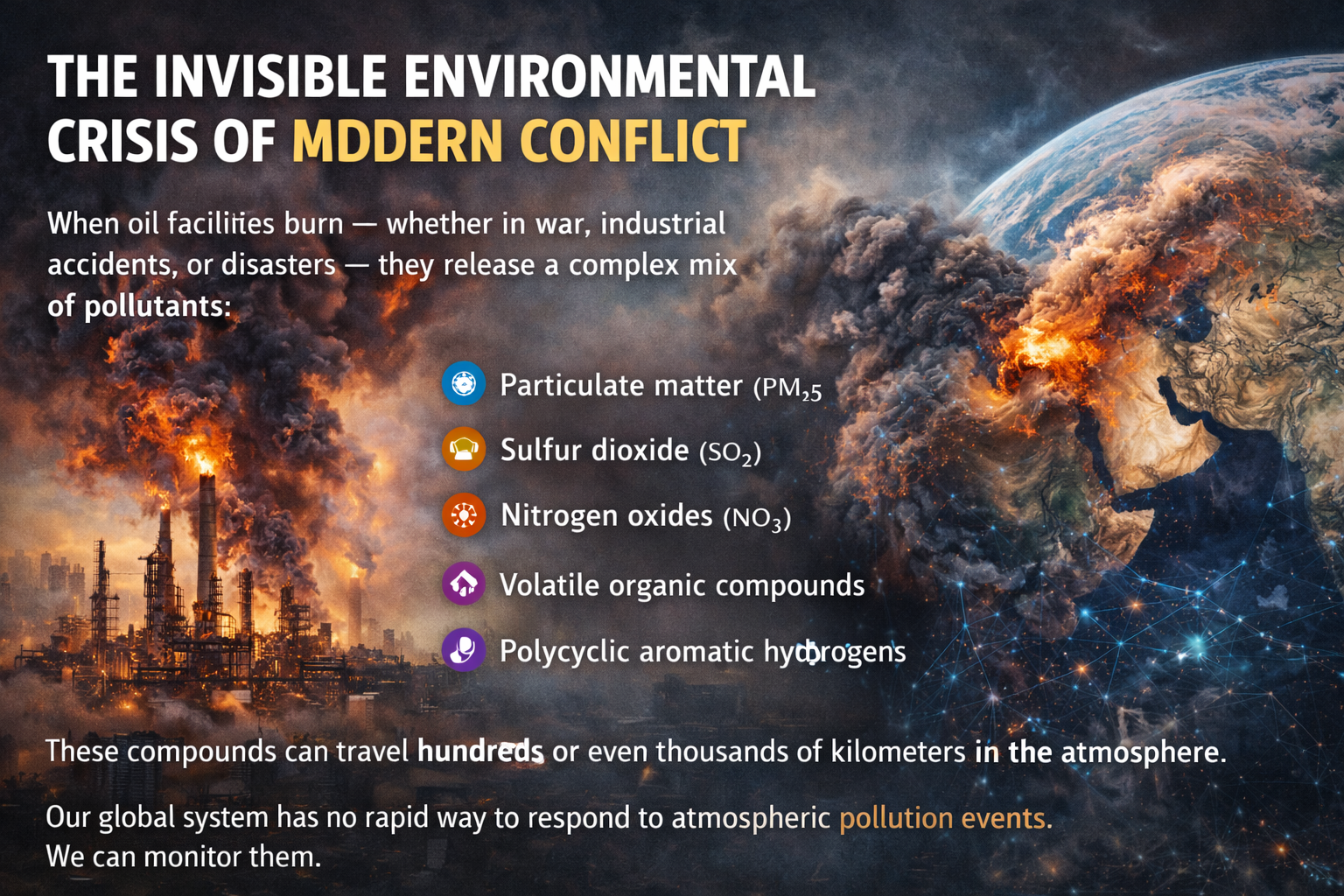
The Invisible Environmental Crisis of Modern Conflict
When oil facilities burn — whether in war, industrial accidents, or disasters — they release a complex mix of pollutants:
particulate matter (PM2.5)
sulfur dioxide (SO₂)
nitrogen oxides (NOₓ)
volatile organic compounds
polycyclic aromatic hydrocarbons
These compounds can travel hundreds or even thousands of kilometers in the atmosphere.
In some cases, oil fires have produced pollution comparable to large volcanic events or major industrial disasters.
The fires currently burning at Iranian energy infrastructure illustrate a broader issue:
Our global system has no rapid way to respond to atmospheric pollution events.
We can monitor them.
But we cannot yet actively manage them.
The Missing Layer of Infrastructure: The Air
Cities have infrastructure for almost everything:
electricity grids
water treatment plants
sewer systems
telecommunications networks
But we have almost no infrastructure for managing the air itself.
Air pollution is largely treated as a passive problem — something that disperses with wind and rain.
However, emerging science suggests something very different may be possible.
Where Physics and AI Begin to Converge
Recent breakthroughs in physics have shown that sound waves can manipulate particles in air.
In laboratory systems, particles can be:
levitated
clustered
organized
moved through acoustic fields
These experiments may seem small today.
But they point toward a larger idea:
the possibility of physically controlling airborne particles.
However, controlling particle systems in the real world — cities, smoke plumes, industrial emissions — would require something else:
Artificial intelligence.
AI could help manage atmospheric systems by:
• modeling pollution movement in real time • predicting dispersion patterns across cities • optimizing pollution capture technologies • coordinating networks of environmental infrastructure
Instead of static pollution controls, we could have self-optimizing atmospheric systems.
Imagine an AI System Responding to an Oil Fire
If technologies like this existed today, the response to a refinery fire could look very different.
An AI-driven environmental system could:
Detect the pollution plume via satellite and ground sensors
Model its trajectory within minutes
Activate industrial pollution capture infrastructure nearby
Optimize particle clustering and capture technologies
Alert cities downwind before dangerous exposure occurs
In effect, we would be building something new:
real-time atmospheric defense systems.
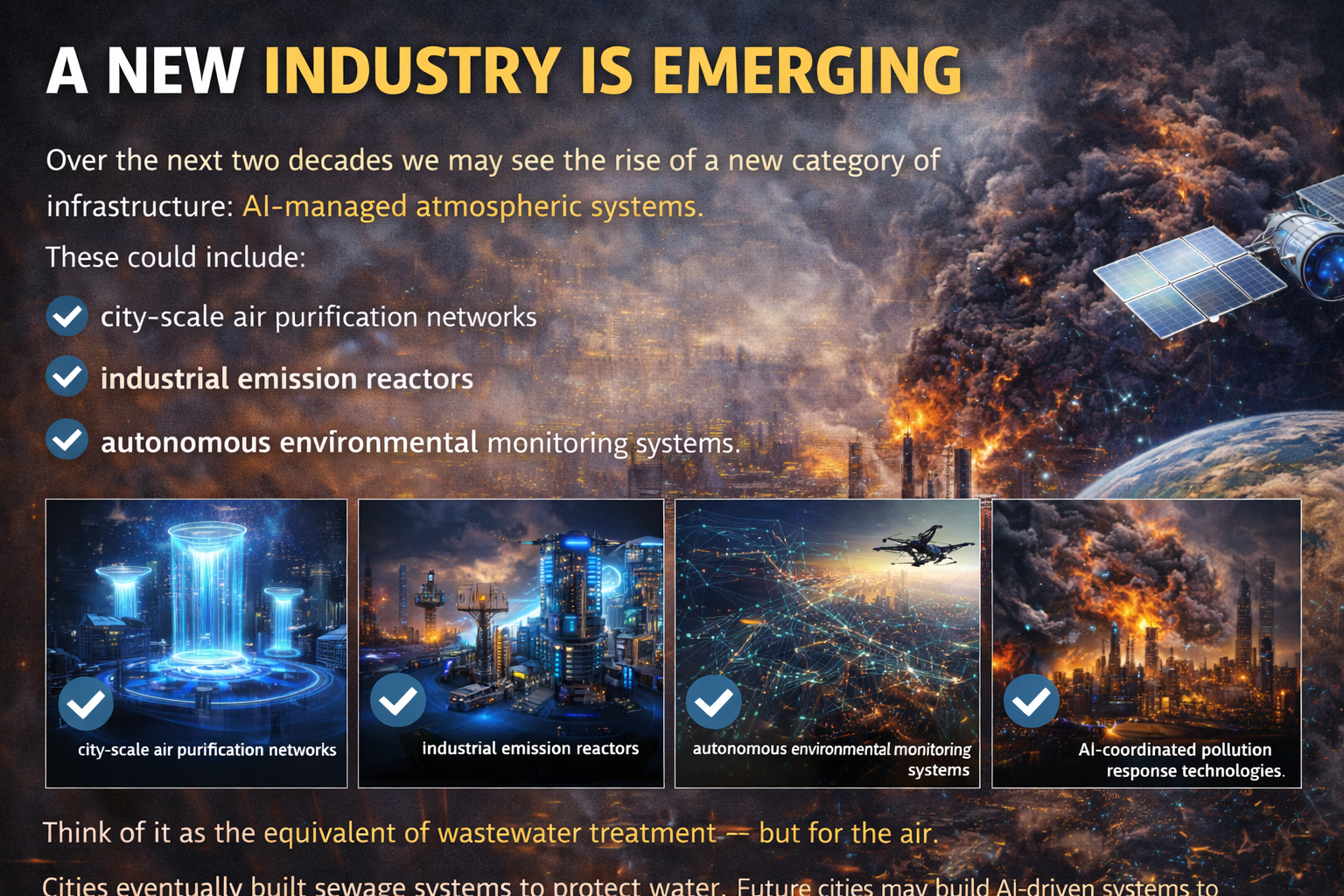
A New Industry Is Emerging
Over the next two decades we may see the rise of a new category of infrastructure:
AI-managed atmospheric systems.
These could include:
city-scale air purification networks
industrial emission reactors
autonomous environmental monitoring systems
AI-coordinated pollution response technologies
Think of it as the equivalent of wastewater treatment — but for the air.
Cities eventually built sewage systems to protect water.
Future cities may build AI-driven systems to protect the atmosphere.
Why This Matters Now
The convergence of three fields is accelerating:
Artificial intelligence Advanced physics Climate technology
Individually, each is transformative.
Together, they may enable something entirely new:
planet-scale environmental infrastructure.
Events like the refinery fires in Iran remind us how fragile the atmosphere can be — and how quickly pollution can affect millions of people.
But they also raise an important question:
What if we could respond to atmospheric pollution the same way we respond to cyberattacks or natural disasters — dynamically and intelligently?
The Big Question for the Next Decade
Who will build the systems that manage the air?
Will it be:
climate tech startups
industrial giants
AI infrastructure companies
governments
or entirely new players?
Because one thing is becoming clear.
The future of climate technology may not only be about reducing emissions.
It may also be about actively managing the atmosphere itself.
💬 Curious to hear perspectives from people working in:
AI infrastructure
climate technology
environmental engineering
atmospheric science
industrial systems
What role do you think AI should play in managing large-scale air pollution events?