
The AI Payback Curve: Why Enterprises Should Measure Cumulative Net Benefit, Not Pilot Success
Enterprise leaders have become fluent in the language of artificial intelligence ambition. They can describe the productivity frontier, the promise of agents, and the strategic risk of being left behind. Yet many still make the same mistake when approving AI programs: they evaluate them as if they were conventional software deployments. They ask whether the model works, whether the pilot impressed users, and whether a vendor demonstration suggests a positive return. These questions are necessary, but they are not sufficient. The question that matters is whether the enterprise can redesign work, change behavior, and sustain adoption long enough for cumulative net benefit to turn positive.
That distinction is not semantic. A proof of concept can show that AI is capable. A cumulative net benefit model shows whether the organization is capable. It accounts for the fact that AI value arrives slowly at first, accelerates only when workflows change, and often pays back after the organization has already absorbed months of visible cost and invisible disruption. In a regulated or brand-sensitive enterprise, those costs include not only software licenses and integration, but also data cleanup, governance, reviewer calibration, legal exception handling, agency renegotiation, user training, and the emotional tax placed on employees asked to change how they work.
The current evidence should make executives cautious. McKinsey’s 2025 global survey found that 88% of organizations are using AI in at least one business function, yet nearly two-thirds have not begun scaling AI enterprise-wide and only 39% report any EBIT impact at the enterprise level. Deloitte’s 2025 research found that most organizations report satisfactory ROI on a typical AI use case only after two to four years, far longer than the seven-to-12-month payback expectation often applied to technology investments. MIT NANDA’s 2025 GenAI Divide report goes further, arguing that most enterprise GenAI investments are failing to produce measurable P&L impact because pilots do not learn from context, integrate into daily operations, or improve over time. The pattern is clear: AI adoption is widespread, but AI value realization is scarce.
The implication for leaders is equally clear. AI ROI is not a moment. It is a curve.
The right metric: cumulative net benefit
Traditional ROI language often hides the timing problem. A team may announce that an AI use case will save $500,000 a month once deployed, but that statement says little about when the savings begin, how fast they ramp, what recurring operating costs are required, and how much one-time change cost has already been incurred. Cumulative net benefit forces a more disciplined view. It measures the running total of gross benefits minus recurring run costs and one-time transformation costs over time.
Cumulative net benefit is the running economic balance of an AI program: gross operational benefits less recurring run costs and one-time change costs, accumulated month by month until the program crosses payback and continues to create durable value.
This framing changes executive behavior. It discourages leaders from declaring victory at pilot completion, because a pilot may still sit deep in negative cumulative territory. It encourages finance to distinguish leading indicators from realized benefits. It also makes adoption visible, because benefits only ramp when people actually use the new process, trust the outputs, and stop duplicating the old process in parallel.
A planning model prepared for a large, regulated marketing content operation illustrates the point. The model assumed a transformation around Adobe Brand Intelligence, a system Adobe describes as using explicit inputs such as brand guidelines and approved assets, as well as implicit inputs such as annotations, reviews, approvals, and human feedback, to build a structured brand ontology for validation and automated assembly. In the base case, the program required $4.02 million in one-time change cost and $215,000 in steady-state monthly run cost. At maturity, it produced $514,723 in monthly gross benefit, or $299,723 in monthly net benefit after recurring run cost. Yet cumulative payback did not occur when the pilot began, when the first workflow went live, or even when material KPI improvement appeared. It occurred in month 26.
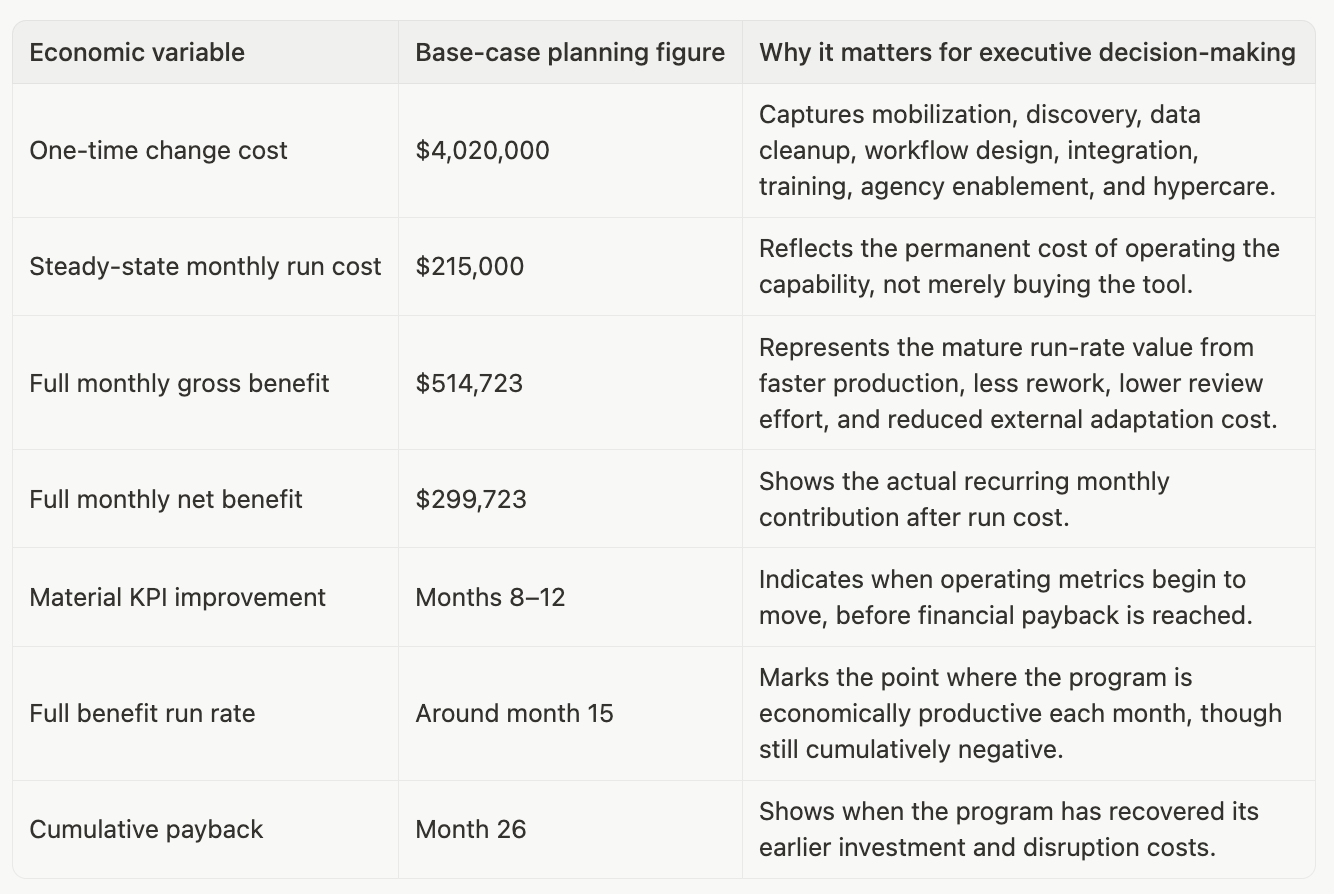
The lesson is not that every enterprise AI program takes 26 months to pay back. Some narrow automation use cases pay back faster; some agentic or regulated workflows take longer. The lesson is that executives should stop asking, “What is the ROI?” as if ROI were a static percentage. They should ask, “What is the cumulative net benefit curve, what must be true for it to steepen, and what human behaviors will prevent it from doing so?”
Why leaders underestimate the real cost of AI
Enterprises undercount AI cost because they treat AI as a technology expense when it is often an operating-model expense. The visible costs are easy to approve and track: licenses, infrastructure, implementation partners, security reviews, and integration work. The hidden costs sit in the work itself. They appear when employees spend time cleaning source data, translating tacit judgment into machine-usable rules, attending calibration sessions, validating AI outputs, correcting early failures, and explaining to colleagues why the process has changed.
This is why AI cost cases so often look unrealistic. Leaders price the model but not the migration from old work to new work. They count expected labor savings but not the temporary productivity dip as people learn new routines. They assume adoption after training, when adoption usually requires confidence, repetition, managerial reinforcement, and proof that the new process will not create personal risk. They describe “human in the loop” as a safety mechanism, but forget that human review is a scarce and expensive capability when every exception requires judgment.
Deloitte’s research identifies the same structural problem. AI benefits are frequently intangible, data platforms are fragmented, technology evolves faster than metrics, adoption depends heavily on people, and AI is entangled with broader transformation efforts. Prosci’s work on AI change management makes the distinction even more sharply: implementation is the technical act of making tools available, while adoption is the behavioral act of making AI a natural part of daily work. In its research, 63% of organizations cite human factors as a primary AI implementation challenge, and insufficient AI training is one of the leading adoption barriers.
The cost stack, therefore, should be explicit from the start.
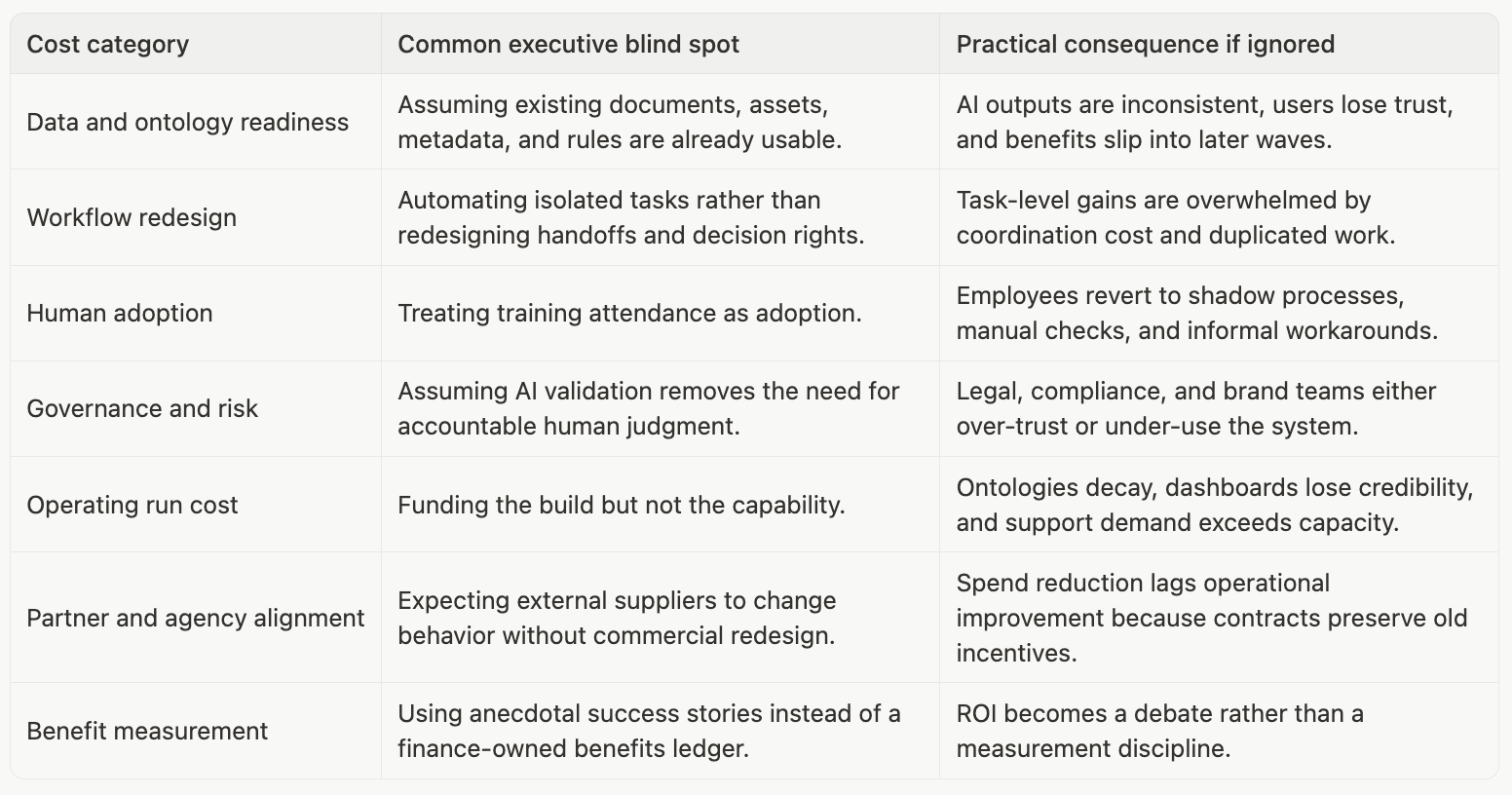
In regulated marketing environments, this cost stack is particularly important. PMI’s public marketing standards, for example, emphasize marketing only to legal-age adults who smoke or use nicotine products, warning consumers about health effects, marketing truthfully and transparently, and respecting the law. A company operating under such standards cannot pursue AI speed by weakening control. It must design AI adoption so that speed, evidence, traceability, and responsible engagement advance together.
The human reason AI payback takes longer than expected
The most difficult part of enterprise AI adoption is not persuading people that AI is powerful. It is persuading them that using AI will make them more effective without making their work less safe, less meaningful, or less under their control. For many employees, AI adoption is destabilizing because it changes the informal knowledge system on which they have relied for years. A reviewer who once exercised judgment through comments and memory may now be asked to encode judgment into reusable rules. A creative operator who once moved quickly through familiar manual work may now be asked to use templates, validation gates, and structured metadata. A market team that once localized assets through personal relationships may now be asked to follow standardized intake, warnings, and exception records.
These changes are rational from an enterprise perspective, but they can feel threatening from the user’s perspective. People may fear that their expertise is being extracted, that their judgment will be second-guessed by a machine, or that they will be blamed when AI-assisted work goes wrong. They may also fear the loss of status that comes when tacit expertise becomes explicit infrastructure.
McKinsey’s workplace research suggests that employees are often more ready for AI than leaders assume, but it also finds that a large minority remain apprehensive and need support. MIT Sloan’s research on AI and workflows adds another reason for patience: AI value often emerges only after organizations adapt the way tasks are sequenced, grouped, and handed off between humans and machines. Until that threshold is reached, adoption costs may dominate gains.
This is why AI transformations require end-customer understanding, not just user training. The “customer” in an enterprise AI program is not only the person who pays for the platform. It is the person whose work must change. In a content supply chain, that includes marketers, brand stewards, reviewers, creative teams, market approvers, agencies, activation teams, and ultimately the external consumer who experiences the content. Each customer has a different pain point. The creative team wants fewer late-stage revisions. Legal wants better evidence and fewer repeated defects. Markets want faster localization without losing accountable control. Finance wants measurable benefit. Consumers need truthful, responsible, relevant communication.
A program that does not understand these pain points will over-optimize for the wrong thing. It may reduce review time while increasing reviewer anxiety. It may accelerate asset assembly while increasing market exceptions. It may automate brand checks while failing to earn trust from the people whose judgment defines the brand. The result is a familiar enterprise pattern: impressive demonstration, cautious pilot, enthusiastic steering committee, and then slow decay into optional usage.
From proof of concept to industrial capability
The POC is often where AI programs become intellectually exciting and operationally dangerous. A POC is designed to prove possibility under controlled conditions. Industrialization is designed to produce repeatable value under messy conditions. The two require different management systems.
MIT NANDA’s report argues that the core barrier to scaling is often not infrastructure, regulation, or talent, but learning: systems fail when they do not retain feedback, adapt to context, or improve in day-to-day operations. Adobe’s Brand Intelligence positioning is notable in this respect because it emphasizes a continuously learning brand ontology built not only from formal guidelines and assets, but also from reviewer decisions, annotations, and feedback. Whether using Adobe or another enterprise AI platform, the underlying principle is the same: industrial AI must learn from work, not sit beside it.
Scaling from POC to industrial capability therefore requires a sequenced operating model.
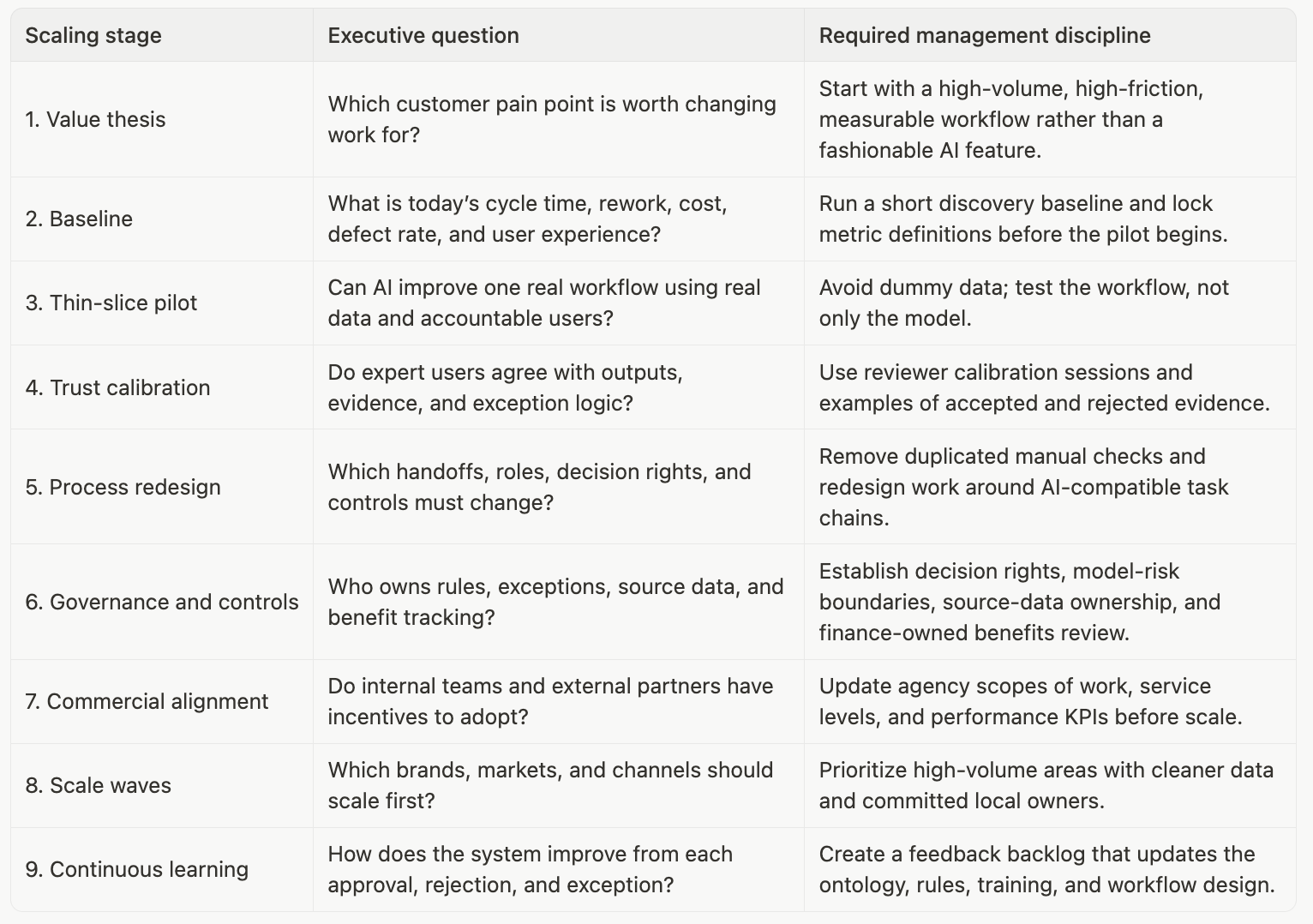
The most important stage is the first. Too many AI programs begin with a technology capability and then search for use cases. Industrial AI begins with a customer pain point severe enough that people will accept the discomfort of changing their work. In the planning model, the most attractive early value pools were not abstract. They were tangible operational frictions: review cycle times of 10–15 business days, time to first usable variant of 5–8 days, material rework rates of 25–35%, inconsistent audit packages, and external production spend that scaled with avoidable adaptation work. Those are pain points people recognize.
Once the pain point is clear, adoption must be co-designed. Users should help define what “good” looks like, what evidence is trusted, what exceptions require escalation, and what must never be automated. This is not a courtesy. It is risk management. People who help design the new process are more likely to trust it, teach it, improve it, and defend it when early problems occur.
How long should executives expect ROI to take?
There is no universal AI payback period, and pretending otherwise creates bad governance. A narrow AI assistant that reduces repetitive administrative work may show value in weeks. A workflow-integrated system that changes legal review, creative production, brand governance, agency economics, and market activation will usually take much longer. Deloitte’s finding that typical AI ROI often takes two to four years is a useful corrective to executive impatience.
The more practical answer is to separate signals, benefits, and payback.
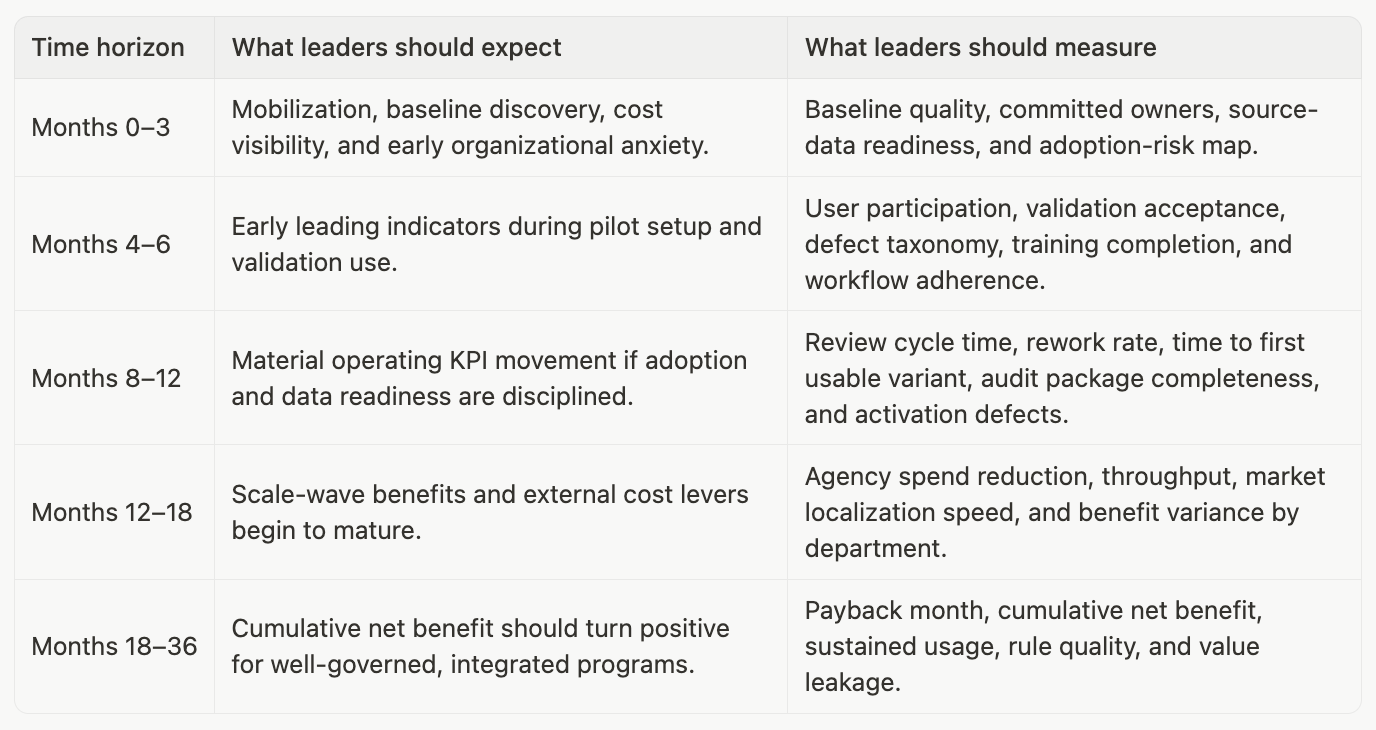
This timeline also clarifies why executives should not cut funding prematurely. In the base-case model, monthly net benefit turned positive in month 8, full monthly net benefit arrived around month 15, and cumulative payback arrived in month 26. A leader focused only on annual budgeting might see the program as underperforming in year one, even though it is behaving exactly as a realistic cumulative net benefit curve would predict.
The end customer is the anchor, not the afterthought
The most durable AI programs are anchored in the end customer. This is true even when the AI system appears to be internal. A brand validation platform, for example, is not merely a tool for reviewers. It shapes what content reaches customers, how quickly campaigns launch, how consistently claims are presented, and how responsibly a company communicates. For PMI, public materials emphasize both adult consumer access to smoke-free products and safeguards around responsible marketing and underage prevention. That strategic context matters because it defines what AI must protect, not only what it must accelerate.
When leaders understand the end customer, they make better trade-offs. They do not measure content throughput in isolation; they measure throughput for compliant, relevant, on-brand, and responsibly targeted content. They do not frame legal review as a bottleneck to be bypassed; they frame it as judgment to be focused on the highest-risk exceptions. They do not ask markets merely to adopt a global process; they ask what local pain points, regulatory differences, and consumer expectations must be reflected in the operating design.
End-customer understanding also helps employees accept change. People are more willing to endure destabilization when they can see the purpose behind it. A reviewer may accept a new evidence workflow if it reduces repeated low-value checks and improves responsible communication. A market team may accept structured intake if it gives them faster activation readiness and fewer late-stage escalations. A creative team may accept template discipline if it reduces rework and protects the quality of craft.
The leadership test
AI adoption is not a technology race in which the fastest pilot wins. It is a management test in which the enterprise learns how to convert capability into changed work. The leaders who pass that test do five things differently.
First, they make the economic curve explicit. They show boards and sponsors the expected cumulative net benefit month by month, including the period when costs exceed gains. Second, they fund the operating capability, not just the launch. AI systems require governance, data stewardship, user support, feedback loops, and measurement after go-live. Third, they design for human trust. They make the system explainable enough for expert users to challenge, improve, and rely on it. Fourth, they scale through real workflows, not generic enthusiasm. They choose use cases where pain is acute, data is available, and process owners are accountable. Finally, they keep the end customer visible. AI should not merely make the enterprise faster; it should make the enterprise better at serving, protecting, and earning trust from the people at the end of the value chain.
The promise of AI is real. But the economics are unforgiving. Enterprises do not get paid for experiments, demonstrations, or optimistic adoption forecasts. They get paid when people change how work is done, when the new process becomes normal, and when the accumulated benefits finally exceed the accumulated costs. That is the discipline of cumulative net benefit. It is also the difference between an AI pilot and an AI enterprise.
References
[1] McKinsey, The state of AI in 2025: Agents, innovation, and transformation
[2] Deloitte, AI ROI: The paradox of rising investment and elusive returns
[3] MIT NANDA, The GenAI Divide: State of AI in Business 2025
[4] Adobe, Adobe Brand Intelligence Product Description
[5] Prosci, AI for Change Management
[7] McKinsey, Superagency in the workplace
[8] MIT Sloan, How AI is reshaping workflows and redefining jobs