
HelloFresh, Ingredient Waste and Procurement Inefficiency
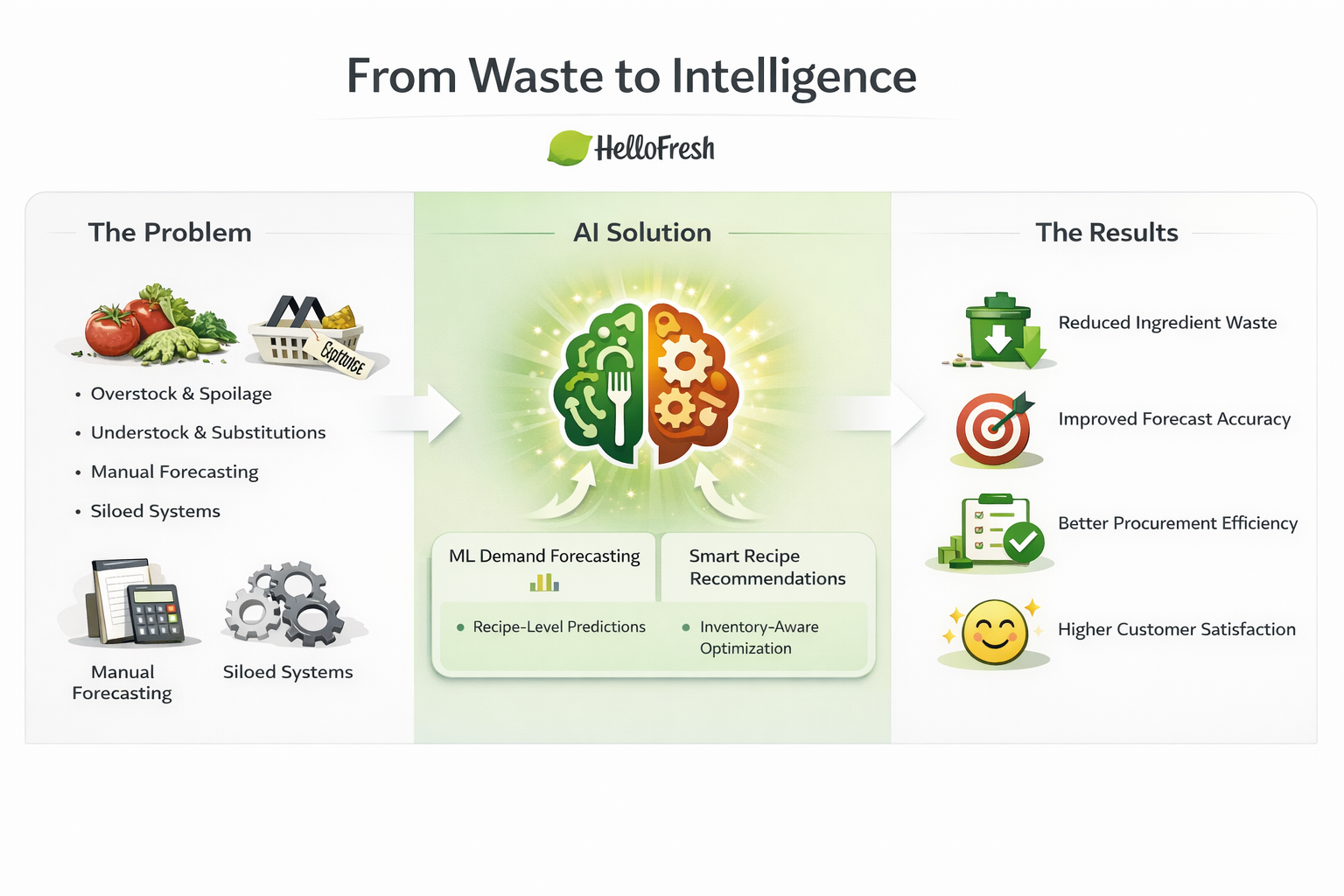
From Waste to Intelligence
On the left, this is where we started. Overstock led to ingredient spoilage and increased cost. Understock caused substitutions and customer dissatisfaction. Forecasting relied heavily on manual heuristics, and systems were disconnected — procurement, recommendations, and customer data weren’t aligned.
In the center is the transformation. We introduced ML-based demand forecasting at the recipe level, combined with an intelligent ranking engine. The key innovation was inventory-aware recommendations — we didn’t just predict demand, we incorporated operational efficiency directly into the product experience.
On the right are the outcomes. Ingredient waste decreased. Forecast accuracy improved. Procurement became more efficient. And customer satisfaction increased due to fewer substitutions.
This wasn’t just a model improvement — it was a system-level transformation.
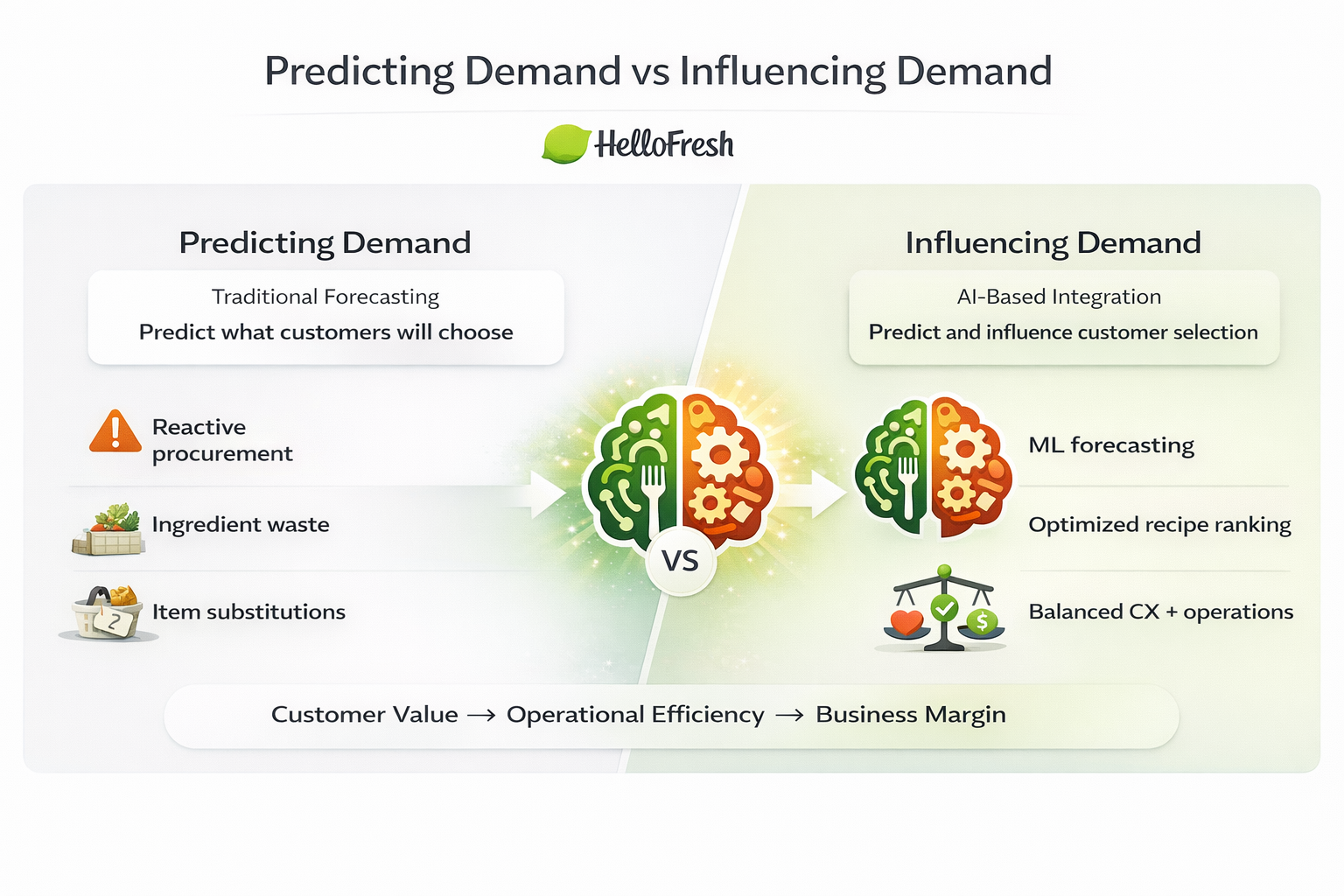
Predicting Demand vs Influencing Demand
Traditionally, forecasting is reactive. You predict what customers will choose, and procurement reacts. That leads to waste when predictions are wrong and substitutions when supply doesn’t match demand.
What we built was fundamentally different.
On the right side, we both predicted demand and influenced demand. By integrating ML into recipe ranking, we optimized which recipes customers saw first — balancing predicted preference with operational efficiency.
At the bottom is the strategic alignment: customer value, operational efficiency, and business margin reinforcing each other.
The key insight was that AI becomes exponentially more valuable when embedded in product UX, not isolated as backend analytics.
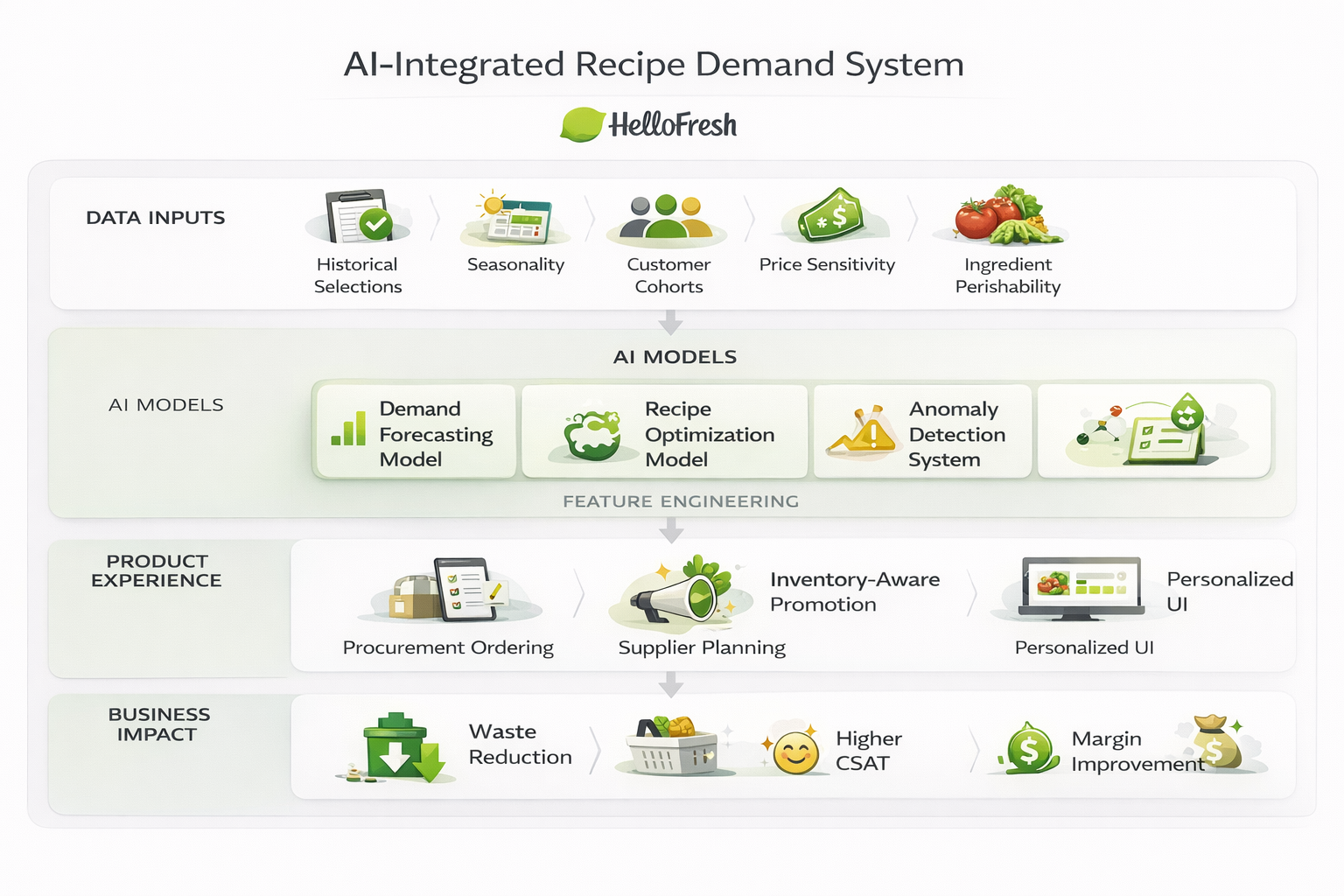
System Architecture
At the top are our inputs: historical selections, seasonality, customer cohorts, price sensitivity, and ingredient perishability risk.
These feed into the model layer: recipe-level demand forecasting, optimization models, and anomaly detection for quality control.
The outputs power the product layer — our recommendation ranking engine, inventory-aware promotions, and personalized UI.
Those outputs then feed directly into operations — procurement ordering, supplier planning, and quality workflows.
At the bottom is business impact: reduced waste, fewer substitutions, higher CSAT, and margin improvement.
This demonstrates production ML deployment integrated directly into real-world operational systems.
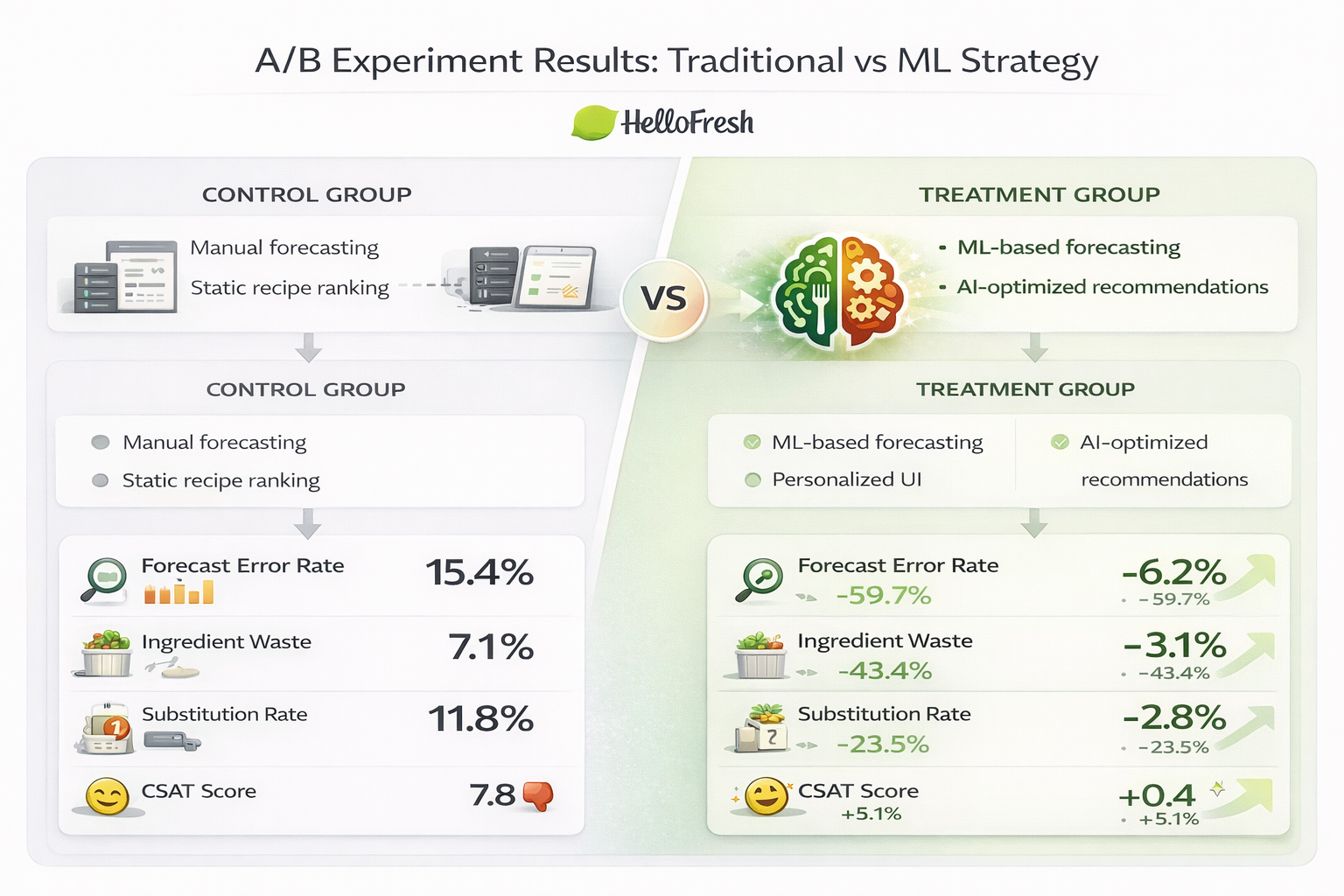
A/B Experiment Results Dashboard
To validate impact, we ran controlled experiments.
The control group used manual forecasting and static recipe ranking.
The treatment group used ML forecasting and AI-optimized ranking.
We measured forecast error rate, ingredient waste percentage, substitution rate, CSAT, and recipe engagement.
Across metrics, the AI-driven system outperformed the control. Forecast error decreased. Waste declined. Substitutions dropped. Customer satisfaction improved.
This wasn’t theoretical AI — it was experimentally validated product impact.
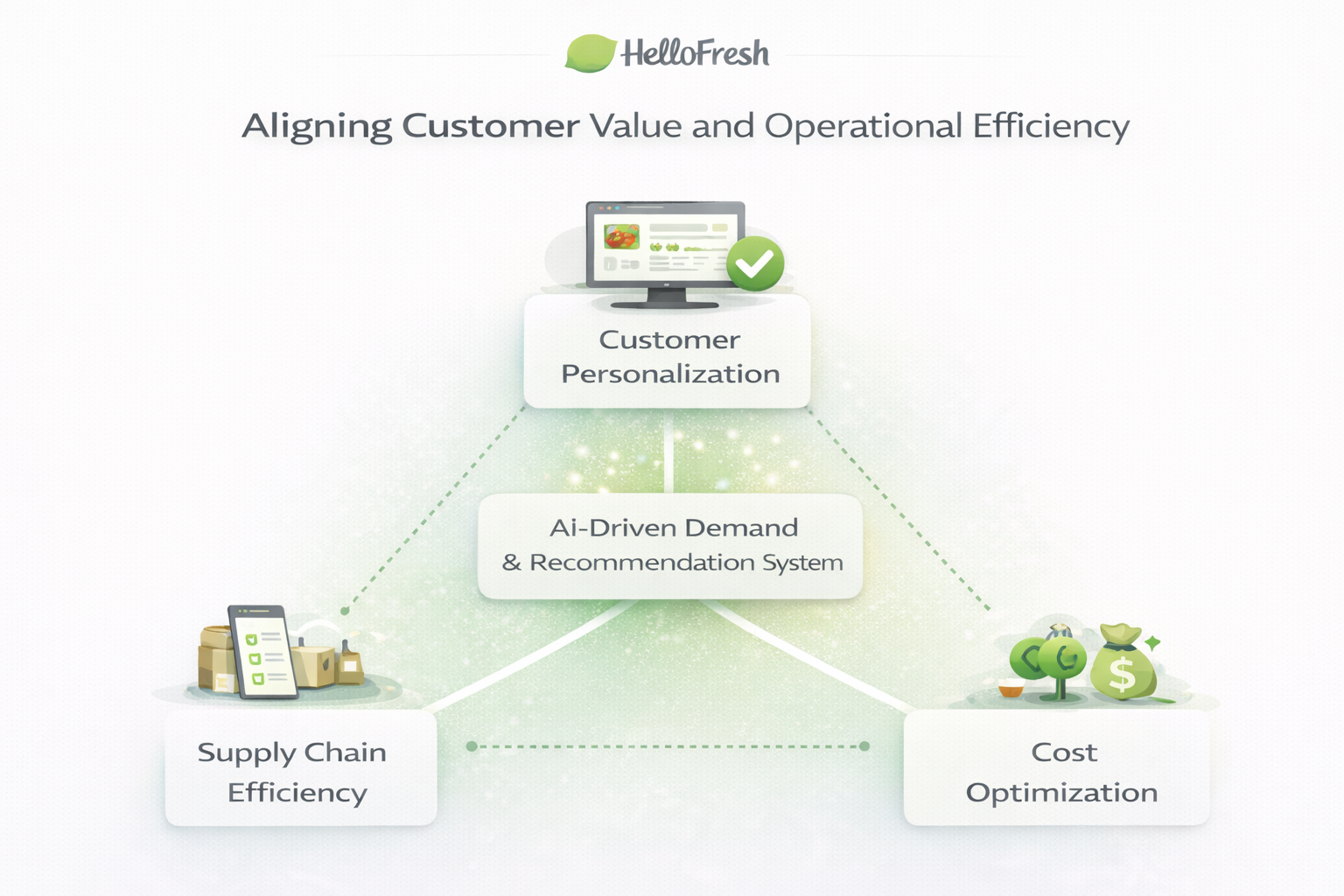
AI MANAGES TRADE OFFS
This triangle represents the strategic tension in food delivery.
At the top: customer personalization.
Bottom left: supply chain efficiency.
Bottom right: cost optimization.
Most companies optimize one corner at the expense of another.
By embedding AI-driven demand forecasting and recommendation optimization in the center, we aligned all three.
The key product lesson: AI delivers maximum leverage when integrated into the product experience, creating value for both customers and operations simultaneously.
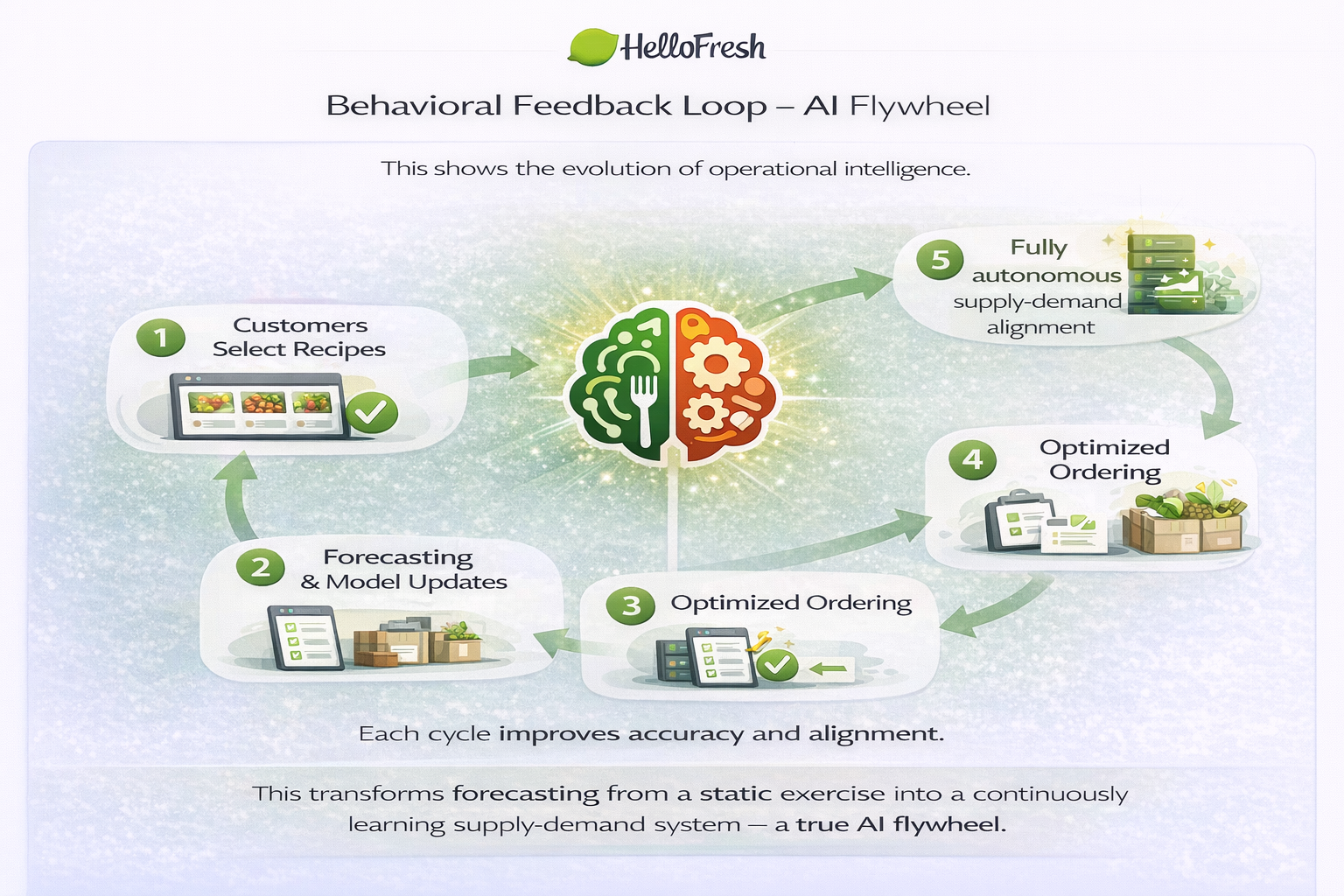
Behavioral Feedback Loop — AI Flywheel
This shows the self-improving AI loop.
Customers select recipes.
That data updates our forecasting models.
Procurement adjusts ordering.
Recommendation ranking updates accordingly.
Customers see optimized options.
New behavioral data flows back into the system.
Each cycle improves accuracy and alignment.
This transforms forecasting from a static exercise into a continuously learning supply-demand system — a true AI flywheel.
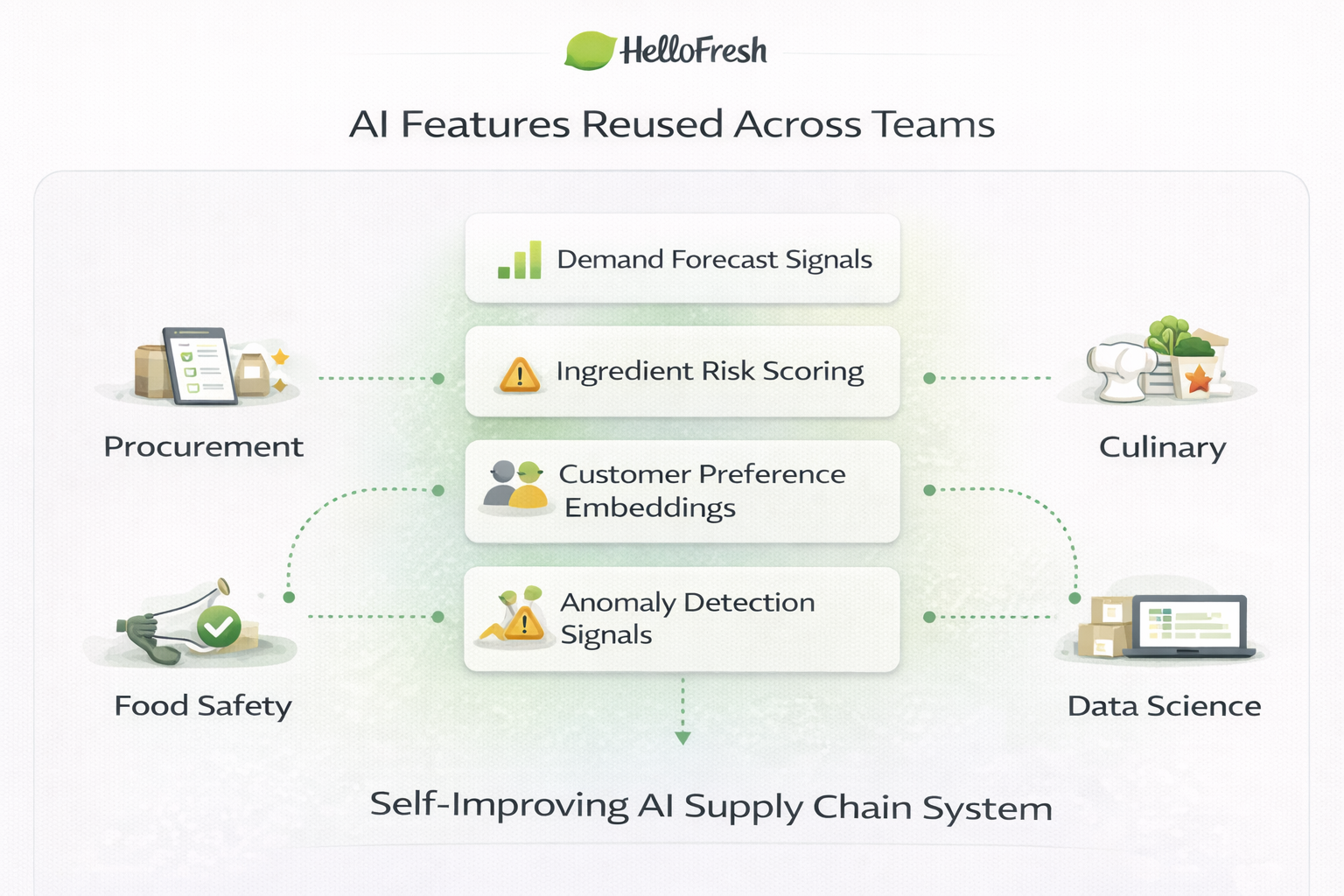
Cross-Team AI Feature Reuse
This diagram highlights platform thinking.
Multiple teams — Procurement, Culinary, Food Safety, Growth, Data Science — all relied on shared AI components.
Demand forecast features.
Ingredient risk scoring.
Customer preference embeddings.
Anomaly detection signals.
Instead of building siloed models, we created reusable feature infrastructure across teams.
This improved model quality, reduced duplication, and accelerated innovation across the organization.
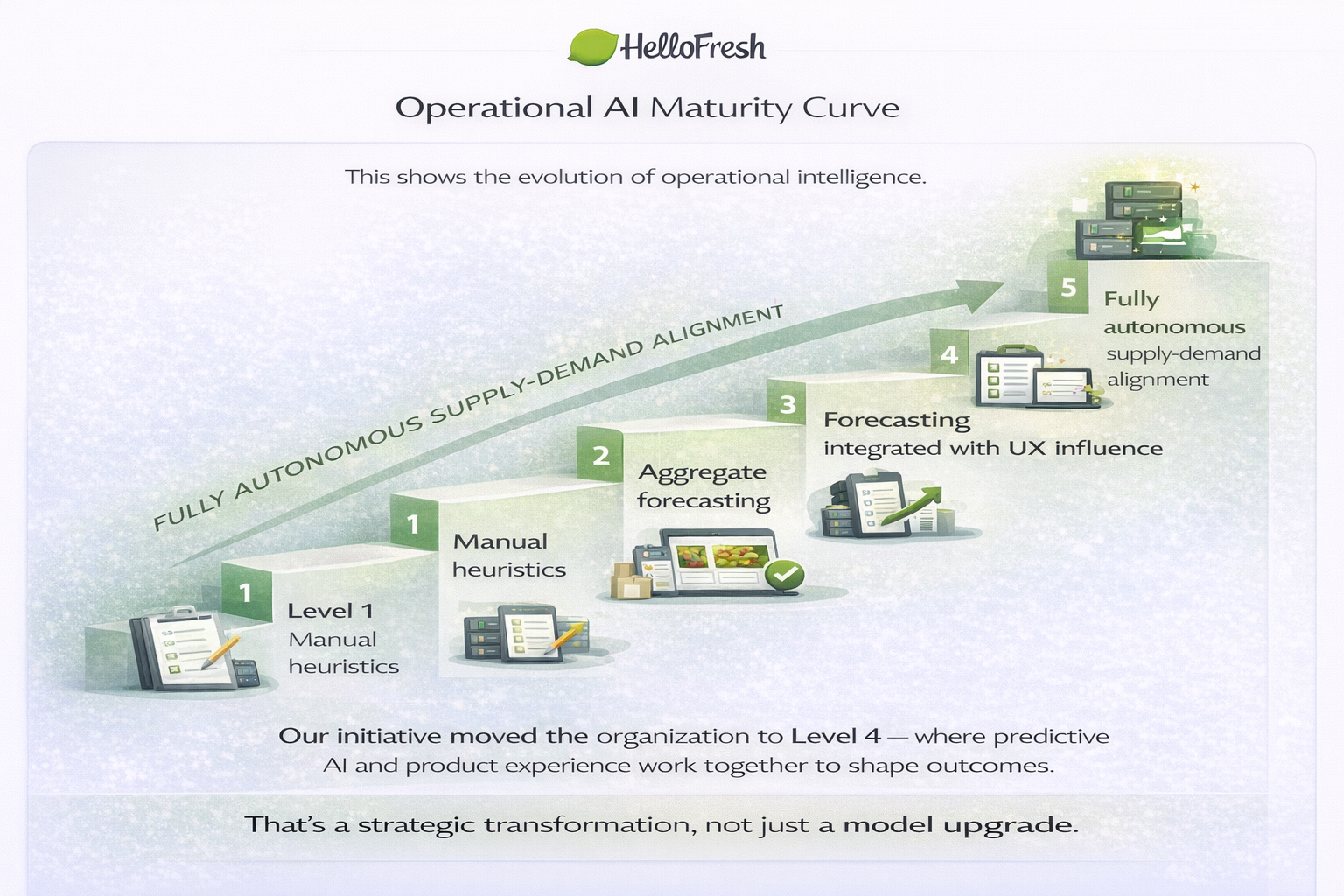
Operational AI Maturity Curve
This shows the evolution of operational intelligence.
Level 1: manual heuristics.
Level 2: aggregate forecasting.
Level 3: recipe-level ML forecasting.
Level 4: forecasting integrated with UX influence.
Level 5: fully autonomous supply-demand alignment.
Our initiative moved the organization to Level 4 — where predictive AI and product experience work together to shape outcomes.
That’s a strategic transformation, not just a model upgrade.
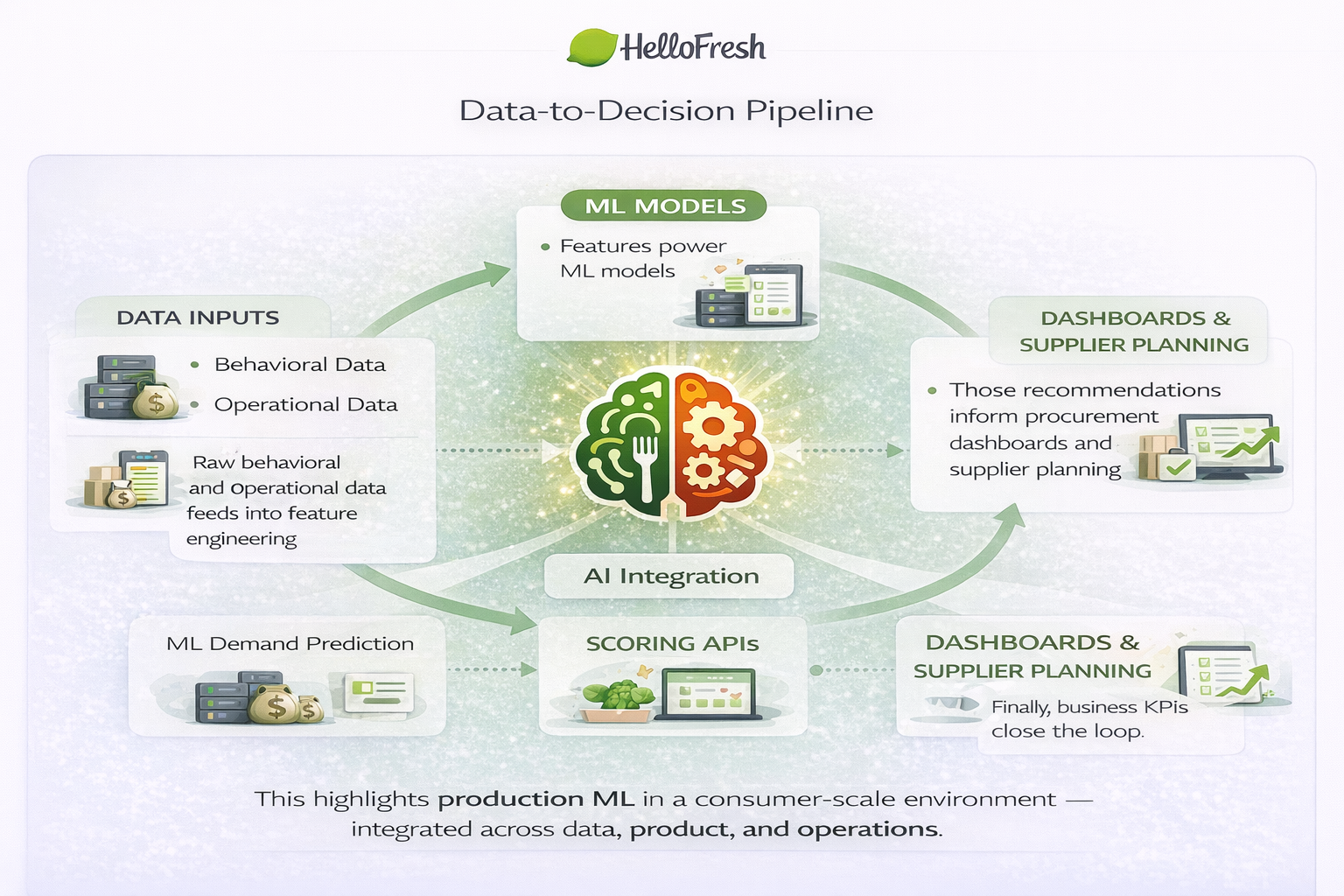
Data-to-Decision Pipeline
This is the technical flow.
Raw behavioral and operational data feeds into feature engineering.
Features power ML models.
Models are deployed via scoring APIs.
Outputs drive the recommendation engine.
Those recommendations inform procurement dashboards and supplier planning.
Finally, business KPIs close the loop.
This highlights production ML in a consumer-scale environment — integrated across data, product, and operations.