
When Light Enters and Splits into Rainbows
The Prism as a Translator
When white light enters a prism, a raindrop, or another transparent medium, it does not merely pass through unchanged. It slows, bends, separates, and reveals itself. What looked like a single beam becomes a spectrum: red, orange, yellow, green, blue, indigo, and violet. The familiar rainbow is therefore not an ornament added to light from the outside. It is the hidden complexity of light made visible.
In physics, this process is called dispersion. White light contains many visible wavelengths, and when those wavelengths pass through a medium such as glass or water, they are bent by slightly different amounts because the medium’s refractive index varies with wavelength.[1] [2] Shorter wavelengths, such as blue and violet, usually bend more strongly than longer wavelengths, such as red.[2] [3] A prism does not create the colors; it translates them from unity into difference.
Dispersion is the spreading of white light into its full spectrum of wavelengths.[1]
This simple event carries a profound lesson. A prism reveals that what appears singular may contain many voices. A beam of light is not one thing in the simple sense; it is a harmony. The rainbow is the visible score of that harmony.
How Light Becomes a Rainbow
The science is elegant. Light travels at different speeds in different media. When it crosses from air into glass or water, its path bends. This bending is called refraction. Because each color corresponds to a different wavelength, each color interacts with the medium slightly differently. The result is that one beam becomes many paths.
Rainbows in the sky arise through the same principle, but the prism is not a triangular piece of glass. It is a suspended droplet of water. Sunlight enters the droplet, refracts and disperses, reflects internally from the back of the droplet, and refracts again as it exits.[3] [4] Each droplet becomes a tiny optical instrument. Together, countless droplets create the circular arc that human beings see as a rainbow.
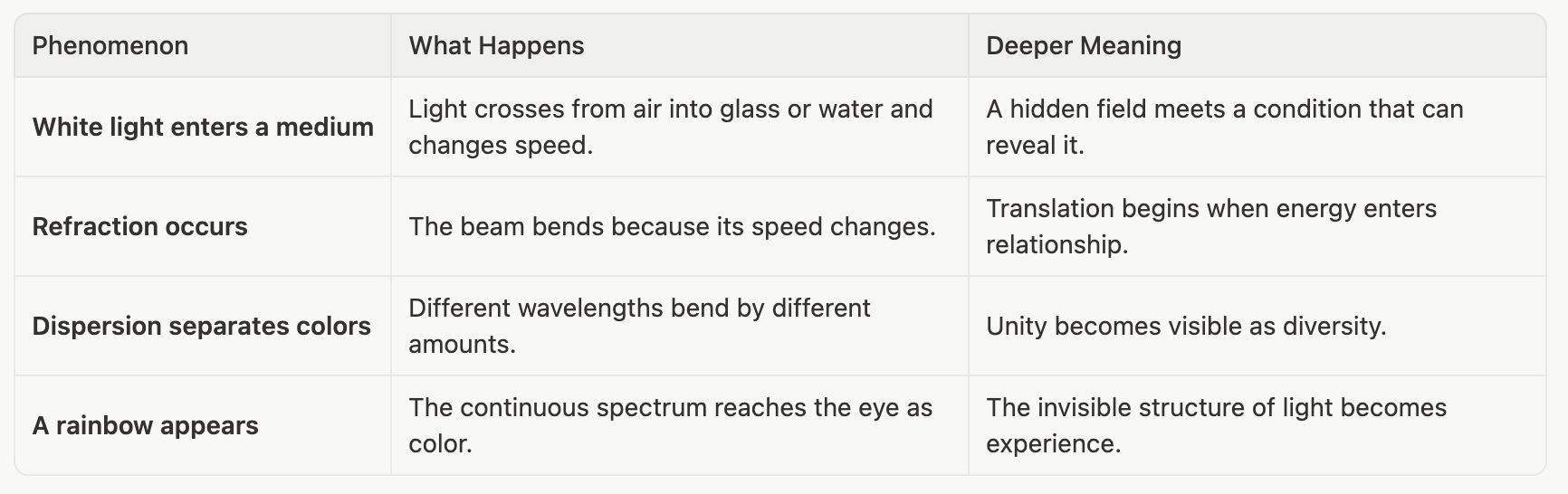
A primary rainbow is seen when sunlight is behind the observer and water droplets are ahead. The brightest concentration of red light typically reaches the observer at about 42 degrees from the direction of incoming sunlight, while blue and violet concentrate closer to 40 degrees.[3] This is why the order of colors is not random. The rainbow is geometry, wavelength, atmosphere, and perception joined in a single event.
The Rainbow Is Continuous
Although people often describe the rainbow as seven colors, the physical spectrum is continuous.[1] There are not hard walls between red and orange, or between blue and violet. Human language divides what nature presents as a flow. The rainbow is therefore both scientific and poetic: it can be measured by wavelength, but it is experienced as wonder.
This distinction matters. Measurement does not destroy mystery; it refines our relationship with it. To say that red light has a longer wavelength than violet light is not to reduce the rainbow. It is to understand one layer of its music. The numbers do not replace awe. They give awe a grammar.
From Optics to Living Fields
The project of the Translator of Living Fields begins with a question: if light can become sound, and sound can become vibration, and vibration can shape matter, what else can be translated? The prism offers a foundational metaphor for this work. It shows that a field may contain patterns that remain hidden until they encounter the right instrument.
A prism is not intelligent in the human sense, yet it performs a kind of revelation. It turns invisible difference into visible order. In the same way, future instruments might reveal subtle biological signatures that are present all around us: light emitted by leaves, electrical pulses moving through fungi, hormonal rhythms in animals, acoustic patterns in oceans, and resonant changes in ecosystems. These would not be separate miracles. They would be different forms of translation.
The rainbow teaches that visibility depends on relationship. White light must meet glass, water, or atmosphere before its spectrum becomes apparent. Likewise, living intelligence may require the right relationship before it can be perceived. A forest may not speak in human words, but it may speak in root chemistry, fungal exchange, electrical signaling, biophotonic emission, rhythm, scent, and growth. To dismiss those languages because they are not human would be like staring at white light and denying the existence of violet.
The Medium Reveals the Message
In every act of translation, the medium matters. Glass reveals one pattern. Water reveals another. A living cell, a tree canopy, a coral reef, or a human nervous system may each reveal fields differently. The same sunlight that becomes a rainbow in rain becomes warmth in skin, sugar in a leaf, electricity in a solar cell, and vision in an eye.
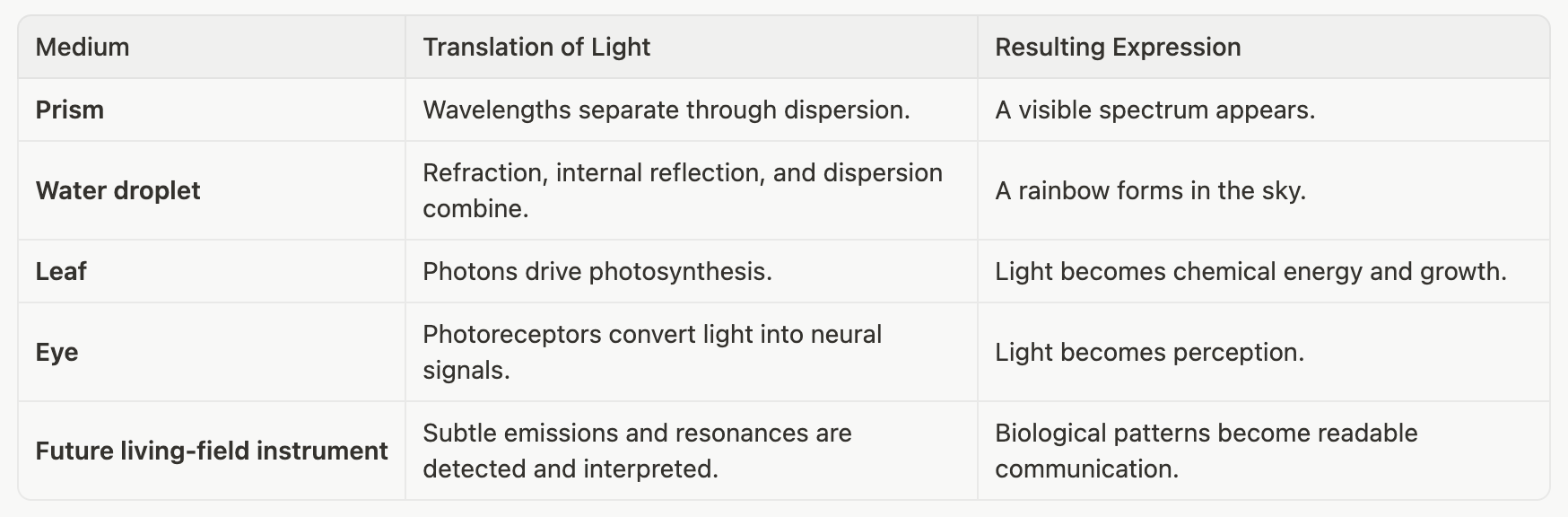
The implication is profound: reality may be full of spectra that are not yet visible to us. The rainbow was always inside the light, but it required a medium to disclose it. Perhaps consciousness, too, has spectra. Perhaps ecosystems have harmonic patterns that we have not yet learned to perceive. Perhaps emotion, growth, memory, and vitality leave traces that are neither supernatural nor merely mechanical, but relational fields awaiting translation.
Science Without Reduction, Wonder Without Confusion
The challenge is to hold two truths together. First, the rainbow is a real optical phenomenon governed by refraction, dispersion, wavelength, and geometry.[1] [2] [3] [4] Second, the rainbow is also a symbol of how hidden order becomes visible when conditions are right. These truths do not compete. They enrich one another.
A mature science of living fields would not abandon evidence. It would deepen evidence. It would not claim that every feeling is a measurable wave in a simplistic way, nor would it reduce life to numbers alone. Instead, it would ask better questions. What patterns are emitted by living systems? How do those patterns change in health, distress, cooperation, and regeneration? What forms of intelligence emerge when organisms are studied not as isolated machines but as participants in shared fields?
The prism becomes an ethical teacher. It reminds us that a being may contain more than first perception reveals. A tree may be more than timber. A river may be more than infrastructure. An animal may be more than instinct. A human body may be more than chemistry in isolation. Each may be a spectrum, and each spectrum may require humility before it can be seen.
A Civilization of Better Instruments
The future imagined by the Translator of Living Fields is not a future in which technology conquers nature. It is a future in which technology becomes sensitive enough to participate respectfully in nature. The instrument does not dominate the field; it listens to it.
In such a civilization, agriculture would no longer treat soil as an inert platform for extraction. Medicine would no longer treat organs as isolated parts. Architecture would no longer treat land as empty space. Education would no longer teach children that consciousness belongs only to human brains. Instead, each field would learn from the prism: the visible world is often the translated surface of deeper relations.
The rainbow, then, is more than an atmospheric event. It is a lesson in epistemology, the study of how we know. It tells us that perception is not passive. What we see depends on the instruments we build, the angles from which we look, the media through which energy passes, and the readiness of the observer.
Conclusion: The Hidden Spectrum of the Living World
When light goes into a prism and splits into rainbows, the universe demonstrates one of its most beautiful principles: oneness does not disappear when it becomes many. The colors were always present, held within the white beam as potential. The prism did not invent them. It revealed them.
So it may be with life. The intelligence of forests, animals, rivers, oceans, and human emotion may not be absent simply because it has not yet appeared in the forms our instruments can measure. It may be waiting for a new prism: a science capable of translating living fields without reducing them, and a culture humble enough to listen.
A rainbow is light speaking in color. The future work of humanity may be to discover how the rest of life is already speaking, and to become worthy translators of its spectrum.
References
[1]: https://phys.libretexts.org/Bookshelves/College_Physics/College_Physics_1e_(OpenStax )/25%3A_Geometric_Optics/25.05%3A_Dispersion_-_Rainbows_and_Prisms "Physics LibreTexts / OpenStax, Dispersion: Rainbows and Prisms"
[2]: https://www.physicsclassroom.com/class/refrn/lesson-4/dispersion-of-light-by-prisms "The Physics Classroom, Dispersion of Light by Prisms"
[3]: https://www.physicsclassroom.com/class/refrn/lesson-4/rainbow-formation "The Physics Classroom, Rainbow Formation"
[4]: https://global.canon/en/technology/s_labo/light/001/02.html "Canon Science Lab, How Do Rainbows Form?"