
Conversational Commerce Intelligence System Resources
Glossary of CCIS Terms
Agent Handoff
The transition of a customer from an AI assistant to a human agent. Triggered when a query is too complex, sensitive, or falls outside the bot's training.
Allergen Ontology
A structured framework defining relationships between ingredients and allergens (e.g., hazelnuts → tree nuts). Used to inform safe product recommendations in CCIS.
Answer Graph
A structured representation of customer FAQs, mapping each question to product data, persona, channel, and answer logic.
Auto-Generated FAQ
FAQs created by AI based on customer questions, product data, and compliance rules. Typically used across Amazon, websites, and chatbots.
Brand Voice (Tone of Voice)
A set of linguistic guidelines that define how the CCIS responds, ensuring consistency with the brand’s personality (e.g., playful, formal, parental, expert).
Channel Consistency
The alignment of answers across platforms (e.g., Amazon, brand website, chatbot) to ensure customers get the same response no matter where they ask.
Compliance Guardrails
Rules and validation layers that prevent AI from generating non-compliant or misleading answers, particularly related to allergens, health claims, or regulatory risks.
Conversational AI
Technology that allows machines to simulate human-like conversations using natural language understanding (NLU) and generation (NLG).
Conversational Commerce
Commerce experiences enabled through chat interfaces or voice assistants that guide, recommend, and transact based on natural language input.
Customer Intent
The underlying goal behind a customer’s query, such as discovery, comparison, troubleshooting, or post-purchase care.
Customer Question Intelligence
The practice of extracting structured insights from customer queries across platforms to identify patterns, gaps, and opportunities.
Dynamic FAQ
An FAQ system that adapts in real time based on product seasonality, customer persona, or channel, often powered by AI.
Entity Recognition (NER)
An NLP process that identifies and classifies key elements in a query—like product names, ingredients, allergens, or dates.
Expert Persona
A branded conversational identity (e.g., Nutritionist, Gifting Advisor) that the CCIS uses to deliver tailored, tone-specific responses.
FAQ Coverage
The percentage of total customer questions that the system can answer with high accuracy, often measured per product or channel.
Fallback Intent
A default response or logic path used when the AI cannot confidently interpret a customer query. Often redirects the user or offers suggestions.
Freshness Alerting
A feature that monitors content age and signals when FAQ answers, descriptions, or assets may be outdated or inconsistent.
Intent Clustering
The grouping of customer queries into categories based on underlying objectives, aiding in bot training and content gap detection.
Knowledge Base (KB)
The structured repository of brand-approved facts, used by the CCIS to generate responses. Can include product attributes, FAQs, certifications, and more.
Knowledge Layer
A system component that connects structured data sources (PIM, DAM, etc.) to the CCIS for accurate and traceable responses.
Large Language Model (LLM)
An advanced AI model (e.g., GPT-4, Claude) trained on vast text corpora to understand and generate human language.
LLM Fine-Tuning
The process of customizing a general-purpose LLM with brand-specific data, tone, or compliance constraints to align with CCIS goals.
Listing Health Monitoring
Ongoing assessment of product page integrity, including accuracy, completeness, visual assets, and regulatory alignment.
Multi-Turn Conversation
Dialogues involving several back-and-forth interactions, requiring the CCIS to retain context across multiple queries.
Omnichannel Deployment
The distribution of conversational answers and assets across all platforms—Amazon, DTC sites, help centers, voice, and social.
Ontology (Product Ontology)
A formal model that defines product concepts, attributes, relationships, and compliance tags (e.g., Ferrero Rocher → contains hazelnuts → tree nut allergen).
Persona Engine
The logic and data layer in CCIS that selects the appropriate tone, voice, and response content based on the detected user profile or context.
PIM (Product Information Management)
The source of structured product data—ingredients, dimensions, certifications—used by CCIS for factual accuracy.
RAG (Retrieval-Augmented Generation)
A technique combining knowledge retrieval (e.g., from KB) with generative AI to produce context-aware responses.
Response Accuracy Score
A metric that assesses whether an answer is factually aligned with structured product data and current compliance rules.
Self-Service Automation
Features that allow customers to complete tasks (e.g., finding allergens, checking storage instructions) without agent interaction, powered by CCIS.
Sentiment Detection
The use of AI to detect emotional tone (positive, negative, neutral) in a user’s query, influencing tone or escalation behavior.
Taxonomy (FAQ or Intent Taxonomy)
A hierarchical classification of customer questions by intent type, used to organize CCIS content and optimize retrieval.
Tone Adaptation
The CCIS’s ability to shift linguistic style based on channel, persona, or user emotion (e.g., informative for nutrition, friendly for gifting).
Vector Search
A semantic search technique using vector embeddings to find conceptually similar content (e.g., retrieving related FAQs).
Workflow Automation
Integration of CCIS with business systems (CMS, PIM, DAM) to auto-publish answers, flag issues, or update listings based on query trends.
Tools & Platforms: AI, PIM, DAM, CMS
AI Platforms.
At the core of a CCIS are modern AI platforms and services that provide language understanding, generation, and analytics. This includes large language models (LLMs) – for example OpenAI’s GPT-4, Anthropic’s Claude, or Amazon’s Bedrock – which power the bot’s natural‐language responses. It also includes conversational AI tools and frameworks (chatbot platforms, custom GPTs, RAG agents) that tie LLMs to domain data. For instance, retrieval-augmented generation (RAG) lets a chatbot pull up-to-date product information or internal FAQs when composing answers. Finally, CCIS implementations use AI analytics and monitoring platforms to measure and improve bot performance (tracking metrics like user satisfaction, fallback rates, and escalation triggers). In practice, AI chatbot platforms (such as Botpress, Rasa, or AWS Lex with Bedrock) offer analytics dashboards or logging so teams can see which questions the bot handles well and where it needs retraining. In short, AI platforms provide the intelligence engine (LLMs and agents) plus the observability to govern and refine customer conversations.
Large Language Models: Core LLM providers (OpenAI, Anthropic, Google, AWS Bedrock, etc.) supply the raw generative intelligence for CCIS. For example, LLM-based bots can answer open‐ended product questions with human-like fluency.
Conversational AI & RAG: Chatbot frameworks and “agent” tools (custom GPTs, chat SDKs) connect LLMs to knowledge sources. By augmenting LLMs with product databases and documents (via RAG), a CCIS can ground responses in Ferrero’s internal product facts or policy docs.
Analytics & Monitoring: Specialized tools collect usage data (conversation logs, sentiment, intent coverage) to optimize the CCIS over time. For example, teams monitor how often the bot escalates to a human or how long responses take, using that analysis to tune prompts or retrain models.
Product Information Management (PIM).
A PIM system is the “single source of truth” for product details and attributes. It centralizes all product descriptions, specifications, pricing, SKUs, ingredient lists, and even related digital assets (like spec sheets or recipe documents) in one place. In practice, CCIS chatbots query the PIM for factual answers about products: for example, a Ferrero bot might retrieve Nutella’s ingredients or allergen warnings from the PIM database. By enriching and normalizing data, a PIM ensures that every channel (web, mobile, voice assistant) and every agent sees the same product info. Crucially, the PIM integrates with the rest of the commerce stack: it pushes updated product data to e-commerce sites, ERPs, and in our context it can feed the CCIS through APIs or a knowledge base interface. As one industry guide notes, “selecting the right PIM is pivotal…[to] centralize, clean, and enrich product content” – but that value comes only when the PIM is integrated with ERP, e-commerce, DAM, CMS, and other systems.
Leading PIM platforms include Akeneo (known for user-friendly, open-source-friendly PXM), Salsify (a cloud-native PXM for brands), and Informatica PIM (an enterprise MDM solution), among others. (For example, global enterprises use Salsify or Informatica for their scalability.) In a Ferrero-like scenario, all of Ferrero’s product specs (every chocolate SKU, size, nutritional table) would be modeled in a PIM. The CCIS accesses that structured data via APIs, and could even write back insights (e.g. flagging missing info or logging common questions) to improve the PIM records over time.
Digital Asset Management (DAM).
DAM systems store and organize rich media – images, videos, PDFs, and packaging artwork – at scale. A DAM provides a centralized media library so that marketers and ecommerce teams can find and reuse assets easily. In CCIS use cases, the DAM supplies product imagery and visual guides. For example, a Ferrero bot answering “What does the new Ferrero Rocher box look like?” could fetch an image from the DAM. Likewise, enriched product listings and FAQs often incorporate product photos or diagrams (ensuring the CCIS’s answers can point customers to visuals). By centralizing packaging visuals and campaign imagery in a DAM, companies ensure consistency and compliance across regions.
Figure: A DAM interface (here Bynder) centralizes product images, packaging artwork, and media assets for easy search and distribution. Modern DAMs (such as Bynder or Adobe Experience Manager Assets) also include AI-powered tagging and search. For example, Adobe notes that product images in a DAM can be automatically tagged or categorized for eCommerce. This means the CCIS can use the DAM’s metadata to surface the right visuals (e.g. search by “Ferrero Rocher packaging”, “Nutella jar photo”, etc.) when generating answers. DAM systems feed product visuals into listing optimization and customer FAQs: a shopper asking “Does Kinder Bueno come with a toy?” could see the relevant product photo, pulled from the DAM repository alongside the answer. Overall, DAMs ensure that every image or video the CCIS might reference is high-quality, approved, and up-to-date.
Content Management System (CMS).
A CMS powers the web presence for product and brand content – hosting things like product detail pages (PDPs), FAQ pages, blog posts, and even brand guideline documents. In a CCIS context, the CMS is where textual content lives and can be updated. For example, a Ferrero customer care site might store FAQs about allergies or recipes in the CMS. A modern, often headless, CMS (like Contentful, Sitecore, or WordPress) provides APIs so that chatbots and other tools can fetch or publish content. According to Contentful, a CMS lets you “create and manage all your content in one place, delivering consistent, on-brand experiences across websites, apps, and more”.
Importantly, AI workflows now integrate with CMS. For instance, the CMS can supply its indexed FAQ content for semantic search, and AI chatbots can query the CMS as part of a knowledge base. One vendor observes: “AI Search and Chatbots use the information available on your site to find and summarize the most relevant information, improving customer experience”. In practice, a CCIS might generate a draft answer in real time, then the marketing team reviews and publishes it back to the CMS as a permanent FAQ or product description. Leading CMS platforms (Contentful, Sitecore, WordPress) all support these API-driven content flows. They also manage “brand voice” and localization: for example, a CMS might hold style guidelines and tone-of-voice templates that the CCIS references when composing answers. By integrating CCIS outputs with the CMS content pipeline, companies ensure that AI-generated responses maintain brand consistency and are stored for reuse (e.g. live updating a FAQ page on a Ferrero site after a popular new question emerges).
Sample Ontology & Taxonomy Templates
This appendix provides practical templates to help CCIS teams model product knowledge and customer questions in a structured, AI-ready format. Use these as starting points for designing knowledge graphs, FAQs, and retrieval systems.
Part I: Product Ontology Template
A Product Ontology defines structured relationships between products, ingredients, attributes, claims, and regulatory tags. It allows the CCIS to reason about products and answer questions with traceable, structured data.
A. Product Ontology – Entity & Attribute Schema
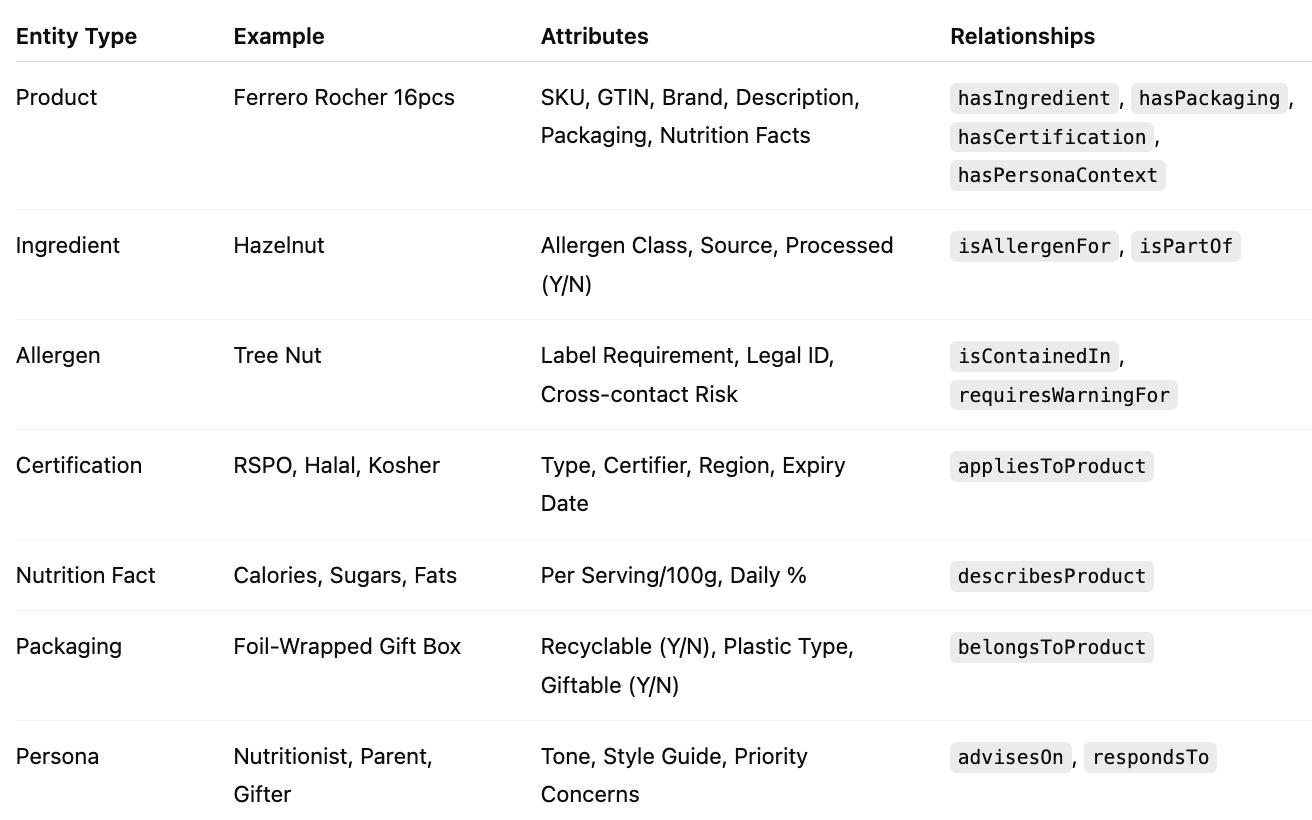
B. Ferrero Use Case (Mini Ontology Snapshot)
Product: Kinder Chocolate Bar
→hasIngredient: Milk Solids
→hasAllergen: Dairy
→hasPersonaContext: Parent
→hasCertification: Halal (IFANCA, EU)Persona: Parent
→advisesOn: Allergen Safety, Portion Size, Sugar Content
→respondsTo: “Is this safe for a 4-year-old?”
This structure enables precise, explainable responses to questions like:
“Is this product gluten-free?” → check
hasIngredient→ verify against ontology → return compliant answer with source.
Part II: FAQ & Intent Taxonomy Template
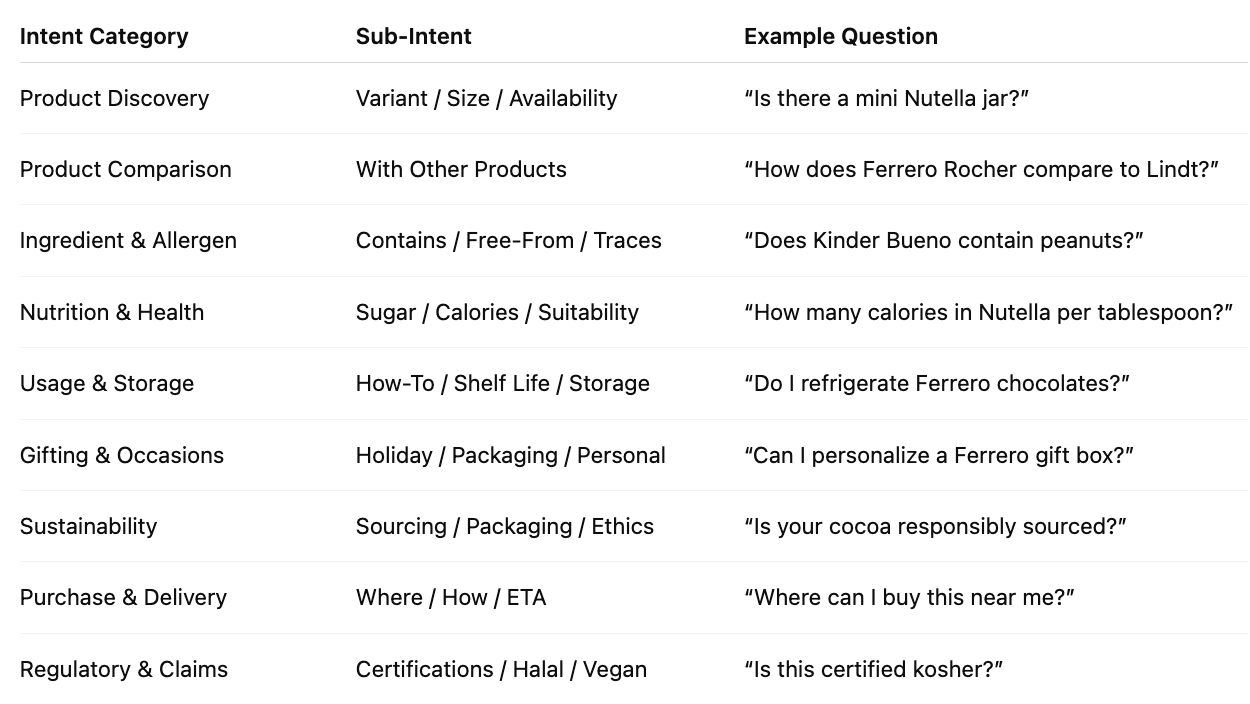
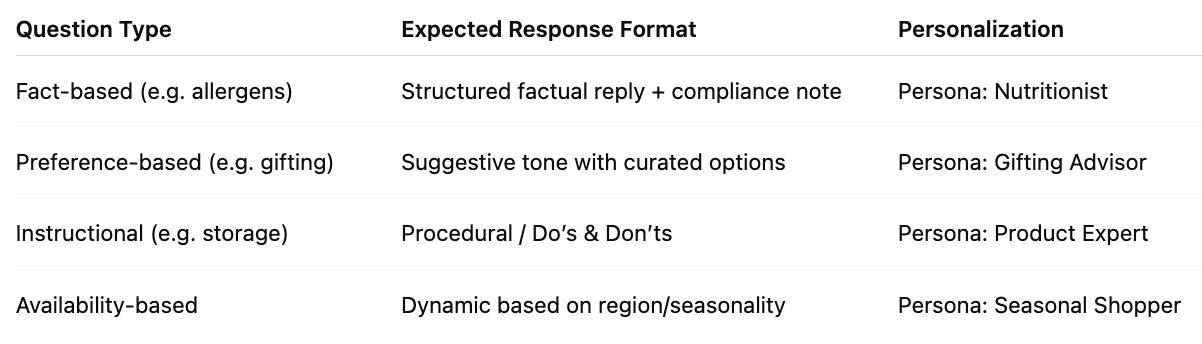
A Taxonomy classifies customer questions by intent, topic, and response type. It allows CCIS to cluster, route, and prioritize FAQs for generation and deployment.
A. Top-Level Intent Categories
B. Response Type Mapping
C. Channel Mapping Template

Recommended Reading & Resources
This curated list of books, reports, blogs, tools, and case studies supports deeper learning and practical implementation of CCIS strategies across AI, commerce, and customer experience.
Books
Conversational AI & Chatbot Design
Effective Conversational AI by Andrew Freed et al. (Manning, 2024) – Practical methods for designing scalable, generative AI-powered bots.
Designing Bots by Amir Shevat (O’Reilly, 2017) – Proven UX and conversation flow strategies across chat platforms.
Conversational Interfaces by Michael McTear et al. – Covers multimodal and voice-first assistant architecture.
AI Product & Experience Design
AI Product Design Handbook by Ramez Nassar – Frameworks for integrating AI into real-world products.
Designing Voice User Interfaces by Cathy Pearl – Key concepts for designing speech-based assistants and AI agents.
Customer Experience & Personalization
AI-Powered Customer Experience by David Royce – Explores how generative AI is transforming service and commerce.
The Effortless Experience by Dixon, Toman & DeLisi – Insight into reducing customer friction across channels.
Reports & Whitepapers
Conversational AI & CX Trends
The Age of Agents (Forrester, 2023) – How GenAI and “super-agents” are redefining digital customer interactions.
Win with Conversations (Meta x Bain, 2024) – Regional data on conversational commerce adoption across Asia and EMEA.
State of Service 2023 (Salesforce) – Forecasts 50% of support cases to be handled by AI by 2027.
Magic Quadrant for Conversational AI Platforms (Gartner, 2025) – Vendor capabilities, market trends, and generative AI maturity.
GPT-4 Technical Report (OpenAI, 2023) – Deep dive into the capabilities, benchmarks, and design of GPT-4.
E-Commerce & Retail AI
McKinsey: The State of AI in Retail 2024 – AI ROI and personalization benchmarks in CPG and e-commerce.
AWS Conversational AI Reference Architectures – End-to-end system design for retail and support chatbots using Lex, Connect, and Bedrock.
Blogs & Newsletters
Tech & AI Strategy
Benedict Evans Newsletter – Strategic trends in platforms, AI, and user behavior.
Stratechery by Ben Thompson – Deep analysis of AI platforms, ecosystems, and business models.
Conversational AI & CX
Voicebot.ai – Industry updates and analysis across chat, voice, and multimodal assistants.
Chatbot News Daily – Examples, case studies, and new tools for conversational UX professionals.
E-Commerce Personalization
PracticalEcommerce Blog – CX, personalization, and merchandising tips for brand websites and marketplaces.
Gartner Blog Network – Insightful posts from analysts tracking CX, commerce, and AI convergence.
Tools & Technical Documentation
AI & LLM Platforms
OpenAI API Docs – Reference for GPT-4, Assistants API, retrieval, and fine-tuning.
Anthropic Console – Claude API documentation and safety configurations.
Amazon Bedrock Docs – Using LLMs like Claude and Titan within AWS ecosystems.
Google Vertex AI – For building custom AI assistants and integrating Gemini models.
Knowledge & Retrieval
LangChain – Framework for building RAG pipelines and knowledge-based agents.
Pinecone – Vector search infrastructure for scalable semantic retrieval.
Weaviate – Open-source vector database with hybrid retrieval features.
Salesforce Einstein GenAI – Custom LLMs and agent integration within CRM and service flows.
PIM/DAM/CMS Integration
Salsify Developer Portal – API documentation for pulling product data.
Contentful Docs – Headless CMS with structured content delivery.
Bynder DAM API – Manage branded assets and delivery pipelines.
Case Studies & Examples
Retail & CPG
Sephora Virtual Artist – AR-powered conversational assistant for makeup discovery and product matching.
Walmart Voice Order – Multichannel assistant enabling hands-free grocery reordering via voice.
H&M AI Stylist – Conversational fashion advisor with dynamic personalization and outfit suggestions.
Pizza Hut Messenger Bot – Increased order conversion through frictionless reordering in Facebook chat.
B2B & Operations
Quantzig CPG Chatbot Case – Automated supply chain Q&A and supplier dashboards using a branded chatbot in Indonesia.
Unilever’s Nutrition Assistant – Internal chatbot for regulatory, allergen, and ingredient lookup across markets.
Nestlé BabyBot – Multi-language infant nutrition bot with guided interactions for new parents (compliant with WHO codes).