



Share of Voice
Benchmark your brand’s presence across Search.
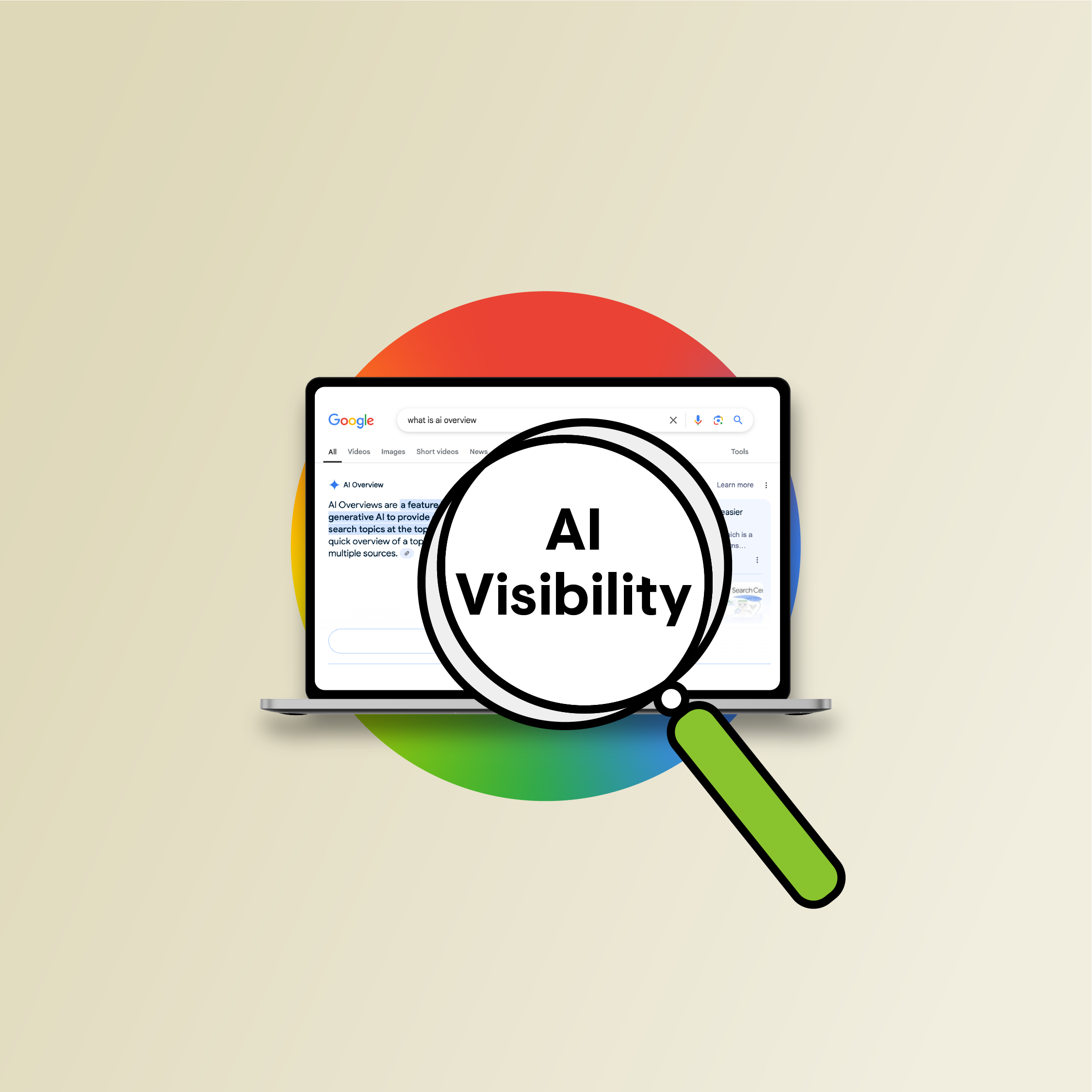
AI is now the discovery layer. Customers rely on Google’s AI Overviews, Amazon’s Rufus, ChatGPT, and Copilot to make decisions long before they reach your website.
But in an AI-driven world, rankings no longer tell you whether AI systems talk about you at all.
AI Growth Hub’s Share of Voice Audit gives you a precise, data-driven benchmark of how often your brand is mentioned, recommended, or excluded across search engines and large language models — and reveals the technical, content, and entity factors shaping your visibility.
This is the foundation of any serious AI visibility strategy.
THE PAIN POINT
Your brand may have market presence, category authority, and strong SEO — yet still be invisible to AI systems.
Common issues we uncover include:
LLMs recommending competitors but not mentioning your brand
Google’s AI Overviews omitting you entirely
Amazon Rufus pushing alternative products
LLMs relying on outdated or inaccurate data about your brand
Weak structured data or missing entity definition
Content that models cannot extract, understand, or cite
Competitors overweighted due to stronger publisher or Wikipedia presence
If AI systems don’t “know” your brand, customers never see you — no matter how strong your traditional SEO is.
Your visibility in LLMs is now a competitive advantage.
And right now, you don't know what you’re missing.
THE SOLUTION
The Share of Voice Audit provides a complete visibility baseline across search AI and large language models.
You’ll see exactly:
When and where you appear in AI-generated answers
How often competitors are recommended instead
What data sources models pull from
Where your entity signals are missing or weak
Why models include or exclude your brand
Which actions will increase your AI visibility the fastest
This audit replaces guesswork with clarity — giving you the intelligence needed to win in the AI discovery ecosystem.
HOW WE DO IT
Our methodology combines technical AI SEO, entity engineering, and model-specific evaluation.
1. AI Share of Voice Analysis
We test your target category, product, and brand queries across:
Google Search + AI Overviews
Bing + Copilot
Amazon search + Rufus
Walmart / Instacart / vertical retail search
ChatGPT, Claude, Gemini, Perplexity
We measure mention frequency, order, omission rate, and competitor share.
2. Entity & Data Layer Audit
We evaluate the technical backbone models rely on:
Schema & structured data depth
Product metadata
Wikipedia & Wikidata alignment
Publisher authority footprint
Entity completeness and consistency
LLM-friendly content availability
3. Citation & Source Mapping
We identify the exact domains, documents, and sources that models are using to make recommendations — and where your brand is missing.
4. AI Red-Team Testing
We stress-test each model for:
Hallucinations
Outdated information
Misattributed brand details
Compliance, medical, or reputational risks
5. Roadmap & Visibility Plan
We translate the findings into a clear 30/60/90-day plan that prioritises the biggest visibility wins.
WHAT YOU GET
The deliverables are built for senior technical and digital leaders who need clarity and immediate actionability.
You receive:
A full Share of Voice benchmark across all major LLMs and search AI
Competitive visibility analysis
Entity and structured data audit
Publisher and citation gap analysis
AI hallucination and risk report
Detailed 30/60/90-day roadmap
Executive summary for CTO/CISO/VP Digital stakeholders
Everything is designed to drive visibility, reduce risk, and enhance brand accuracy across AI systems.
THE OUTCOME
With a Share of Voice Audit, you move from uncertainty to control.
You will:
Understand your real visibility across AI systems
Know exactly why competitors are outranking or replacing you
Improve inclusion in LLM-generated answers
Strengthen your entity signals across search and AI ecosystems
Reduce hallucination and compliance risk
Align teams around a clear AI visibility strategy
Build a defensible position in category-defining AI surfaces
AI discovery is now the battleground for customer attention.
This audit ensures your brand isn’t invisible in the systems shaping decisions.
Featured


Website Tech Optimization
Make Your Brand Machine-Legible for AI-Powered Search
AI systems like ChatGPT, Perplexity, Bing Copilot, Google SGE, and Amazon Rufus are now major discovery channels. These models crawl, parse, and interpret websites to decide which brands to surface in answers, recommendations, and summaries.
If your site isn’t technically sound, you don’t just lose rankings — you lose visibility inside the AI ecosystem.
The Pain Point
Your website may look great to humans, but invisible to machines.
AI search relies on technical signals: crawlability, structured data, site speed, accessibility, clean architecture, and entity consistency.
If these foundations are weak, AIs struggle to ingest your content, understand your brand, or recognise your products.
The result:
Competitors with machine-readable sites are chosen as the authoritative sources — not you.
Our Solution
We transform your website into a fully AI-readable, entity-rich, technically flawless data source.
Our Website Tech Optimization service ensures AI systems can crawl you, understand you, and surface you across all emerging discovery surfaces.
This is the foundation layer of AI visibility — the layer everything else depends on.
How We Do It
We apply a structured, engineering-led process to make your site machine-legible:
1. Technical Crawlability & Indexation
Robots.txt and sitemap optimisation
Deep crawl diagnostics
Removal of blocks, dead ends, and crawl traps
Architecture simplification and internal linking clean-up
2. Structured Data & Entity Mapping
Organization, Product, FAQ, HowTo, and Review schema
Schema cleanup and error resolution
Entity alignment with knowledge graphs (Wikidata, GMB, Wikipedia)
Creation of machine-readable relationships between categories and products
3. Performance & Accessibility Upgrades
Core Web Vitals improvements
Semantic HTML structure
Accessibility: alt text, ARIA roles, heading hierarchy
Render path, script, and resource optimisation
4. Technical Hygiene & Trust Signals
Canonicalisation, metadata consistency, clean URL patterns
HTTPS & security checks
Duplicate content and legacy template removal
Template-level technical quality improvements
5. AI Ingestion Testing
LLM browse-test scenarios
Perplexity / SGE retrieval simulations
Structured data validation and ingestion score
What You Get
A complete, machine-ready technical environment built for AI-driven discovery:
Full Technical AI Visibility Audit
Complete schema deployment & validation
Fixed crawl errors, sitemap rebuild, robots.txt optimisation
Accessibility and performance uplift (Core Web Vitals)
Entity mapping and structured knowledge alignment
AI ingestion readiness score + before/after benchmarking
Technical documentation for engineering teams
A future-proof technical foundation for all AI visibility strategy
The Outcome
Your website becomes a trusted, machine-legible source of truth that AI systems can easily ingest, understand, and recommend.
You gain:
Higher inclusion in AI-generated answers
Increased brand presence in ChatGPT, Perplexity, Copilot, and SGE
Stronger entity recognition for products, categories, and authors
More citations, summaries, and product recommendations
A long-term technical advantage your competitors can’t easily replicate
When AI systems understand your content, they promote your brand.
Website Tech Optimization ensures they can.
Featured

















Content Optimizations
Transform Your Content Into AI-Ready Authority
Pain Point
Your content may be excellent for human readers—but when it comes to AI, it often goes unseen. LLMs and AI-powered search don’t rank pages like traditional search engines—they extract answers, synthesize insights, and cite authoritative sources. Without structured, retrievable content, your expertise stays buried, leaving your brand invisible in AI-driven channels.
Our Solution
We optimize your content to be AI-ready, ensuring your brand is not just found—but trusted and cited. Using SOP-driven workflows, we turn your website into a coherent, high-authority knowledge graph that AI models can reliably access and reuse.
How We Do It
Topic Mapping & Authority Clusters – Define your core topics and subtopics, ensuring every page strengthens your domain expertise.
Content SOPs – Standardize structure, terminology, and semantic clarity so every asset is AI-friendly.
Retrievability Scoring – Evaluate content for clarity, entity density, and extractability, highlighting what AI can and cannot parse.
Content Refinement & Optimization – Audit existing pages, refine language, add cross-links, and enrich entities to maximize AI recall.
Continuous Measurement – Track AI visibility and iteratively improve content based on retrievability and citation metrics.
What You Get
Fully structured, SOP-aligned content ready for AI extraction
Improved internal linking and topical coherence
Semantic clarity across all pages and assets
Actionable retrievability scores to prioritize optimization
Scalable content creation framework for future growth
The Outcome
Your content stops competing for attention and starts earning it—AI models cite your brand, surface your expertise in answers, and drive measurable traffic, trust, and visibility. In short, your website becomes a recognized authority for both humans and AI.
Featured


KNOWELEDGE GRAPHS
STRUCTURED DATA & KNOWELEGE GRAPHS
1. AI Understands Entities, Not Just Keywords
Tools like ChatGPT don’t think in “keywords” the way SEO does — they build entity maps (people, places, products, brands, relationships).
Structured data (schema markup, knowledge graphs) makes it easier for AIs to recognize your brand as an entity and connect it to your category, products, and authority.
2. Structured Data = Machine Readability
Schema markup (Organization, Product, FAQ, HowTo, Review, etc.) provides contextual signals in a format that AIs can parse quickly.
Without structured data, AI may overlook or misinterpret your content.
With structured data, AI can pull direct answers, product specs, FAQs, and attributes straight into responses.
3. Knowledge Graphs Power Brand Recognition
ChatGPT and other LLMs lean heavily on structured knowledge sources like Wikidata, Google’s Knowledge Graph, and industry databases.
If your brand is absent from these graphs, AI may fail to associate you with your category — or worse, default to citing your competitors.
4. Industry Directories Act as Structured Authority Sources
Specialized knowledge bases (Crunchbase for startups, IMDB for media, Healthgrades for healthcare, TripAdvisor for travel) feed directly into AI training and retrieval.
Being present and complete in these directories strengthens your authority footprint.
Tactics
Implement Schema Markup on Your Site
Organization schema → brand info, logo, sameAs links.
Product schema → product specs, ratings, availability.
FAQ schema → common customer questions.
Author schema → expertise, linked profiles.
Ensure Your Brand Exists in Wikidata
Wikidata is a central knowledge base powering both Wikipedia and Google’s Knowledge Graph.
Add or update your entity entry with accurate brand details, aliases, and links.
Optimize Knowledge Graph Entries
Claim and update your Google Knowledge Panel.
Ensure consistent NAP (name, address, phone) and branding across platforms.
Align With Industry Directories
Add and maintain accurate profiles in sector-specific databases.
Example: Crunchbase (business), IMDB (media), Healthgrades (medical), TripAdvisor (hospitality).
Featured