
The Global Tech Talent Landscape in 2025
A Landscape in Flux
The global market for technology talent has entered a new and complex era. The post-pandemic period has been marked by a series of profound disruptions, beginning with an intense hiring boom, followed by unprecedented mass layoffs that reshaped the workforce. This cycle of correction has been compounded by the rapid integration of Artificial Intelligence (AI) into core business functions and heightened geopolitical competition for technological leadership. The result is a dynamic and often contradictory environment where skills shortages coexist with widespread job cuts, and long-held assumptions about career stability in the tech sector have been fundamentally challenged.
The core purpose of this analysis is to dissect these interconnected trends and provide a clear-eyed assessment of the global tech talent landscape. We will evaluate the impacts of the recent market correction, the dual role of AI as both a catalyst for restructuring and a driver of new skills demand, and the shifting geography of talent supply. By examining these forces, this analysis identifies the key strategic considerations for organizations seeking to attract, retain, and develop the skilled professionals required to compete effectively in this new employment paradigm.
The New Employment Paradigm: Key Trends and Tensions
Understanding the fundamental shifts in the tech employment model is a strategic imperative. The established norms of hiring, retention, and workforce planning have been upended by a confluence of economic corrections, technological leaps, and evolving employee expectations. Navigating this new paradigm requires a clear understanding of the key trends and underlying tensions that now define the relationship between tech companies and their most valuable asset: their people.
The "Boom and Bust" Correction: From Hyper-Growth to Efficiency
The recent cycle of mass layoffs across the technology sector was not a reaction to declining productivity but a direct correction for the over-hiring that occurred during the pandemic. Many leading companies, including Meta, officially attributed their downsizing decisions to mistaken projections of sustained, pandemic-level e-commerce growth and a failure to anticipate the return to prior trends. This correction was both swift and severe, creating significant disruption across the global workforce.
The scale of this adjustment has been substantial. Over 500,000 tech employees have been laid off since 2022. Year-to-date in 2025, technology firms have announced 141,159 job cuts, a 17% increase from the 120,470 announced through the same period in 2024.
The impact of these layoffs extends far beyond the numbers. Occurring during a period when many tech companies were posting record profits, the cuts fostered a deeply disillusioned and alienated workforce. The perception of the tech industry as an innovative, employee-centric space has been damaged, with many now viewing it as "just another industry." This sentiment has been amplified by a noticeable shift in leadership discourse. The aspirational "Messiah" leadership style, once common in the sector, has been largely replaced by a "Controller" discourse that prioritizes efficiency, cost structures, and shareholder value. This is evident in the language of layoff memos from leaders at Meta, Google, and Microsoft, which consistently emphasize the need to re-engineer cost bases and sharpen focus. This shift from aspirational to operational leadership presents a direct challenge to the established tech employer value proposition. Organizations must now consciously rebuild trust and demonstrate a new, more pragmatic path to career growth, or risk losing top talent to competitors who better manage this cultural transition.
The Rise of AI as a Workforce Catalyst and Reskilling Imperative
The efficiency-driven mindset that fueled the recent market correction is also accelerating the adoption of Artificial Intelligence, which leadership views as a primary lever for further productivity gains. AI is acting as a powerful dual-sided catalyst, simultaneously driving workforce restructuring while also creating net new demand for skilled professionals. This is exemplified by IBM, which announced it would replace 8,000 jobs with AI while concurrently launching a program to "massively upskill" its entire employee base on AI. This underscores a critical reality: AI adoption is less about simple job displacement and more about a fundamental reshaping of roles and skill requirements.
Contrary to narratives of mass job elimination, data indicates that AI's overall impact on hiring is positive. The net hiring effect attributed to AI adoption is projected to expand from 18% in 2024 to 23% in 2026.
The most critical challenge posed by AI adoption is not job loss, but a significant and widening skills gap. Organizations report being severely understaffed in the very domains essential for leveraging AI and modernizing their infrastructure. This shortage poses a direct barrier to innovation and growth.
• AI & ML Engineering: 68% of organizations report being understaffed.
• Cybersecurity & Compliance: 65% of organizations report being understaffed.
• FinOps & Cost Optimization: 61% of organizations report being understaffed.
• Cloud Computing: 59% of organizations report being understaffed.
2.3 The Entrenchment of Hybrid Work and the Return-to-Office Paradox
Hybrid work has become the predominant and default model for technology professionals. However, this new norm exists in a state of tension with a growing push for corporate return-to-office (RTO) mandates. Major tech companies, including Amazon, Dell, Apple, Google, and Meta, now require employees to be in the office between three to five days per week. This creates a strategic paradox: while hybrid models are the new operational default, leadership mandates for return-to-office are creating significant friction, directly threatening talent retention and undermining the flexibility employees now consider standard.
Strategically, the normalization of remote and hybrid work has had a lasting impact on global hiring strategies. It has made emerging global markets more viable within distributed team structures, fundamentally altering how and where companies source talent.
While these trends define the new terms of demand for tech professionals, a complete strategic picture requires an equally granular analysis of the global supply landscape, which is segmenting in profound ways.
The Global Talent Supply: A Segmented and Shifting Landscape
To compete effectively, organizations must move beyond a monolithic view of the "global talent pool." The landscape is highly segmented, with distinct characteristics defining established, high-growth, and emerging markets. Each segment presents a unique set of opportunities and challenges related to skill depth, cost, and operational environment, requiring a tailored strategic approach.
Established "Powerhouse" Markets: Deep Talent, High Costs
Traditional tech hubs in North America and Europe remain formidable centers of talent and innovation. Their primary attributes include large clusters of diverse tech companies, high concentrations of existing talent, and close proximity to preeminent universities that fuel a steady pipeline of skilled graduates and foster commercial R&D. These markets, however, come with a significant strategic trade-off: high operating costs.
The educational foundation of these markets is exceptionally strong. Countries such as Ireland, Switzerland, the U.K., the Netherlands, and the U.S. all have educational attainment rates above 40% for residents with a bachelor's degree or higher, ensuring a deep and renewable talent base.
High-Growth Hubs: The Scale of Asia-Pacific and Latin America
The sheer scale of the talent pools in Asia-Pacific and Latin America makes them central to any global talent strategy. In 2023, all eight global markets with over 500,000 tech talent workers were in the Asia-Pacific region. Three of these hubs—Beijing, Bengaluru, and Shanghai—each exceeded one million tech professionals.
This scale extends to specialized, high-demand skills. The world's largest AI-development workforces are concentrated in the United States (approx. 406,000 professionals) and India (approx. 375,000 professionals). Furthermore, China serves as the world's largest source of talent for other nations, with a pool that includes approximately 900,000 students studying abroad, creating a vast resource of globally educated professionals.
The New Frontier: Drivers of Emerging Markets
The entrenchment of hybrid work (Section 2.3) has done more than change daily routines; it has redrawn the global talent map, making the emerging markets detailed below strategically viable components of a distributed workforce for the first time. A new tier of these markets is becoming increasingly attractive for talent acquisition, driven by a combination of favorable economic and social factors.
Key drivers include:
• Advancing Education and Tech Skills: University partnerships are boosting talent pipelines in cities like Belo Horizonte (Brazil), while specialized skill sets, such as hardware engineering, are growing rapidly in markets like Ho Chi Minh City (Vietnam).
• Business-Friendly Environments: Pro-business government policies and targeted incentives are attracting foreign investment and multinational companies to cities such as Casablanca (Morocco) and Medellin (Colombia).
• Lower Operating Costs: Markets like Jaipur (India) offer significant labor cost advantages compared to more established national tech hubs, making them attractive for scaling operations.
• Attractive Quality of Life: Cities such as Belgrade (Serbia) and Katowice (Poland) have become appealing destinations for mobile tech talent and digital nomads, benefiting from their vibrant cultures and affordable cost of living.
Understanding this fragmented and shifting global supply is the first step; capitalizing on it requires the set of strategic imperatives we will now address.
Strategic Imperatives for Competing in the Global Talent Market
Navigating the complexities of the current talent landscape requires a deliberate, multi-faceted strategy. Simple recruitment is no longer sufficient. Lasting success depends on a sophisticated approach that optimizes location, prioritizes internal capability development, masters the complexities of global mobility, and builds deep organizational resilience against market and geopolitical volatility.
The Primacy of Upskilling and Internal Development
The severe and widening skills gap identified in Section 2.2—particularly in AI, cybersecurity, and cloud—makes the case for upskilling the existing workforce a matter of strategic urgency, not merely an HR initiative. In an environment defined by persistent skills gaps and high turnover, upskilling has become the single most effective strategy for building and retaining technical capabilities. The data is decisive: organizations are 3.2 times more likely to invest in upskilling their current employees than to recruit externally. The business case for this internal-first approach is built on clear advantages in speed, retention, and strategic alignment with technological shifts like AI.
• Speed: The average time required to upskill an existing employee is 5.2 months. This is 38% faster than the 8.4 months it takes to hire and fully onboard a new professional, allowing organizations to close capability gaps more quickly.
• Retention: Technical training is 91% effective as a talent retention tool, and fostering an open source culture has an 84% effectiveness rate. This is a critical advantage when 19.2% of new hires depart within their first six months, representing a significant sunk cost in recruitment and onboarding.
• AI Implementation: Upskilling the existing workforce is the top strategy (cited by 49% of organizations) for addressing AI-related core activities. This approach is favored over leveraging open-source tools (40%) and hiring new staff (28%), as it combines new skills with invaluable institutional knowledge.
Diversified Location Strategy as a Core Business Resilience Tool
The normalization of remote work, combined with growing geopolitical instability, has elevated diversified talent and location strategies from an operational consideration to a critical C-suite concern. Mitigating geographical concentration risk is now central to business continuity and resilience. A best-practice, three-pronged strategy has emerged to address this challenge:
1. Comprehensive Risk Assessment: Develop a holistic risk matrix that evaluates a full spectrum of potential disruptions, including political, economic, geographic, and supply-chain risks for every operational location.
2. Peer Benchmarking: Compare the organization’s location and talent footprint against that of key competitors to identify relative concentration risks and potential strategic vulnerabilities or opportunities.
3. Futureproofing: Analyze the workforce by size, function, and location to establish risk thresholds aligned with the overall business strategy, ensuring that talent distribution supports long-term resilience.
Furthermore, the rise of AI is poised to fundamentally alter the decades-old calculus of labor arbitrage. The productivity enhancements offered by AI tools could make a single experienced developer in a high-cost location as effective as a larger team in a low-cost one. The strategic decision will no longer be a simple comparison of salaries, but a complex evaluation of AI-augmented productivity in high-cost hubs versus the operational and management overhead of larger teams in low-cost markets. This could trigger a strategic reshoring of high-value functions previously considered prime candidates for offshoring.
Navigating the Complexities of Global Talent Mobility
While talent is globally distributed, the ability to move it across borders is often constrained by significant friction from national immigration policies. The United Kingdom serves as a compelling case study of how these barriers can impede an organization's ability to attract and hire top international talent. Despite government initiatives to attract skilled professionals, the visa system imposes substantial burdens on both applicants and employers.
Key barriers within the UK system include:
• High Cost: The UK's up-front visa costs are characterized as higher than any comparable country. This creates a significant financial barrier, particularly for individual researchers and small to medium-sized enterprises (SMEs).
• Complexity: The Global Talent and Skilled Worker visa routes are described as ambiguous and confusing to navigate. Frequent and often unclear policy changes add to the uncertainty for both applicants and compliance professionals.
• Administrative Strain: The system's complexity imposes substantial costs and administrative burdens on organizations. In one notable case, a large UK university now spends £1 million annually to outsource its immigration administration due to concerns about its ability to remain compliant internally.
The Role of Transparency in Building Sustainable Tech Ecosystems
Market transparency is a foundational element for creating a self-sustaining technology cluster capable of attracting both global talent and capital. Mature and transparent business environments—most often found in North America, Europe, and Central/East Asia—provide the stability and predictability that tech companies and their employees rely on. In contrast, regions with lower transparency, such as much of sub-Saharan Africa and South Asia, face greater challenges in building competitive tech ecosystems.
The key components of a transparent market include clearly defined legal rights, ease of doing business and property registration, straightforward tax compliance, and a reliably functioning legal system and labor market. These factors create the institutional quality that is fundamental to the long-term functioning and stability of a business ecosystem, making them a crucial consideration in global location strategy.
Charting the Future of the Tech Workforce
The global tech talent landscape has undergone a fundamental transformation. The era of unrestrained growth has given way to a new paradigm defined by strategic efficiency, intense competition for highly specialized skills, and a necessary re-evaluation of the employer-employee relationship. The "boom and bust" cycle has eroded trust, while the rise of AI has created both unprecedented opportunities and an urgent mandate for workforce development. In this environment, success is no longer about simply hiring more people; it is about building a smarter, more resilient, and more adaptable workforce.
For organizations charting a course through this new landscape, three strategic takeaways are paramount:
1. Mastering the Talent Pipeline Internally is the Primary Differentiator. In an environment of persistent skills gaps, high external hiring costs, and significant new-hire turnover, the ability to rapidly and effectively upskill the existing workforce has become a primary competitive differentiator. Investing in internal talent is faster, more cost-effective, and a powerful tool for retention.
2. Geography is Both a Risk and an Opportunity. A sophisticated location strategy is no longer a simple cost-optimization exercise but a core component of business resilience. Successful organizations will build a distributed and diversified global workforce that deliberately balances cost, skill availability, and geopolitical risk.
3. Rebuilding the Psychological Contract is a Prerequisite for Growth. Despite the intense focus on AI, efficiency metrics, and corporate restructuring, the underlying drivers of talent attraction and retention remain fundamentally human: career progression, work-life balance, and transparent, credible leadership are more important than ever. The recent market correction has damaged the psychological contract between tech companies and their employees. Rebuilding that trust will be essential for any organization seeking long-term, sustainable success.
INTRODUCING THE Global Tech Talent Map
Your comprehensive guide to navigating the global tech talent landscape
https://techtalent-aevw6arp.manus.space
Our Mission
The Global Tech Talent Map is designed to help tech professionals, companies, and researchers make informed decisions about where to work, hire, and invest in the global technology ecosystem.
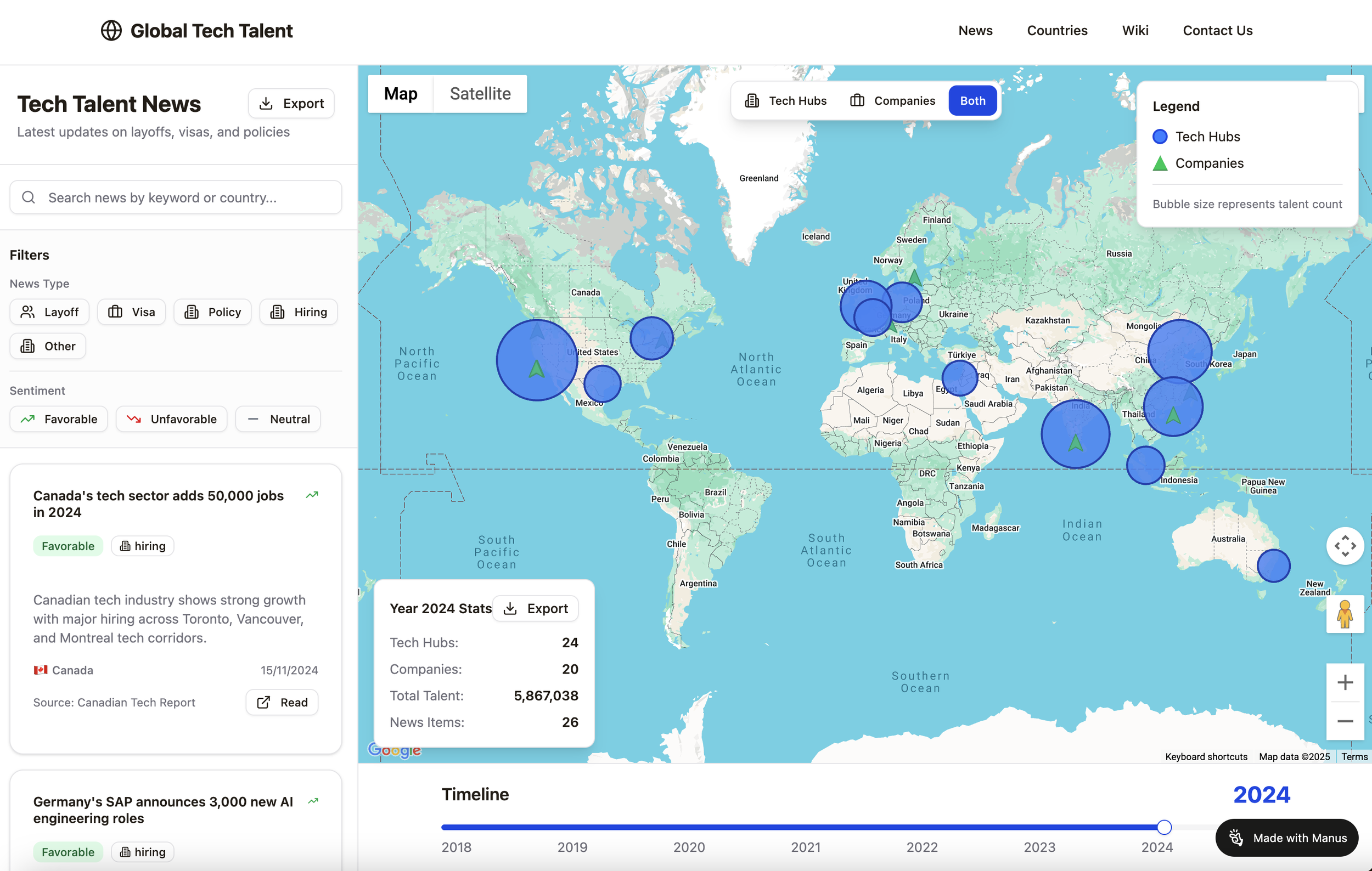
We aggregate data from multiple sources to provide comprehensive insights into tech hubs, hiring trends, visa policies, compensation levels, and quality of life across 20 countries.
Key Features
🗺️ Interactive Map
Visualize tech hubs and major companies worldwide. Toggle between views and explore talent concentrations across different regions.
📊 Country Profiles
Compare 20 countries across six key metrics: tech hubs, hiring activity, visa ease, compensation, quality of life, and innovation.
📰 Tech Talent News
Stay updated with the latest developments in tech hiring, visa policies, and market trends. Search and filter by country or topic.
🔍 Advanced Filtering
Search countries by name, filter by minimum scores, and sort by any metric to find the best match for your needs.
📤 Data Export
Export news and statistics to CSV for further analysis or integration with your own research.
✍️ Community Contributions
Submit relevant tech talent news via form or CSV upload. All submissions are validated for relevance before publication.
How to Use
For Job Seekers
Compare countries by compensation, quality of life, and visa ease
Explore tech hubs on the map to find emerging opportunities
Stay informed about hiring trends and visa policy changes
For Employers
Identify regions with high talent concentrations
Understand visa requirements for international hiring
Track hiring activity and competition in key markets
For Researchers
Export data for quantitative analysis
Track trends over time through the news timeline
Compare innovation ecosystems across countries
Scoring Methodology
How we evaluate countries (1-10 scale)
Tech Hubs: Number and maturity of major tech ecosystems (Silicon Valley, London, Bangalore, etc.)
Hiring Activity: Volume of tech job postings, company growth, and talent demand
Visa Ease: Simplicity of work visa processes, tech visa programs, and processing times
Compensation: Average tech salaries adjusted for purchasing power and cost of living
Quality of Life: Healthcare, safety, work-life balance, infrastructure, and livability
Innovation: R&D investment, startup ecosystem, patents, and technological advancement