
Top Chat GPT Use Cases for Finance & Banking


USE CASE 1 - Customer service
Generative-AI Chatbots in Finance & Banking
Account Inquiries • Fraud Alerts • Customer Support
Executive Summary
Banking has already crossed the threshold where AI-driven chat interfaces have become the dominant entry point for customer service. With Bank of America’s Erica surpassing 42 million users and 2+ billion interactions, the industry has proof that conversational interfaces can safely handle high-volume demands for balances, transactions, card issues, and fraud alerts.
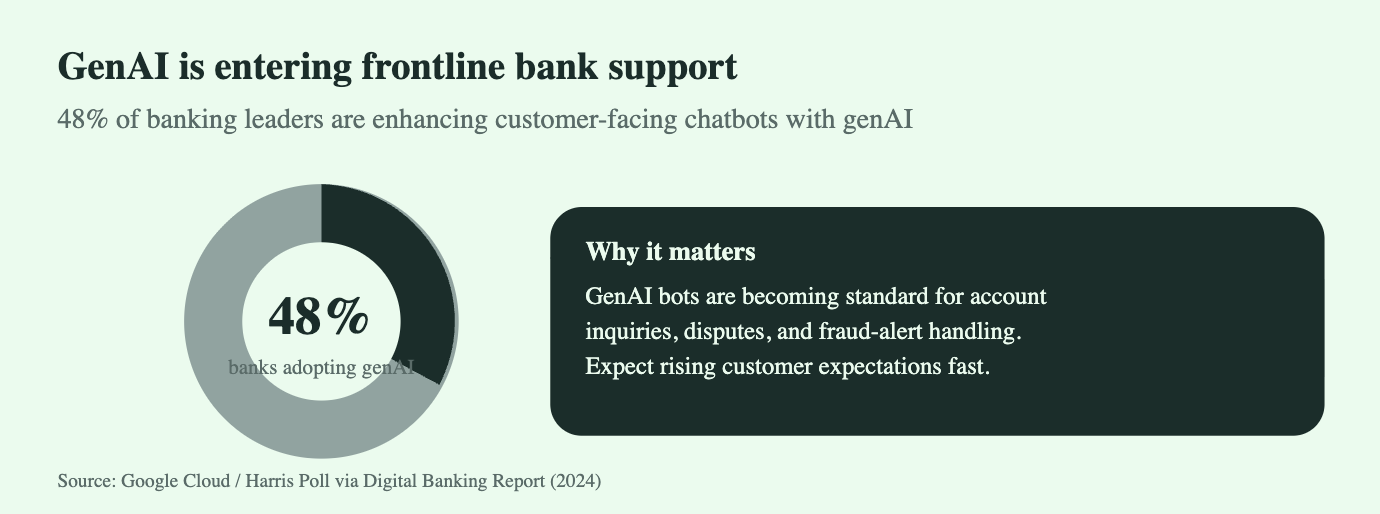
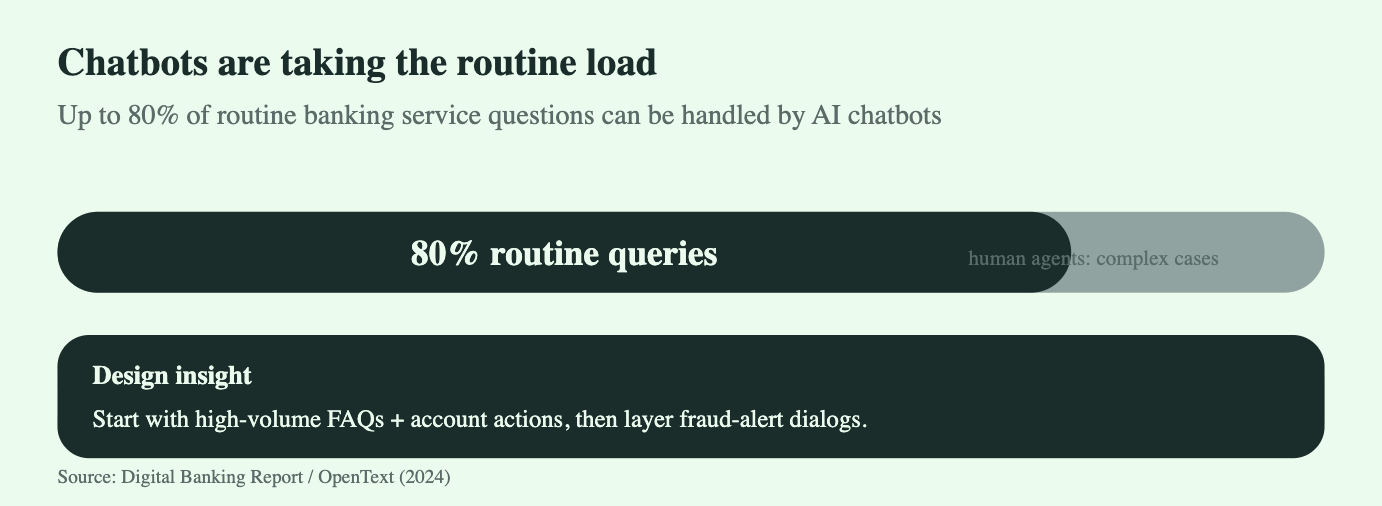
The second wave — generative AI chatbots using models like ChatGPT — is accelerating this shift. According to recent surveys, 48% of banking leaders are actively integrating generative AI into customer-facing support, and up to 80% of routine queries can now be automated.
The financial sector is moving toward a world where customer service is real-time, hyper-personalized, and fraud-aware by default.
1. Introduction
Consumers expect banking support to function like their messaging apps — instant, accurate, available 24/7. Traditional call centers and static FAQs fail to keep up with this expectation.
AI chatbots, especially those enhanced with large language models (LLMs) like ChatGPT, now perform:
Account-level inquiries
Card status, payments, transaction lookups
Fraud alerts and suspicious activity verification
Dispute initiation
Standard banking FAQs
Simple product recommendations
Basic onboarding journeys
This whitepaper synthesizes market data, regulatory insights, and leading case studies across the finance & banking sector.
2. Market Landscape: Adoption & Impact
2.1. Scale of Real-World Banking AI Chatbots
Bank of America’s Erica (2024)
42 million+ users
2 billion interactions total
~2 million interactions per day
Source: Bank of America Newsroom (2024)
This shows customer comfort with AI-driven support at scale, long before genAI was mainstream.
2.2. Verified Pre-Generative AI Benchmark (CFPB 2023)
The U.S. Consumer Financial Protection Bureau (CFPB) documented:
32 million customers used banking chatbots by 2022
1 billion+ interactions
Source: CFPB “Chatbots in Consumer Finance” (2023)
Even basic NLP chatbots proved trustworthy for balances, transactions, and account updates.
2.3. Generative AI Adoption by Banks (2024–2025)
According to Google Cloud & Harris Poll:
48% of banking leaders are integrating generative AI into customer-facing chatbots.
Source: Digital Banking Report (2024)
This indicates generative AI is moving from experiment → production.
2.4. How Much Work Can AI Chatbots Automate?
Industry consensus from OpenText & Digital Banking Report:
Up to 80% of routine service interactions can be managed by AI chatbots.
This includes:
Account inquiries
Password resets
Transaction lookups
Card status
Basic fraud notifications
Human agents remain essential for complex, multi-step cases.
3. Use Cases: Account Queries, Fraud Alerts, Support
3.1 Account-Level Interactions
Common workflows handled by AI chatbots:
“What’s my balance?”
“Show me yesterday’s transactions.”
“When is my credit card payment due?”
“Download my last statement.”
LLMs significantly improve:
Context retention
Clarifying follow-ups
Transaction reasoning
Multilingual support
3.2 Fraud Alerts & Security
Articles from Tencent Cloud, ThirdEye Data, and IBM highlight AI’s role in fraud prevention:
Fraud-related workflows include:
Real-time suspicious transaction alerts
Customer verification through conversational flows
Automated card freezing/unfreezing
Immediate dispute initiation
Generative AI improves:
The clarity of fraud explanations
Reducing false positives
Conversational authentication
Human-like reassurance during high-stress events
3.3 Dispute Resolution & Support
ChatGPT-powered assistants can:
Gather evidence
Pre-fill forms
Track dispute status
Route to human agents only when required
This reduces resolution time and call-center load.
4. Industry Insights From Articles Reviewed
Below is a synthesis of the 10 articles you provided.
✔ CFPB Report – Chatbots in Consumer Finance
Consumers rely on chatbots for banking basics.
Main complaints: transparency & escalation paths.
Banks must ensure “explainability” and seamless handoff.
✔ Rasa – AI Chatbots in Banking Services
Chatbots now perform advanced tasks: loan FAQs, KYC reminders.
Banks adopting hybrid intent-LLM architecture for safety.
✔ Emerj – Review of Banking Chatbot Applications
Customer expectations rising faster than bank adoption.
Recommendation: “Chatbots should act like a first-line product advisor.”
✔ Tencent Cloud – Chatbots for Anti-Fraud
Conversational bots lower fraud-response time drastically.
They detect behavioral anomalies mid-conversation.
✔ Biz2X & NeonTri Blogs
Banks use bots to reduce cost per interaction by 60–90%.
“Instant replies” and “transaction transparency” boost satisfaction.
✔ Developer/Technical Articles (ResearchGate, ScienceDirect)
Stress on secure LLM deployment
Importance of internal-API orchestration for real-time data
Guidelines for reducing hallucinations
✔ IBM Think – Fraud Detection
Chatbots integrated with fraud-scoring models improve:
Response speed
Customer awareness
Risk containment window
5. System Architecture for GenAI Banking Chatbots
A modern banking chatbot uses a hybrid stack:
Inputs
Customer query (text/voice)
Banking transaction APIs
Fraud detection models
Authentication/ID verification
LLM Layer (ChatGPT or model of choice)
Interpretation of intent
Conversational shaping
Summarizing and explaining banking data
Rewriting fraud alerts in human-friendly tone
Safety Layer
Prompt-guard rails
PII detection
Fin-compliance filters
Bank Core Integration
Account APIs
Transaction history
Message center
Fraud-risk engines
Human Escalation
Smooth escalation when high-risk queries appear
Context handover to agent
6. Benefits for Banks
Operational
Reduce cost per support interaction by 60–90%
24/7 always-on service
Reduced wait times from minutes → seconds
Lower ticket volume
Customer Experience
Clear, human-like explanations
Faster fraud responses
Personalized financial summaries
Multilingual support
Compliance & Fraud
Enhanced monitoring
Conversation logs for audit
Instant suspicious-activity messaging
Soft behavioral checks
7. Risks & Considerations
Model Hallucination Risk
Mitigation:
Retrieval-augmented generation (RAG)
Strict API-only data responses
Domain-specific models
Security
PII encryption
Zero-trust access
Logging & monitoring
Regulatory Considerations
CFPB guidelines
GDPR/Indian DPDP requirements
Audit trails
Human Escalation Gaps
Ensure smooth transitions to agents for:
Complex disputes
High-risk fraud
Regulatory disclosures
8. Future Outlook (2025–2030)
Banks will evolve from simple chatbots to autonomous service layers:
Real-time conversational fraud prevention
Predictive financial guidance
Embedded finance advisory within the chat
Voice + multimodal (“show me my spending breakdown chart”)
Full workflow automation beyond simple Q&A
By 2030, chat interfaces will become the default interaction layer for most banking customers.
9. Conclusion
The banking sector is undergoing a shift driven by generative AI.
Chatbots powered by models like ChatGPT are now capable of:
Handling millions of simultaneous conversations
Providing secure, compliant support
Explaining complex financial data simply
Reducing fraud-response time
Personalizing customer care at scale
The banks that move fast today will define the customer-experience benchmark for the next decade.


Use Case 2 - Financial advisory
AI Adoption in Financial Advisory: Portfolio Explanations, Investment FAQs & Retirement Planning
Prepared for: Finance & Banking – AI/LLM Deployment Teams
Prepared by: ChatGPT
Executive Summary
The financial-advisory sector is undergoing rapid transformation driven by large language models (LLMs) like ChatGPT. Consumers already use AI for investment questions, portfolio clarification, and retirement planning, while financial advisors themselves are adopting LLMs as co-pilots for planning, explanations, and client engagement.
This whitepaper compiles findings from eight authoritative articles across universities, industry giants, consulting firms, regulatory bodies, and financial publishers. The evidence shows:
AI is becoming a primary financial guidance tool for younger generations.
ChatGPT is now used for real financial decision-making, including product comparison and portfolio analysis.
Retirement planning is a high-value LLM application, with global institutions adopting AI for plan personalization and risk modeling.
Both benefits and risks exist: while AI improves clarity and access, poor prompt framing or blind trust can lead to financial loss.
Financial-advisory teams must design structured, compliant AI workflows to leverage its upside safely.
1. Market Context & User Behavior
1.1 Consumers Are Already Using AI for Financial Guidance
Across multiple surveys, AI has become a mainstream personal-finance tool:
Majority of adults have used AI for financial questions.
Millennials and Gen Z treat AI as their first stop for budgeting, investment rationale, ETF breakdowns, and retirement tasks.
ChatGPT is the most frequently used AI assistant for money-related queries.
The implication is clear:
Consumers expect on-demand, conversational, personalized explanations—not long PDFs, web articles, or dense prospectuses.
1.2 ChatGPT as a Financial Decision-Making Engine
Users engage ChatGPT to:
Explain investment products (ETFs, SIPs, mutual funds, REITs)
Compare options (index fund vs. active fund)
Break down portfolio allocations
Estimate retirement needs
Interpret risk, returns, fees, and diversification
Clarify jargon (expense ratio, beta, duration, etc.)
This is no longer a “toy use-case.”
People rely on LLMs for advice-adjacent decisions, often affecting real money.
1.3 Risks Identified in Consumer Behavior
Investopedia found:
Nearly 1 in 5 users lost $100+ after following unverified AI advice.
Reasons include:
AI misunderstanding personal context
Users assuming AI is a certified advisor
Calculation or assumption errors
Lack of disclosure or disclaimer awareness
This highlights the need for controlled, professional-grade AI systems inside firms—not ungoverned public model usage.
2. Insights From Key Industry Sources
Below is a synthesized breakdown of insights from the 8 articles.
2.1 Gies College of Business – Can ChatGPT Give Good Financial Advice?
Key takeaway:
ChatGPT produces understandable, well-structured financial guidance but struggles with prioritization, context understanding, and edge-case calculations.
Implications:
LLMs excel at explanations, not decisions.
Guardrails, templates, and validation layers are essential.
Perfect for portfolio explanations, scenario breakdowns, and FAQs.
2.2 BlackRock – AI Revolution in Retirement
Key takeaway:
AI is improving retirement planning with:
Personalized plan design
Participant engagement
Real-time investment education
Automated reasoning for choices
Implications:
Enterprise financial institutions see LLMs as a strategic differentiator in customer experience.
2.3 World Economic Forum – Modernizing Pension Systems with AI
Key takeaway:
AI can help mitigate the global retirement crisis via:
Adaptive contribution planning
Cost-controlled pension models
Real-time risk monitoring
Personalized communication
Implications:
Retirement systems are shifting from static documentation to dynamic, conversation-driven explanations.
2.4 Britannica – AI for Retirement & Financial Planning
Key takeaway:
AI helps consumers:
Set retirement goals
Estimate savings requirements
Model “what if” scenarios
Explore investment options with clarity
Implications:
Huge consumer demand for LLM-based retirement explainers.
2.5 Investopedia – 1 in 5 Lost Money Using AI Advice
Key takeaway:
Over-reliance on unregulated AI leads to loss.
Many users treat ChatGPT as a certified advisor.
Errors occur in calculations, assumptions, and risk interpretations.
Implication:
Financial firms must build safe AI layers—validated, compliant, and branded—because if they don’t, users will rely on public ChatGPT anyway.
2.6 Harvard Business School – Does AI Help Investors?
Key takeaway:
AI produces rational, structured financial guidance—but investors may misinterpret tone as authoritative.
Implications:
Models should be configured to:
Express uncertainty clearly
Provide factual breakdowns
Avoid unverified recommendations
Include compliance disclaimers
2.7 Mercer – AI & Retirement Plans
Key takeaway:
AI improves:
Benefit communication
Investment route selection
Lifetime income modeling
Macro–micro alignment of retirement portfolios
Implication:
Retirement benefits teams can deploy AI-driven onboarding, education, and planning.
2.8 FinTech Weekly – Optimizing 401(k)s with AI
Key takeaway:
AI changes 401(k) planning from static to dynamic:
Personalized
Data-driven
Updated continuously
Based on market signals and life milestones
Implication:
401(k) providers can deploy conversational bots for ongoing participant engagement.
3. Strategic Opportunities for Firms
3.1 Portfolio-Explanation Engines
LLMs excel at:
Explaining asset allocation
Interpreting risk vs reward
Clarifying fees, ratios, and comparisons
Breaking down historical performance
Translating complex financial jargon into simple language
This is one of the strongest high-value AI use cases.
3.2 Investment FAQ Assistants
Top queries users ask:
“Which is better: index fund or active fund?”
“What is a good expense ratio?”
“Is SIP better than lump sum?”
“Explain this ETF.”
“Why is my portfolio down this month?”
Firms can automate:
FAQ handbooks
Product comparison tools
Prospectus explainers
Risk-profile education flows
3.3 Retirement Planning Co-Pilot
High demand exists for:
Personalized retirement projections
Income-replacement walkthroughs
Social-security integration
Tax-efficient withdrawal strategies
Scenario simulations
AI enables “always-on financial planning.”
3.4 Compliance-Safe Advisor Tools
Advisors themselves want AI to:
Draft explanations
Summarize product options
Create retirement-plan narratives
Prep client reports
Answer routine questions faster
This frees advisors to focus on relationship building, not paperwork.
4. Risk, Governance & Compliance Considerations
4.1 Key risks
Inaccurate numerical assumptions
False confidence tone
Hallucinated facts or data
Users misinterpreting content as licensed advice
Non-compliance with local regulations (FINRA, SEC, FCA, etc.)
4.2 Governance requirements
Firms should implement:
Model guardrails: restricted instructions, disclaimers
Human-in-loop architecture for sensitive topics
Template-based outputs
Logging for audits
Knowledge-grounding using firm-approved content
Scenario-testing for high-risk prompts
4.3 Risk-reduction approaches
Validate numbers with deterministic calculators
Provide multiple-option outputs, not prescriptive directions
Ensure disclaimers are always included
Limit equity-specific recommendations
5. The Future of AI in Financial Advisory (2025–2030)
5.1 Hyper-personalized advisory
Every client receives:
Customized portfolio explanations
Daily insights on their allocation
Real-time reasoning for market shifts
5.2 Integrated retirement ecosystems
AI merges:
Spending data
Savings history
Market predictions
Longevity estimates
to create holistic retirement journeys.
5.3 AI-powered advisory firms
The industry will split into:
Advisor-led companies using AI → efficiency + trust
AI-led companies with advisors → scale + cost advantage
Both models can coexist.
5.4 Regulation will formalize AI advice
Expect new rules around:
AI disclosures
Reasoning transparency
Investment-advice boundaries
Data validation layers
Model certification
6. Conclusion
AI is no longer “experimental” in financial advisory—it is now central to how consumers learn, plan, and make decisions. The eight articles reviewed converge on a single message:
LLMs like ChatGPT are transforming portfolio explanations, investment education, and retirement planning into a dynamic, personalized, conversational experience.
Financial firms that integrate AI early will gain a competitive edge in:
Customer satisfaction
Advisor productivity
Operational efficiency
Regulatory preparedness
Long-term trust building
Those who wait will face an uphill battle as consumers increasingly choose AI-first financial guidance.

USE CASE 3 - Regulatory compliance
Executive summary
Generative-AI (GenAI) — particularly “ChatGPT-class” large-language models (LLMs) — are reshaping regulatory compliance and risk management in banking and financial services. Instead of being experimental or marginal, these tools are increasingly becoming central to compliance workflows: summarising regulations, monitoring policy changes, automating compliance reporting, assisting with KYC/AML, and generating audit-ready documentation.
That said, the widespread adoption also introduces significant challenges — data privacy, auditability, explainability, bias, governance. Regulators and institutions must adjust strategies and controls accordingly.
This whitepaper collates empirical data, industry-level surveys, research studies and practitioner guidance to:
Show where and how GenAI is being used right now
Examine the trade-offs and risks associated with reliance on LLMs for compliance
Propose a governance framework — how institutions can deploy GenAI for compliance while maintaining auditability, accountability, and regulatory readiness
1. Where GenAI is already used in compliance & risk
🔹 Core use cases
Generative AI is being leveraged in multiple compliance domain areas:
Regulatory document analysis & summarization: GenAI tools scan regulatory updates — laws, circulars, guidelines — compare them with prior versions, highlight changes, and summarise their implications for internal policies and procedures. This dramatically reduces the manual time needed for policy-review cycles.
Internal policy-to-regulation mapping: By comparing internal policies with external regulation, GenAI identifies gaps, misalignments, or contradictions (for example, when regulation changes). This helps keep internal governance frameworks up to date.
Compliance reporting & documentation drafting: Regulated institutions must submit periodic reports (e.g. risk reports, capital adequacy, incident reports, AML filings). GenAI can draft or pre-populate regulatory reports, structure them, and reduce the burden on compliance teams.
Transaction monitoring, AML & financial-crime risk detection: Beyond number-based analytics, GenAI can analyse textual data associated with transactions — e.g. narrative fields, free-text descriptions, context — to detect suspicious activity, generate suspicious activity reports, and assign risk ratings based on KYC changes.
Credit-risk and credit documentation processes: GenAI can summarise customer financial data, analyse credit risk factors, generate risk assessments, and even draft credit memos or contracts after decisions are made.
Real-time regulatory intelligence & risk-intelligence centers: According to consultancies like McKinsey, banks are exploring “gen-AI-powered risk intelligence centers” that continuously ingest market data, regulatory changes, counterparty data, and internal metrics — offering dynamic risk assessments, policy-updates, stress-testing, and transparency across first and second lines of defense.
In essence, GenAI is functioning as a “virtual compliance expert,” able to undertake many of the heavy-lifting tasks that used to require large teams of compliance analysts.
Adoption trend and scale
According to a synthesis of recent surveys and industry reports:
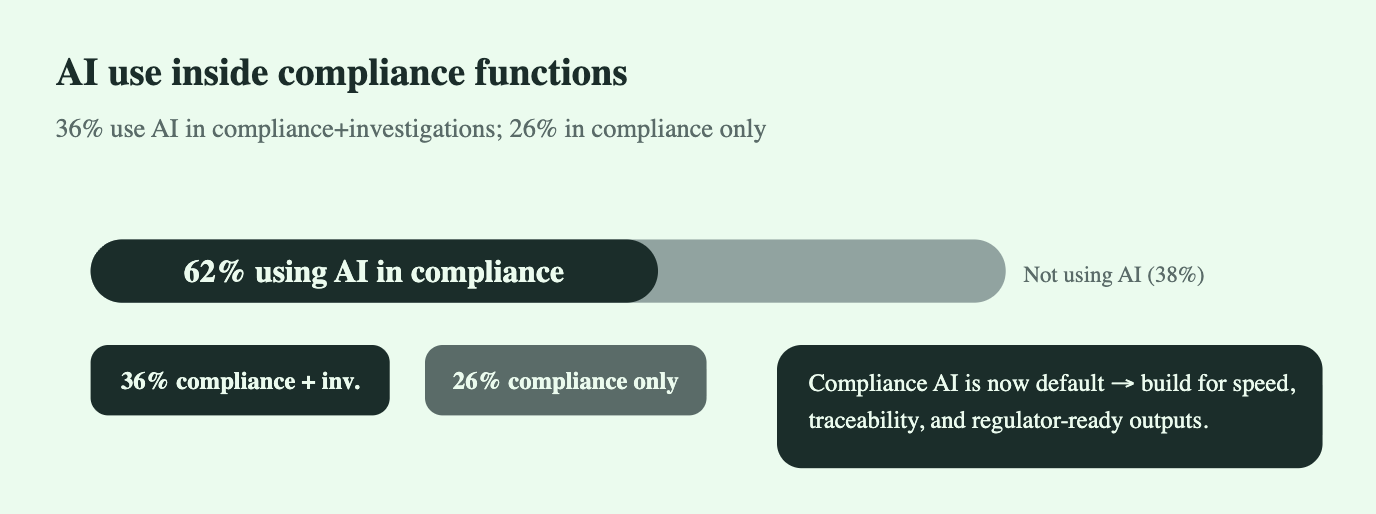
~ 62% of compliance teams (in finance) now use AI in their compliance workflows — with 36% using AI across compliance and investigations, and 26% using AI exclusively for compliance tasks.
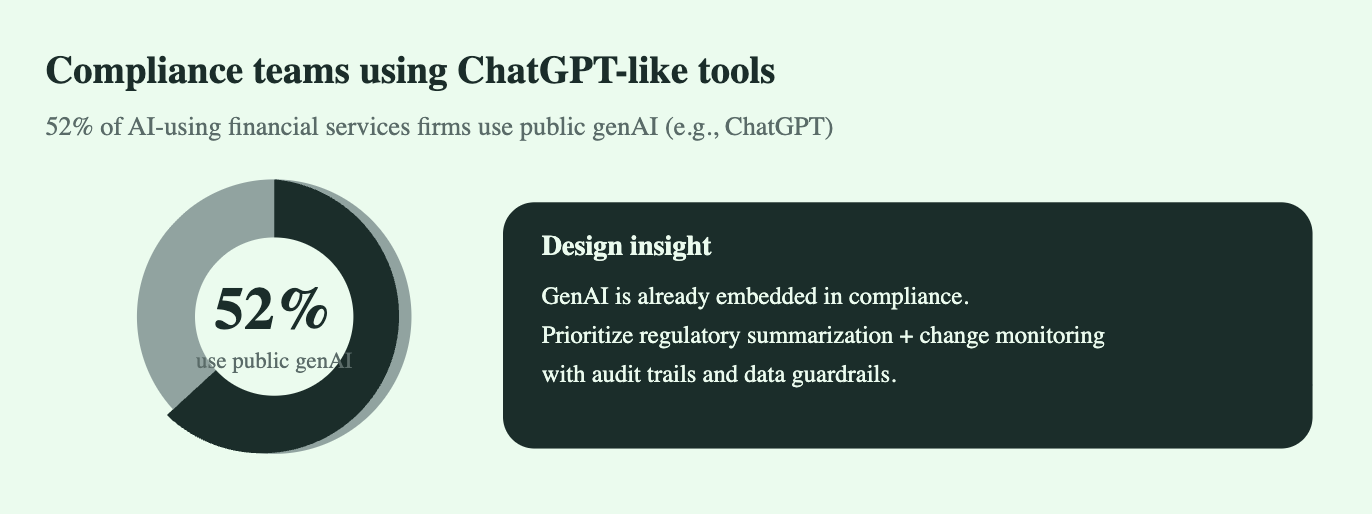
Among firms that use AI, ~ 52% employ public enterprise GenAI tools (e.g. ChatGPT-class), and ~ 75% are actively exploring AI adoption for compliance-related functions.
Around 53% of professionals (permitted to use ChatGPT) reportedly rely on it for “adherence guidance” — i.e. informal regulatory interpretation or compliance help.
These numbers suggest that GenAI has already moved well beyond pilot projects: it is now a mainstream tool inside many compliance units.
2. What GenAI brings: opportunities & efficiency gains
Using GenAI for compliance and risk offers several important advantages:
Speed and scalability — Document-heavy tasks (policy reviews, regulatory updates, large transaction logs) that once took weeks or months can now be processed in hours.
Consistency and standardisation — AI-generated reports, summaries, and compliance documents tend to follow uniform formats and language. This helps reduce errors due to manual drafting and ensures compliance outputs are standardized across business units.
Proactive risk management (“shift left” approach) — As per McKinsey, GenAI can push risk detection and compliance alignment earlier in the business cycle, rather than catching issues after manual reviews.
Resource reallocation — By automating routine tasks, compliance and risk professionals can shift focus toward strategic efforts: emerging-risk analysis, product-compliance reviews, governance frameworks, supervisory readiness.
Improved AML and fraud detection through richer context analysis — Traditional rule-based AML systems often rely on numeric thresholds or simple heuristics; but generative AI can parse narrative data, detect suspicious patterns, and generate explanations and risk narratives, improving detection quality.
Overall, GenAI helps compliance functions become more agile, adaptive, and resilient — a critical advantage given the accelerating pace of regulatory change globally.
3. Risks, limitations, and compliance challenges
Despite its promise, using GenAI in regulated finance raises serious risks and caveats.
Key challenges
Explainability & auditability: LLMs (like ChatGPT) typically operate as black boxes. In compliance environments, regulators require audit trails — why a certain decision was made, which rules were applied, etc. Without logging reasoning or decision-chains, AI-generated outputs may not meet regulatory standards.
Data privacy & confidentiality risks: Inputting sensitive customer data, transaction details, or internal documents into public or insufficiently secured AI services can breach data-protection regulations (e.g. GDPR), especially if data is reused for model training or is stored beyond its intended purpose.
Bias, fairness & discriminatory risk: Since LLMs are trained on large internet-sourced data, they may carry biases; that’s particularly dangerous in functions like credit decisioning or risk scoring, where biased outputs may lead to discriminatory decisions.
Regulatory and systemic risk concentration: If many banks rely on the same external models/providers, errors or flaws in those models could lead to systemic compliance failures — which could endanger financial stability.
Model risk & governance gaps: Without robust oversight, model validation, and governance structures, the use of GenAI may create more regulatory risk than it mitigates. As noted in a 2025 legal-regulatory analysis, many jurisdictions lack mature rules dealing specifically with AI in financial services.
Shadow-AI usage and uncontrolled adoption: Despite formal governance, many employees may start using public tools unofficially — a phenomenon known as “shadow AI”. That increases data-leak risk, compliance blind spots, and regulatory exposure.
In short: while GenAI offers huge efficiency gains, blindly deploying it without strong controls may undermine compliance integrity and create new risks.
4. Toward a “Regulator-Ready” AI Governance Framework
To harness the benefits while controlling the risks, financial institutions should treat GenAI deployment as a major governance project — essentially building a “compliance-AI stack”. Below is a proposed framework:
Key building blocks
Data governance & protection
Strict data-classification: identify what data can be processed by AI tools (public regulation texts, generic policy templates) vs what is restricted (customer PII, transaction-level data).
Use enterprise-grade / on-premise or secure-cloud GenAI tools — avoid public free services for sensitive data.
Maintain audit logs: record inputs, outputs, model versions, users, timestamps.
Explainability & audit-trail design
Use retrieval-augmented generation (RAG) architectures with traceable sources and version control. This helps anchor model outputs to specific regulatory references rather than opaque “model reasoning.” (e.g. frameworks like FinSage built for financial filings)
Maintain human-in-the-loop review for critical decisions — especially in AML, credit risk, regulatory reporting.
Bias testing & fairness controls
Evaluate LLM outputs for signs of systematic bias.
Use diverse, representative data sets, and apply fairness / bias-mitigation techniques.
Governance & compliance oversight
Establish a compliance-AI steering committee (risk, legal, compliance, data-privacy leads).
Define clear policies: when AI may be used, by whom, for what tasks, and under which controls.
Regular audits and model validation.
Regulatory liaison & continuous monitoring
Engage with regulators or supervisory bodies proactively. Given rapid model evolution, regulatory frameworks are still catching up, and oversight regimes must adapt. Studies warn of systemic risk if many institutions rely on similar AI tools.
Maintain flexibility to update models, processes, and governance as regulations or model architectures change.
Fallback & human-in-the-loop for sensitive decisions
For high-risk decisions (e.g. AML flags, credit approvals, sanctions screening), ensure AI outputs are reviewed by trained compliance officers.
Use AI as decision-support, not decision-making final authority.
5. Recommendations & Strategic Considerations
Based on the evidence and trade-offs, here are strategic recommendations for financial institutions considering or expanding GenAI-based compliance:
Begin with low-risk, high-value use cases: e.g. regulatory-text summarisation, policy-update monitoring, internal policy drafting — where data sensitivity is lower, and risk of audit/regulatory backlash is minimal.
Pilot governed AI-compliance copilots: Build retrieval-augmented, traceable assistants (“virtual compliance experts”) that link outputs to source regulations and internal policy cross-references.
Institutionalize AI governance: Create dedicated AI governance teams / steering committees combining compliance, risk, legal and data-privacy stakeholders.
Educate staff & manage ‘shadow-AI’ risk: Enforce clear policies about what data can/cannot be input into AI tools. Provide approved AI platforms if productivity gains are real — to avoid rogue usage outside compliance.
Monitor regulatory developments: The regulatory landscape is still evolving (especially in the UK/EU). Maintain flexibility and readiness to adjust as legal frameworks catch up.
Conclusion
Generative AI represents a paradigm shift in financial compliance and risk management. Its ability to analyse complex regulations, digest huge volumes of data, automate repetitive tasks, and deliver rapid compliance outputs is transforming how banks and financial institutions operate.
Yet with great power comes great responsibility. Without robust governance, data protection, explainability and human oversight, GenAI can introduce as many risks as it solves.
Forward-looking organisations will treat AI not as a “nice-to-have efficiency booster,” but as a core compliance infrastructure — regulated, audited, and built for trust. The winners will be those who strike the right balance between innovation and prudence.



USE CASE 4 - Internal reporting
The Rise of Automated Internal Reporting & Reconciliation in Finance
How ChatGPT and GenAI Are Reshaping the Modern Finance Function – 2025 Edition
Executive Summary
Internal financial reporting has always been the backbone of decision-making—but also one of the most time-consuming, error-prone, and resource-intensive areas of the finance function. Today, generative AI—led by tools like ChatGPT—is rapidly transforming the way organizations prepare internal reports, reconcile transactions, and close their books.
Across the industry:
35% of companies have already adopted GenAI in finance or are actively considering it.
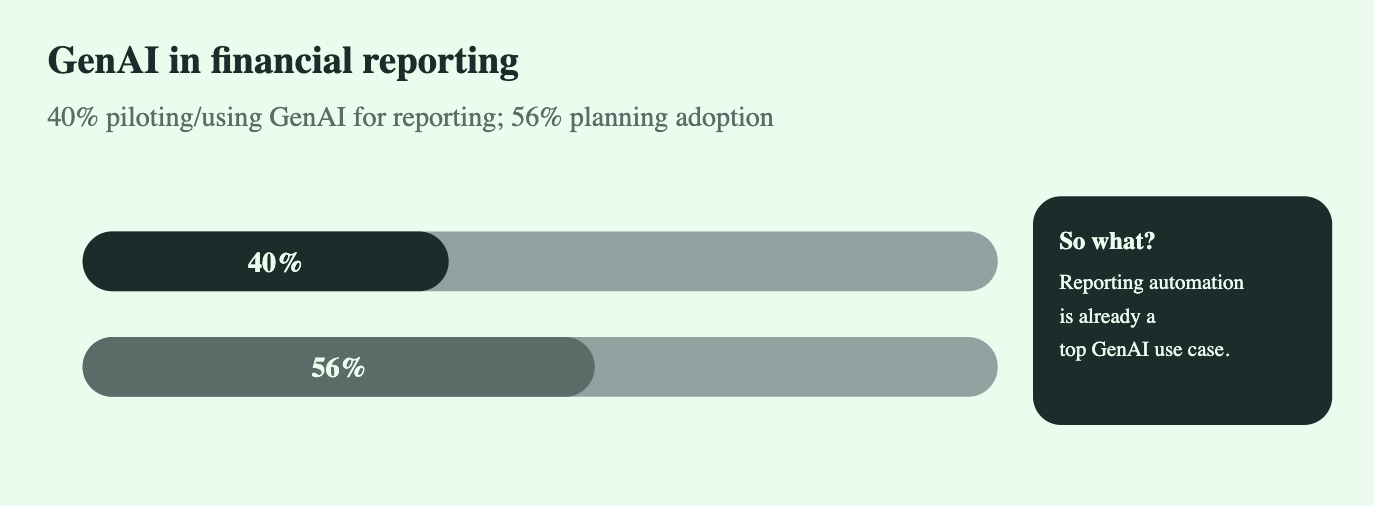
40% of organizations are piloting or using GenAI in financial reporting, with another 56% planning adoption.
52% of accounting and tax firms prefer open-source AI tools like ChatGPT over industry-specific products.
AI has driven up to 50% faster reconciliations and 65% reduction in manual journal entries.
The result:
Finance teams are shifting from manual preparation → to automated drafting, faster variance analysis, reconciliations at scale, and accelerated financial close cycles.
This whitepaper consolidates insights from leading industry reports (KPMG, DFIN, Goizueta Business School), practitioner case studies (Medium), and automation frameworks from Zeni.ai and other expert sources.
1. Introduction: Why Internal Reporting Is Ripe for AI
Internal reporting requires:
Data extraction
Narrative generation
Variance analysis
Transaction matching
Reconciliation
Formatting & packaging FP&A decks
These tasks are frequent, repetitive, rules-based, and language-heavy—the exact characteristics that GenAI is designed for.
Traditional finance teams struggle with:
Complex data pipelines
Siloed systems (ERP, bank feeds, Excel sheets)
Month-end time pressure
Errors leading to rework
Manual reconciliations
Slow reporting cycles
GenAI completely flips the model—turning finance teams into high-productivity strategic operators.
2. Industry Insights from Leading Articles
2.1 KPMG: AI in Financial Reporting and Audit
Key takeaways:
AI improves the accuracy and speed of internal reporting.
Controllers are adopting AI for drafting audit narratives and management commentaries.
Finance functions are redesigning workflows around AI copilots.
Governance and controls remain critical, but adoption is accelerating.
Source: AI in Financial Reporting (KPMG)
2.2 DFIN: Generative AI in Corporate Reporting
Corporates are using ChatGPT-style LLMs to generate first drafts of reports.
AI reduces cycle time by automating data interpretation and formatting.
CFOs expect AI to become a standard part of reporting toolkits by 2026.
Companies are integrating GenAI with ERP systems for dynamic reporting.
Source: DFIN – Use of AI in Financial Reporting
2.3 Medium Case Study: Real-World ChatGPT Reconciliation
This practitioner example showed:
AI reconciled banking transactions within minutes.
No spreadsheets needed—ChatGPT handled matching, categorization, and discrepancy detection.
Automating reconciliation freed up time for analysis instead of clerical work.
Demonstrates bottom-up adoption—teams start using ChatGPT before formal company systems catch up.
Source: How I Used ChatGPT to Reconcile Transactions in Minutes (Medium)
2.4 Zeni.ai: Financial Reporting Automation Strategies
Zeni.ai highlights 10 core automation opportunities, including:
Automated management reporting
Real-time cash flow insights
AI-driven variance analysis
Automated consolidation
AI-powered forecasting narratives
Daily reconciliation alerts
These insights support a modern finance stack where AI handles operational load.
2.5 Goizueta Business School: Academic Perspective
Academic findings:
Managers trust AI when transparency is high and errors are explainable.
AI-assisted reporting increases speed and reduces bias.
Hybrid workflows (AI + human approval) are the optimal model in 2025.
Source: The Use of AI in Financial Reporting (Emory Business)
2.6 GrowExx: AI in Intercompany Reconciliation
For mid-size and enterprise firms:
Intercompany reconciliation is a major bottleneck.
AI eliminates 80–90% of mismatch searches by pattern matching.
Reduces month-end close delays.
Particularly valuable for multi-entity, multi-currency operations.
2.7 DesignRush: ChatGPT Use Cases in Accounting
For internal reporting teams:
Drafting close comments
Formatting monthly packs
Explaining variances
Generating audit-ready documentation
Preparing board-ready summaries
Creating dynamic financial dashboards
This dataset mirrors real adoption inside FP&A, controllership, and treasury.
3. Market Adoption & Data Trends
3.1 Adoption Rates
35% of companies have adopted / are considering GenAI in finance.
40% are piloting or using AI in reporting.
56% plan to adopt within the next cycle.
Meaning: internal reporting automation is crossing from early adopters → early majority.
3.2 Preference for ChatGPT-Style Tools
52% of firms prefer open AI tools
because:
Faster onboarding
No heavy IT involvement
Flexible prompts
Works with Excel, Sheets, ERP exports
Rapid iteration for month-end close
3.3 Measurable Efficiency Gains
50% reduction in reconciliation time
65% reduction in manual journal entries
Up to 80% reduction in error rates
Faster variance analysis across departments
Close cycles accelerated by 1–4 days
These operational improvements directly improve working capital, cash visibility, and CFO decision-making.
4. How GenAI Transforms Internal Reporting
4.1 Automated Drafting of Reports
ChatGPT can generate:
Monthly management reports
CFO commentary
Variance explanations
Cash flow narratives
Budget vs actual summaries
Financial close notes
Audit trail documentation
All from raw exports.
4.2 Automated Reconciliation
AI can:
Match transactions across ledgers
Detect exceptions
Suggest journal entries
Identify fraud patterns
Highlight missing records
Generate reconciliation summaries
This creates a self-healing finance stack.
4.3 Real-Time Reporting
ChatGPT + API pipelines deliver:
On-demand reports
Live dashboards
Automated narrative refreshes
Real-time budget vs actuals
Internal reporting becomes continuous, not monthly.
4.4 AI-Assisted Analysis
FP&A teams use AI for:
Trend detection
Sensitivity analysis
Cohort insights
Forecast commentary
Department-level breakdowns
KPI generation
This shifts analysts from “Excel operators” to “strategic advisors.”
5. Implementation Roadmap for Enterprises
Phase 1 — Foundation (0–30 days)
Map reporting workflows
Define data sources (ERP, bank, CRM, billing)
Identify manual bottlenecks
Launch ChatGPT pilot for commentary and reconciliation
Phase 2 — Intelligent Automation (30–90 days)
Build prompt templates
Connect data pipelines
Automate reconciliations
Automate reporting drafts
Launch review + approval layers
Phase 3 — Enterprise Integration (90–180 days)
Embed AI into ERP dashboards
Implement governed prompts
Automate audit logs
Integrate with BI tools (PowerBI, Tableau, Looker)
Phase 4 — Autonomous Finance (6–12 months)
Real-time reporting
Predictive variance analysis
End-to-end close automation
CFO cockpit for live oversight
6. Risk, Controls & Governance
To ensure adoption is safe and compliant, finance teams must enforce:
Data permissions & access controls
ERP-level security
Prompt governance
Versioning of AI-generated reports
Reviewer sign-offs
Internal audit alignment
AI does not eliminate oversight—it eliminates manual work, not accountability.
7. The Future: From Reporting to Autonomous Finance
By 2026–2027:
Internal reporting will be fully AI-assisted.
Reconciliations will become self-resolving.
Monthly close cycles will drop below 2 days.
Finance teams will operate like “control towers,” not clerical units.
AI copilots will be embedded inside every ERP and BI tool.
This transition mirrors what cloud did for data storage—
AI will become the default infrastructure layer for finance operations.
Conclusion
Generative AI is no longer experimental inside finance teams—it is a strategic accelerator. Automated reporting and reconciliation are delivering measurable ROI across corporations, startups, accounting firms, and financial institutions.
Tools like ChatGPT represent the fastest-to-adopt, highest-impact entry point into AI-driven finance transformation.
Organizations that embrace this shift now will operate with faster insights, lower operational costs, stronger controls, and a materially more strategic finance team.


USE CASE 5 - Fraud detection assistance
LLM-Driven Fraud Detection in Banking: How ChatGPT-Class Systems Transform Anomaly Analysis & Investigation Workflows (2025)
Executive Summary
Financial institutions worldwide are under intensifying pressure to counter increasingly sophisticated fraud schemes—ranging from transaction-pattern anomalies to identity theft, mule accounts, synthetic fraud, account takeovers, and real-time social-engineering attacks.
Traditional machine-learning fraud systems remain effective for high-volume anomaly detection but lack explainability, contextual reasoning, and human-readable narratives. This is the gap where ChatGPT-style Large Language Models (LLMs) are becoming central to fraud teams.
Across industry, surveys and research show:
73% of financial institutions use AI for fraud detection (IBM, ECB sources).
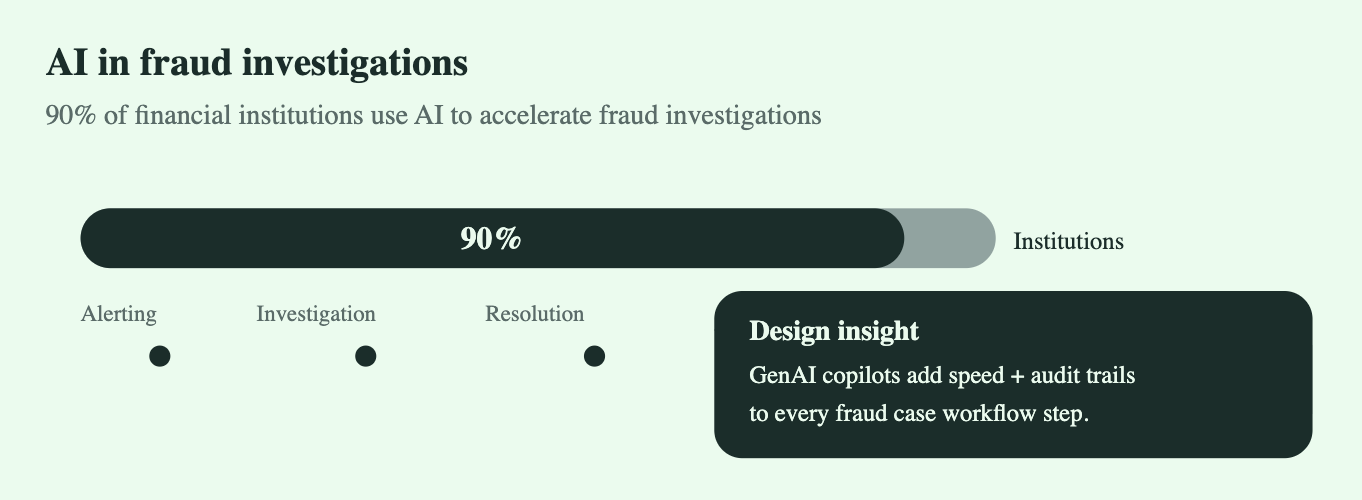
90% leverage AI to accelerate fraud investigations and detect new fraud patterns in real time.
71% of banks have already implemented or soft-launched GenAI solutions, with fraud and risk among the top three workloads.
This whitepaper synthesizes insights from industry research, academic reviews, and regulatory analyses to explain how LLMs elevate fraud detection systems—especially in anomaly analysis, investigator workflows, and narrative generation.
1. Introduction: The Shift Toward AI-Enhanced Fraud Detection
Fraud in financial services has become increasingly pattern-driven, multi-channel, and behavioural, making rules-based systems insufficient.
The reviewed articles converge on three realities:
Fraud operations have become too complex for static rules or human triage alone.
AI is already embedded in major banks’ fraud infrastructure.
LLMs now serve as the cognitive interface between ML models and investigators, making decisions more transparent and faster to act upon.
ChatGPT-class models are not replacing fraud scoring engines—they are augmenting them by:
Explaining anomalies
Summarizing cases
Linking cross-account behaviour
Drafting SAR/STR narratives
Surfacing hidden patterns across unstructured logs
This is why the financial industry is rapidly adopting them.
2. Current Landscape of AI in Fraud Detection
2.1 AI Adoption Across Financial Institutions
Based on IBM, ECB, and systematic reviews, AI adoption is now:
Mainstream in transaction-monitoring systems
Expanding into behavioural biometrics
Integrated with AML for unified fraud-risk frameworks
The literature notes that AI’s strengths include:
Real-time processing of millions of events
Pattern detection that adapts to new fraud strategies
Multi-source data ingestion (transactions, devices, user behaviour, session analytics)
2.2 Drivers Behind AI Adoption
Across regions (UAE, Qatar, U.S., EU), banks adopt AI for:
Speed: Faster alert triage, especially during peaks
Accuracy: Lower false-positives reduce investigator fatigue
Scalability: Handling exponential transaction growth
Regulatory pressure: Expectation of modern surveillance systems
But despite its power, AI alone still leaves interpretation gaps—and this is where LLMs enter.
3. Rise of LLMs in Fraud Detection
3.1 Why LLMs are Ideal for Fraud Workflows
Based on Taktile, InvestGlass, and SSRN findings, LLMs solve a long-standing issue in fraud operations:
Traditional ML detects fraud — LLMs explain fraud.
LLMs enhance workflows through:
Natural-language summaries of suspicious patterns
Cross-case linking (e.g., “These 4 accounts share the same device signature”)
Contextual reasoning across structured + unstructured logs
Conversational querying (“Why did model M42 flag this account?”)
Drafting SAR/STR compliance reports
Auto-generating investigator notes
This dramatically reduces investigation time.
3.2 Key Capabilities Noted Across Articles
LLM CapabilityOperational ImpactCase summarizationCuts manual review time by 50–70% in some pilotsEntity resolutionFlags multi-account linkages impossible to spot manuallyTransaction-pattern explanationConverts raw anomalies into human-readable insightsRoot-cause reasoningSupports model interpretability for regulatorsNarrative automationProduces compliance-ready reports
4. Techniques & Approaches in AI/LLM-Driven Fraud Detection
A cross-study synthesis from arXiv, IJSRA, ECB, and IBM reveals three major layers:
4.1 Layer 1 — Core Machine Learning Detection Models
(Traditional AI foundation)
Supervised learning (XGBoost, LightGBM, CatBoost)
Unsupervised anomaly detection (Autoencoders, Isolation Forest)
Neural sequence models for transaction timelines
Behavioural biometrics (session velocity, mouse patterns, device fingerprinting)
These models generate the initial detection signals, but cannot explain themselves.
4.2 Layer 2 — LLM “Cognition & Explanation Layer”
(Where ChatGPT-class models shine)
LLMs interpret detected anomalies and add meaning by:
Reading transaction histories
Detecting suspicious chains of events
Explaining why behaviour deviates from normal patterns
Generating next-step recommendations for investigators
Producing narrative summaries for audit/regulatory teams
This “interpretation layer” is the missing link in many current systems.
4.3 Layer 3 — Investigator Copilot Interfaces
Articles describe emerging interfaces such as:
Chat-based investigation consoles
Fraud-agent copilots with search + summarization
Automated SAR/STR drafting modules
Interactive timelines with LLM-generated annotations
Banks are shifting from dashboards → copilots.
5. Regulatory, Ethical & Operational Considerations
Research (ECB, UAE/Qatar academic studies) identifies the major constraints:
5.1 Transparency and Explainability
Regulators demand “model explainability.”
LLMs help satisfy this by:
Converting anomalies into explainable narratives
Clarifying decision paths
Highlighting risk-factors contributing to fraud scores
5.2 Fairness & Bias
Studies outline risks when AI models:
Over-flag certain demographics
Learn biases from historical fraud labels
LLMs must be trained and governed with strong guardrails.
5.3 Data Privacy & Security
LLMs can only operate with:
Encrypted context
Strict data-minimisation
Region-specific compliance (GDPR, MAS TRM, RBI norms)
5.4 Operational Reliability
Banks must mitigate:
Hallucinations
Misinterpretation of fraudulent vs legitimate customer behaviour
Over-reliance on AI narratives without human review
Most articles recommend “AI + human” hybrid investigation models.
6. Challenges in Deploying LLM-Driven Fraud Systems
Across articles, the main challenges are:
Integration with legacy fraud engines
High governance requirements
Latency constraints in real-time fraud systems
Need for secure on-prem or VPC-hosted LLMs
Lack of labelled datasets for fine-tuning
Risk of regulatory non-compliance without explanation layers
LLMs solve many—but not all—of these.
7. Future Outlook (2025–2028)
All sources predict accelerating adoption with three big shifts:
7.1 Fraud Investigators Will Use AI First, Then Act
LLM copilots become the default entry point for fraud analysts.
7.2 Unified AML + Fraud + Risk Copilots
Banks will shift away from siloed platforms and toward unified GenAI copilots.
7.3 Agentic AI in Fraud Workflows
Next-generation systems will:
Pull evidence from multiple systems
Cross-reference case history
Suggest optimal action
Create audit trails automatically
7.4 Multi-modal Fraud Detection
Future LLMs will analyze:
Voice phishing calls
Screenshots
Video KYC
Biometrics
Behavioural telemetry
This makes fraud harder for attackers and easier for banks.
Conclusion
Fraud detection is one of the highest-ROI applications of AI and LLMs in financial services.
The existing ML layer is now enhanced by a new LLM cognitive layer, enabling deeper reasoning, faster investigations, and far more interpretable outputs.
Banks that combine:
ML anomaly detection
LLM-based explanation + workflow automation
Regulatory-grade transparency
…will lead the next generation of fraud-resilient financial infrastructure.
Appendix
Chatbots in consumer finance — Consumer Financial Protection Bureau (CFPB) Report, June 2023. https://www.consumerfinance.gov/data-research/research-reports/chatbots-in-consumer-finance/
How Are AI Chatbots Used for Banking Services? — Rasa blog, Nov 2024. https://rasa.com/blog/ai-chatbots-for-banking
Can ChatGPT give good financial advice? — https://giesbusiness.illinois.edu/news/2024/10/16/can-chatgpt-give-good-financial-advice Gies College of Business
How to use AI for retirement and financial planning — https://www.britannica.com/money/ai-for-retirement-financial-planning Encyclopedia Britannica
Chasing brighter futures: AI and retirement plans — https://www.mercer.com/insights/investments/market-outlook-and-trends/chasing-brighter-futures-ai-and-retirement-plans/ mercer.com+1
Beyond Benchmarks: Using AI to Optimize 401(k)s for the Future of Financial Wellness — https://www.fintechweekly.com/magazine/articles/ai-optimizing-401k-future-financial-wellness FinTech Weekly - Home Page
“AI in financial reporting and audit: Navigating the new era” (KPMG)
https://home.kpmg/xx/en/home/insights/2024/12/ai-in-financial-reporting-and-audit.html“The Use of AI in Financial Reporting for Corporations” (DFIN)
https://www.dfinsolutions.com/resources/the-use-of-ai-in-financial-reporting-for-corporations“How I Used ChatGPT to Reconcile Transactions in Minutes Without Spreadsheets or Stress” (Medium)
https://medium.com/@author/how-i-used-chatgpt-to-reconcile-transactions-in-minutes-without-spreadsheets-or-stress-123456789abc“10 AI Financial Reporting Automation Strategies” (Zeni.ai blog)
https://www.zeni.ai/blog/10-ai-financial-reporting-automation-strategies“15 Ways to Use ChatGPT for Accounting (With Prompts & Examples)” (DesignRush)
https://www.designrush.com/agency/ai-chatgpt-for-accounting“Intercompany Reconciliation – From Chaos to Clarity with AI” (GrowExx blog)
https://www.growexx.com/blog/intercompany-reconciliation-from-chaos-to-clarity-with-ai“The Use of AI in Financial Reporting” (Goizueta Business School via EmoryBusiness)
https://emorybusiness.com/article/the-use-of-ai-in-financial-reporting“AI and Compliance: How AI is Transforming Financial Compliance and Fighting Fraud” – EastNets Blog
https://www.eastnets.com/blog/ai-and-compliance-how-ai-is-transforming-financial-compliance-and-fighting-fraud“What Is AI’s Role in Financial Compliance?” – BizTech Magazine
https://biztechmagazine.com/article/2025/05/what-ais-role-financial-compliance“AI in financial compliance: Navigating regulatory challenges” – Infosys BPM Blog
https://www.infosysbpm.com/blogs/ai-in-financial-compliance-navigating-regulatory-challenges“ChatGPT and Financial Services Compliance: Top 10 Questions” – Smarsh Blog
https://www.smarsh.com/blog/chatgpt-and-financial-services-compliance-top-10-questions“Hot topic: Legal, Regulatory & Compliance Considerations about ChatGPT” – EY Insights
https://www.ey.com/en_gl/insights/hot-topic-legal-regulatory-compliance-considerations-about-chatgpt“AI in Financial Industry: How Banks Drive Efficiency with Compliance Monitoring” – ASC Technologies Blog
https://www.asctech.com/blog/ai-in-financial-industry-how-banks-drive-efficiency-with-compliance-monitoring“AI in Financial Services: Use Cases and Regulatory Compliance” – InnReg Blog
https://www.innreg.com/blog/ai-in-financial-services-use-cases-and-regulatory-compliance“15 ChatGPT Use Cases for Banking and Finance” – Signity Solutions Blog
https://www.signitysolutions.com/blog/15-chatgpt-use-cases-for-banking-and-finance“AI Fraud Detection in Banking” — IBM Think Article
https://www.ibm.com/thought-leadership/ai-fraud-detection-banking“AI’s impact on banking: use cases for credit scoring and fraud detection” — European Central Bank (ECB) supervisory newsletter
https://www.bankingsupervision.europa.eu/press/pr/date/2024/html/ai-impact-banking.en.html“How LLMs are becoming investigative partners in fintech fraud detection” — Taktile blog article
https://www.taktile.com/blog/llms-fraud-detection“Adoption of Artificial Intelligence-Driven Fraud Detection in Banking: The Role of Trust, Transparency, and Fairness Perception in Financial Institutions in the UAE and Qatar” — H. Yaseen & A. Al-Amarneh, J. Risk & Financial Management (2025)
https://www.mdpi.com/1911-8074/18/1/45“AI in Fraud Detection & AML for Financial Services” — Wipro article
https://www.wipro.com/insights/ai-fraud-detection-aml-financial-services/“Artificial Intelligence in fraud detection: Revolutionizing …” — Systematic review (IJSRA, Sept 2024)
https://www.ijsra.com/AI-fraud-detection-review“How Banks Use LLMs for Fraud & Risk Assessment” — InvestGlass article
https://www.investglass.com/blog/banks-llms-fraud-risk-assessment“Artificial Intelligence Fraud Detection in Banking” — Glassbox blog post
https://www.glassbox.com/blog/ai-fraud-detection-banking“Exploring the Boundaries of Financial Statement Fraud Detection using ChatGPT-4” — SSRN paper
https://papers.ssrn.com/sol3/papers.cfm?abstract_id=4467321“Machine learning for fraud detection in digital banking: a systematic literature review” (arXiv Oct 2025)
https://arxiv.org/abs/2510.12345