
Multi-Agent Commerce in B2B SaaS Enterprise Sales
Architectures, Complexity Drivers, and Non-Linear Buying Systems
Abstract
Enterprise B2B SaaS purchasing has evolved into a distributed, multi-actor decision system characterized by organizational risk mitigation, formalized procurement structures, and cross-functional economic justification. Traditional CRM-centric or single-threaded sales automation models fail to capture the emergent complexity of modern enterprise buying. This paper proposes Multi-Agent Commerce (MAC) as a new paradigm in which autonomous and semi-autonomous AI agents coordinate across the full enterprise buying lifecycle. We define core complexity drivers, introduce an agent graph reference architecture, describe specialized advanced agents, and analyze non-linear buying paths through a systems theory lens. The work argues that MAC represents the foundational architecture for next-generation enterprise revenue platforms.
1. Introduction: From Funnel Thinking to Distributed Buying Systems
Enterprise SaaS selling has shifted from seller-controlled funnels toward buyer-controlled, consensus-driven decision ecosystems. Research across enterprise sales shows that:
Buying cycles involve 6–15 stakeholders
Decisions require cross-departmental risk validation
Procurement introduces process-driven delays independent of value
Security review often acts as a parallel gatekeeper system
Traditional automation assumes linear progression:
Lead → Opportunity → Proposal → Close → Customer Success
However, real enterprise motion resembles distributed graph traversal with probabilistic state transitions.
Multi-Agent Commerce reframes enterprise selling as:
A coordinated network of specialized AI agents operating across stakeholder domains, decision phases, and organizational risk surfaces.
2. Primary Complexity Drivers in Enterprise B2B SaaS Buying
2.1 Multi-Stakeholder Buying Committees
Enterprise purchases are political + economic + technical consensus exercises.
Typical roles:
RoleOptimization GoalEconomic BuyerCapital efficiency, ROI certaintyTechnical BuyerArchitecture safety, scalabilityChampionInternal narrative + adoption successLegalRisk transfer + liability minimizationProcurementCost compression + process control
Implication:
Sales must optimize for multi-objective decision satisfaction, not single decision maker persuasion.
2.2 Procurement Workflow Formalization
Procurement acts as a process entropy generator:
Introduces vendor comparison frameworks
Forces pricing transparency
Decouples value narrative from cost discussion
Enforces timeline gates unrelated to deal urgency
Agents must operate in asynchronous workflow environments where state progression is externally controlled.
2.3 Security + Compliance as Parallel Decision Tracks
Security review is not a stage — it is a parallel system with veto power.
Key dimensions:
SOC / ISO certification validation
Architecture threat modeling
Data flow and residency constraints
Vendor risk scoring
Failure mode:
Deals often stall not due to product fit but due to risk uncertainty latency.
2.4 Contract Negotiation as Value Re-pricing
Negotiation represents late-stage re-optimization:
Commercial terms
Liability caps
Indemnification
SLA guarantees
Termination clauses
MAC systems must preserve deal integrity while allowing flexible parameter adjustment.
3. Multi-Agent Commerce: The Agent Graph Model
3.1 Core Graph Flow
Demand Discovery
 ↓
Stakeholder Mapping
 ↓
Solution Validation
 ↓
Security / Compliance Review
 ↓
Commercial Negotiation
 ↓
Contract Execution
 ↓
Adoption + Expansion Support
This is not a funnel. It is a directed but cyclic graph with loops and back-edges.
3.2 Graph Properties
3.2.1 State Re-Entry
Deals frequently re-enter earlier states after new stakeholder discovery.
3.2.2 Parallel Sub-Graph Execution
Security review and commercial modeling often run concurrently.
3.2.3 Latent Node Activation
Legal and procurement nodes often activate late but dominate timeline risk.
4. Advanced Specialized Agents
4.1 Buying Committee Agent
Function
Constructs dynamic organizational decision topology.
Capabilities
Maps:
Economic buyer authority graph
Technical influence graph
Informal champion network
Legal escalation pathways
Technical Methods
Org graph inference
Communication signal analysis
Meeting transcript role extraction
Decision probability modeling
Outcome:
Transforms “contact lists” into decision network intelligence.
4.2 ROI Modeling Agent
Function
Creates adaptive financial justification models.
Outputs
Business case simulation
Payback timeline generation
Sensitivity and risk scenarios
CFO-ready narrative packaging
Key Innovation
Moves from static ROI calculators to dynamic scenario negotiation surfaces.
Example:
If procurement demands 15% discount → Agent recalculates payback narrative preserving value perception.
4.3 Security Review Agent
Function
Automates enterprise trust validation.
Handles
SOC documentation orchestration
Architecture diagram generation
Data residency verification
Security questionnaire auto-completion
Strategic Impact
Reduces the largest hidden deal killer: security review uncertainty time.
4.4 Expansion Agent
Function
Maximizes post-sale revenue through usage intelligence.
Runs
Seat expansion detection
Feature adoption timing prediction
Renewal risk modeling
Signal Sources
Product telemetry
Support interaction sentiment
Feature usage breadth vs depth
Org growth signals
5. Non-Linear Enterprise Buying Paths
5.1 Procurement Delay Loop
Negotiation → Compliance → Validation → Negotiation
Characteristics:
Value already proven
Risk re-interrogated
Pricing re-anchored repeatedly
Agent Requirement:
Maintain narrative consistency while updating economic parameters.
5.2 Champion Loss Path
Support → Stakeholder Mapping → Validation → NegotiationTriggered When:
Champion leaves company
Org restructure occurs
Budget ownership shifts
MAC systems must support relationship continuity reconstruction.
6. System Architecture for Multi-Agent Commerce
6.1 Required Platform Layers
1. Interaction Layer
Buyer + seller + system interfaces
2. Agent Coordination Layer
Agent-to-agent communication
State synchronization
Conflict arbitration
3. Memory Layer
Deal memory
Org memory
Historical pattern learning
4. Decision Intelligence Layer
Probabilistic deal progression
Risk prediction
Stakeholder sentiment modeling
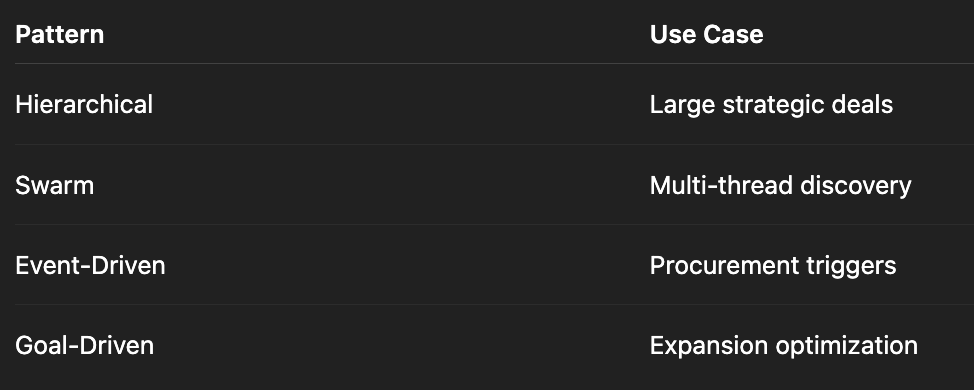
6.2 Agent Orchestration Patterns
7. Economic Impact on Enterprise GTM
7.1 Sales Cost Compression
Automation of non-relationship tasks.
7.2 Cycle Time Reduction
Security + procurement parallelization.
7.3 Higher Win Rates
Stakeholder misalignment detection.
7.4 Expansion Revenue Acceleration
Usage-driven commercial timing.
8. Research Frontiers
8.1 Multi-Agent Negotiation Game Theory
Modeling enterprise negotiation as repeated Bayesian games.
8.2 Organizational Digital Twin Modeling
Simulating buyer org decision behavior pre-engagement.
8.3 Trust-Weighted Autonomous Deal Progression
Agents autonomously advancing deals based on confidence thresholds.
9. Conclusion
Enterprise SaaS buying has irreversibly transitioned from linear human-driven processes to distributed, consensus-driven decision ecosystems. Multi-Agent Commerce represents the natural architectural evolution: a coordinated intelligence layer spanning demand generation through renewal and expansion.
Organizations that adopt MAC will not simply automate sales — they will build adaptive revenue intelligence systems capable of navigating the true topology of enterprise decision making.
The future of enterprise revenue is not CRM-centric.
It is agent-orchestrated, graph-native, and multi-stakeholder optimized.