
The Routing Layer in Multi-Agent Commerce: Contextual Decision Execution as the Core Economic Control Plane
Abstract
As commerce systems evolve from linear workflow automation into adaptive, multi-agent ecosystems, a new architectural primitive emerges as the central locus of system intelligence: the Routing Layer. This essay formalizes the Routing Layer as a real-time decision execution system that operationalizes context, policy, and optimization objectives into executable behavioral paths. We argue that routing is not merely a technical switching mechanism but an economic arbitration engine, reconciling competing objectives — revenue, risk, trust, experience, and long-term customer value — under uncertainty and dynamic environmental signals. We situate routing within multi-agent system theory, decision theory, cybernetics, and computational economics, and propose a formal framework for understanding routing across time horizons, organizational boundaries, and autonomy gradients.
1. Introduction: From Workflow Automation to Adaptive Economic Systems
Traditional commerce systems were designed around deterministic flows:
If Condition → Execute StepThis paradigm presumes:
Stable context
Static policies
Single-objective optimization
Low autonomy variation
Multi-agent commerce violates all four assumptions.
Modern commerce environments include:
Multiple cooperating and competing agents (AI, humans, tools, services)
Probabilistic and incomplete context
Dynamically changing regulatory and policy constraints
Multi-objective optimization across conflicting value functions
Within this environment, the core system challenge is not execution — it is decision arbitration under uncertainty.
The Routing Layer emerges as the system component responsible for answering a single question:
Given everything we know and everything we are allowed to do, what should happen next?
2. The Triadic Foundation: Context, Policy, and Routing
We define the core triad:
Routing is therefore the behavioral realization layer.
It converts knowledge and rules into action.
Critically:
Context without routing is observation.
Policy without routing is compliance theory.
Routing without context or policy is chaos.
3. Formalizing Routing as a Decision Function
We define routing as a constrained optimization function:
Next_Action=argmax(EV−RC−PV+CX+LTV)Next\_Action = \arg\max \Big( EV - RC - PV + CX + LTV \Big)Next_Action=argmax(EV−RC−PV+CX+LTV)
Where:
EV (Expected Value) — Immediate economic gain
RC (Risk Cost) — Expected loss from uncertainty or failure
PV (Policy Violation Penalty) — Compliance and regulatory risk
CX (Customer Experience Score) — Trust and satisfaction metrics
LTV (Long-Term Value) — Future economic potential
This formalization reframes routing as continuous economic arbitration rather than discrete logic selection.
4. Why the Routing Layer Exists
4.1 Complexity Explosion
Multi-agent systems introduce combinatorial path growth:
Agents × Tools × Channels × Customer States × Regulatory Conditions
Static orchestration becomes computationally and operationally infeasible.
4.2 Real-Time Context Volatility
Commerce context mutates continuously:
Risk scores update
Customer sentiment shifts
Inventory changes
Fraud signals emerge
Regulatory triggers activate
Routing provides real-time adaptation.
4.3 Strategy-to-Behavior Translation
Routing is where:
Board-level strategy
Risk tolerance
Customer experience philosophy
Economic models
…become executable behavior.
5. The Control Surface of Routing
Routing controls four fundamental axes.
5.1 Agent Selection
Determines who reasons next.
Examples:
Discovery → Validation
Validation → Support
Support → Human Specialist
This is essentially cognitive delegation management.
5.2 Path Selection
Determines which journey topology to follow.
Examples:
Fast checkout
Guided advisory journey
Risk review loop
Recovery / retention flow
This is experience topology selection.
5.3 Autonomy Level Selection
Determines who has execution authority.
Continuum:
Fully autonomous AI
AI + human confirmation
Human approval gate
Human-led execution
This is autonomy risk management.
5.4 Tool Invocation
Determines which system performs work.
Examples:
Payment gateway
Inventory reservation system
Dynamic pricing engine
Fraud detection API
This is infrastructure execution selection.
6. Routing Inputs: The Decision Information Substrate
6.1 Context Signals
These represent probabilistic world state estimates:
Intent strength
Identity trust score
Sentiment trajectory
Model confidence
Data completeness
Behavioral anomaly detection
Journey memory
6.2 Policy Constraints
Hard or soft boundaries:
Must escalate
Must verify identity
Cannot transact
Must disclose information
Must obtain consent
Policy often overrides optimization.
6.3 Optimization Objectives
Multi-objective vector:
Revenue maximization
Conversion probability
Operational cost minimization
Risk minimization
Trust preservation
Long-term customer value
Routing is fundamentally Pareto optimization in real time.
7. Types of Routing Decisions
Deterministic Routing
Hard constraint logic.
Example:
IF compliance_failed → Validation Agent
Used when:
Legal certainty required
Risk unacceptable
Policy mandates deterministic behavior
Probabilistic Routing
Weighted decision scoring across candidate paths.
Example:
Transaction Path Score = 0.72
Support Path Score = 0.68
Choose highest expected utility.
Policy-Forced Routing
Policy overrides economic logic.
Example:
Regulatory rule → Mandatory human review.
Exploration Routing
Used in learning systems:
Multi-armed bandits
Reinforcement learning
Counterfactual experimentation
Purpose:
Improve long-term system performance.
8. Temporal Dimensions of Routing
Immediate Routing
Next atomic action.
Timescale: milliseconds → seconds.
Near-Term Routing
Next 2–5 actions.
Timescale: session-level optimization.
Lifecycle Routing
Cross-journey strategy selection.
Timescale: months → years.
Example:
When to shift customer from self-serve → advisory relationship.
9. Multi-Level Routing in Multi-Agent Architectures
Micro Routing
Within-agent decision selection.
Example:
Which reasoning chain or tool call.
Agent Routing
Between agents.
Example:
Sales agent → Risk agent → Payment agent.
Journey Routing
Across customer lifecycle states.
Example:
Acquisition → Conversion → Retention → Expansion.
Ecosystem Routing
Across organizations and platforms.
Example:
Marketplace → Financing partner → Insurance partner → Logistics provider.
10. Routing vs Orchestration
DimensionOrchestrationRoutingNatureStructural coordinationReal-time decision selectionTimescalePredefined sequenceDynamic selectionLogic TypeWorkflow logicEconomic + probabilistic decision logicRoleEnables executionDetermines behavior
Routing is decision intelligence inside orchestration skeletons.
11. Routing Failure Modes
Over-Optimization
Maximizes short-term revenue at cost of trust or regulatory exposure.
Policy Blind Spots
Unmodeled regulatory edge cases.
Context Misinterpretation
Garbage-in → optimal wrong decision.
Oscillation
System loops between states due to unstable scoring gradients.
12. Advanced Routing Paradigms
Confidence-Aware Routing
Lower confidence → safer or human-involved path.
Risk Budget Routing
Allows higher risk tolerance for low-value transactions.
Opportunity Routing
Optimizes for long-term customer value over immediate transaction value.
Multi-Agent Voting Routing
Agents propose candidate actions → routing arbitrates.
13. Reference Routing Architecture
Production-grade systems typically include:
Context Aggregation Layer
Decision Engine
Scoring Engine
Policy Enforcement Filter
Path Graph Manager
Experimentation Layer
Simulation / Digital Twin Layer
This architecture mirrors financial trading systems more than traditional workflow engines.
14. The Deeper Theoretical Insight
The Routing Layer is the cybernetic control loop of digital commerce.
It is where:
Strategy becomes action
Risk becomes constraint
Context becomes probability
Policy becomes boundary
Economics becomes behavior
Trust becomes system stability
In sufficiently advanced systems, routing becomes the de facto operating system of economic interaction.
15. Conclusion
The Routing Layer represents a fundamental shift from software as process executor to software as real-time economic decision-maker. As multi-agent systems proliferate, routing will evolve from an implementation detail into a primary design surface — one that encodes organizational values, regulatory posture, economic strategy, and customer philosophy.
Future commerce architectures will not be defined primarily by models, agents, or channels.
They will be defined by how they decide what happens next.
And that is the domain of routing.
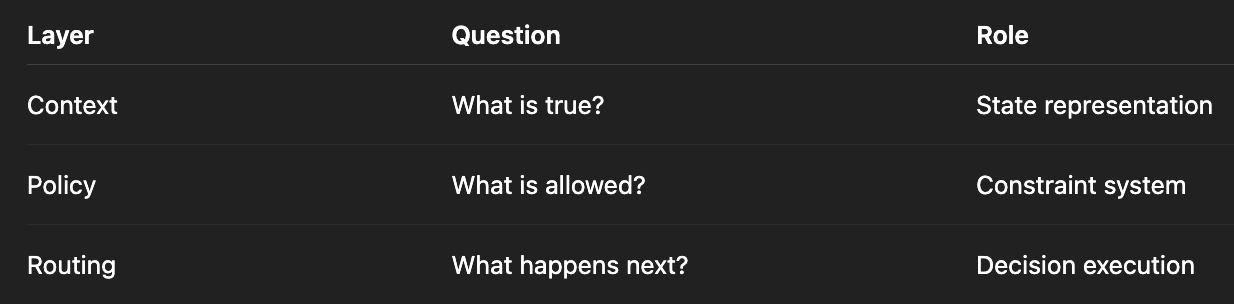
Routing is therefore the behavioral realization layer.
It converts knowledge and rules into action.
Critically:
Context without routing is observation.
Policy without routing is compliance theory.
Routing without context or policy is chaos.
3. Formalizing Routing as a Decision Function
We define routing as a constrained optimization function:

Where:
EV (Expected Value) — Immediate economic gain
RC (Risk Cost) — Expected loss from uncertainty or failure
PV (Policy Violation Penalty) — Compliance and regulatory risk
CX (Customer Experience Score) — Trust and satisfaction metrics
LTV (Long-Term Value) — Future economic potential
This formalization reframes routing as continuous economic arbitration rather than discrete logic selection.
4. Why the Routing Layer Exists
4.1 Complexity Explosion
Multi-agent systems introduce combinatorial path growth:
Agents × Tools × Channels × Customer States × Regulatory Conditions
Static orchestration becomes computationally and operationally infeasible.
4.2 Real-Time Context Volatility
Commerce context mutates continuously:
Risk scores update
Customer sentiment shifts
Inventory changes
Fraud signals emerge
Regulatory triggers activate
Routing provides real-time adaptation.
4.3 Strategy-to-Behavior Translation
Routing is where:
Board-level strategy
Risk tolerance
Customer experience philosophy
Economic models
…become executable behavior.
5. The Control Surface of Routing
Routing controls four fundamental axes.
5.1 Agent Selection
Determines who reasons next.
Examples:
Discovery → Validation
Validation → Support
Support → Human Specialist
This is essentially cognitive delegation management.
5.2 Path Selection
Determines which journey topology to follow.
Examples:
Fast checkout
Guided advisory journey
Risk review loop
Recovery / retention flow
This is experience topology selection.
5.3 Autonomy Level Selection
Determines who has execution authority.
Continuum:
Fully autonomous AI
AI + human confirmation
Human approval gate
Human-led execution
This is autonomy risk management.
5.4 Tool Invocation
Determines which system performs work.
Examples:
Payment gateway
Inventory reservation system
Dynamic pricing engine
Fraud detection API
This is infrastructure execution selection.
6. Routing Inputs: The Decision Information Substrate
6.1 Context Signals
These represent probabilistic world state estimates:
Intent strength
Identity trust score
Sentiment trajectory
Model confidence
Data completeness
Behavioral anomaly detection
Journey memory
6.2 Policy Constraints
Hard or soft boundaries:
Must escalate
Must verify identity
Cannot transact
Must disclose information
Must obtain consent
Policy often overrides optimization.
6.3 Optimization Objectives
Multi-objective vector:
Revenue maximization
Conversion probability
Operational cost minimization
Risk minimization
Trust preservation
Long-term customer value
Routing is fundamentally Pareto optimization in real time.
7. Types of Routing Decisions
Deterministic Routing
Hard constraint logic.
Example:
IF compliance_failed → Validation AgentUsed when:
Legal certainty required
Risk unacceptable
Policy mandates deterministic behavior
Probabilistic Routing
Weighted decision scoring across candidate paths.
Example:
Transaction Path Score = 0.72
Support Path Score = 0.68
Choose highest expected utility.
Policy-Forced Routing
Policy overrides economic logic.
Example:
Regulatory rule → Mandatory human review.
Exploration Routing
Used in learning systems:
Multi-armed bandits
Reinforcement learning
Counterfactual experimentation
Purpose:
Improve long-term system performance.
8. Temporal Dimensions of Routing
Immediate Routing
Next atomic action.
Timescale: milliseconds → seconds.
Near-Term Routing
Next 2–5 actions.
Timescale: session-level optimization.
Lifecycle Routing
Cross-journey strategy selection.
Timescale: months → years.
Example:
When to shift customer from self-serve → advisory relationship.
9. Multi-Level Routing in Multi-Agent Architectures
Micro Routing
Within-agent decision selection.
Example:
Which reasoning chain or tool call.
Agent Routing
Between agents.
Example:
Sales agent → Risk agent → Payment agent.
Journey Routing
Across customer lifecycle states.
Example:
Acquisition → Conversion → Retention → Expansion.
Ecosystem Routing
Across organizations and platforms.
Example:
Marketplace → Financing partner → Insurance partner → Logistics provider.
10. Routing vs Orchestration
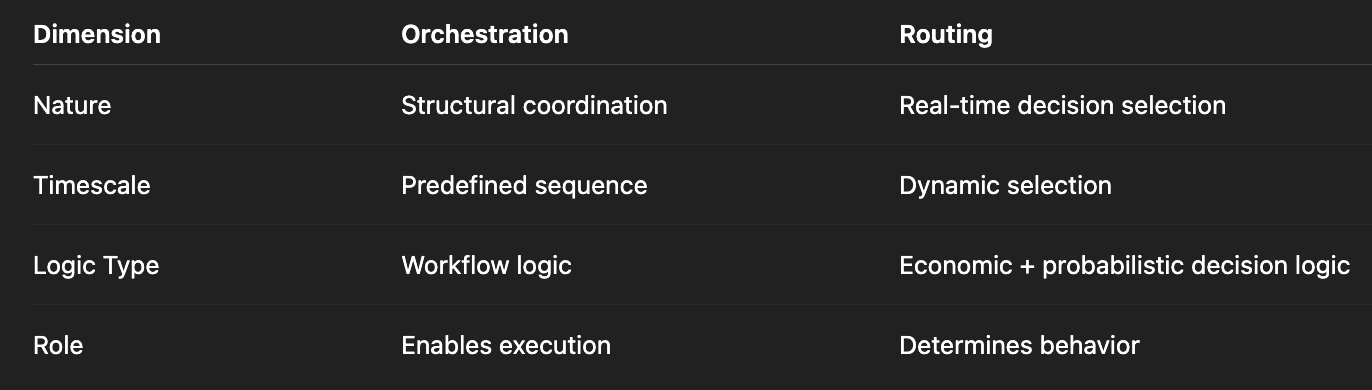
Routing is decision intelligence inside orchestration skeletons.
11. Routing Failure Modes
Over-Optimization
Maximizes short-term revenue at cost of trust or regulatory exposure.
Policy Blind Spots
Unmodeled regulatory edge cases.
Context Misinterpretation
Garbage-in → optimal wrong decision.
Oscillation
System loops between states due to unstable scoring gradients.
12. Advanced Routing Paradigms
Confidence-Aware Routing
Lower confidence → safer or human-involved path.
Risk Budget Routing
Allows higher risk tolerance for low-value transactions.
Opportunity Routing
Optimizes for long-term customer value over immediate transaction value.
Multi-Agent Voting Routing
Agents propose candidate actions → routing arbitrates.
13. Reference Routing Architecture
Production-grade systems typically include:
Context Aggregation Layer
Decision Engine
Scoring Engine
Policy Enforcement Filter
Path Graph Manager
Experimentation Layer
Simulation / Digital Twin Layer
This architecture mirrors financial trading systems more than traditional workflow engines.
14. The Deeper Theoretical Insight
The Routing Layer is the cybernetic control loop of digital commerce.
It is where:
Strategy becomes action
Risk becomes constraint
Context becomes probability
Policy becomes boundary
Economics becomes behavior
Trust becomes system stability
In sufficiently advanced systems, routing becomes the de facto operating system of economic interaction.
15. Conclusion
The Routing Layer represents a fundamental shift from software as process executor to software as real-time economic decision-maker. As multi-agent systems proliferate, routing will evolve from an implementation detail into a primary design surface — one that encodes organizational values, regulatory posture, economic strategy, and customer philosophy.
Future commerce architectures will not be defined primarily by models, agents, or channels.
They will be defined by how they decide what happens next.
And that is the domain of routing.