
Content Supply Chain Dashboard
Global marketing organisations increasingly operate within complex content supply chains where creative assets flow through multiple organisational roles, systems, and approval stages before reaching markets. Despite the strategic importance of this pipeline, the operational infrastructure supporting it often remains fragmented across tools such as Adobe Workfront, Adobe Experience Manager, and internal brand portals.
The result is a workflow environment characterised by manual handoffs, limited visibility, asset duplication, and delayed market activation.
This article introduces the Content Supply Chain Dashboard (CSC Dashboard) — a unified operational layer that connects existing enterprise systems into a single operational command centre for content programmes. The platform provides real-time pipeline visibility, in-platform workflows, and automated asset logistics, enabling stakeholders across the supply chain to coordinate from global toolbox planning through to local market activation.
1. The Modern Content Supply Chain
Marketing organisations increasingly function like distributed production networks.
A single campaign may involve:
global programme owners
creative agencies
production teams
localisation specialists
channel agencies
local market teams
Each stage transforms creative assets into new deliverables.
Programme Brief
      │
      ▼
Creative Concept
      │
      ▼
Master Assets
      │
      ▼
Production Adaptations
      │
      ▼
Transcreation
      │
      ▼
Market Activation
This pipeline is what we call the Content Supply Chain.
However, in many enterprises, each step is handled in separate platforms:
planning in Adobe Workfront
asset storage in Adobe Experience Manager
brand distribution through portals such as Brandfolder
creative production in tools like Adobe Photoshop
The lack of integration across these environments results in operational fragmentation.
2. Structural Problems in Current Content Operations
Across large global organisations, the content supply chain typically suffers from five structural inefficiencies.
2.1 Invisible Pipeline
Programme owners often cannot see the real status of a toolbox campaign.
Key questions remain unanswered:
Which assets are approved?
What is currently in transcreation?
Which markets are waiting?
Which milestones are at risk?
Without a central pipeline view, programme governance becomes reactive rather than proactive.
2.2 Manual Asset Logistics
Localisation teams frequently perform repetitive tasks:
Download asset packages
Rename files
Transfer assets between tools
Upload completed versions
This manual process leads to:
version drift
duplicated assets
incorrect naming conventions
delays in delivery
2.3 Siloed Tooling
Even within a single organisation, core platforms rarely communicate effectively.
Typical stack fragmentation includes:
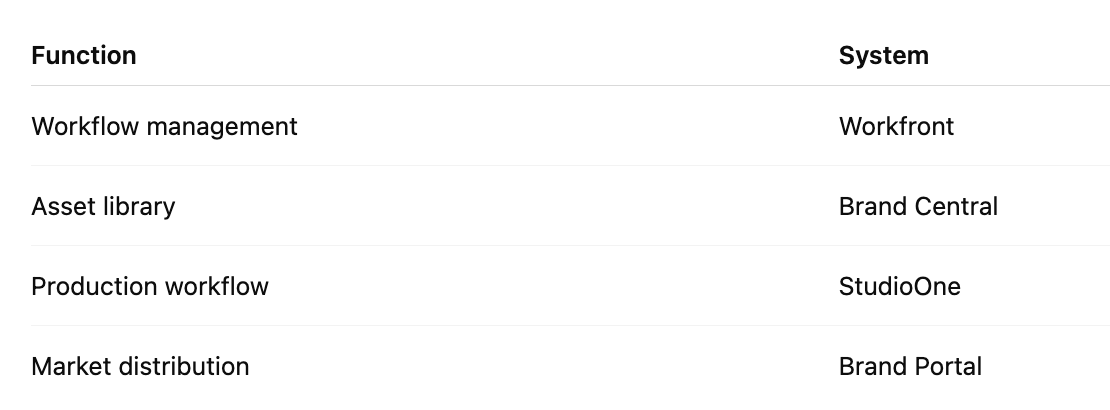
Users must continuously switch between systems, losing context and traceability.
2.4 Market Exclusion
Local market teams frequently operate outside the primary production environment.
Their typical workflow:
Request assets via email
Submit briefs through PowerPoint
Wait for updates from central teams
This creates unnecessary friction and delays.
2.5 Risk Blindness
Programme managers overseeing multiple campaigns struggle to detect schedule risk early enough.
Without milestone visibility, delays are often discovered only after deadlines have passed.
3. The Content Supply Chain Dashboard
The CSC Dashboard introduces a single operational interface that unifies visibility and workflows across the entire content pipeline.
Rather than replacing existing enterprise systems, it connects them.
Core Platforms Integrated
Adobe Workfront
Brand Central
StudioOne
The dashboard acts as a coordination layer above these systems.
4. Platform Architecture
The system operates as an integration-driven architecture.
Creative Systems
(Photoshop / Agencies)
        │
        ▼
StudioOne (Production)
        │
        ▼
Workfront (Workflow)
        │
        ▼
CSC Integration Layer
        │
        ▼
Content Supply Chain Dashboard
        │
        ▼
Brand Central (Distribution)
The dashboard becomes the operational interface for the entire pipeline.
5. Programme Command Centre
At the heart of the platform is the Programme Command Centre.
This module provides a real-time operational overview of all toolbox programmes.
Key features
Gantt timeline view
milestone tracking
RAG (Red / Amber / Green) status
owner assignments
risk indicators
Programme managers can immediately see:
which toolboxes are progressing normally
which tasks are approaching deadlines
where escalation is required
This transforms programme management from status chasing to active orchestration.
6. Digitised Playbook Builder
Traditional toolbox playbooks are often distributed as PowerPoint documents that require manual updates.
The CSC Dashboard replaces these with a digital playbook system.
Capabilities
Generate playbooks from global templates
Auto-populate approved assets
Version-controlled updates
One-click publishing to Brand Central
This eliminates the need for manually maintained presentation files.
7. Asset Hub and Basket
A central Asset Hub enables stakeholders to browse available masters and assets.
Users can:
filter by campaign
search by channel
preview creative assets
add assets to a shopping basket
The basket mechanism allows market teams to submit structured requests directly through the platform.
This replaces:
email requests
PowerPoint briefs
manual file transfers
8. Transcreation Workflow
Localisation — often referred to as transcreation — is one of the most complex steps in the supply chain.
The CSC Dashboard enables the entire process to occur inside the platform.
Workflow
Market user submits request with selected assets
CDT team receives structured brief
Assets remain attached to the request
Adaptations occur within the shared environment
Completion triggers market review
Approved assets are automatically published to Brand Central
This eliminates repeated download/upload cycles.
9. Real-Time Risk Visibility
The platform introduces early risk detection through automated milestone monitoring.
Indicators include:
delayed approvals
overdue tasks
missing assets
dependency bottlenecks
Programme owners receive alerts when milestones enter Amber or Red status, allowing intervention before schedules slip.
10. Target Outcomes
The CSC Dashboard is designed to deliver measurable operational improvements.
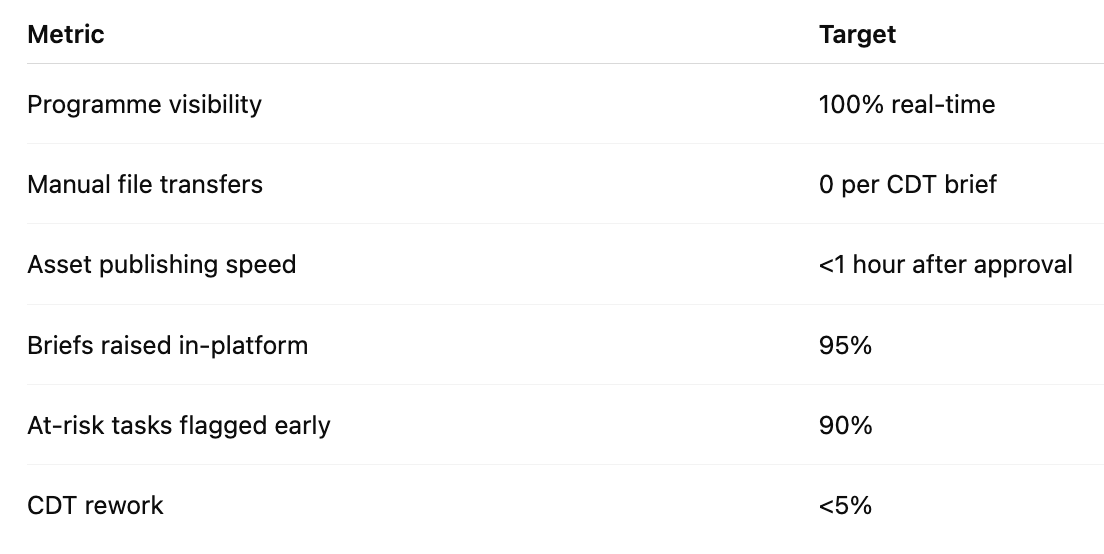
These metrics directly address the inefficiencies of traditional workflows.
11. Developer Platform
The dashboard is implemented as a web-based application integrated with enterprise systems.
Platform
Web application hosted within Brand Central.
Core stack
Node.js
PostgreSQL
Workfront APIs
Brand Central APIs
StudioOne integrations
12. Repository Structure
The system is structured as a monorepo architecture.
docs/
   architecture
   ADRs
   API contracts

services/api/
   integrations
   REST API
   sync services

apps/dashboard/
   frontend
   command centre
   asset hub
   briefs
   playbook builder
This architecture separates the integration layer from the user interface.
13. Local Development
Developers can run the platform locally using either Docker or a manual setup.
Docker
docker-compose up -dServices available:
API        http://localhost:3001
Dashboard  http://localhost:5173
Manual setup
pnpm install

cd services/api
pnpm run dev

cd apps/dashboard
pnpm run dev
Health endpoint:
http://localhost:3001/health14. Integration Strategy
The dashboard follows a non-disruptive integration philosophy.
It does not replace enterprise systems but synchronises them.
Integration patterns include:
event-driven asset updates
API orchestration
metadata synchronisation
workflow state propagation
This allows organisations to retain existing infrastructure while improving coordination.
15. Strategic Implications
The CSC Dashboard reflects a broader shift in marketing technology toward supply-chain thinking.
Just as manufacturing optimised production through supply chain management, modern marketing requires structured orchestration of creative assets.
Key advantages include:
operational transparency
faster global deployment
reduced operational overhead
improved compliance
greater scalability
16. Conclusion
The Content Supply Chain Dashboard transforms fragmented creative operations into a coordinated, transparent, and automated pipeline.
By connecting planning, production, localisation, and distribution systems into a unified interface, the platform enables organisations to move from manual coordination to programmatic orchestration.
The result is a marketing infrastructure capable of delivering assets to global markets faster, with fewer errors, and with full operational visibility.