Building an Enterprise Prompt Library: Processes, Options, and Strategic Considerations
The rise of AI across enterprise operations has made prompt engineering a critical skill and capability. Enterprises increasingly recognize that high-quality prompts—carefully crafted instructions that guide AI models—can dramatically influence output accuracy, efficiency, and compliance. To scale this capability, organizations need a structured prompt library: a curated repository of tested and approved prompts for different workflows, teams, and business objectives.
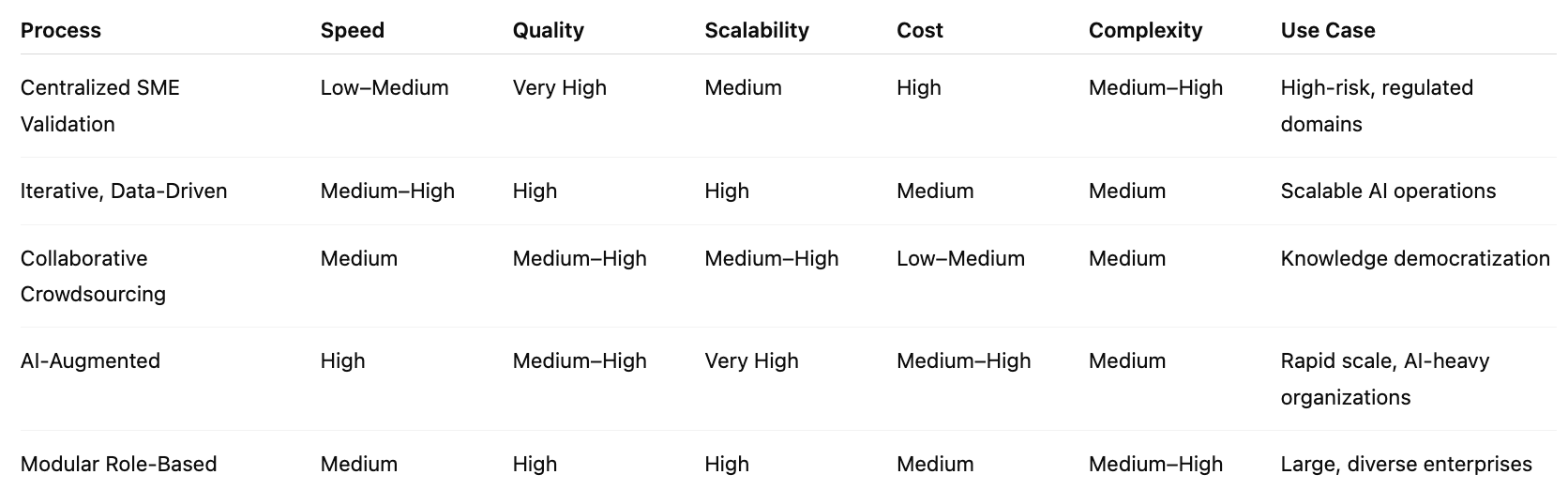
However, designing such a library is not a trivial exercise. It requires balancing speed, quality, cost, scalability, and governance. This article explores five alternative processes for building a prompt library, evaluates them against key operational metrics, and provides guidance for enterprises looking to implement this capability.
Why a Prompt Library Matters
Before diving into the processes, it’s worth clarifying why a prompt library is valuable:
Consistency: Ensures outputs across teams follow the same standards for tone, format, and accuracy.
Efficiency: Reduces repetitive work in prompt creation, allowing teams to leverage tested prompts.
Governance & Compliance: Helps enterprises maintain legal, regulatory, and internal compliance.
Knowledge Capture: Preserves best practices in AI prompt design across the organization.
Continuous Improvement: Provides a platform to iterate, optimize, and scale prompts for evolving business needs.
With these benefits in mind, let’s explore the key processes enterprises can adopt.
Process 1: Centralized SME Validation
Overview:
This approach relies on subject matter experts (SMEs) to draft, review, and approve prompts before they are published in the library.
Steps:
Gather requirements from business units and workflows.
SMEs draft domain-specific prompts.
Conduct initial AI testing in a sandbox environment.
Evaluate using metrics such as accuracy, relevance, and compliance.
SMEs validate prompts.
Publish prompts in a centralized repository with metadata.
Periodically review and update prompts.
Evaluation:
Speed: Low–Medium
Feasibility: High (requires SMEs)
Complexity: Medium–High
Cost: High (labor-intensive)
Scalability: Medium
Quality Control: Very High
Best Use Case: Regulated industries (finance, healthcare) or high-risk workflows requiring strict compliance.
Process 2: Iterative, Data-Driven Prompt Engineering
Overview:
This process emphasizes rapid, iterative improvement of prompts using AI feedback loops and performance metrics.
Steps:
Identify workflows and use cases.
Draft multiple candidate prompts.
Test prompts in an AI sandbox and collect output data.
Evaluate using metrics such as relevance, accuracy, and tone.
Refine prompts based on performance.
Publish top-performing prompts in the library.
Monitor outputs and iterate continuously.
Evaluation:
Speed: Medium–High
Feasibility: Medium–High
Complexity: Medium
Cost: Medium
Scalability: High
Quality Control: High
Best Use Case: Enterprises that need scalable, high-volume AI prompt generation, and can tolerate minor human oversight initially.
Process 3: Collaborative Crowdsourcing
Overview:
This approach engages employees across the organization to submit, review, and refine prompts.
Steps:
Launch a portal for prompt submissions.
Conduct peer review and ratings of submitted prompts.
Test high-rated prompts against AI outputs.
Refine and approve prompts iteratively.
Publish the library and encourage ongoing contributions.
Evaluation:
Speed: Medium
Feasibility: Medium (requires cultural buy-in)
Complexity: Medium
Cost: Low–Medium
Scalability: Medium–High
Quality Control: Medium–High
Best Use Case: Large organizations looking to democratize AI usage and capture domain knowledge from diverse teams.
Process 4: AI-Augmented Prompt Generation
Overview:
AI itself helps generate candidate prompts, which are then validated and refined by humans.
Steps:
Define goals and constraints for outputs.
Use AI to generate multiple prompt candidates.
Conduct SME validation for accuracy and relevance.
Test prompts in production-like scenarios.
Publish validated prompts with metadata.
Implement automated monitoring for underperforming prompts.
Evaluation:
Speed: High
Feasibility: Medium–High (trust in AI required)
Complexity: Medium
Cost: Medium–High (AI platform licensing + SME oversight)
Scalability: Very High
Quality Control: Medium–High
Best Use Case: Enterprises seeking to rapidly scale prompt libraries while reducing human workload.
Process 5: Modular Role-Based Library
Overview:
Prompts are organized by enterprise role, department, or workflow rather than topic.
Steps:
Map enterprise roles and workflows.
Draft prompts for each role and task.
Conduct role-specific testing in real scenarios.
Review cross-functional conflicts.
Publish the library with role-based access.
Update prompts periodically based on feedback.
Evaluation:
Speed: Medium
Feasibility: High
Complexity: Medium–High
Cost: Medium
Scalability: High
Quality Control: High
Best Use Case: Large enterprises with diverse workflows seeking high adoption and relevance across teams.