
Prompt Studio - the Enterprise Prompt Library Generator
Executive Summary: Prompt Studio
Prompt Studio is a next-generation enterprise platform designed to help organizations systematically manage, optimize, and scale AI prompt engineering across departments, teams, and workflows. With the rapid adoption of AI in business operations, enterprises face a growing need for high-quality, standardized prompts that ensure consistent, accurate, and compliant AI outputs. Prompt Studio addresses this need by combining role-based organization, AI-assisted generation, sandbox testing, and collaborative workflows into a unified platform.
Key Objectives
Standardize AI Outputs: Align AI-generated content with enterprise workflows, tone, and compliance requirements.
Enhance Productivity: Reduce repetitive prompt creation and provide employees with ready-to-use, high-quality prompts.
Capture Organizational Knowledge: Enable cross-functional contribution and peer-reviewed improvements.
Continuous Optimization: Leverage AI testing and performance metrics to iteratively refine prompts for accuracy, relevance, and effectiveness.
Core Features
Role-Based Organization: Prompts categorized by department, team, and role for easy access.
AI-Augmented Prompt Generation: Automated generation of multiple candidate prompts, adjustable for tone, style, and output requirements.
Sandbox & Testing Environment: Safe testing space to evaluate prompts with metrics such as accuracy, relevance, and tone.
Collaborative Submission & Peer Review: Employees can submit, review, and rate prompts to ensure high quality and continuous improvement.
Central Library & Governance: Secure repository with version control, access management, and compliance oversight.
Analytics & Reporting: Dashboards provide actionable insights on prompt performance, usage, and gaps.
Strategic Benefits
Efficiency: Reduces manual prompt creation while ensuring quality outputs.
Scalability: Supports enterprise-wide deployment across multiple roles and departments.
Governance & Compliance: Maintains enterprise standards and regulatory adherence.
Innovation & Knowledge Sharing: Encourages cross-functional collaboration and captures institutional expertise.
Data-Driven Optimization: Continuous monitoring allows prompt refinement based on real usage and performance.
Branding
Typography
Primary Fonts
Bebas Neue: Bold, condensed sans-serif for headings and brand elements; conveys authority and strong hierarchy
Rubik: Modern, readable sans-serif for body text and UI components; balances professionalism with approachability
Hierarchy
H1 to H3: Bebas Neue, sized from 2xl to 4xl
Body: Rubik in weights from 300 to 900
Monospace: Used for technical and code content
Layout and Spacing
Component Structure
Cards: Rounded corners (8-12px), soft shadows
Buttons: Consistent sizing, accessible focus and hover states
Visual Design Principles
Minimalism and Clarity
Clean interfaces with generous white space
Emphasis on essential content and actions
Interactive Elements
Subtle hover and shadow transitions
Unique Brand Elements
Accent System: Used for CTAs, progress bars, active navigation, and focus indicators
Micro-Interactions: Smooth transitions, hover effects, loading indicators, and subtle animations for engagement
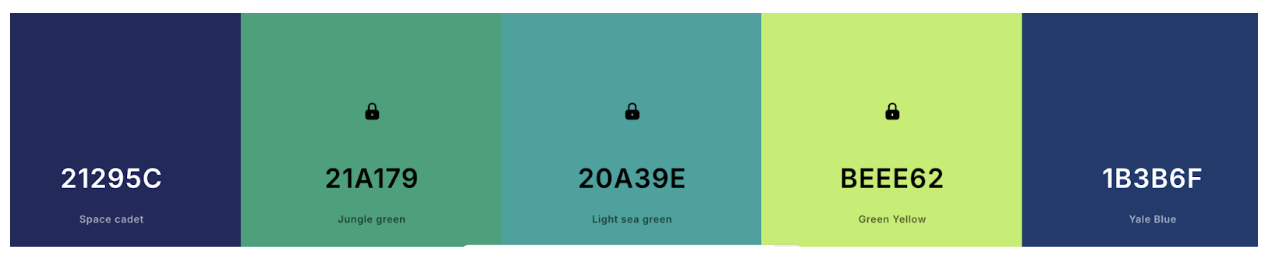
Colours
#21295C - Space Cadet
#21A179 - Jungle Green
#20A39E - Light Sea Green
#BEEE62 - Green Yellow
#1B3B6F - Yale Blue
UX / UI DESIGN PROMPTS
1. Dashboard / Landing Page Prompt
Design a clean, modern enterprise dashboard for a Prompt Management Platform. Include:
- Sidebar with department, team, and role filters
- Main panel showing recent prompts, top-performing prompts, and metrics (accuracy, relevance, usage)
- Quick action buttons: "Create Prompt", "Test Prompt", "Submit New Prompt"
- Notifications panel for updates and feedback
- Color-coded performance indicators (green, yellow, red)
Style: minimalist, professional, enterprise SaaS, intuitive UX, easy-to-read typography
2. Role-Based Prompt Library Prompt
Design a role-based prompt library interface for enterprise users. Include:
- Sidebar filters: Role, Department, Workflow, Prompt Type, Status
- List or card view for prompts with title, role, performance metrics, last updated
- Search bar with AI-powered suggestions
- Action buttons on each prompt: "View/Edit", "Test in Sandbox", "Submit Feedback"
Style: modern, clean, easy to navigate, enterprise SaaS
3. AI Prompt Generator Prompt
Design an AI Prompt Generator interface. Include:
- Input panel: workflow description, tone, style, length, constraints
- AI-generated candidate prompts displayed with selection and refinement options
- Refinement tools: tone slider (formal–casual), complexity toggle (basic–advanced), keyword include/exclude
- Action buttons: "Save to Sandbox", "Add to Library Draft", "Submit for Peer Review"
Style: professional, intuitive, visually clean with clear sections
4. Sandbox / Testing Environment Prompt
Design a prompt testing sandbox interface. Include:
- Scenario selector dropdown for workflow simulations
- Test panel for AI-generated outputs
- Metrics dashboard: accuracy, relevance, tone, consistency
- Iteration tools: tweak prompts, rerun tests, submit refined prompt
- Clear visual indicators for task performance
Style: clean, professional, focused on data visualization and usability
5. Employee Mapping & Prompt Generator Tab Prompt
Design a single enterprise tab for mapping employees and generating prompts. Include:
- Multi-line input box for copy/paste of LinkedIn-style employee data or CSV upload
- AI parsing preview showing Name, Role, Team, Department
- Auto-generated organizational table: Department, Team, Role, Employee Count, Key Tasks
- Editable AI-suggested task list with priority tags
- Preview panel for AI-generated system prompts per role/task
- Bulk add prompts button to central library
- Optional visualization: collapsible org chart from Department → Team → Role → Task
Style: professional, clear layout, drag-and-drop or collapsible sections, intuitive for enterprise users
6. Peer Review Portal Prompt
Design a collaborative prompt submission and peer review interface. Include:
- Submission form: Title, Workflow, Role, Sample Output
- Peer review panel: Ratings (accuracy, clarity, usefulness), comment section
- AI suggestion panel for refining prompts
- Leaderboard or recognition section for top contributors
- Action buttons: approve, request changes, send to sandbox
Style: clean, interactive, encourages collaboration, professional enterprise UI
7. Analytics & Reporting Prompt
Design an analytics dashboard for enterprise prompt performance. Include:
- Usage metrics by department and role
- Performance metrics: AI accuracy, relevance, user ratings, sandbox test success rate
- Highlight prompts needing improvement
- Export options: PDF, CSV
- Graphs and charts for trends over time
Style: modern, data-centric, professional, easy-to-read visualizations
Backend and AI Development Prompts
Enterprise Prompt Management Platform
This comprehensive guide provides a structured set of development prompts for building the backend infrastructure and AI functionality for the Enterprise Prompt Management Platform. These prompts are designed to guide development teams in implementing the required features to support the Bolt frontend application.
Part 1: Core Infrastructure and Data Management
1.1 User Authentication and Authorization System
Prompt: "Develop a secure user authentication system with the following capabilities: (1) Email and password-based login with password hashing and salting, (2) Optional integration with enterprise SSO providers (Okta, Azure AD, Google Workspace), (3) JWT token-based session management with configurable expiration, (4) Role-based access control (RBAC) with support for multiple roles per user, (5) Permission management at the feature level (e.g., create prompts, approve prompts, access admin panel), (6) Audit logging for all authentication events. The system should follow OAuth 2.0 standards and implement proper security measures including rate limiting on login attempts."
Integration Points: Dashboard, Prompt Library, Admin Panel
1.2 Employee Data Ingestion Pipeline
Prompt: "Build a robust data ingestion pipeline that supports the following input methods: (1) CSV file upload with automatic format detection, (2) Copy/paste raw text data with intelligent parsing, (3) LinkedIn-style employee data format parsing. The pipeline should: (1) Validate and normalize data fields (Full Name, Job Title, Team, Department), (2) Detect and handle duplicate entries, (3) Provide a preview panel showing the first 10 rows for user validation, (4) Return structured JSON output with parsed employee records, (5) Generate error reports for malformed or incomplete data. The system should be capable of handling files with 10,000+ employee records without performance degradation."
Integration Points: Employee Mapping & Prompt Generator
1.3 Relational Database Schema Design
Prompt: "Design and implement a production-ready relational database schema with the following entities and relationships: (1) Users table with authentication credentials, roles, and department assignments, (2) Departments and Teams tables with hierarchical relationships, (3) Employees table with role assignments and task associations, (4) Prompts table with metadata (title, description, type, status), (5) Prompt_Versions table tracking all changes with timestamps and author information, (6) Prompt_Reviews table storing peer feedback and ratings, (7) Sandbox_Tests table recording test runs with metrics, (8) Analytics_Events table for usage tracking, (9) Audit_Logs table for compliance tracking. Include appropriate indexes for common queries, foreign key constraints, and cascading rules. Provide migration scripts for schema versioning."
Integration Points: All backend services
1.4 API Gateway and Request Routing
Prompt: "Implement an API gateway layer that provides: (1) Request routing to appropriate microservices, (2) Authentication token validation on all protected endpoints, (3) Rate limiting and throttling per user/API key, (4) Request/response logging and monitoring, (5) CORS configuration for frontend integration, (6) API versioning support (v1, v2, etc.), (7) Comprehensive error handling with standardized error response formats, (8) Request validation against OpenAPI/Swagger specifications. The gateway should support both REST and GraphQL endpoints."
Integration Points: All frontend components
Part 2: Prompt Library and Management
2.1 Prompt CRUD API Endpoints
Prompt: "Create a comprehensive set of RESTful API endpoints for prompt management with the following operations: (1) POST /prompts - Create a new prompt with metadata, (2) GET /prompts - List all prompts with filtering by role, department, workflow, type, and status, (3) GET /prompts/:id - Retrieve a specific prompt with full details and version history, (4) PUT /prompts/:id - Update prompt content and metadata, (5) DELETE /prompts/:id - Soft delete with archival, (6) GET /prompts/:id/versions - Retrieve version history, (7) POST /prompts/:id/revert - Revert to a previous version. All endpoints should include pagination, sorting, and filtering capabilities. Implement proper authorization checks to ensure users can only access prompts relevant to their role."
Integration Points: Prompt Library, Dashboard, Sandbox
2.2 Prompt Versioning and History Tracking
Prompt: "Implement a comprehensive version control system for prompts that: (1) Automatically creates a new version entry whenever a prompt is modified, (2) Stores the complete prompt content, metadata, and change author information for each version, (3) Provides a diff view showing what changed between versions, (4) Allows users to revert to any previous version with a single API call, (5) Maintains a complete audit trail with timestamps and change descriptions, (6) Supports branching for experimental prompt variations, (7) Provides an API endpoint to compare two versions side-by-side. The system should use efficient storage mechanisms (e.g., delta compression) to minimize database storage."
Integration Points: Prompt Library, Admin Panel, Analytics
2.3 Prompt Filtering and Search Service
Prompt: "Build a comprehensive filtering and search service with the following capabilities: (1) Filter by Role/Department using hierarchical taxonomy, (2) Filter by Workflow/Task with multi-select support, (3) Filter by Prompt Type (AI-generated, SME-approved, user-submitted), (4) Filter by Status (Draft, Approved, Pending Review), (5) Full-text search across prompt titles and descriptions, (6) Faceted search allowing multiple simultaneous filters, (7) Sorting options (relevance, date, popularity, rating), (8) Saved search filters for quick access. Implement caching mechanisms to optimize query performance for frequently accessed filters."
Integration Points: Prompt Library, Dashboard
2.4 Prompt Metadata and Tagging System
Prompt: "Develop a flexible metadata and tagging system that allows: (1) Assignment of multiple tags to each prompt for categorization, (2) Automatic tag suggestions based on prompt content, (3) Tag hierarchy and relationships (parent/child tags), (4) User-defined custom tags with role-based visibility, (5) Tag-based filtering and search, (6) Tag analytics showing usage frequency and trends. The system should support both pre-defined organizational tags and user-created tags with appropriate governance controls."
Integration Points: Prompt Library, AI Generator, Analytics
Part 3: AI-Powered Features
3.1 AI Prompt Generation Engine
Prompt: "Develop an AI-powered prompt generation service that: (1) Accepts workflow descriptions and output requirements (tone, style, length, constraints) as structured input, (2) Integrates with a large language model (LLM) API (OpenAI GPT-4, Claude, or similar) to generate multiple candidate prompts, (3) Returns 3-5 diverse prompt variations with quality scores, (4) Implements prompt engineering best practices including chain-of-thought and few-shot examples, (5) Provides refinement capabilities allowing users to adjust tone, complexity, and keywords, (6) Stores generation history and user feedback for model improvement, (7) Implements rate limiting and cost tracking for API usage. The service should cache similar requests to reduce API calls and costs."
Integration Points: AI Prompt Generator, Sandbox
3.2 AI Task Generation for Roles
Prompt: "Build an AI-powered task generation service that: (1) Takes a role title and team/department context as input, (2) Uses an LLM to suggest typical tasks and responsibilities for that role, (3) Returns 5-10 relevant task suggestions with descriptions, (4) Allows users to edit, add, or remove suggested tasks, (5) Supports task prioritization with tags like 'High Impact,' 'Frequent,' or 'Compliance Critical', (6) Learns from user modifications to improve future suggestions, (7) Provides task templates for common roles (Account Executive, Recruiter, etc.). The system should maintain a knowledge base of role-to-task mappings to improve accuracy over time."
Integration Points: Employee Mapping & Prompt Generator
3.3 System Prompt Generation from Role-Task Combinations
Prompt: "Create a service that automatically generates system prompts for AI engines based on role-task combinations. The service should: (1) Accept Department, Team, Role, and Task as input parameters, (2) Generate contextually appropriate system prompts that define the AI's role and responsibilities, (3) Include relevant constraints, tone guidelines, and output format specifications, (4) Support customization of prompt templates for different use cases, (5) Provide a preview of generated prompts before adding to the library, (6) Enable bulk generation of prompts for multiple role-task combinations, (7) Support exporting generated prompts to CSV/Excel or directly to the central library. Generated prompts should follow best practices for system prompt design and include examples of expected outputs."
Integration Points: Employee Mapping & Prompt Generator, Prompt Library
3.4 AI-Powered Search and Recommendations
Prompt: "Implement an AI-powered search and recommendation engine that: (1) Understands natural language search queries and maps them to relevant prompts, (2) Provides autocomplete suggestions as users type, (3) Implements semantic search using embeddings to find conceptually similar prompts, (4) Recommends prompts based on user role, recent activity, and peer usage patterns, (5) Learns from user interactions (clicks, ratings, feedback) to improve recommendations, (6) Supports 'Did you mean?' suggestions for misspelled or unclear queries, (7) Provides search analytics showing popular queries and search trends. The system should use vector embeddings and similarity search to provide high-quality recommendations."
Integration Points: Prompt Library, Dashboard
3.5 AI Content Analysis and Quality Scoring
Prompt: "Develop an AI-powered content analysis service that evaluates prompt quality by: (1) Analyzing clarity and specificity of prompt instructions, (2) Assessing tone consistency and appropriateness for the intended role, (3) Checking for completeness and coverage of expected outputs, (4) Detecting potential biases or problematic language, (5) Scoring prompts on a scale of 1-10 based on best practices, (6) Providing specific recommendations for improvement, (7) Flagging prompts that may need review or refinement. This service should integrate with the peer review process to assist reviewers in evaluating submissions."
Integration Points: Prompt Submission & Peer Review, Admin Panel
Part 4: Sandbox and Testing Environment
4.1 Sandbox Execution Engine
Prompt: "Build a sandbox execution engine that: (1) Supports pre-configured test scenarios (customer support, marketing copy, HR communication, etc.), (2) Accepts sample input data in various formats (text, JSON, structured forms), (3) Executes prompts against an LLM with the provided sample data, (4) Returns generated outputs with metadata (tokens used, execution time, model version), (5) Handles errors gracefully and provides debugging information, (6) Implements timeout and resource limits to prevent runaway executions, (7) Logs all test executions for audit and analytics purposes. The engine should support testing with multiple LLM providers and versions."
Integration Points: Sandbox / Testing Environment
4.2 Sandbox Metrics Collection and Analysis
Prompt: "Implement a comprehensive metrics collection system for sandbox tests that: (1) Measures relevance of generated output to expected output, (2) Calculates accuracy scores based on predefined criteria, (3) Analyzes tone consistency with prompt specifications, (4) Tracks consistency across multiple runs with the same prompt, (5) Collects user feedback ratings on test outputs, (6) Generates performance dashboards with visualizations, (7) Identifies trends and patterns in prompt performance over time, (8) Supports custom metric definitions for specific use cases. Metrics should be stored with full traceability to the prompt version and test scenario."
Integration Points: Sandbox / Testing Environment, Analytics & Reporting
4.3 Sandbox Iteration and Refinement API
Prompt: "Create an API for iterating on and refining prompts within the sandbox environment that: (1) Allows users to modify prompt text and re-run tests, (2) Supports adjusting tone, complexity, and other parameters, (3) Tracks iterations and maintains history of changes, (4) Compares metrics across iterations to show improvement, (5) Enables A/B testing of prompt variations, (6) Provides recommendations for optimization based on metrics, (7) Allows saving refined prompts back to the library or as new versions. The system should make it easy for users to experiment and iterate until they achieve desired performance."
Integration Points: Sandbox / Testing Environment, Prompt Library
Part 5: Peer Review and Collaboration
5.1 Prompt Submission and Review Workflow
Prompt: "Implement a comprehensive peer review workflow that: (1) Accepts prompt submissions with title, workflow, role, description, and sample output, (2) Routes submissions to appropriate reviewers based on role and expertise, (3) Provides a review interface for rating prompts on accuracy, clarity, and usefulness, (4) Supports commenting and feedback with threaded discussions, (5) Tracks review status and provides notifications to reviewers and submitters, (6) Implements approval logic (e.g., requires 2 approvals from senior reviewers), (7) Allows resubmission after feedback, (8) Maintains complete audit trail of review process. The workflow should be configurable to support different organizational governance models."
Integration Points: Prompt Submission & Peer Review Portal, Admin Panel
5.2 Reviewer Assignment and Notification System
Prompt: "Build a reviewer assignment and notification system that: (1) Automatically assigns prompts to appropriate reviewers based on role expertise and workload, (2) Supports manual reviewer assignment by admins, (3) Sends notifications to reviewers when new prompts are assigned, (4) Provides reminder notifications for pending reviews, (5) Tracks reviewer response times and completion rates, (6) Escalates overdue reviews to managers, (7) Supports reviewer workload balancing to prevent bottlenecks. Notifications should be delivered via email with links to the review interface."
Integration Points: Prompt Submission & Peer Review Portal, Admin Panel
5.3 Leaderboard and Recognition System
Prompt: "Develop a leaderboard and recognition system that: (1) Tracks contributions by user (prompts created, prompts approved, reviews completed), (2) Calculates contribution scores based on impact and quality, (3) Identifies top contributors and most-used user-submitted prompts, (4) Provides departmental and organizational leaderboards, (5) Supports gamification elements (badges, milestones), (6) Generates recognition reports for leadership, (7) Integrates with HR systems for performance recognition. The system should motivate participation while maintaining focus on quality over quantity."
Integration Points: Prompt Submission & Peer Review Portal, Dashboard
Part 6: Analytics and Reporting
6.1 Usage Analytics and Tracking
Prompt: "Implement a comprehensive usage analytics system that: (1) Tracks every prompt usage event with user, timestamp, and context, (2) Calculates usage metrics by department, role, and individual user, (3) Identifies most-used prompts and emerging trends, (4) Tracks adoption rates over time, (5) Measures feature usage (sandbox tests, peer reviews, etc.), (6) Supports cohort analysis to compare usage patterns across groups, (7) Provides drill-down capabilities to explore data at multiple levels of detail. All analytics events should be stored with sufficient detail for future analysis."
Integration Points: Analytics & Reporting, Dashboard
6.2 Performance Metrics and KPIs
Prompt: "Build a performance metrics system that calculates and tracks: (1) Average AI accuracy scores by prompt and department, (2) User satisfaction ratings and feedback trends, (3) Sandbox success rates and test pass/fail ratios, (4) Time-to-approval metrics for the review process, (5) Prompt utilization rates (used vs. unused prompts), (6) Cost metrics (API usage, token consumption), (7) Quality metrics (prompts flagged for revision, revision frequency). Metrics should be calculated in real-time and support comparison across time periods."
Integration Points: Analytics & Reporting, Dashboard, Admin Panel
6.3 Report Generation and Export
Prompt: "Develop a report generation engine that: (1) Creates customizable reports with selected metrics and visualizations, (2) Supports scheduling of recurring reports, (3) Exports reports in PDF and CSV formats, (4) Includes executive summaries with key insights, (5) Provides detailed breakdowns by department, role, and workflow, (6) Supports trend analysis and year-over-year comparisons, (7) Enables email distribution of reports to stakeholders, (8) Maintains report history for archival and compliance. Reports should be professional, data-driven, and actionable."
Integration Points: Analytics & Reporting, Admin Panel
6.4 Insights and Recommendations Engine
Prompt: "Create an AI-powered insights engine that: (1) Analyzes usage and performance data to identify patterns and anomalies, (2) Flags prompts that may need refinement based on low ratings or poor performance, (3) Identifies gaps in the prompt library by workflow or role, (4) Recommends new prompts to create based on user needs, (5) Detects duplicate or overlapping prompts, (6) Provides optimization recommendations for high-impact prompts, (7) Generates insights on user adoption and engagement. Insights should be actionable and tied to specific data points."
Integration Points: Analytics & Reporting, Dashboard, Admin Panel
Part 7: Admin and Governance
7.1 Prompt Approval Queue and Workflow
Prompt: "Implement an admin-controlled prompt approval workflow that: (1) Maintains a queue of prompts pending validation or testing, (2) Provides an admin interface for reviewing pending prompts, (3) Supports bulk approval or rejection of multiple prompts, (4) Allows admins to request revisions before approval, (5) Tracks approval status and history for each prompt, (6) Sends notifications to submitters about approval decisions, (7) Supports conditional approval (e.g., approved for specific departments only), (8) Implements SLA tracking for approval time. The workflow should be flexible to support different organizational approval processes."
Integration Points: Admin / Governance Panel, Prompt Submission & Peer Review Portal
7.2 Role-Based Access Control (RBAC) Management
Prompt: "Build a comprehensive RBAC management system that: (1) Defines roles with granular permissions (create prompts, approve prompts, access analytics, etc.), (2) Supports role hierarchy (admin, manager, contributor, viewer), (3) Allows assignment of multiple roles to users, (4) Enables department-scoped permissions (e.g., can only approve prompts for own department), (5) Supports time-limited role assignments, (6) Provides an admin interface for managing roles and permissions, (7) Implements role templates for common organizational structures, (8) Tracks all permission changes in audit logs. The system should follow the principle of least privilege."
Integration Points: Admin / Governance Panel, User Management
7.3 Compliance and Audit Trail System
Prompt: "Develop a comprehensive compliance and audit trail system that: (1) Logs all significant platform actions (prompt creation, modification, approval, deletion), (2) Records user identity, timestamp, and action details for each event, (3) Captures before/after state for all modifications, (4) Supports compliance reporting for regulatory requirements, (5) Provides search and filtering capabilities for audit logs, (6) Implements retention policies for log data, (7) Generates audit reports for leadership and compliance teams, (8) Supports integration with external compliance systems. Audit logs should be immutable and tamper-proof."
Integration Points: Admin / Governance Panel, Analytics & Reporting
7.4 Data Governance and Retention Policies
Prompt: "Implement data governance policies that: (1) Define data retention periods for different data types (prompts, test results, user data), (2) Support automatic archival of old data, (3) Enable data deletion in compliance with privacy regulations (GDPR, CCPA), (4) Track data lineage and dependencies, (5) Implement data classification (public, internal, confidential), (6) Support data masking for sensitive information in reports, (7) Provide admin controls for data lifecycle management, (8) Generate reports on data storage and retention compliance. The system should balance data utility with privacy and compliance requirements."
Integration Points: Admin / Governance Panel, Analytics & Reporting
Part 8: Integration and Deployment
8.1 Frontend-Backend API Integration
Prompt: "Define and document all API contracts between the frontend (Bolt) and backend services. This includes: (1) Complete OpenAPI/Swagger specifications for all endpoints, (2) Request/response schemas with examples, (3) Authentication and authorization requirements, (4) Error handling and status codes, (5) Rate limiting and throttling policies, (6) Pagination and filtering specifications, (7) WebSocket endpoints for real-time updates (notifications, live metrics), (8) File upload/download specifications. Provide comprehensive API documentation accessible to frontend developers."
Integration Points: All frontend components
8.2 LLM Integration and Provider Management
Prompt: "Build a flexible LLM integration layer that: (1) Supports multiple LLM providers (OpenAI, Anthropic Claude, Google PaLM, etc.), (2) Implements provider abstraction to allow easy switching between models, (3) Manages API keys securely using environment variables or secrets management, (4) Implements retry logic and fallback mechanisms, (5) Tracks API usage and costs per provider, (6) Supports model versioning and A/B testing different models, (7) Implements caching for repeated requests, (8) Provides monitoring and alerting for API health. The layer should make it easy to add new providers or switch providers without code changes."
Integration Points: AI Prompt Generator, AI Task Generator, Sandbox
8.3 Monitoring, Logging, and Alerting
Prompt: "Implement comprehensive monitoring, logging, and alerting infrastructure that: (1) Collects application logs from all services with structured logging (JSON format), (2) Implements centralized log aggregation and search, (3) Monitors system metrics (CPU, memory, disk, network), (4) Tracks application-level metrics (API response times, error rates, throughput), (5) Implements health checks for all services, (6) Provides dashboards for real-time monitoring, (7) Configures alerts for critical issues (service down, high error rates, performance degradation), (8) Supports distributed tracing for debugging complex issues. Use industry-standard tools like ELK Stack, Prometheus, or Datadog."
Integration Points: All backend services
8.4 Deployment and Infrastructure as Code
Prompt: "Set up deployment infrastructure and automation that: (1) Defines infrastructure as code (Terraform, CloudFormation, or similar), (2) Supports multiple environments (development, staging, production), (3) Implements CI/CD pipelines for automated testing and deployment, (4) Supports blue-green or canary deployments for zero-downtime updates, (5) Implements database migration automation, (6) Provides rollback capabilities for failed deployments, (7) Supports horizontal scaling and load balancing, (8) Implements backup and disaster recovery procedures. Infrastructure should be reproducible and version-controlled."
Integration Points: All backend services
Part 9: Security and Compliance
9.1 Data Security and Encryption
Prompt: "Implement comprehensive data security measures that: (1) Encrypts sensitive data at rest using AES-256 or similar, (2) Encrypts data in transit using TLS 1.3, (3) Implements secure password hashing (bcrypt, Argon2), (4) Supports encryption key rotation, (5) Implements field-level encryption for highly sensitive data, (6) Provides secure key management using a secrets vault (HashiCorp Vault, AWS Secrets Manager), (7) Implements data masking in logs and error messages, (8) Supports compliance with data protection regulations. All encryption should follow industry best practices."
Integration Points: All backend services
9.2 API Security and Rate Limiting
Prompt: "Build API security features that: (1) Implements rate limiting per user and per IP address, (2) Detects and blocks suspicious activity patterns, (3) Implements CORS policies to prevent unauthorized cross-origin requests, (4) Validates all input to prevent injection attacks, (5) Implements CSRF protection for state-changing operations, (6) Supports API key authentication in addition to OAuth, (7) Implements request signing for sensitive operations, (8) Provides DDoS protection mechanisms. Security should be implemented at the API gateway level."
Integration Points: API Gateway
9.3 Access Control and Secrets Management
Prompt: "Implement secure access control and secrets management that: (1) Stores all secrets (API keys, database passwords, encryption keys) in a secure vault, (2) Rotates secrets on a regular schedule, (3) Implements least-privilege access to secrets, (4) Audits all secret access, (5) Supports different secret types (passwords, API keys, certificates), (6) Provides secret versioning and rollback, (7) Integrates with deployment pipelines for secure secret injection, (8) Supports emergency secret revocation. Never store secrets in code or configuration files."
Integration Points: All backend services
Part 10: Performance Optimization
10.1 Database Query Optimization
Prompt: "Optimize database performance by: (1) Creating appropriate indexes on frequently queried columns, (2) Analyzing and optimizing slow queries, (3) Implementing query result caching, (4) Using database connection pooling, (5) Partitioning large tables for better performance, (6) Implementing read replicas for read-heavy workloads, (7) Optimizing N+1 query problems through batch loading, (8) Monitoring query performance metrics. Database optimization should be ongoing based on usage patterns."
Integration Points: All backend services
10.2 Caching Strategy
Prompt: "Implement a multi-layer caching strategy that: (1) Uses in-memory caching (Redis) for frequently accessed data, (2) Implements cache invalidation strategies (TTL, event-based), (3) Caches API responses to reduce database load, (4) Implements cache warming for critical data, (5) Supports distributed caching across multiple servers, (6) Monitors cache hit rates and effectiveness, (7) Implements cache versioning for safe updates, (8) Provides cache management APIs for admins. Caching should improve response times while maintaining data freshness."
Integration Points: All backend services
10.3 API Response Optimization
Prompt: "Optimize API responses by: (1) Implementing pagination to limit response sizes, (2) Supporting field selection (GraphQL-style) to return only needed data, (3) Compressing responses using gzip, (4) Implementing lazy loading for related data, (5) Using asynchronous processing for long-running operations, (6) Implementing webhooks for event notifications instead of polling, (7) Optimizing JSON serialization, (8) Monitoring response times and payload sizes. APIs should be fast and efficient even with large datasets."
Integration Points: API Gateway, All backend services
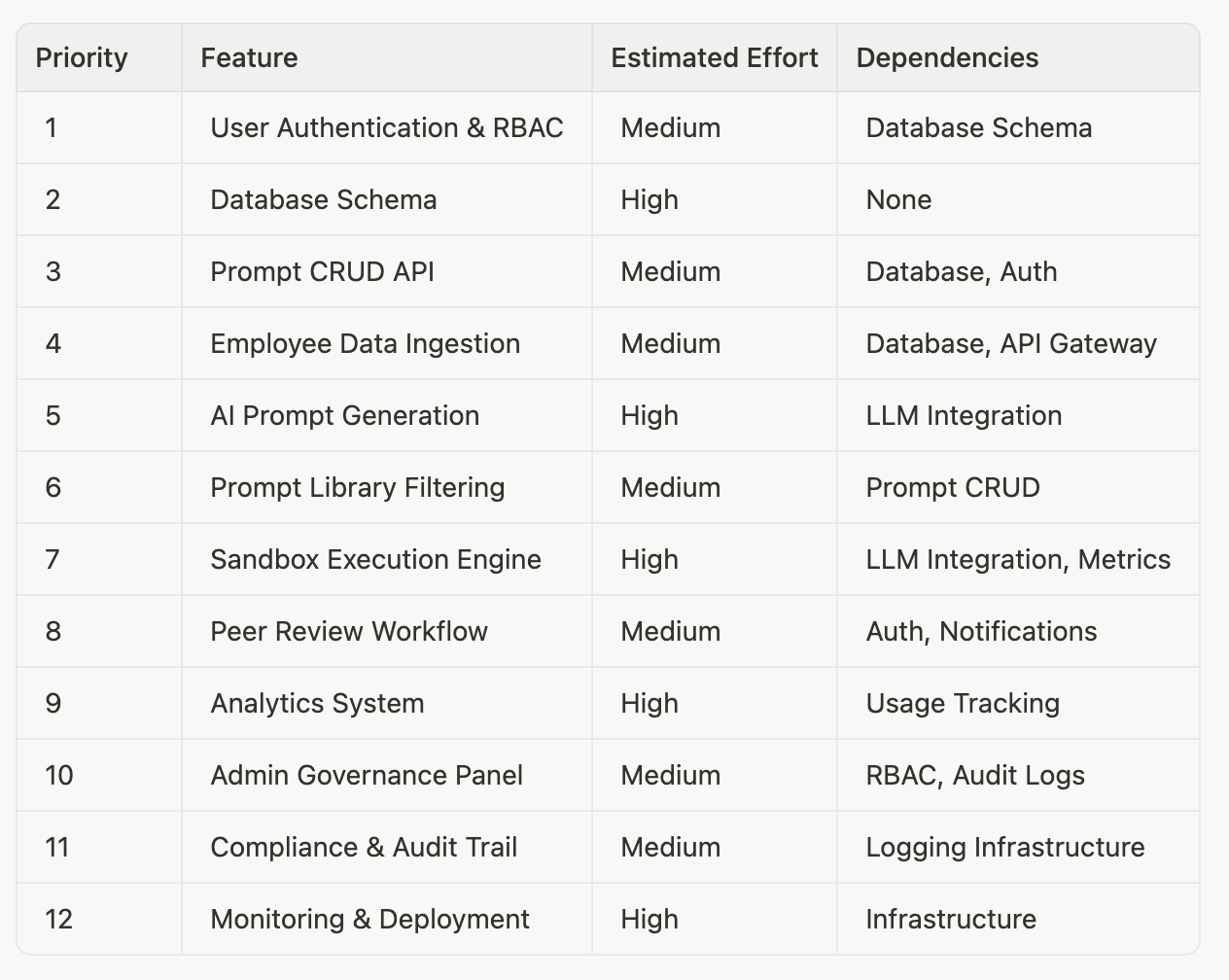
Implementation Priorities
Based on the frontend requirements, we recommend implementing features in the following order:
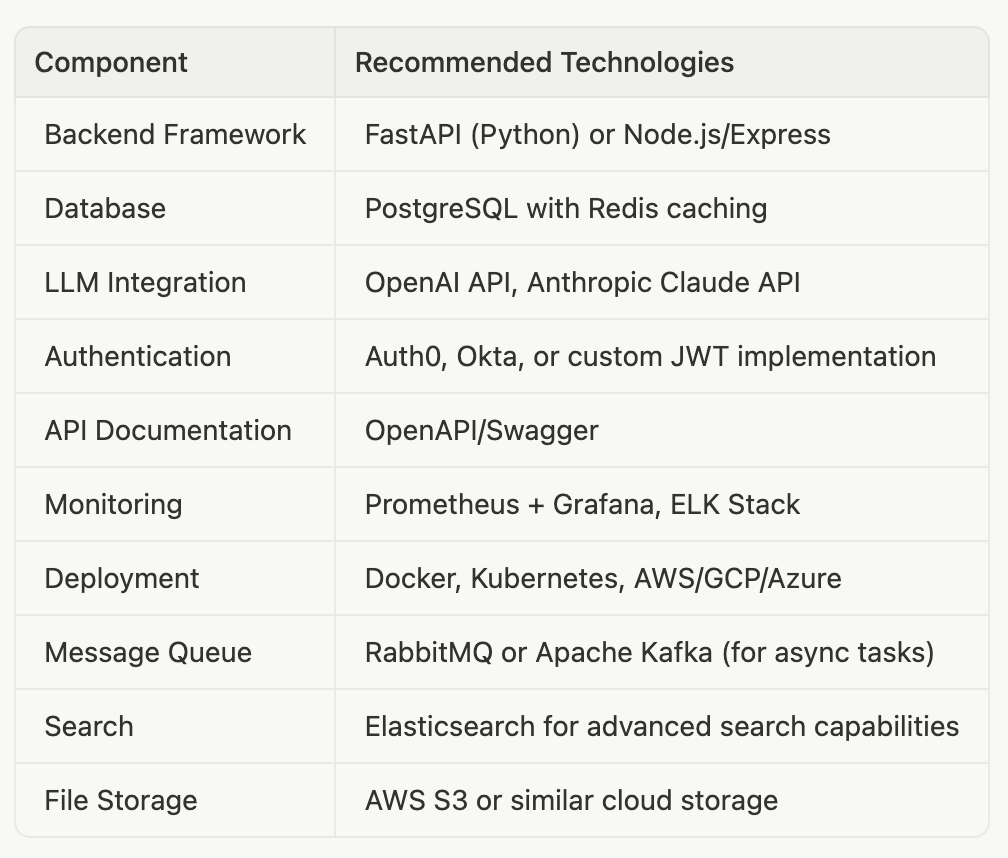
Technology Stack Recommendations
Next Steps
1.Prioritize Features: Select which features to implement first based on business priorities and resource availability.
2.Detailed Design: For each feature, create detailed technical design documents including data models, API schemas, and architecture diagrams.
3.Team Assignment: Assign development teams to each feature area based on expertise and capacity.
4.Development Sprints: Plan development in 2-week sprints with clear deliverables and acceptance criteria.
5.Testing Strategy: Implement comprehensive testing including unit tests, integration tests, and end-to-end tests.
6.Documentation: Maintain comprehensive documentation for APIs, architecture, and deployment procedures.
7.Security Review: Conduct security reviews at each stage of development, especially for authentication, data handling, and compliance features.
8.Performance Testing: Implement performance testing early to identify bottlenecks before they become production issues.