
The Shift to AI-Driven Search: An Analysis of Generative Engine Optimization and the New Digital Landscape
Executive Summary
The digital marketing landscape is undergoing a fundamental and rapid transformation, moving from a search-centric to an answer-centric model. The foundational principles of Search Engine Optimization (SEO) that have governed online visibility for two decades are becoming obsolete, challenged by the rise of Large Language Models (LLMs) and Generative Engines (GEs) like Google's AI Overviews, ChatGPT, and Perplexity.ai. This shift is precipitating the collapse of the referral economy, where organic traffic from search engines is in steep decline, creating an existential threat for businesses reliant on this model.
In response, a new discipline of optimization has emerged, broadly termed AI Visibility, which encompasses several specialized fields: Answer Engine Optimization (AEO), focused on securing placement in direct answers and snippets, and Generative Engine Optimization (GEO), the practice of making content visible and preferred by AI systems that synthesize information into conversational responses.
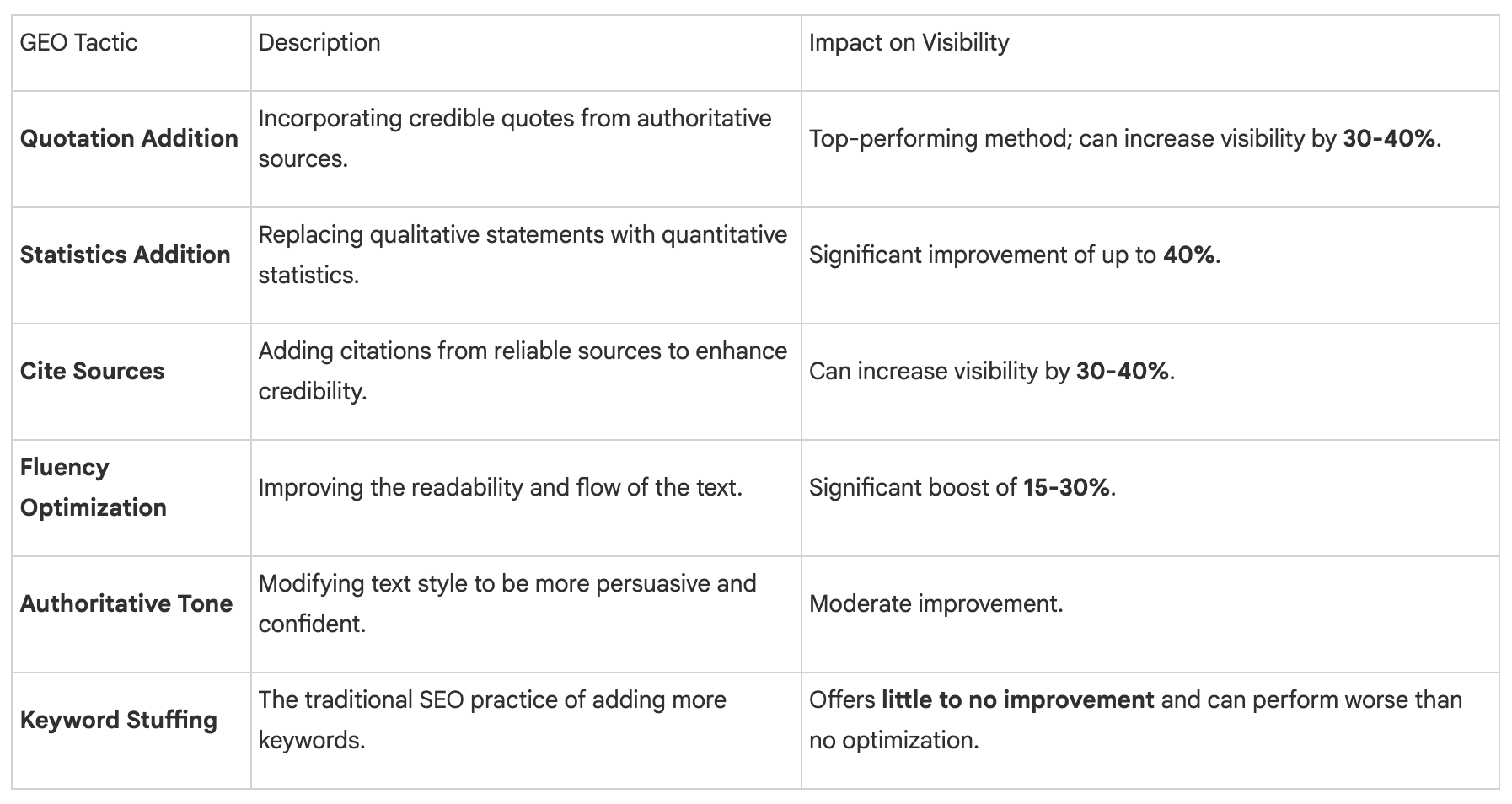
Key findings indicate that traditional SEO tactics like keyword stuffing are ineffective in this new paradigm. Instead, success hinges on a combination of technical precision, content credibility, and a deep understanding of new user behaviors. Foundational strategies include implementing robust structured data (Schema) to provide "ground truth" for AIs, managing AI crawler access via robots.txt and the emerging llms.txt standard, and developing content that demonstrates Experience, Expertise, Authoritativeness, and Trustworthiness (E-E-A-T). Research shows that specific GEO tactics—such as adding statistics, citations, and quotations—can boost source visibility in AI responses by up to 40%.
This disruption is creating a new competitive landscape. Industries from e-commerce and public relations to aviation and beauty are grappling with this change. For content creators, the economic model is shifting from traffic referral to data harvesting, with AI crawlers consuming vast amounts of content while sending back a fraction of the visitors. For businesses, particularly on platforms like Shopify, a "Visibility Gap" exists where native platform limitations hinder effective AI optimization. The future points toward Agentic Commerce, where autonomous AI agents conduct transactions, making the foundational work of AI Visibility a prerequisite for future relevance. Early adoption of these new optimization strategies is no longer a competitive edge but a strategic imperative for survival and growth.
I. The Paradigm Shift: From Search Engines to Answer Engines
The established symbiosis between content creators and search engines is breaking down. For years, the model was simple: businesses created valuable content, and search engines delivered qualified referral traffic. This referral economy is now collapsing due to a deliberate strategic shift by search engines and a corresponding evolution in user behavior.
The Collapse of the Referral Economy
The primary driver of this collapse is the rise of the "zero-click" search engine results page (SERP). Search engines have transformed from directories of links into destinations that provide answers directly, obviating the need for users to click through to external websites.
• Zero-Click Dominance: In 2024, nearly 60% of all Google searches in the United States, and 65% globally, concluded without a click to an organic or paid result. This is projected to exceed 70% by 2025. On mobile devices, over 75% of searches are zero-click.
• The AI Overview Effect: The widespread rollout of Google's AI Overviews has accelerated this trend, causing catastrophic declines in click-through rates (CTR). Analysis shows the presence of an AI Overview causes CTR for the #1 organic position to plummet by 32% to 34.5%. One major publisher, Mail Online, reported a 56.1% drop in desktop CTR.
• Low Engagement with AI Sources: Users rarely click on the source links embedded within AI summaries. A Pew Research Center study found this happens in a mere 1% of visits. Users are also more likely to end their search session after viewing an AI Overview (26% of the time) compared to a traditional SERP (16%).
• Asymmetrical Data Consumption: The new relationship is one of data harvesting, not traffic referral. AI crawlers consume vastly more content than the traffic they send back.
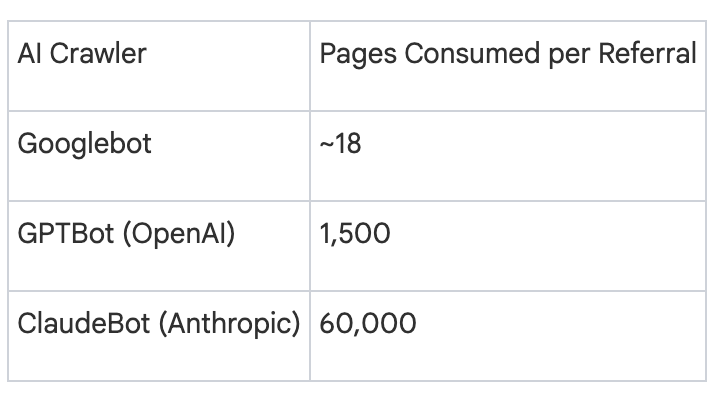
This technological shift is amplified by a cultural one, as users, particularly younger demographics, redefine the concept of "search."
• From Keywords to Conversations: Users are moving away from stilted keyword queries (e.g., "best running shoes") toward complex, natural language questions (e.g., "Plan me a 5-day Italy itinerary with budget tips and local eats"). Search queries with five or more words are growing 1.5 times faster than shorter queries.
• Gen Z's Search Exodus: For Generation Z, Google is often no longer the primary starting point for information discovery.
◦ 53% of Gen Z users turn to platforms like TikTok, Reddit, or YouTube before Google.
◦ 64% of U.S. Gen Z users have used TikTok as a search engine.
◦ When searching for local businesses, Gen Z prefers Instagram (67%) and TikTok (62%) over Google (61%).
• Fragmentation of the Purchase Journey: The classic linear marketing funnel is shattered. A consumer may discover a product on TikTok, seek reviews on Reddit, and use ChatGPT for a detailed comparison before purchasing, making brand visibility across multiple, non-traditional platforms essential.
II. Defining the New Optimization Landscape: A Glossary of Terms
The rapid evolution of search has led to a proliferation of acronyms to describe the new optimization disciplines. Understanding their distinctions is crucial for developing a coherent strategy.
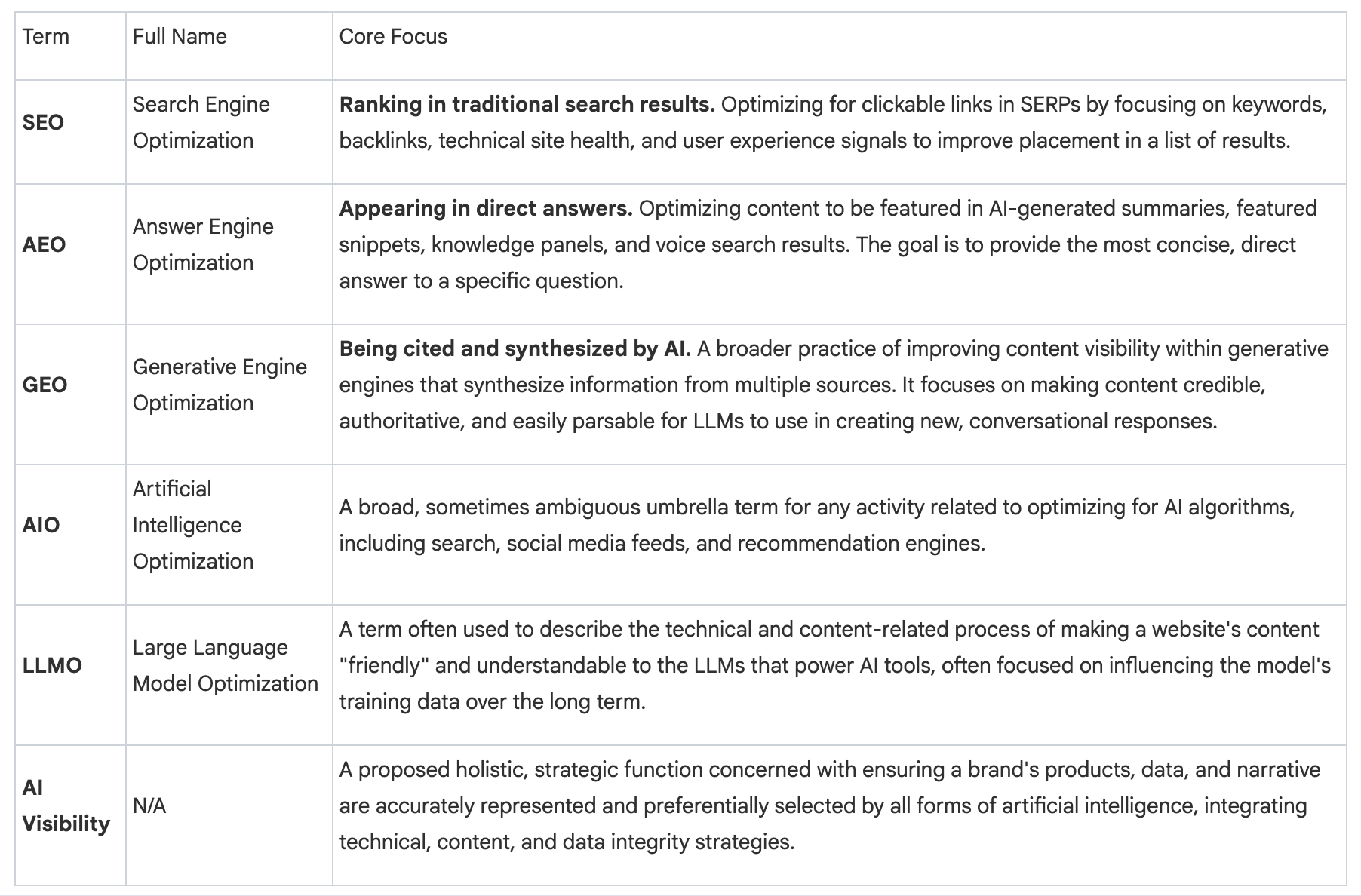
While traditional SEO focused on driving traffic, AEO and GEO focus on being the source of the answer itself, either directly (AEO) or as part of a synthesized response (GEO).
III. Core Principles of AI Visibility
To succeed in the new AI-driven landscape, businesses must move beyond legacy SEO tactics and embrace a new set of foundational principles centered on machine-readability and demonstrable credibility.
Technical Foundations for Machine Consumption
AI systems require clear, unambiguous signals to understand and trust web content. Technical optimization is the first step.
• Structured Data (Schema): The New "Ground Truth": The primary role of Schema.org markup is no longer just to achieve rich snippets. In the AI era, its purpose is to provide "ground truth"—unambiguous, machine-readable facts that help AIs avoid "hallucination." It transforms an unstructured webpage into an actionable data source. For e-commerce, essential schema types include:
◦ Product and Offer (with price, priceCurrency, and availability)
◦ AggregateRating and Review
◦ FAQPage
◦ Organization
• AI Crawler Management (robots.txt): This file remains the universal standard for controlling crawler access. A modern robots.txt must include AI-specific directives for user-agents like GPTBot, ClaudeBot, and Google-Extended to manage how different AIs interact with a site.
• The Emerging llms.txt Standard: While robots.txt is a set of rules, llms.txt is a proposed standard that acts as a proactive, curated guide or "smart sitemap" for LLMs. Written in Markdown, it highlights a site's most important, AI-friendly content.
◦ The Debate: Google has stated it does not currently use llms.txt, comparing it to the obsolete meta keywords tag. However, other AI players like Anthropic are reportedly utilizing it. Implementing llms.txt is seen as a strategic bet on a multi-polar AI landscape where Google is not the only gatekeeper.
Content, Credibility, and Specific GEO Tactics
Once content is technically accessible, it must be evaluated by the AI for credibility.
• E-E-A-T as the Credibility Algorithm: Google's E-E-A-T framework (Experience, Expertise, Authoritativeness, Trustworthiness) has become the de facto logic for how AI models assess source quality. It is no longer just an SEO concept but a foundational principle for AI Visibility.
• Proven GEO Content Strategies: Research from the paper "GEO: Generative Engine Optimization" demonstrates that specific, engine-agnostic content modifications can significantly boost visibility in GE responses.
Understanding AI Crawlers
Different AI systems deploy crawlers with distinct purposes and behaviors, which has significant technical implications.
• Crawler Types: It is critical to distinguish between crawlers for model training (GPTBot, ClaudeBot) and those for live retrieval (OAI-SearchBot, PerplexityBot), as they serve different functions.
• JavaScript Rendering: Many prominent AI crawlers, including those from OpenAI and Anthropic, do not execute JavaScript. They parse the raw HTML source code. This means any critical content loaded dynamically via JavaScript may be completely invisible to these systems, making server-side rendering essential.
IV. Industry Applications and Impact
The transition to AI-driven search is impacting all sectors, requiring tailored strategies based on industry-specific challenges and consumer behaviors.
Public Relations and the Press Release
The press release, a tool created in 1906, has proven to be a resilient and credible source for generative AI engines. The "2025 Global State of the Press Release Report" highlights key trends:
• AI Adoption by Communicators: APAC is rapidly adapting its strategy for AI search, while EMEIA and North America are moving more slowly. North America lags significantly in using generative AI for content creation, with 13% having no intention to use it, compared to only 8% in APAC and 11% globally.
• Headline Optimization: The optimal headline character count for press releases has shifted to 76-100 characters, likely because longer headlines provide more context for LLMs, a change from the previous SEO-driven optimum of 51-75 characters.
• Key Release Elements: PR practitioners rank the headline, subheadline, and executive pull quote as the most crucial elements for a release's success.
• Distribution Strategy: EMEIA and North American communicators primarily target national distribution, whereas APAC focuses on intra-continental distribution.
E-Commerce and the "Shopify Visibility Gap"
E-commerce is a natural testbed for GEO, as ranking improvements translate directly to commercial outcomes. However, platforms like Shopify present unique challenges.
• The Shopify Paradox: While Shopify as a platform is strategically aligned with AI (serving as a third-party product search provider for ChatGPT), individual stores face significant technical hurdles, creating a "Visibility Gap."
• Native Limitations:
◦ robots.txt Rigidity: Editing requires complex coding, limiting granular AI crawler control.
◦ Duplicate Content: The platform's rigid URL structure creates duplicate content issues that can confuse AI crawlers.
◦ Schema Gaps: Default themes often generate incomplete or buggy schema.
◦ No llms.txt Support: It is natively impossible to upload an llms.txt file to the root domain.
• Solutions for E-Commerce GEO: New tools like clickfrom.ai are emerging to address these gaps. Their philosophy is to "Optimize for Questions, Not Keywords."
◦ llms.txt Engine: Automatically generates and hosts an llms.txt file for Shopify stores.
◦ Smart Product Cards: Automatically embeds visually rich, AI-friendly product cards directly within blog content, "fusing" knowledge and products into a single, cohesive unit that AI answer engines prefer.
The Beauty Industry and the Rise of Social Search
The beauty sector illustrates the splintering of the search landscape and the high level of consumer trust in AI.
• Social as a Search Engine: 67% of consumers now search on social platforms. Gen Z drives 64% of beauty searches on TikTok. Four of the seven most-used search platforms are social: YouTube (49%), Facebook (44%), Instagram (30%), and TikTok (29%).
• AI's Influence on Purchases:
◦ 75% of beauty consumers ask AI to act as an "expert," indicating high trust.
◦ 30% say AI-powered product comparisons influenced a beauty purchase in the last six months.
◦ However, the process is AI + HI (Human Intelligence): 64% seek out human reviews after getting an AI recommendation.
The Airline Industry's "AI-First" Transformation
The airline industry provides a macro view of how a complex sector is strategically reorienting around AI to manage operational pressures and evolving customer expectations.
• Strategic Imperative: 97% of airlines are planning or already integrating AI into operations to combat volatile demand, low margins, and labor shortages.
• Maturity Levels: Few airlines are truly "AI-future built." An AI leader can create a sustained +5-6% margin advantage over laggards.
• Three Horizons of AI Implementation:
1. Deploy (Table Stakes): Applying AI to support functions (e.g., contact center copilots).
2. Reshape (Core Differentiators): Reimagining core functions (e.g., dynamic pricing, disruption management, AEO/GEO optimization for visibility).
3. Invent (Future Vision): Creating new, AI-first concepts (e.g., personalized AI retailers, agentic AI "smart journeys").
V. Measurement and Tooling in the AI Era
As the search landscape shifts, the metrics and tools used to measure success must also evolve.
• From Clicks to Mentions: The key performance indicator is no longer organic traffic via clicks. The new focus is on brand mentions, citations, and overall visibility within AI-generated responses.
• A Bifurcation of Tools: A divide is emerging in the martech landscape:
◦ AI Analytics (Passive Monitoring): Legacy SEO platforms like Semrush and Ahrefs are adapting by adding features to track brand mentions and visibility in AI Overviews. They are powerful diagnostic tools that report on what has already happened.
◦ AI Activation (Proactive Optimization): New, specialized tools like Otterly.ai and clickfrom.ai are defining this category. They are active optimization engines that directly modify a site's assets (e.g., generating llms.txt, enhancing schema, fusing content) to improve performance within AI systems.
VI. The Future Horizon: Agentic Commerce
The current state of conversational AI is a transitional phase. The ultimate trajectory is toward agentic commerce, where proactive, autonomous AI agents execute complex tasks, including purchasing products, on behalf of users.
• The Autonomous Shopper: An agentic AI will be given a goal (e.g., "Find and order the best eco-friendly running shoes for under $150 that will arrive by Friday") and will be empowered to carry out the entire transaction without direct human intervention.
• Market Potential: The market for agentic commerce is projected to reach 136billionby2025∗∗andpotentially∗∗1.7 trillion by 2030.
• Prerequisite for Participation: An autonomous agent cannot buy from a store it cannot see, understand, or trust. It will rely on the same machine-readable signals being optimized for today: clean structured data, verifiable E-E-A-T signals, and clear directives like llms.txt. The foundational work of AI Visibility is therefore the essential prerequisite for remaining a relevant merchant in the emerging machine-driven economy.