
The Master Prompt Method: A Step-by-Step Guide to Unlocking AI's Full Potential
The Master Prompt Method is a strategic approach to using large language models (LLMs) like Claude, Gemini, or ChatGPT by providing them with a comprehensive, detailed document containing all the necessary context about your business. This turns the AI from a simple chatbot into a highly informed strategic partner and operating system for your company.
What is the Master Prompt?
The Master Prompt is essentially a living document (e.g., a 10-30 page Google Doc) that you feed to an AI model using features like Claude’s personal preferences or custom instructions in other LLMs.1
The key idea is to give the AI full context up front. Every time you ask a question, the AI accesses this entire knowledge base, eliminating the need for constant clarification or repeating basic business information.2 This results in exponentially better, faster, and more relevant output compared to simple, one-off prompts.
Why the Master Prompt Method Matters (The Impact)
Implementing a Master Prompt can fundamentally change your business operation, leading to:
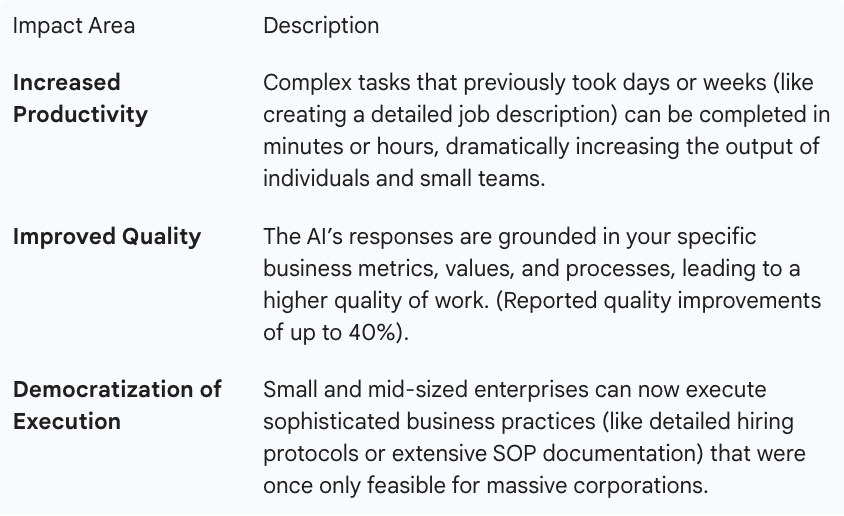
Step-by-Step Guide: Building Your V1 Master Prompt
The first version (V1) of your Master Prompt should be a compilation of fundamental information about yourself and your company. Start with a simple document and populate the following six sections.
Step 1: Personal Info & AI Mandate 👤
This section helps the AI understand who you are and how to interact with you.
Role and Company: Your exact title, your position in the company hierarchy, and who you report to.
Strengths & Weaknesses: What you are good at, and more importantly, what your weaknesses are.
AI Mandate: Explicitly state how you want the AI to help you. For example: "I want AI to compensate for my weakness in driving accountability, detailed documentation, and maintaining project schedules."
Step 2: Core Company Information 🏢
Provide the foundational facts about the business.
Establishment & Size: When the company was founded and the current number of employees.
Products & Services: A detailed list of what you sell, including their features and customer benefits.
The "What": Define the core outcome you provide to your customer.
Step 3: Ideal Customer & Market Information 🎯
Define the "who" and the competitive landscape.
Ideal Customer Profile (ICP): Who do you serve perfectly?
Competitors: Who are your main competitors, and what makes your approach different from theirs (your unique value proposition or "how" you operate)?
Step 4: People & Key Performance Indicators (KPIs) 📈
Give the AI a map of the organization and its performance metrics.
Team Structure: List the team members who report to you and their key responsibilities.
KPIs/APIs (Accountability Performance Indicators): For key roles, provide the one number they are accountable for. This allows the AI to ground its strategic advice in measurable targets.
Step 5: Culture & Core Values 🧭
This is critical for ensuring the AI's output maintains your company's voice and principles.
Core Values: List your company's non-negotiable values (e.g., Serve, Systematic Excellence, Transparency).
Mission & Vision: Your company's overarching mission statement and its Big Hairy Audacious Goal (BHAG).
The AI will reference these values when generating content, emails, or internal process recommendations.
Step 6: Define Your Protocols (The "Mini-Programs") 🛠️
Once the context is set, you can write short, pre-defined instructions that act like software programs the AI can execute. These are powerful additions you will refine over time.
Example Protocol: "AI SOP"
The Instruction: "Whenever I type 'AI SOP' and provide a process flowchart, take every single step in the diagram and create a full, detailed Standard Operating Procedure (SOP) for it, ensuring all steps adhere to our core value of Systematic Excellence."
Example Protocol: "1-3-1 Decision Framework"
The Instruction: "For any decision-making prompt, you must first clarify the Problem and the desired Outcome. Then, provide three potential paths and one recommended course of action based on my business context. Always ask five questions one at a time for clarification before proceeding."
Next Steps: Iteration and Advanced Use
Choose Your Platform: Use a platform that supports persistent context or detailed custom instructions (e.g., Claude, or custom GPTs).3
Test and Refine: When using a protocol, ask the AI to first answer its own question based on the Master Prompt and then wait for your approval. This helps you identify what the AI misunderstood, allowing you to go back and add or correct information in your V1 document.
Warning on Strategy: Do not put long-term goals (3-5 years out) into your first Master Prompt. The rapid pace of AI development may allow you to achieve goals in 6 months that you currently plan for in 3 years. Be flexible and update your strategy constantly as you realize AI's true capabilities.