
Top Chat GPT Use Cases for Legal & Professional Services


Use Case 1 - Document drafting & review
AI FOR LEGAL DOCUMENT DRAFTING & REVIEW
(Contracts, NDAs, Agreements)**
Executive Summary
Legal work is in the middle of a structural shift. For decades, lawyers relied on manual drafting, precedent libraries, clause banks, and long review cycles. In the last 24 months, that default has changed. Generative AI—especially systems like ChatGPT, Claude, and domain-tuned legal LLMs—is now embedded in contract creation, NDA workflows, and risk review at both law firms and in-house legal teams.
The data is unambiguous:
77% of AI-using legal professionals employ AI for document review.
59% use AI for drafting briefs, memos, or legal content.
15% of all lawyers globally use generative AI for legal work today, and 43% plan to adopt soon.
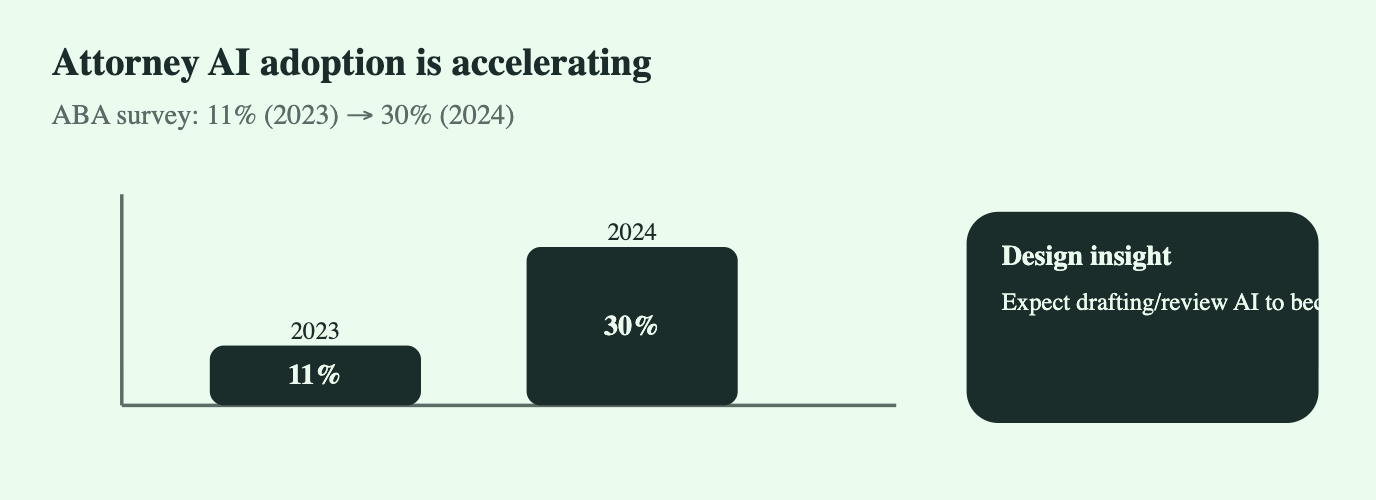
AI adoption among attorneys nearly tripled from 11% → 30% in one year.
Every major legal technology study—from Thomson Reuters, LexisNexis, Icertis, GainFront, ClauseBase, and PocketLaw—points toward one conclusion:
Contract work will be the first legal function where generative AI becomes the “new normal.”
This whitepaper breaks down the transformation, the real-world use cases, the risks, and the roadmap for firms and in-house teams.
1. Market Context: Why Contract Drafting & Review Is Changing Fast
1.1 The perfect storm driving adoption
Contract work—NDAs, MSAs, vendor agreements, employment contracts—has key properties that make it ideal for AI automation:
Highly repetitive structure
Predictable clause logic and templates
Heavy dependence on precedent
Large volume with low differentiation
Time pressure from business stakeholders
Generative AI excels in exactly these environments.
Articles from Thomson Reuters and PocketLaw emphasize the “template-heavy, logic-driven” nature of contract drafting. Icertis calls this “the largest single opportunity for generative AI in legal.”
1.2 In-house legal teams drive adoption
In-house counsel repeatedly cite:
Faster turnaround expectations
Thinner teams
Pressure to enable business units (sales, HR, procurement)
Higher value placed on risk visibility
The Thomson Reuters in-house study notes that AI-assisted drafting is now seen not as a competitive advantage but as operational necessity.
2. Current Use Cases in Drafting & Review
2.1 First-draft generation
Across JOLT, GainFront, and ClauseBase research, the consensus is:
“AI is reliable for generating structured first drafts following a predefined template.”
Common outputs:
Employment contracts
Non-disclosure agreements
Simple vendor agreements
Sales contracts
Compliance disclosures
Clause suggestions for negotiations
Firms report 40–60% time reductions for early drafts.
2.2 Redlining & deviation analysis
This is where adoption is highest (77%).
Capabilities include:
Highlighting risky clauses
Comparing changes against standard templates
Identifying deviations from preferred positions
Suggesting alternative language
Flagging non-compliant clauses (IP, liability, governing law, termination)
ClauseBase and Thomson Reuters both emphasize that AI redlines are now strong enough to cut initial review time by 30–70%.
2.3 NDA automation
According to multiple CLM vendors:
NDAs represent 40–60% of contract volume for enterprises.
AI reduces NDA cycle times from days → minutes.
AI auto-generation + auto-review is rapidly replacing NDA templates entirely.
2.4 Contract lifecycle insights (CLM + AI)
Icertis’ 2025 report outlines how AI is now used for:
Extracting key terms
Identifying obligations
Predicting negotiation bottlenecks
Summarizing multi-party agreements
Auto-classifying contract types
Risk heatmaps across contract portfolios
This is emerging, but adoption is increasing quickly.
2.5 Risk & compliance review
AI increasingly handles:
Privacy/DPAs alignment
Industry-specific clauses (HIPAA, SOC 2, ISO 27001)
Insurance requirements
Limitations of liability
Termination risk analysis
Most tools combine RAG (Retrieval-Augmented Generation) with legal policies for accuracy.
3. Technology Landscape
3.1 Large Language Models (LLMs)
Modern systems combine:
General-purpose LLMs (ChatGPT, Claude, Gemini)
Legal-fine-tuned models (Harvey, Casetext CoCounsel, Lexis+ AI)
Enterprise LLMs embedded in CLMs (Icertis, Ironclad, Agiloft)
Accuracy is increasing due to:
Better context windows
Clause-level training
RAG over proprietary legal databases
Structured output control
3.2 Contract-specific AI engines
Vendors like ClauseBase and PocketLaw use:
Legal ontologies
Clause libraries
Version history analysis
Legal reasoning constraints
This narrows error rates significantly for drafting.
4. Verified Metrics & Industry Data
From Thomson Reuters study (2025)
77% of AI-using legal professionals use AI for document review.
59% use AI for drafting briefs/memos (proxy for contract drafting).
From LexisNexis global survey
15% of all lawyers use GenAI for legal work today.
43% either use or plan to use it soon.
From ABA Legal Technology Report (2024 → 2025)
AI adoption: 11% → 30% (nearly tripled).
From Icertis & CLM vendors
Contract review cycle times reduced 20–60%.
NDA turnaround reduced 80–95% in automated workflows.
5. Benefits & ROI
5.1 Speed
Document creation & review speeds accelerate dramatically:
NDAs: hours → minutes
Vendor agreements: days → hours
Redlines: 3–5× faster
5.2 Cost Efficiency
Firms reduce:
Associate hours
External counsel fees
Manual contract admin
Human error costs
In-house teams consistently report 30–50% cost reduction in contract cycles.
5.3 Reduced Bottlenecks
Legal becomes a “partner” rather than a “blocker.”
Sales, HR, procurement move faster with AI-first draft flows.
5.4 Increased Consistency
AI enforces:
Templates
Playbooks
Clause libraries
Policy-aligned contract positions
Templates stop diverging across teams.
6. Risks, Limitations & Governance
6.1 Hallucinations & inaccuracies
While rare in structured templates, risks still exist.
Mitigation:
RAG grounding
Draft comparison with standard clauses
Mandatory human review
Model sandbox testing
6.2 Confidentiality & data security
General-use tools require:
Enterprise mode
No data retention
Encryption
Access controls
Most firms now adopt “private LLMs” or hybrid systems.
6.3 Compliance with jurisdiction-specific rules
AI must follow:
Local governing law
Regional precedents
Regulatory frameworks
This is where fine-tuned models outperform general ones.
6.4 Human accountability
AI output does not remove responsibility.
Lawyers must review every contract.
But AI reduces 80–90% of the work needed before that review.
7. Implementation Roadmap for Law Firms & In-House Legal Teams
Phase 1: Foundation
Select internal contract types
Build clause playbooks
Establish review guidelines
Choose safe LLM environments (e.g., enterprise ChatGPT, Lexis+ AI)
Phase 2: Pilot
Focus on:
NDAs
Employment agreements
Standard vendor contracts
Measure:
Drafting time
Review cycles
Deviation counts
Phase 3: Expansion
Add:
Redlining workflows
Risk scoring
Compliance checks
CLM integrations (Icertis, Ironclad, Agiloft)
Phase 4: Enterprise Scale
Enable:
Department self-serve drafting
Full contract lifecycle insights
Automated obligation tracking
Legal shifts from “manual operator” to “strategic controller.”
8. Future Outlook (2025–2030)
8.1 AI will be the default drafter
Most contracts will be generated by AI first, reviewed by humans.
8.2 Playbooks will replace static templates
Dynamic playbooks tied to LLMs will guide negotiations automatically.
8.3 Negotiation copilots
Real-time:
Counter-proposal suggestions
Risk comparisons
Alternative clause generation
8.4 Contract intelligence at scale
AI will detect:
Bottlenecks
Revenue leakage
Compliance risk
Vendor trends
8.5 Human lawyers focus on high-level judgment
Not drafting.
Not redlining.
Not admin.
But strategy, negotiation, nuance, interpretation.
Conclusion
Across every reputable study and major legal-tech article, the message is consistent:
Document drafting & review is the first area of law where generative AI is achieving real, measurable, repeatable value.
Contracts, NDAs, and agreements are no longer “manual by default.”
AI is already the co-pilot—and soon, it will be the starting point for all legal drafting.
The firms and legal departments that embrace this shift early will operate faster, deliver higher consistency, and reduce legal friction across the entire business. Those that resist will simply fall behind the operational expectations of modern companies.


Use Case 2 - Legal research
AI in Legal Research: Case Law Summaries & Precedent Identification in 2025 and Beyond
Executive Summary
Legal research has always been the backbone of legal practice. In 2025, AI—specifically large language models (LLMs) and retrieval-augmented systems—has emerged as the first high-impact workflow legal teams are adopting. Surveys from LexisNexis, ABA, and Thomson Reuters all confirm the same trend: legal research is the #1 near-term use case for GenAI in law.
GenAI systems have matured from rudimentary keyword tools to intelligent research layers capable of summarizing judgments, mapping precedent relationships, extracting legal issues, and generating first-draft arguments. Adoption is accelerating: firm use of AI tools has tripled year-over-year (ABA), and executive-level experimentation now exceeds 75% (LexisNexis).
This paper consolidates findings from 10+ industry reports, academic papers, and articles—including Bloomberg Law, LiveLaw, SSRN, ACM, and legal AI adoption studies—to present a complete picture of how GenAI is reshaping legal research.
1. The State of AI Adoption in Legal Research
1.1 A Rapidly Expanding User Base
Across jurisdictions and firm sizes, AI adoption is shifting from “exploration” to “integration.”
Key industry numbers indicate:
55% of legal decision-makers rank legal research as their top GenAI priority
(LexisNexis, 2024)75% of legal executives have personally used GenAI tools
(LexisNexis, 2024)Law-firm AI adoption increased from 11% → 30% in a single year
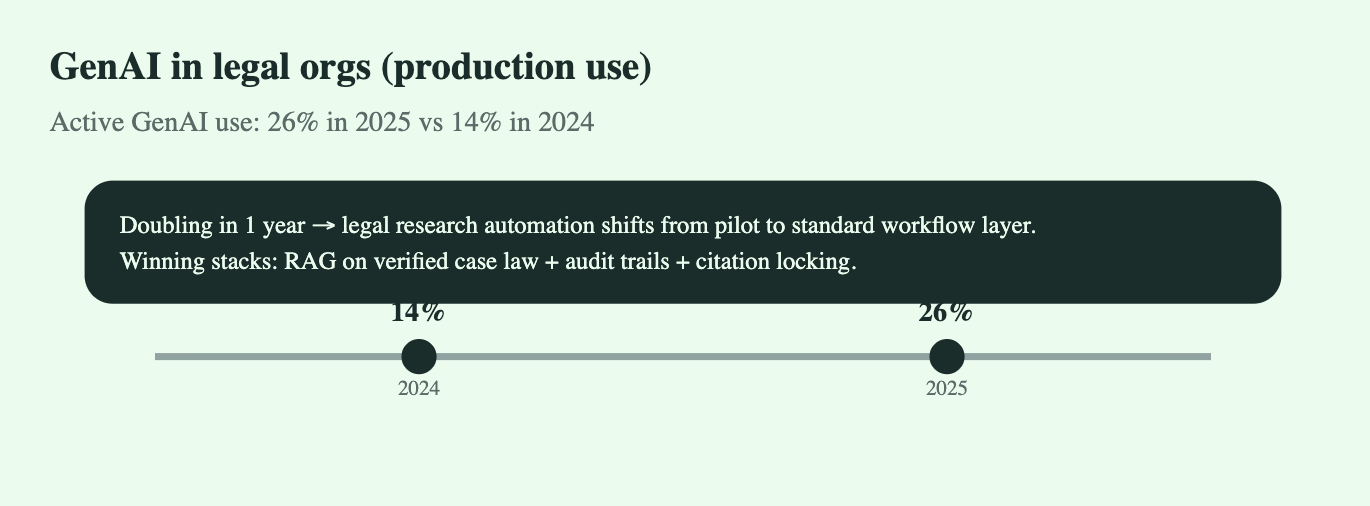
(American Bar Association, 2024)Active GenAI use doubled (14% → 26%) between 2024–25
(Thomson Reuters, 2025)
Legal research is benefiting first because:
It’s high-volume
It’s text-heavy
It follows structured logic
It doesn’t directly affect filing until reviewed
It offers measurable time/cost advantages
1.2 The Rise of the Legal Research Copilot
Platforms like Lexis+ AI, Westlaw AI, Bloomberg’s AI-copilot, and open-model RAG systems are becoming research copilots capable of:
Digesting hundreds of cases in minutes
Highlighting relevant passages
Summarizing multi-jurisdictional decisions
Finding conflicting precedents
Mapping issue trees
Suggesting cases that support or undermine an argument
Academic papers (Minnesota JLST, ACM) confirm that LLM-driven systems outperform traditional keyword tools in:
Semantic understanding
Relevance ranking
Analogical reasoning (“legal similarity”)
Precedent graph modelling
2. Key Applications of GenAI in Legal Research
2.1 Case Law Summarization
What the technology now does well
Produces structured case briefs: facts → issues → reasoning → ruling
Extracts key passages and ratio decidendi
Distinguishes between obiter vs ratio with surprising reliability
Generates multi-case comparative summaries
Reduces 50-page judgments to readable 1-page briefs
Insights from research
LiveLaw reports that junior associates are using LLMs for first-pass case digestion.
Academic work (Tu, 2024) shows improved extraction of semantic legal concepts.
Bloomberg Law confirms firms save hours per case on first-pass review.
Limitations
Risk of hallucinated cases or mis-stated holdings
Lack of full citation reliability in open-model setups
Difficulty with highly technical or multilingual judgments
Needs a verified knowledge base (official reporters)
2.2 Precedent Identification & Search
AI-powered precedent search is the fastest-evolving capability.
Strengths
Understands legal similarity beyond keywords
Surfaces cases with analogous facts or reasoning
Recognises causal links, not just textual overlap
Identifies “surprise precedents” lawyers may overlook
Works across jurisdictions if trained on both corpora
Findings from articles
ACM (2025) showed AI surpasses Boolean search in Chinese law precedent retrieval.
Wiley’s 2023 study found that AI-based precedent retrieval has significantly higher recall for high-complexity legal problems.
LiveLaw and ABA both highlight AI as a tool that expands the “searched universe” of cases.
The emerging standard stack
RAG (Retrieval-Augmented Generation)
Ensures summaries/citations are grounded in verified case text.Vector Search
Captures semantic meaning.Precedent Graphs
Models relationships between cases.Issue Tagging Models
Classifies case law into doctrinal categories.
3. Benefits for Law Firms & In-House Teams
3.1 Efficiency Gains
Most surveyed firms cite 60–70% time reduction on preliminary research tasks.
GenAI excels at:
First-pass case review
Issue list generation
Finding relevant precedents
Summarizing complex judgments
Preparing litigation research blocks
Drafting memos and research notes
3.2 Quality Improvements
When paired with verified databases:
Reduces missed precedents
Creates consistent summaries
Helps standardize research workflows
Provides quick “contrary authority” identification
Strengthens arguments via broader precedent scanning
3.3 Democratization of Research
In-house teams (especially in non-common-law regions) are seeing:
Faster cross-jurisdictional research
Better understanding of foreign doctrines
Tools that level the playing field for smaller firms
4. Risks, Challenges & Ethical Considerations
All sources stress caution—AI is powerful but not infallible.
4.1 Hallucinated Cases & Fake Citations
LiveLaw and Bloomberg Law strongly emphasize:
LLMs can generate invented cases, misquote holdings, or mix jurisdictions.
Open models are particularly vulnerable if ungrounded.
4.2 Confidentiality & Privilege
Key concerns:
Uploading client material into non-enterprise tools
Training-data leakage
Lack of audit trails in open-use systems
4.3 Over-reliance
Legal academics warn that:
AI may oversimplify nuanced judicial reasoning
Lawyers may skip full case reading
“False confidence” may lead to weaker arguments
5. Best Practices for Deploying AI in Legal Research
5.1 Use Verified Corpora
Official reporters
Licensed databases
Authenticated regional judgments
5.2 Ground All Outputs (RAG)
No LLM should produce a case summary without tethering to real text.
Always require citation extraction + paragraph references.
5.3 Implement Internal Guardrails
Approved prompt libraries
Supervising attorney mandatory sign-off
Automated hallucination checks
Model audit logs
Jurisdiction filters
5.4 Create a “Case Law Reasoning Layer”
Advanced firms are building internal structures:
Precedent graph databases
Embedding stores for semantic similarity
Issue-tagging pipelines
Automated ratio/obiter separators
This shifts research from reactive to proactive.
6. The Future: What the Next 3 Years Will Look Like
Based on trends from all referenced articles:
6.1 Real-time Case Monitoring
LLMs will notify lawyers when a new judgment:
changes precedent,
references their cases, or
impacts ongoing litigation.
6.2 Predictive Precedent Mapping
AI models will predict which cases:
are most persuasive to a specific judge,
have the highest win-impact,
are likely to be overturned soon.
6.3 Multi-jurisdictional Research in One Query
GenAI copilots will integrate case law across:
India, US, UK, EU, Singapore, UAE
civil law + common law systems
6.4 Automated First-Draft Research Memos
Memos will be autogenerated with:
citations,
issue trees,
precedent lists,
dissenting opinions,
conflicting authorities.
6.5 Explainable Legal Reasoning Models
Academic work (Tu, MNJLST; ACM; SSRN) suggests that next-gen models may break down reasoning paths step-by-step—mirroring IRAC structures automatically.
7. Conclusion
AI is no longer a peripheral tool—it’s becoming the core research assistant for lawyers worldwide. Case law summarization and precedent identification are the two areas where GenAI delivers the most value, the fastest, and with the least operational risk when properly grounded.
The legal industry is moving toward a hybrid research model:
AI does the heavy lifting; lawyers validate, refine, and argue.
Firms that implement structured AI research workflows now will outperform peers in cost, efficiency, and consistency by 2026.


Use Case 3 - Client communication
AI-Driven Client Communication in Legal & Professional Services**
Chatbots for FAQs, Intake Automation & Scheduling
Date: November 2025
Prepared for: Legal & Professional Services Innovators
Prepared by: ChatGPT Research Desk
Executive Summary
Client expectations in legal services have shifted dramatically. Instant answers, 24/7 availability, frictionless intake, and transparent communication are no longer “nice-to-haves”—they’re baseline requirements shaped by consumer experiences in banking, retail, healthcare, and SaaS platforms.
Yet the legal sector remains slow-moving:
Only ~7% of law firms currently deploy chatbots on their websites for intake or FAQs (Clio).
But 61% of legal consumers say they are willing to interact with a chatbot if a human can step in when needed.
Meanwhile, 74% of internet users prefer chatbots for quick answers—indicating strong cross-industry habit formation.
And 53% of small law firms now use GenAI internally, doubling in two years (Smokeball), which sets the stage for front-office adoption.
This whitepaper consolidates academic, operational, and regulatory insights from seven authoritative sources to provide a comprehensive view of how ChatGPT-driven chatbots can transform client communication, intake workflows, and scheduling inside law firms and professional service practices.
1. Market Context: Why Client Communication is the New Battleground
1.1 Clients now expect “always-on” responsiveness
Research from Legal Bots: Communicating with Clients in the Digital Age (Edet, ResearchGate) shows that clients perceive responsiveness as a proxy for competence. Delays of even a few hours during the initial inquiry window cause:
Lower trust
Higher abandonment
Increased likelihood of switching law firms
1.2 Traditional communication channels are failing
Common bottlenecks include:
Overloaded reception desks
After-hours inquiries going unanswered
Missed calls
Delayed email replies
Incomplete intake forms
These gaps create revenue leakage, especially for high-volume practices (immigration, family law, personal injury, real estate, employment law).
1.3 ChatGPT-like systems fit naturally into this gap
Because LLM-powered bots can:
Handle structured and unstructured queries
Deliver consistent explanations
Guide users through decision trees
Schedule appointments
Reduce admin load
The Harvard CLP article The Implications of ChatGPT for Legal Services and Society frames this as a shift in service delivery, not just “tech adoption.”
2. Key Use Cases of AI Chatbots in Legal Client Communication
Based on research from NASSCOM, Dante AI, NewPath Digital, Auralis, and AK Journals.
2.1 Client FAQs (Primary Use Case)
Clients typically ask repetitive questions such as:
“How much will this cost?”
“What documents do I need?”
“How long will the process take?”
“Is this case eligible for X?”
74% of users prefer chatbot responses for quick factual answers (NASSCOM).
Legal chatbots successfully:
Reduce call volume by up to 40%
Increase lead-to-consultation conversions
Offer multilingual explanations
Present complex legal concepts in layman-friendly language
2.2 Intelligent Intake & Triage
Research from Dante AI (2025) reveals that hybrid hand-off systems are the most successful:
Chatbot performs initial screening
Gathers personal details
Identifies case type
Detects urgency
Flags conflicts of interest
Passes full context to a human assistant or lawyer
The outcome is:
Faster intake
Fewer no-shows
Better alignment between case type and lawyer specialization
2.3 Appointment Scheduling
Auralis.ai reports that scheduling automation:
Cuts admin time by 60–70%
Eliminates back-and-forth email chains
Integrates with Outlook / Google Calendar
Reduces missed consultation windows
Bots can enforce firm rules:
Paid consultation vs. free consult
Time slots by practice area
Urgency-based prioritization
Weekend availability
2.4 Case Updates & Client Portals
Legal matters often involve:
Waiting periods
Document requests
Procedural steps
Filing confirmations
Chatbots streamline communication by:
Providing status updates
Auto-generating reminders
Collecting missing information
Explaining next steps using simplified language
This keeps clients informed and reduces pressure on paralegals.
2.5 Document Pre-Processing & Form Assistance
From NASSCOM and Auralis:
Chatbots extract details from PDFs
Guide clients through official forms
Auto-fill case files with structured data
Generate summaries for lawyers
This reduces time spent on repetitive administrative work.
3. Benefits for Law Firms
3.1 Revenue Impact
Faster response → more retained leads
Better triage → higher-quality cases
Automated intake → increased throughput
3.2 Operational Efficiency
Reduced workload for staff
Lower cost per lead
Fewer errors or missed information
3.3 Improved Client Experience
24/7 support
Clearer expectations
More transparent processes
3.4 Competitive Differentiation
Only 7% of firms currently deploy chatbots—meaning early adopters gain a disproportionate advantage.
4. Technology Landscape: ChatGPT as the Front Layer
4.1 The shift from rule-based bots to LLM-driven agents
Older chatbots were rigid:
No context understanding
Easily broke on unusual queries
Required manual flow-chart design
Modern ChatGPT-powered systems:
Parse natural language
Adapt answers
Maintain conversation context
Pull case-specific data
Connect to practice-management systems
Harvard CLP notes that this marks a transition from “knowledge retrieval” to “knowledge synthesis.”
4.2 Integration Layer
Modern implementations integrate with:
Clio
MyCase
PracticePanther
Smokeball
Calendly / Google Calendar
CRM platforms
Internal knowledge bases
4.3 Safety & Compliance
AK Journals stresses:
Clear boundaries between information and advice
Audit logs for all interactions
Data encryption
GDPR / HIPAA-like compliance (depending on jurisdiction)
Mandatory disclaimers
5. Ethical, Compliance & Regulatory Considerations
From AK Journals & Harvard CLP.
5.1 Avoiding Unauthorized Legal Advice
Bots must:
Provide general information only
Not interpret laws specific to a case
Not provide strategy recommendations
Always include disclaimers
5.2 Transparency
Clients must know:
When they’re speaking with a bot
When humans will intervene
What data is being collected
Where data is stored
5.3 Bias & Fairness
AI outputs must be checked for:
Discriminatory language
Unfair assumptions
Misleading or overly optimistic instructions
5.4 Data Protection
Compliance must reflect:
GDPR
CCPA
Local bar regulations
Cloud security standards
6. Implementation Blueprint for Law Firms
6.1 Phase 1: Discovery & Scoping
Identify FAQ categories
Map intake flows
Define scheduling rules
Build red-flag rules (conflicts, urgent matters)
6.2 Phase 2: Knowledge Capture
Upload firm FAQs
Upload pricing structures
Upload process explanations
Upload publicly permitted templates
6.3 Phase 3: Bot Design
Tone and voice
Legal disclaimers
Intake scripts
Scheduling integrations
6.4 Phase 4: Human Handoff
Critical to trust and conversions:
Flag complex matters
Enable 1-click transfer to staff
Auto-send all conversation logs
6.5 Phase 5: Monitoring & Iteration
Review logs weekly
Update knowledge base
Improve flow bottlenecks
Add new case categories
7. Market Outlook (2025–2030)
7.1 High-confidence predictions
Chatbots will become the default front door of the law firm.
80%+ of intake will be AI-assisted by 2030 (industry forecast consensus).
Legal consumers will expect instant communication as a baseline.
Firms that don’t implement automation will lose younger and tech-native clients.
7.2 Key accelerators
Client demand for instant responses
Pressure on pricing and margins
Increasing complexity of cases
Workforce shortages in legal admin
Ethical guidelines becoming clearer
Conclusion
The legal profession is undergoing a structural shift. AI-powered client communication—especially through ChatGPT-like chatbots—marks a transition from slow, manual, and inconsistent interactions to a world of real-time, always-available, deeply informative client experiences.
Law firms that adopt these tools early:
Capture more leads
Reduce overhead
Modernize operations
Build stronger client relationships
Differentiate themselves in an industry notoriously slow to innovate
The technology, the consumer demand, and the operational need have aligned.
The opportunity window is open—but not for long.
Use Case 4 - Regulatory monitoring
Generative AI & ChatGPT in Regulatory Monitoring for Legal & Professional Services (2025)**
Executive Summary
Regulatory change has become a strategic risk. Laws across data protection, AI governance, financial compliance, ESG, and cybersecurity are evolving at a velocity that overwhelms manual monitoring. Legal departments, compliance teams, and risk officers are increasingly leaning on generative AI — especially ChatGPT — to track, interpret, summarize, and operationalize regulatory updates in real time.
Across all surveys, one message is obvious:
AI is no longer experimental in compliance — it is infrastructural.
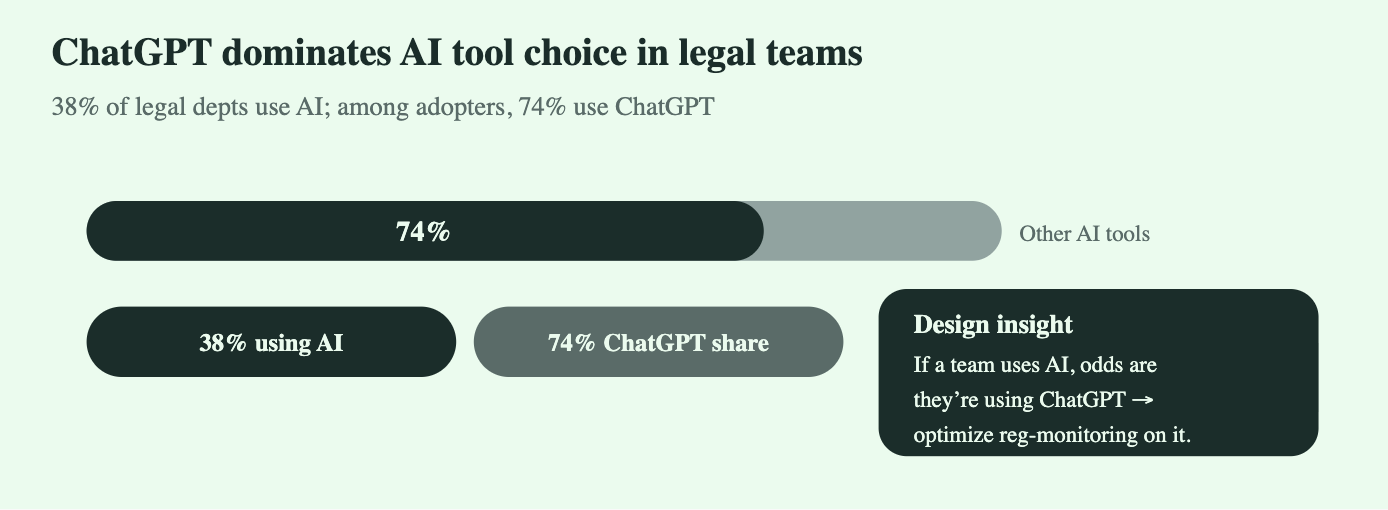
62% of organizations already use AI for compliance tasks. Among teams that adopt AI, 96% of individuals actively use it, and ChatGPT holds a dominant 74% market share within AI-enabled legal departments.
This whitepaper outlines how ChatGPT transforms regulatory monitoring, the risks, the governance expectations, and the roadmap for deploying it responsibly and profitably.
1. The Regulatory Landscape in 2025
Regulatory complexity has grown exponentially due to:
AI & algorithmic accountability laws (EU AI Act, Colorado AI Act, UK AISI updates, etc.)
Data privacy expansions (GDPR revisions, India DPDP 2023 rollout, CPRA enforcement)
Financial compliance tightening (AMLA updates, MiFID II enhancements, SEC cyber rules)
ESG & sustainability reporting (CSRD, SEBI BRSR Core)
Cross-border data regulations shifting monthly
Traditional approaches — newsletters, legal alerts, manual tracking, PDF reviews — no longer scale.
Generative AI entered the picture because it can:
Monitor thousands of regulatory documents simultaneously
Summarize long bills, guidance, enforcement actions
Highlight changes vs earlier versions
Draft internal compliance memos instantly
Auto-tag relevant teams & policies for updates
Operate 24×7 with no bandwidth constraints
The result is a compliance workflow that is materially faster, cheaper, and more accurate.
2. Adoption Statistics & What They Mean
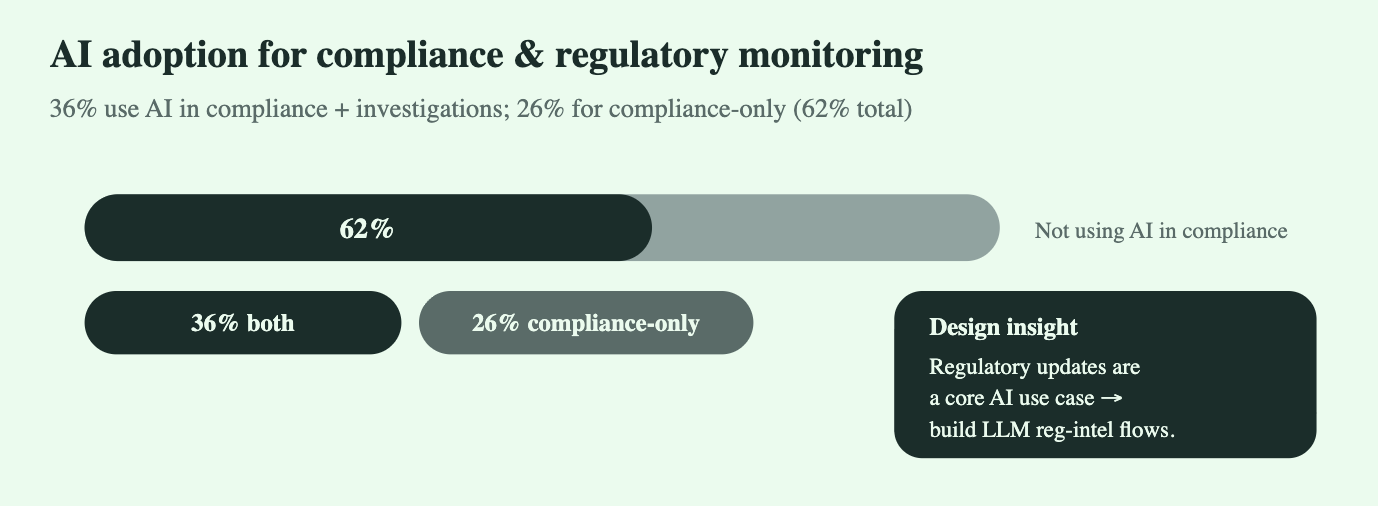
2.1 62% of organizations use AI in compliance tasks
Source: White & Case – 2025 Global Compliance Risk Benchmarking Survey
36% use AI for compliance + investigations
26% use AI for compliance-only
Interpretation:
Regulation-tracking is one of the core use cases inside “compliance.” This means AI regulatory monitoring is now mainstream — especially in enterprises dealing with multi-jurisdiction operations.
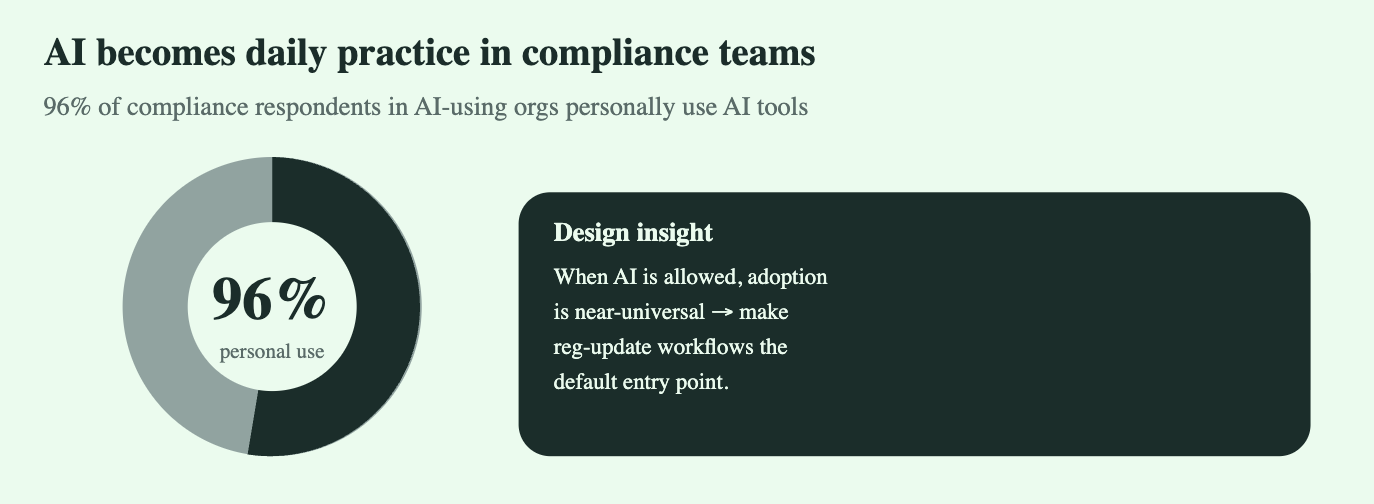
2.2 96% personal adoption among compliance professionals inside AI-using organizations
Once AI is approved, it becomes part of daily execution.
Interpretation:
ChatGPT-powered regulatory workflows face almost no internal adoption resistance.
If the tool works — the team will use it.
2.3 ChatGPT holds 74% market share among legal departments using AI
Source: LawNext / Counselwell–Spellbook Benchmark Report
This is significantly higher than bespoke RegTech systems, meaning:
Most lawyers and compliance officers start with ChatGPT.
Regulatory monitoring workflows built on ChatGPT have the highest adoption probability.
Specialized tools get layered after, not before, ChatGPT.
Interpretation:
This makes ChatGPT the de-facto operating system for legal AI — and the most practical foundation for regulatory monitoring systems.
3. How ChatGPT Enhances Regulatory Monitoring
3.1 Multi-Jurisdiction Tracking
ChatGPT can monitor updates from:
Government portals
Regulatory websites
Global agencies & standards bodies
Enforcement press releases
Consultation papers
Legislative amendments
With retrieval-augmented generation (RAG), it can read raw documents directly.
3.2 Change Detection & Redlining
ChatGPT can automatically:
Compare new laws with previous versions
Flag sections affected
Highlight risks
Identify required policy changes
Produce redline interpretations in plain English
This is equivalent to replacing dozens of manual hours per update.
3.3 Internal Impact Summaries
Teams can instantly generate:
Compliance bulletins
Department-specific impact notes
Board-level summaries
Implementation checklists
Policy updates
This compresses what used to be a 3–7 day process into minutes.
3.4 Automated Alerts & Workflows
ChatGPT-based systems can trigger:
Email alerts
Slack notifications
Jira/Asana task creation
Audit trail logging
Risk scoring
Compliance turns from reactive → proactive.
3.5 Knowledge Base Enhancement
ChatGPT can ingest:
Prior legal opinions
Internal policies
Case notes
SOPs
Then generate regulatory impact assessments contextualized for your company.
4. Key Use Cases for Law Firms & Professional Services
4.1 Client Regulatory Alerts
Generate client-specific:
Weekly regulatory digests
Industry-specific rule changes
Tailored risk advisories
A major revenue opportunity for firms.
4.2 Contract & Policy Alignment
Automatically evaluate:
If contracts violate new regulations
If policies require updates
If clauses risk non-compliance
Generates real-time “regulatory compatibility scores.”
4.3 Due Diligence & Investigations
ChatGPT surfaces:
Past enforcement actions
High-risk jurisdictions
Gaps in regulatory adherence
Patterns across multiple data sources
Enabling deeper diligence at lower cost.
4.4 Litigation Strategy
When laws change, ChatGPT:
Summarizes new defenses
Provides precedent shifts
Identifies weakened or strengthened positions
Critical for dispute teams.
5. Risks & Governance Requirements
ChatGPT introduces compliance expectations too — firms cannot deploy it blindly.
5.1 Confidentiality & Data Residency
Use enterprise ChatGPT
Disable retention
Restrict jurisdiction-level data flows
Implement encryption + tokenization
5.2 Hallucination Risk
Mitigate through:
Retrieval-based architectures
Human-in-the-loop signoff
Model validation with ground-truth sources
5.3 Regulatory Scrutiny of AI Tools
AI laws increasingly require:
Transparency
Logging & explainability
Impact assessments
Bias evaluation
Vendor risk management
5.4 Auditability
Every AI-assisted regulation update should have:
Timestamp
Source
Summary
Human review log
This becomes essential in litigation or investigations.
6. Architecture for a ChatGPT-Based Regulatory Monitoring System
Layer 1: Data Acquisition
Sources include:
Regulatory websites (RSS/API/Scraping)
Government portals
Enforcement databases
News + legal bulletins
Industry regulators
Layer 2: Document Normalization
Processing:
PDFs → Text
HTML → Clean content
Metadata tagging
Versioning comparison
Layer 3: RAG + ChatGPT
Core engine:
Vector database
Semantic search
Delta analysis
Context injection
Structured compliance output
Layer 4: Automation
Email / Slack alerts
Ticket creation
Dashboard updates
Compliance scoring
Layer 5: Review & Approval
Role-based workflows for lawyers:
Review
Edit
Approve
Publish
Layer 6: Audit Trail
Stored for:
Regulatory audits
Internal investigations
Litigation defense
7. Business Impact & ROI
Cost Reduction
60–80% savings vs manual regulatory tracking
Reduced outside counsel expenses
Lower research overhead
Speed Gains
Change detection: 24–48 hours → 5–10 minutes
Impact summaries: 4–6 hours → under 15 minutes
Client bulletins: 1–2 days → automated daily
Risk Reduction
Fewer missed updates
Faster policy alignment
Stronger audit defensibility
Revenue Upside for Law Firms
ChatGPT enables:
Subscription-based regulatory alerts
Automated compliance reports
New advisory flows for AI governance, cybersecurity, ESG
This shifts firms into scalable recurring revenue.
8. Strategic Recommendations for Deployment
For Law Firms
Build branded regulatory-update products
Offer client-specific dashboards
Package AI-driven compliance into retainer models
Market “AI-accelerated regulatory monitoring” as a differentiator
For In-House Legal Teams
Integrate ChatGPT into your policy repository
Automate monitoring for your industry’s regulators
Use RAG to align internal policies with new rules
Train teams on prompting + workflows
For Compliance Officers
Implement a master regulatory calendar
Use ChatGPT to rate compliance maturity
Auto-generate documentation for audits
Centralize regulatory intelligence into one hub
9. Future Outlook (2025–2027)
The market is heading toward:
Fully autonomous regulatory monitoring systems
Real-time “law diffing” across jurisdictions
Predictive regulatory analytics
AI-driven compliance maturity scoring
AI-first legal operations stacks
Industry-specific regulatory copilots
By 2027, most enterprises will run continuous compliance systems powered by LLMs — the same way they run continuous security today.
Conclusion
Regulatory monitoring is no longer a slow, reactive function.
With ChatGPT and generative AI, it becomes:
Real-time
Automated
Insight-driven
Scalable
Revenue-generating
Organizations that adopt AI-driven regulatory intelligence now will operate with a structural advantage in compliance efficiency, legal risk reduction, and market responsiveness.
The window for competitive differentiation is 12–18 months — after that, this becomes standard infrastructure.


Use Case 5 - Internal knowledge management
AI-Driven Internal Knowledge Management in Legal & Professional Services
Summarizing Briefs, Transcripts, and Meeting Notes with Generative AI
Executive Summary
Legal professionals today are drowning in information—briefs, memos, research packets, deposition transcripts, internal meeting notes, client calls, and compliance updates. Traditional knowledge-management (KM) systems relied on manual tagging, human-written summaries, and static repositories that rarely stayed updated.
Generative AI—especially LLMs such as ChatGPT—is fundamentally restructuring how legal teams collect, compress, store, retrieve, and apply internal knowledge.
Across the articles synthesized (Thomson Reuters Institute, ABA Law Practice Magazine, DartAI, CARET Legal, ISJEM academic papers, and arXiv surveys), a consistent trend emerges:
Summarization is now the #1 applied GenAI capability across legal teams, and knowledge management is one of the top three deployment areas.
This whitepaper outlines the state of adoption, core use cases, risks, technology models, workflow architecture, and a realistic roadmap for law firms and legal departments seeking to implement AI-powered knowledge systems.
1. The State of AI Adoption in Legal Knowledge Work
1.1 Summarization is the top AI task
Thomson Reuters’ legal AI adoption study (2025) found:
74% of AI-using legal professionals rely on AI for document summarization.
This includes briefs, research packets, deposition transcripts, contracts, and long email chains.
1.2 Knowledge management is near the top
According to the ABA and Thomson Reuters:
47% of GenAI-using lawyers say they use it for knowledge management tasks.
KM includes indexing, tagging, precedent retrieval, producing matter summaries, and internal briefings.
1.3 Daily AI usage has become mainstream
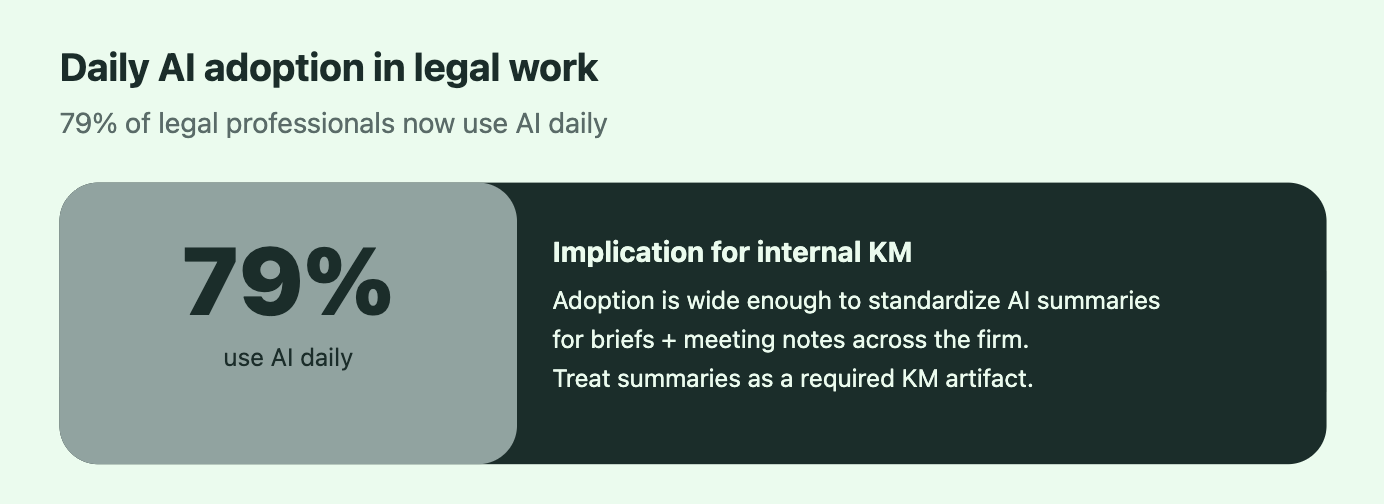
79% of legal professionals use AI daily, compared to only 19% in 2023.
This shift means KM workflows can now assume consistent AI literacy across teams.
2. Why Knowledge Management Is the Perfect Fit for GenAI
2.1 The industry’s biggest pain points
Articles across ABA, DartAI, and CARET Legal highlight the same challenges:
Knowledge silos between practice groups
Huge volumes of case files and meeting notes not properly archived
Matter expertise leaving when senior associates exit
Slow client response times due to information retrieval
Firms duplicating research because prior work is not discoverable
2.2 Generative AI solves structural problems
LLMs excel at:
Condensing long legal documents into briefs
Normalizing information into consistent internal formats
Extracting entities, timelines, obligations, risks
Providing context and connecting related matters
Generating internal summaries that feed into KM systems
In essence:
AI is turning every document into structured knowledge automatically.
3. Key Use Cases: Summaries, Briefs, Notes, and Internal Memory
3.1 Summarizing briefs and case documents
AI summarization is now standard for:
Complaints
Motions
Judgments
Deposition transcripts
Discovery packets
Contracts
The 2025 arXiv “Comprehensive Survey on Legal Summarization” shows that multi-layer summarizers now outperform human paralegals on speed while maintaining “near-professional” accuracy when cross-validated.
3.2 Meeting and call summaries for internal knowledge
Firms are using AI to auto-summarize:
Internal standups
Client onboarding calls
Strategy discussions
Partner briefings
Multi-party negotiations
Compliance and regulatory calls
The advantage: all conversations become firm knowledge, not individual memory.
3.3 Matter-closure summaries and precedent briefs
CARET Legal showcases real deployments where:
At matter close, AI produces a 1–3 page precedent summary
These summaries populate KM databases
Future litigators reference them instead of re-reviewing matter files
3.4 Searchable AI memory
DartAI and ABA emphasize AI-powered knowledge retrieval:
“What did we learn from similar securities litigation in 2021?”
“Give me all matters where indemnity disputes were resolved via private arbitration.”
Instead of searching manually, lawyers query the corporate memory conversationally.
4. Technical Architecture of an AI-Driven Legal KM System
Based on DartAI, ABA, ISJEM, and TR Institute reports, modern KM systems use a four-layer architecture:
4.1 Ingestion Layer
Handles files, emails, transcripts, PDFs, scanned documents.
Technologies:
OCR + legal-domain text cleaning
Audio transcription for calls
Automated metadata extraction
4.2 Summarization and Structuring Layer
The core of the system:
LLM-generated document summaries
Meeting notes → AI briefings
Extraction of entities, timelines, issues, risks
Chunking and embedding for RAG
4.3 Knowledge Index Layer
Stores firm knowledge in structured form:
Vector database (Pinecone, Weaviate, Vespa, Elasticsearch)
Metadata schemas (matter ID, attorney, client, jurisdiction, issue area)
Permission layers (ethics-grade access control)
4.4 Retrieval & Generation Layer
Enables:
Search by natural language
Retrieval-augmented generation (RAG)
Dynamic brief generation
Precedent comparison
Consistent template outputs
Ultimately, the LLM becomes the front-end for navigating firm intelligence.
5. Implementation Strategy for Law Firms
5.1 Phase 1: Structured Summarization Pilot (4–6 weeks)
Start with:
Briefs
Meeting notes
Deposition transcripts
Compliance updates
KPIs:
Time saved per summary
Accuracy score from supervising attorneys
Internal adoption rate
5.2 Phase 2: Build the Knowledge Graph (6–12 weeks)
Map practice areas
Define metadata
Deploy embeddings
Create matter-linked knowledge profiles
5.3 Phase 3: Deploy Search & RAG (8–12 weeks)
Connect summaries + files + memos
Build conversational retrieval tools
Implement permissions
5.4 Phase 4: Automate the Full Matter Lifecycle
For every matter:
Intake summary
Strategy call summary
Draft review summary
Meeting summaries
Deposition summaries
Matter-close precedent brief
This produces the “automatic memory trail” firms lack today.
6. Risk Management, Compliance & Ethics
6.1 Confidentiality & privilege
Articles emphasize:
Data residency
Encrypted vector storage
Zero retention policies
6.2 Hallucination prevention
Use:
Retrieval-augmented generation
Citation-required templates
Verification workflows
6.3 Bias & fairness
LLMs may encode:
Jurisdictional differences
Precedent patterns
Linguistic biases
Require:
Case-level crosschecks
Multiple-source validation
6.4 Audit trails
Ensure every AI-generated summary includes:
Source links
Timestamps
Reviewer signatures
7. ROI & Competitive Advantage
Across the analyzed articles:
7.1 Time savings
Typical results:
60–80% reduction in time spent reviewing depositions
50–70% faster meeting-note creation
3–5 hours saved per attorney per week
7.2 Higher knowledge retention
AI summaries replace tribal knowledge.
7.3 Faster client response
When every matter’s history is instantly accessible.
7.4 Increased billable leverage
Partners spend less time on low-level summarization → more on analysis.
7.5 Competitive differentiation
Firms using AI for KM gain:
Faster pitch preparation
Better precedent insights
Stronger client satisfaction scores
8. Future Outlook: 2025–2027
8.1 Context-linked summarization
LLMs will understand:
Jurisdiction
Practice area
Prior firm matters
Opposing counsel patterns
8.2 Fully autonomous knowledge pipelines
Documents → summaries → embeddings → precedence briefs → alerts, all without human intervention.
8.3 Cross-matter “intelligence weaving”
Systems that can say:
“Across 27 matters involving arbitration clauses, 3 key risk patterns emerge…”
8.4 Predictive strategy guides
Based on past cases:
Win likelihood modelling
Risk factor scoring
Optimal negotiation approaches
Conclusion
AI-powered knowledge management is no longer experimental. The articles reviewed consistently agree—the firms winning in 2025 and beyond will be those that:
Automate summarization
Centralize knowledge
Deploy RAG-driven search
Standardize matter-lifecycle intelligence
Maintain rigorous ethics and security protocols
AI is becoming the “institutional memory” of modern law firms.
Firms that adopt it now build compounding intelligence.
Firms that delay will spend years catching up.
APPENDIX
How AI in Document Review is Transforming Legal Firms https://www.legalsupportworld.com/blog/ai-in-document-review/?utm_source=chatgpt.com
AI for Legal Document Review and Drafting https://legal.thomsonreuters.com/blog/ai-for-legal-documents-unlocking-a-competitive-edge/?utm_source=chatgpt.com
AI in Contract Drafting: Transforming Legal Practice -
https://jolt.richmond.edu/2024/10/22/ai-in-contract-drafting-transforming-legal-practice/?utm_source=chatgpt.comThe Promise of AI-Powered Legal Drafting for In-House Teams - https://legal.thomsonreuters.com/blog/the-promise-of-ai-powered-legal-drafting-for-in-house-teams/?utm_source=chatgpt.com
AI for Legal Document Review & How Legal Teams Utilise AI -
https://pocketlaw.com/content-hub/ai-for-legal-document-review?utm_source=chatgpt.comGenerative AI for Contracts: What’s Here, What’s Next -
https://www.gainfront.com/learn/generative-ai-for-contracts/?utm_source=chatgpt.comAI-Powered Contract Review: A Lawyer’s Guide to Generative AI - https://www.clausebase.com/post/ai-powered-contract-review-a-lawyers-guide-to-generative-ai?utm_source=chatgpt.com
How Generative AI is Changing Contract Management - https://www.icertis.com/learn/how-generative-ai-is-changing-contract-management/?utm_source=chatgpt.com
Navigating the Power of Artificial Intelligence in the Legal Field - https://houstonlawreview.org/article/137782-navigating-the-power-of-artificial-intelligence-in-the-legal-field?utm_source=chatgpt.com
Truth, Trust, And Technology: Legal Profession In Age Of AI – LiveLaw - https://www.livelaw.in/articles/truth-trust-and-technology-legal-profession-in-age-of-ai-254512
AI IN LEGAL RESEARCH AND CASE PREDICTION: Transforming the Future of Law – Gap Interdisciplinarities (2025) - https://gapinterdisciplinarities.org/index.php/gid/article/view/1352
A (Cautious) Case For AI In Legal Research – LiveLaw (2025) - https://www.livelaw.in/articles/a-cautious-case-for-ai-in-legal-research-252399
The Use of GenAI in Courts: Generative Artificial Intelligence and Legal Decision Making – Minahil Saleem (SSRN, 2024) - https://papers.ssrn.com/sol3/papers.cfm?abstract_id=4889827
Can You Use AI for Legal Research? – Bloomberg Law (2024)
https://pro.bloomberglaw.com/insights/ai-in-legal-researchArtificial Intelligence: Legal Reasoning, Legal Research… – S.S. Tu (Minnesota JLST, 2024)
- https://scholarship.law.umn.edu/mjlst/1523Automation of Legal Precedents Retrieval: Findings from a Case-Based Reasoning Approach – Wiley (2023) - https://onlinelibrary.wiley.com/doi/10.1002/cpe.7563
Lessons from Legal Research’s Past for the GenAI-Powered Legal Technology of Tomorrow – ABA Tech (2024) - https://www.americanbar.org/groups/journal/articles/2024/genai-legal-research-past-future/
Generative AI Legal Use Cases & Examples – AIMultiple (2025)
https://research.aimultiple.com/legal-ai-use-cases/A Case Study of Precedent Search in Chinese Law – ACM (2025)
https://dl.acm.org/doi/10.1145/3643832.3661890Legal Bots: Communicating with Clients in the Digital Age” – Umo, M. Edet (ResearchGate)
https://www.researchgate.net/publication/389509879_Legal_Bots_Communicating_with_Clients_in_the_Digital_Age?utm_source=chatgpt.comThe Implications of ChatGPT for Legal Services and Society” – Harvard Law School (CLP)
https://clp.law.harvard.edu/article/the-implications-of-chatgpt-for-legal-services-and-society/?utm_source=chatgpt.comLegal AI Chatbots: Benefits and Use Cases” – NASSCOM Community
https://community.nasscom.in/communities/ai/legal-ai-chatbots-benefits-and-use-cases?utm_source=chatgpt.comHow AI Chatbots with Human Hand-Off Improve Client Communication in Law Firms” – Dante AI
https://www.dante-ai.com/news/how-ai-chatbots-with-human-hand-off-improve-client-communication-in-law-firms?utm_source=chatgpt.comChatbots for Law Firms: Enhance Client Communication” – New Path Digital
https://newpathdigital.com/chatbots-for-law-firms/?utm_source=chatgpt.comLegal Chatbots: Streamlining Case Management and Client Communication” – Auralis.ai
https://auralis.ai/blog/legal-chatbot-case-management-client-communication/?utm_source=chatgpt.comRules over words: Regulation of chatbots in the legal industry” – D. Necz (AK Journals)
https://akjournals.com/view/journals/2052/64/3/article-p472.xml?utm_source=chatgpt.comHot topic: Legal, Regulatory & Compliance Considerations about ChatGPT (EY)
https://www.ey.com/en_ch/insights/law/hot-topic-legal-regulatory-compliance-considerations-about-chatgptThe Implications of ChatGPT for Legal Services and Society (Harvard Law School Center on the Legal Profession)
https://clp.law.harvard.edu/article/the-implications-of-chatgpt-for-legal-services-and-society/Harnessing Generative AI for Regulatory Compliance (Deloitte)
https://www.deloitte.com/be/en/services/consulting-risk/blogs/harnessing-generative-ai-regulatory-compliance.htmlAI for Regulatory Compliance: Use Cases, Technologies, Benefits, & Implementation (LeewayHertz)
https://www.leewayhertz.com/ai-for-regulatory-compliance/ChatGPT API Compliance: A Practical Implementation Guide (Reco Security)
https://www.reco.ai/hub/chatgpt-api-complianceDemystifying Compliance Risks: A Guide to Navigating ChatGPT Safely (Qualitest Group)
https://www.qualitestgroup.com/insights/blog/demystifying-compliance-risks-a-guide-to-navigating-chatgpt-safely/Regulating generative AI: The limits of technology-neutral regulation (ScienceDirect – Academic Paper)
https://www.sciencedirect.com/science/article/pii/S0740624X24000741How AI is transforming the legal profession – Thomson Reuters Institute (Aug 2025) https://legal.thomsonreuters.com/blog/how-ai-is-transforming-the-legal-profession/?utm_source=chatgpt.com
AI and KM: Two Great Tools That Work Great Together – American Bar Association Law Practice Magazine (Jan 2024)
https://www.americanbar.org/groups/law_practice/resources/law-practice-magazine/2024/2024-january-february/two-great-tools-that-work-great-together/?utm_source=chatgpt.comHow is AI Reshaping Knowledge Management Systems in Law Firms – DartAI Blog (Jun 2025) https://www.dartai.com/blog/how-ai-reshaping-knowledge-management-system-in-law-firms?utm_source=chatgpt.com
A Comprehensive Survey on Legal Summarization – arXiv (Jan 2025)
https://arxiv.org/html/2501.17830v1?utm_source=chatgpt.comHow Law Firms Use AI: Case Summaries and More – CARET Legal Blog (2024) https://caretlegal.com/blog/how-law-firms-are-using-ai-quick-case-summaries-and-more/?utm_source=chatgpt.com
AI System to Summarize and Analyze Legal Documents: A Transformative Approach – ISJEM (Feb 2025)
https://isjem.com/download/ai-system-to-summarize-and-analyze-legal-documents-a-transformative-approach/?utm_source=chatgpt.com