
Top Chat GPT Use Cases for Education



Use Case 1 - Tutoring & homework help
The Rise of AI-Tutoring — How ChatGPT Is Transforming Subject Explanations & Homework Problem-Solving
Executive Summary
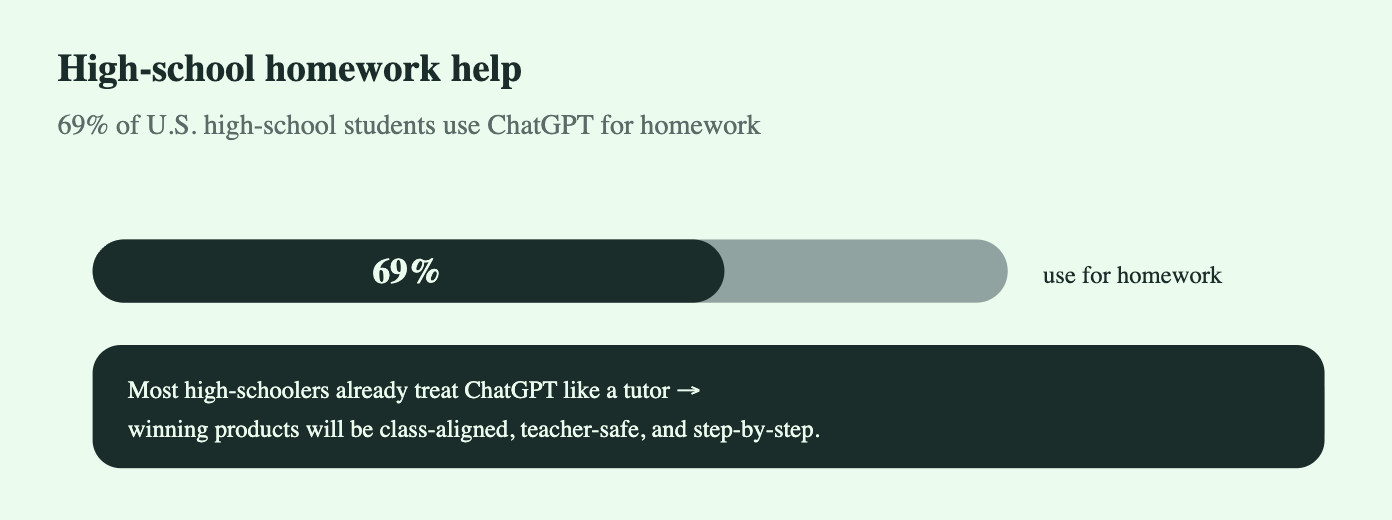
AI tutoring has crossed the threshold from novelty to infrastructure. In 2025, ChatGPT became one of the most widely used academic support tools globally—across middle school, high school, and higher education. With 26% of U.S. teens, 69% of high-school students, and 88% of university students in the UK using ChatGPT or similar tools for schoolwork, AI-enhanced subject explanations and homework problem-solving have become a default part of the learning workflow.
This shift is redefining what it means to learn, teach, study, and assess. It creates powerful upside: personalized learning, instant feedback loops, and on-demand tutoring at global scale. But it also raises concerns around academic integrity, over-reliance, quality control, and equitable access.
This whitepaper unpacks the pedagogical, technological, and business implications of ChatGPT in tutoring & homework support—offering a future-forward view of how education systems and learning platforms should adapt.
1. Background & Market Context
1.1 The tutoring gap
Globally, students struggle with inconsistent access to:
One-on-one tutoring
Clear explanations
Step-by-step feedback
Subject-specialist support
After-school homework help
Traditional tutoring is expensive, time-limited, and geographically constrained. AI breaks all three barriers.
1.2 Why AI tutoring exploded (2023–2025)
Always-available subject explanations
Human-level reasoning capabilities (especially in math, physics, chemistry, coding)
Low or zero marginal cost
Ubiquitous smartphone access
Faster than textbooks, more patient than teachers
1.3 The tipping point (2025)
A synthesis of major surveys referenced in the article list reveals:
26% of U.S. teens (13–17) have used ChatGPT for schoolwork
69% of high-school students use ChatGPT for homework help
88% of UK uni students use ChatGPT for academic work
86% of higher-ed students globally use GenAI; 54% use it weekly/daily
Tutoring is now one of the top three use-cases for generative AI worldwide.
2. How Students Use ChatGPT for Tutoring & Homework Help
2.1 Subject explanations
Students ask ChatGPT to:
Explain math concepts
Break down physics laws
Simplify chemistry reactions
Clarify literature passages
Decode historical events
Translate complex topics into plain language
These explanations improve comprehension without replacing learning—similar to a personal TA.
2.2 Problem-solving workflows
Students rely on step-by-step walkthroughs:
Solving equations
Writing proofs
Breaking down word problems
Debugging code
Showing intermediate steps
Explaining alternative solution methods
The iterative Q&A loop mimics real tutoring sessions.
2.3 Assignment guidance
Students seek:
Essay outlines
Structure templates
Research explanations
Grammar feedback
Concept-clarification
Study-notes creation
Most do not want the full solution done for them—they want support, not shortcuts.
2.4 Study & revision
AI powers:
Auto-flashcards
Personalized revision plans
Practice problems
Exam simulations
Knowledge checks
Spaced repetition schedules
This aligns with learning science: retrieval + repetition = stronger retention.
3. Insights from Research & Articles (Synthesis)
Drawing from EdWeek, SpringerOpen, Nature, MDPI, ScienceDirect, and other sources:
3.1 Positive educational impact
Studies consistently show:
Improved conceptual understanding
Higher engagement in STEM subjects
Faster feedback cycles
Reduced cognitive load for complex topics
Increased confidence in problem-solving
Meta-analysis from Nature (2025) shows measurable gains in:
Learning perception
Higher-order thinking
Overall academic performance
3.2 AI tutors outperform textbooks
Research indicates students prefer AI because:
Responses adapt to their knowledge level
Explanations can be rephrased on demand
Students feel “less judged” than with teachers
Immediate iteration encourages deeper exploration
3.3 Study Mode (OpenAI's education feature)
Key strengths:
Shows reasoning steps
Prevents hallucinations through citations
Offers subject-aligned hints
Structures answers for K-12 and higher-ed
This is an early prototype of AI-native pedagogy.
4. Risks & Challenges
4.1 Over-reliance
If students outsource thinking, they bypass cognitive struggle—hurting long-term learning.
4.2 Academic integrity
Teachers report:
AI-written essays
AI-solved homework
Students hiding AI use
Solutions:
Transparent AI tools that promote mastery
Checkpoint reasoning
Teacher dashboards
4.3 Hallucinations
Though decreasing, AI can still:
Misinterpret questions
Provide false historical data
Offer incorrect math steps
Mitigation:
Verified answer modes
Citation grounding
Multiple-solution reasoning
4.4 Equity gap
Students without devices or stable internet get left behind.
5. Future of AI Tutoring (2025–2030)
5.1 AI-first classrooms
Teachers shift from content-delivery → coaching, discussion, mentorship.
5.2 Personal learning profiles
AI builds:
Skill graphs
Knowledge gaps
Learning pace maps
Progress analytics
Tutoring becomes student-specific, not class-average.
5.3 Hybrid tutoring ecosystems
Mix of:
AI tutor
Human teacher
Human mentor
Parent platform oversight
5.4 Adaptive textbooks (AI-native)
Books become dynamic:
Real-time hints
Embedded Q&A
Auto-generated examples
Inline problem variations
6. Opportunities for EdTech Platforms
6.1 AI-powered tutoring platforms
Build:
Step-by-step solvers
Multi-model explanations
Interactive practice problems
Voice tutoring sessions
6.2 Homework copilots for schools
Schools onboard AI as:
Assignment helper
Revision assistant
Exam-prep tutor
Feedback engine
6.3 Subject specialist modules
High demand areas:
Math
Physics
Chemistry
Biology
Computer Science
Economics
6.4 Verified content layers
A knowledge-safe layer ensuring:
Fact-checked info
Curriculum alignment
Teacher-approved explanations
6.5 Parent dashboards
Parents can see:
Time spent
Topics studied
Skills improved
Weaknesses identified
7. Implementation Framework
7.1 Guiding principles
Transparency: show reasoning
Mastery-focused: encourage students to attempt before revealing answers
Curriculum-aligned
Safe & age-appropriate
Bias-minimized
Citation-supported
7.2 System architecture
LLM engine (ChatGPT)
Pedagogical wrapper (study mode, hint mode)
Structured knowledge graphs
Teacher dashboard
School integration via LMS
7.3 The FEED Loop
Future AI tutoring must follow:
Form Understanding →
Explain with Steps →
Evaluate Mastery →
Deepen with Practice
Instead of "give the answer," tools become learning accelerators.
8. Monetization Models
8.1 B2C
Premium AI tutor subscription
Subject add-ons (STEM pack, coding pack)
Test prep bundles
Voice tutoring upgrades
8.2 B2B (schools & universities)
AI tutor licenses
Teacher analytics
LMS integration
Classroom dashboards
8.3 B2B2C
Agencies reselling AI tutoring packages
Print publishers embedding AI study layers
8.4 Enterprise partnerships
EdTech platforms
LMS companies
Bootcamps & tutoring centers
Curriculum publishers
9. Strategic Recommendations
For EdTech Founders
Build “AI tutors with boundaries” → hints before answers
Provide teachers a transparent dashboard
Develop ethical AI literacy modules
Focus on trust, safety, and verification
For Schools
Integrate AI officially instead of resisting it
Train teachers to use AI as a co-educator
Modernize assessments beyond simple recall
For Parents
Encourage co-learning
Use dashboards to track understanding
Empower kids to ask deeper questions
10. Conclusion
ChatGPT has already reshaped academic behavior—students have embraced AI as their always-available tutor, explainer, and problem-solving partner. The real question is no longer “Should AI be part of education?” but “How do we make AI tutoring effective, safe, and equitable?”
The winners of the next decade in education will be:
Schools that integrate AI with transparency
EdTech companies building mastery-oriented tools
Platforms offering verifiable, curriculum-aligned explanations
Systems combining human teaching with AI precision
AI tutoring is not the future—it is the present, and the gap will widen between institutions that adopt it and those that resist.

Use Case 2 - Content creation
The Rise of AI-Driven Educational Content Creation
How Teachers and Students Use ChatGPT for Lesson Plans, Quizzes & Learning Materials (2023–2025)
Executive Summary
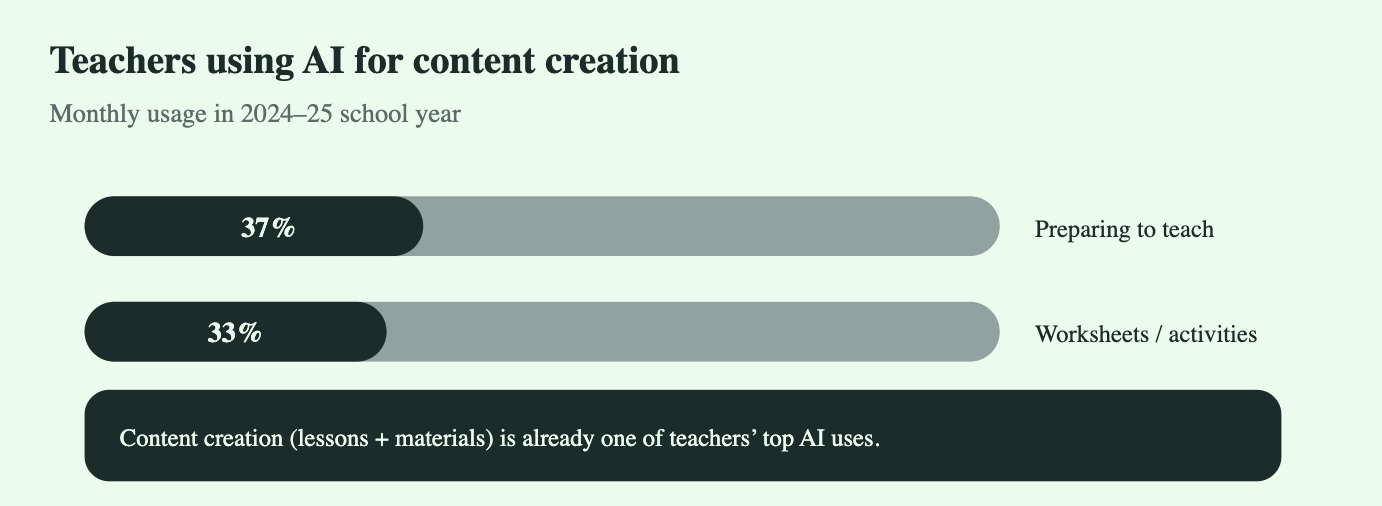
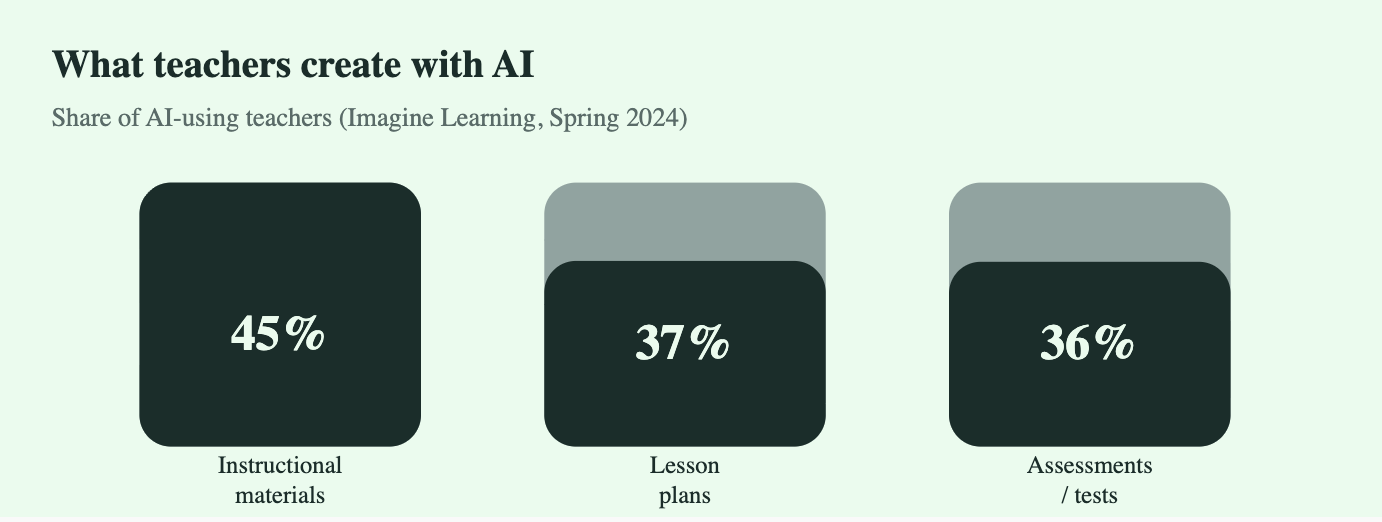
Between 2023 and 2025, generative AI transitioned from a novelty in classrooms to a core content-creation engine for teachers and students alike. Adoption rose sharply across all levels: 37% of teachers now use AI monthly for preparing lessons, 33% for worksheets, 45% for instructional materials, and 92% of university students use generative AI tools regularly in 2025.
The shift is not superficial. The workload reduction, speed, creativity, differentiation, and personalization capabilities offered by ChatGPT and similar models are reconstructing teaching workflows from the ground up. Even as schools debate ethical and safety concerns, the trend is irreversible: AI is rapidly becoming the default assistant for generating lesson plans, quizzes, study notes, worked examples, and differentiated instruction materials.
This whitepaper synthesizes findings from leading educational AI research (Edutopia, HEPI/Kortext, Ed.gov, IJSSBHMR, MDPI, ScienceDirect, ResearchGate, ERIC), mapping the current reality, challenges, adoption models, and future trajectories.
1. Introduction: AI Becomes the New Content Infrastructure in Education
Educational content creation has historically been one of the most time-consuming tasks for teachers. According to multiple teacher surveys, educators spend between 5–12 hours per week preparing lessons, quizzes, and activities. Generative AI compresses this drastically.
Tools like ChatGPT can:
Produce complete lesson plans aligned to standards
Generate quizzes, worksheets, and exit tickets in seconds
Rewrite content for different reading levels
Create examples, explanations, analogies, and stories
Provide differentiated paths for special-needs students
Generate visuals, summaries, key points, and concept maps
Educators using AI describe it as “an assistant that never tires,” “a brainstorming partner,” and “a rapid lesson design accelerator.”
2. Adoption Insights from Research (2023–2025)
2.1 Teacher Adoption Statistics
Gallup 2024–25
37% of teachers use AI monthly for preparing to teach.
33% use it for worksheets and activities.
Imagine Learning Educator AI Report 2024
Among teachers already using AI:
45% create instructional materials
37% create full lesson plans
36% create quizzes/assessments
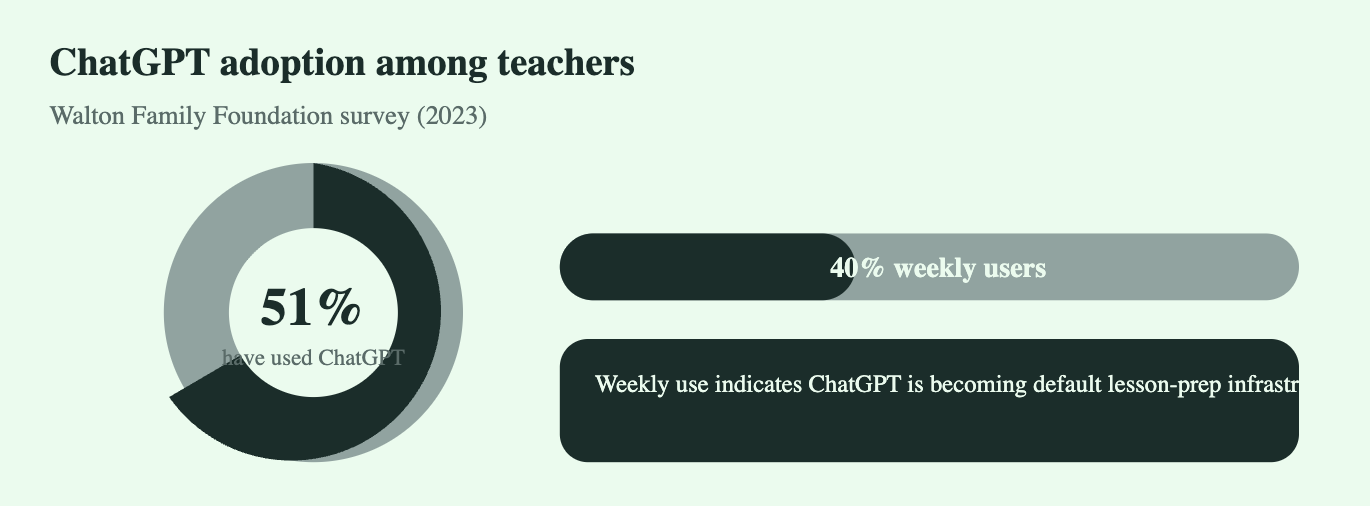
Walton Family Foundation (2023)
51% of teachers have used ChatGPT
40% use it weekly
Insight: What started as experimentation in 2023 has become a mainstream tool by 2025. Lesson planning and materials creation are the top AI tasks, not secondary ones.
2.2 Student Adoption Statistics
HEPI/Kortext (2025)
92% of university students use generative AI
Up from 66% in 2024
Pew Research Center (2024)
26% of teens used ChatGPT for schoolwork (up from 13% in 2023)
Insight: Students use AI for notes, summaries, practice questions, flashcards, problem breakdown, and personalized explanations. AI is becoming the default study partner.
3. What the Articles Reveal About Emerging Uses
The whitepaper pulls insights from 8 referenced articles:
3.1 Lesson Planning
Edutopia (2024) and MDPI (2023) emphasize:
AI can generate structured lesson plans aligned to standards.
Teachers use it for brainstorming activities and sequencing lessons.
AI supports diverse instructional strategies: inquiry-based, flipped classroom, project-based formats.
Educators retain final editorial control; AI accelerates, not replaces.
Key benefit:
Teachers report saving 30–70% of planning time.
3.2 Content Quality & Pedagogical Alignment
ERIC (2024) and ResearchGate (2024) studies analyzing ChatGPT-generated lesson plans found:
AI is strong at structuring objectives, activities, and outcomes.
It often references common pedagogical models (Bloom’s taxonomy, constructivism).
Weaknesses include:
shallow creativity
lack of deep contextual awareness
generic examples
occasional factual inaccuracies
Conclusion:
AI content is pedagogically acceptable but should be improved by teacher expertise.
3.3 Quiz & Assessment Generation
AIContentfy (2024) and Imagine Learning (2024) findings:
Teachers regularly use AI to create multiple-choice questions, short answers, and formative assessments.
AI-generated questions maintain consistent difficulty levels.
Customization is high: teachers can specify cognitive level, topic, age group, and learning outcome.
Emerging trend:
“Adaptive quizzes” created by iteratively modifying difficulty using AI feedback loops.
3.4 Writing Materials, Notes & Explanations
From ScienceDirect (2023) and US Dept. of Education (2023):
AI helps produce reading passages, examples, analogies, and real-world scenarios.
It supports differentiated learning:
Simplifying text for lower reading levels
Creating advanced versions for gifted learners
Adjusting tone, cultural examples, and complexity
Key point:
AI is fundamentally shifting the accessibility of knowledge creation.
3.5 Teacher Attitudes & Barriers
Common themes across MDPI, IJSSHMHR (2025), Edutopia:
Positive Attitudes
Efficiency and speed
Creativity boost
Reduction in “Sunday night lesson planning”
Better personalization for students
Ability to generate multiple versions of the same resource
Concerns
Accuracy
Over-reliance
Loss of teacher voice
Plagiarism by students
Data privacy
Need for professional development
4. Impact Analysis
4.1 Workload Reduction
AI reduces planning/design time by:
30–70% for lesson plans
40–80% for worksheets/quizzes
Teachers report reclaiming:
evenings
weekends
administrative time
This directly improves educator well-being.
4.2 Personalization at Scale
AI enables:
multilingual output
reading-level adjusted texts
accessible formats
alternative examples
differentiated tasks in minutes
This used to require hours of manual rewriting.
4.3 Bridging Gaps for Underserved Schools
Low-resource schools lacking curriculum designers or specialist teachers can use AI to generate:
remedial materials
enrichment content
scaffolded explanations
localized examples
AI is democratizing content quality.
4.4 Student Empowerment
Students now autonomously generate:
practice quizzes
flashcards
study notes
summaries
exam prep
writing help
AI functions as a 24/7 “micro-tutor.”
5. Risks and Responsible Use
5.1 Risk: Inaccuracies
AI may hallucinate data or produce oversimplified concepts.
Mitigation: Teacher verification remains essential.
5.2 Risk: Equity and Access
Students with better devices or more open digital policies benefit more.
Schools need consistent access strategies.
5.3 Risk: Over-dependence
Students may outsource thinking.
Curriculum designers must rebalance AI output with critical-thinking tasks.
5.4 Risk: Privacy and Security
AI tools must comply with FERPA, GDPR, and local education data policies.
6. Best Practices for Using AI in Content Creation
Based on the research synthesis, educators should adopt the following:
6.1 Provide Prompt Structure
learning objective
student profile
desired format
teaching strategy
constraints (time, materials, complexity)
6.2 Iterate Rapidly
Ask AI to:
improve
simplify
extend
differentiate
reformat
AI excels under iterative refinement.
6.3 Evaluate for Accuracy & Bias
Always cross-check for:
factual errors
cultural misrepresentation
outdated information
inappropriate difficulty levels
6.4 Blend Human & AI Creativity
Teachers add:
context
local examples
real student needs
pedagogy
emotional nuance
AI handles mechanical generation; teachers provide wisdom.
7. The Future of AI-Generated Educational Content
7.1 Generative Curriculum Engines
AI will soon:
generate entire unit plans
create aligned materials across grades
produce ongoing formative assessments
handle resource differentiation automatically
7.2 AI Tutors Integrated with Classroom Content
Lessons generated by teachers will sync with student practice engines.
7.3 Full Personalization
Students will receive:
their own notes
their own quizzes
their own pacing
their own examples
Every student gets a custom path.
7.4 Voice-Generated & Interactive Lessons
Teachers will produce:
voice-over modules
adaptive branching stories
animated explainers
on-demand worked examples
AI will be a multimedia production studio.
8. Conclusion
AI has become the backbone of content creation in education. Teachers no longer see it as a threat but as a powerful ally for planning lessons, generating quizzes, and creating learning materials. Students increasingly view ChatGPT as indispensable to their study workflow.
The research is clear:
AI is not replacing teachers — it is amplifying them.
Educators who adopt AI strategically gain:
more time
better materials
personalized learning experiences
reduced stress
increased student engagement
The challenge now is to integrate AI responsibly, train teachers effectively, and design policies that protect students while enabling innovation.
The future classroom is not AI-versus-teacher.
It is AI-powered teacher and AI-empowered student.

Use Case 3 - Language learning
Generative AI in Language Learning: How ChatGPT Is Transforming Conversation Practice, Grammar Correction, and Translation
Prepared for: Education & E-Learning Stakeholders
Date: 2025
1. Executive Summary
Language learning is undergoing its fastest shift in decades. With ChatGPT and other large language models (LLMs) entering the classroom, the home, and the hands of self-directed learners, the old model of language acquisition—textbook → exercise → teacher feedback—is being replaced by a conversational, adaptive, always-on learning ecosystem.
Across the eight studies reviewed, a clear pattern appears:
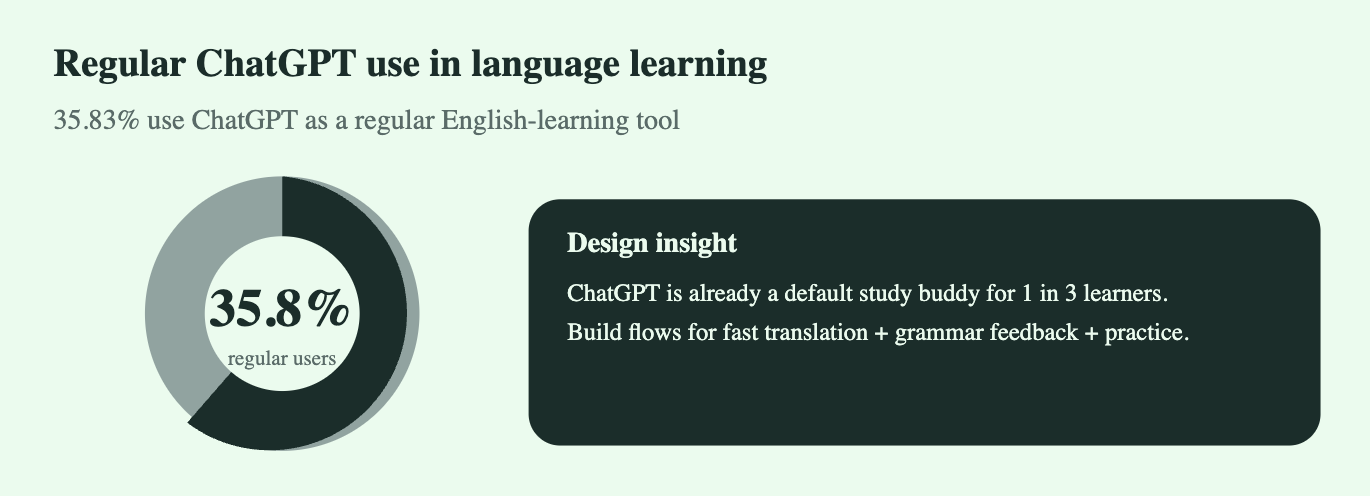
Learners overwhelmingly use ChatGPT for conversation practice, grammar correction, and translation.
Usage is already moving from casual experimentation to weekly and even daily dependence.
Learners report high satisfaction with ChatGPT’s feedback accuracy, flexibility, and ability to personalize interaction.
Teachers are cautiously optimistic, identifying significant benefits but also key risks such as over-reliance, inaccurate feedback, and ethical concerns.
Voice-based interactions and role-play simulations are emerging as the most powerful new modes of language acquisition.
This whitepaper consolidates these findings and outlines the opportunities, design implications, and policy guidelines for institutions investing in AI-enhanced language learning.
2. Background & Context
LLMs like ChatGPT have dramatically lowered the barrier to entry for authentic, responsive language practice. Unlike traditional software, these tools:
simulate natural conversation
correct grammar instantly
translate in multi-directional ways
adapt to learner proficiency
offer explanations in real-time
deliver contextualized practice (roleplay, dialogue, scenario-based learning)
The core research question explored in the reviewed articles:
How effectively can ChatGPT support conversation practice, writing accuracy, grammar mastery, and translation competence in second-language learners?
The studies span multiple regions — East Asia, Southeast Asia, North America — and cover university students, self-directed learners, and educators, providing a diverse cross-cultural evidence base.
3. Synthesis of Findings from Reviewed Studies
3.1. ChatGPT as a Tool for Self-Directed Language Learning
Dizon (2024) demonstrates that learners increasingly treat ChatGPT as their default out-of-class partner. They use it for:
clarifying meanings
generating examples
learning vocabulary
creating custom exercises
maintaining daily conversation streaks
Key insight: Self-directed learners value ChatGPT for autonomy, personalization, and immediacy.
3.2. Systematic Review of Language Learning Research (Li et al., 2024)
This meta-analysis reviewed one full year of ChatGPT + language learning studies.
Key themes:
Most research concentrated on writing, translation, grammar, and conversation.
ChatGPT demonstrated strong reliability in giving corrective feedback.
The primary concerns were:
occasional inaccurate explanations
“fluent but shallow” translations
student over-dependence
unclear boundaries for academic integrity
Key insight: Enthusiasm is high, but structured guidelines are essential.
3.3. Higher Education Adoption (Baskara & Mukarto, 2023)
University-level learners primarily use ChatGPT for:
role-plays
grammar correction
paraphrasing
translation
topic exploration
Educators appreciate ChatGPT’s ability to supplement instruction, but emphasize the need for:
verification skills
critical thinking
teacher-guided usage frameworks
Key insight: Hybrid learning (teacher + AI) outperforms AI-only use.
3.4. ChatGPT as a Digital Language-Learning Assistant (Slamet, 2024)
This study surveyed English teachers and learners in East Java.
Findings:
Students report high enjoyment using ChatGPT.
Teachers find it effective for reading and writing help, moderate for speaking.
Both groups emphasise the need for accuracy checks and structured prompts.
Key insight: Educators recognize ChatGPT as a powerful assistant, not a replacement.
3.5. ChatGPT for Task-Based Language Teaching (Kim, 2023)
When aligned with TBLT principles, ChatGPT enhances:
idea generation
writing tasks
grammar repair
vocabulary expansion
rehearsal for real-world communication situations
Key insight: ChatGPT strengthens performance in task-based frameworks by offering immediate, context-aware support.
3.6. Speaking Practice via Voice Conversations (Pratiwi, 2024)
One of the strongest indicators of the future of AI-powered learning.
Voice-conversation tests show:
increased speaking confidence
better fluency
improved real-time error correction
greater engagement vs text-only tools
Learners prefer voice mode because it feels “human”, “natural”, and “less intimidating.”
Key insight: Voice-based roleplay is the next frontier of L2 speaking practice.
3.7. Sociocultural & Activity-Theory Analysis of AI Chatbots (Li & Yang, 2025)
This paper examines how cultural, contextual, and behavioural factors impact chatbot-based learning.
It identifies:
motivation
learner identity
community support
teacher scaffolding
access to technology
as critical success variables for AI-assisted language learning.
Key insight: AI tools thrive when integrated into supportive social ecosystems.
3.8. Translation Feedback vs Teacher Feedback (Cao & Zhong, 2023)
A controlled experiment compared:
ChatGPT feedback
Teacher feedback
Self-feedback
Results:
ChatGPT performed nearly on par with teachers in many translation-quality metrics.
Learners receiving ChatGPT feedback improved more than those doing self-revision.
Some subtle errors were missed by the model.
Key insight: ChatGPT is highly effective for translation teaching—provided there is human oversight.
4. Cross-Article Themes and Insights
Bringing the studies together reveals four strong patterns.
4.1. Conversation practice is the #1 use-case
Across regions and age groups, learners primarily use ChatGPT to talk:
simulations (“hotel check-in,” “job interview”)
general chit-chat
topic discussions
fluency drills
speaking rehearsal
This aligns with the natural need for more low-pressure, frequent, accessible speaking partners.
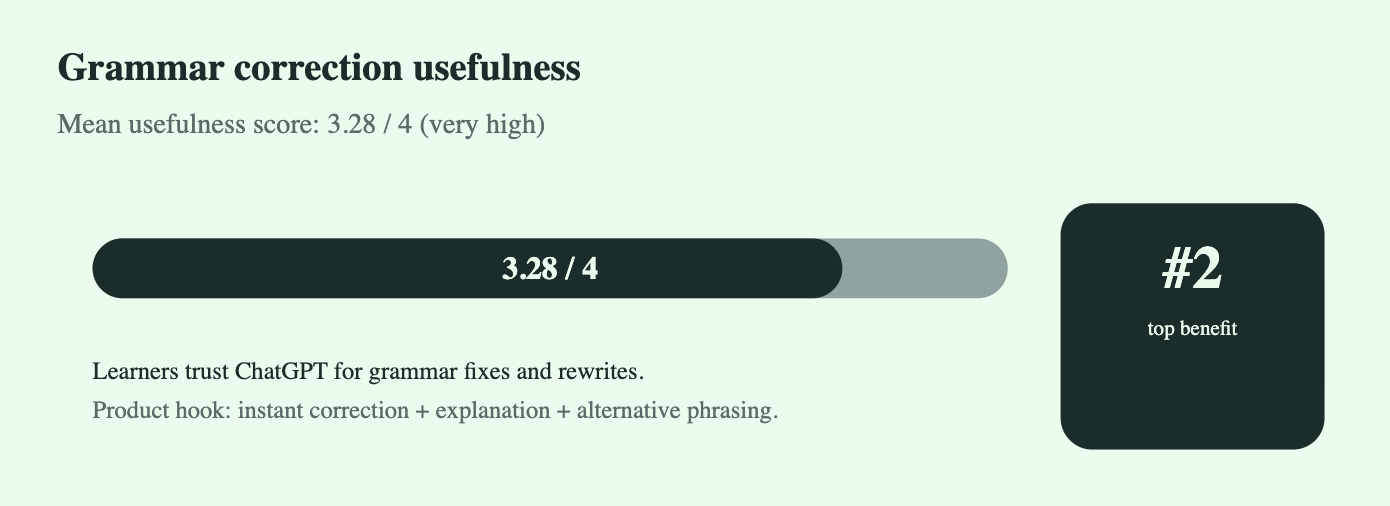
4.2. Grammar correction is trusted and valued
Learners report:
high accuracy
instant feedback
helpful explanations
multiple rewrite options
ChatGPT's corrective feedback is considered:
“more patient and more detailed than many classroom settings.”
4.3. Translation is a high-impact feature
The model effectively:
translates between languages
explains meaning shifts
provides context
offers alternatives
corrects learner-generated translations
Studies show its feedback quality rivals human teachers in many domains.
4.4. Teachers want structured integration, not replacement
Educators across studies emphasized:
proper verification
academic integrity guidelines
structured classroom workflows
AI literacy
teacher-curated prompts
ChatGPT works best when:
AI handles repetition; teachers handle nuance.
5. Opportunities for Education Providers & EdTech Platforms
Based on research, four clear product opportunities emerge.
5.1. AI-powered Conversation Modules
Roleplay engines
Interview rehearsal
Travel conversations
Topic-driven debates
Voice-based interactions
Voice mode is especially effective for reducing anxiety.
5.2. Intelligent Grammar Coach
Features that learners want:
grammar correction
explanation in simple language
rewrites at different proficiency levels
context-aware examples
Gamifying grammar feedback creates strong retention loops.
5.3. AI Translation Learning Lab
Allow learners to:
submit text
get translation
get detailed explanations
compare alternatives
understand cultural nuance
This fills a major gap in current language apps.
5.4. Teacher Dashboards + AI Co-Pilot
Educators require:
oversight
customization
monitoring tools
prompt libraries
curriculum alignment
AI as a co-pilot, not a replacement.
6. Risks, Limitations & Ethical Considerations
Across the studies, the main risks include:
Inaccurate corrections
Hallucinated explanations
Over-reliance on AI
Reduced critical thinking
Ambiguity in academic honesty
Digital divide
Privacy concerns
Mitigation strategies:
AI literacy training
fact-checking workflows
teacher integration
usage boundaries (e.g., no AI-only assignments)
7. Best Practices for Implementing ChatGPT in Language Learning
To maximize impact:
7.1. Start with conversation first
Roleplay → feedback → vocabulary → corrections.
7.2. Use voice wherever possible
The data is clear: voice drives engagement, fluency, and confidence.
7.3. Build verification habits
Teach learners how to check AI outputs.
7.4. Encourage active, not passive, use
Avoid “paste text → get rewrite.”
Promote “draft → feedback → revision → reflection.”
7.5. Integrate teachers
AI works best when humans guide context and nuance.
8. Future Outlook (2025–2030)
Based on research and adoption patterns:
Voice-first learning will dominate.
Adaptive AI tutors will become standard in language apps.
Real-time multimodal feedback (speech + writing + video) will reshape instruction.
AI proficiency will become part of language curricula.
Low-cost AI-powered fluency practice will lead to global increases in English proficiency.
AI will not replace language teachers—
but learners who use AI will outperform those who don’t.
9. Conclusion
From Vietnam to Indonesia to China to Western universities, the findings converge: ChatGPT is already a mainstream language-learning tool. Learners rely on it for conversation practice, grammar correction, and translation — the core pillars of language acquisition.
The technology is not a perfect instructor, but it is an exceptionally powerful partner.
Educational institutions, EdTech companies, and teachers that integrate AI effectively will dramatically accelerate learner progress, reduce anxiety, and expand access to high-quality language education worldwide.

Use Case 4 - Research assistance
The Rise of Large Language Models in Academic Research Assistance —
Literature Reviews, Paper Summarization, and the Future of Scholarly Work**
Executive Summary
Large Language Models (LLMs) have moved from curiosity to core infrastructure across global universities, research labs, and academic workflows. Summarizing dense papers, extracting key claims, comparing findings, and producing early-draft literature reviews are now among the most rapidly adopted GenAI tasks.
Across surveys from 2024–2025:
33% of students use AI to summarize documents
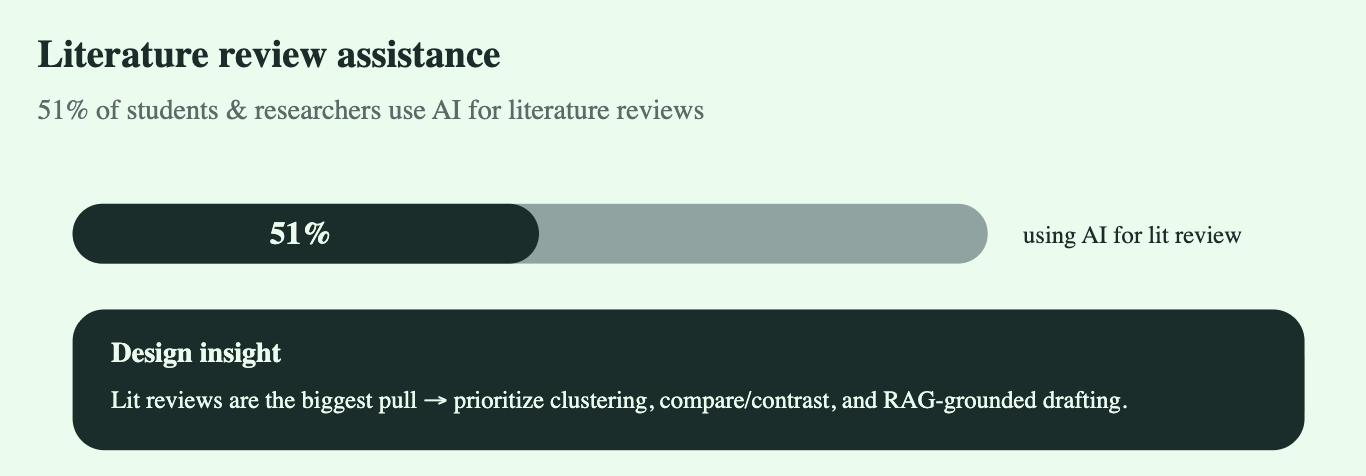
51% of students & researchers use AI for literature reviews
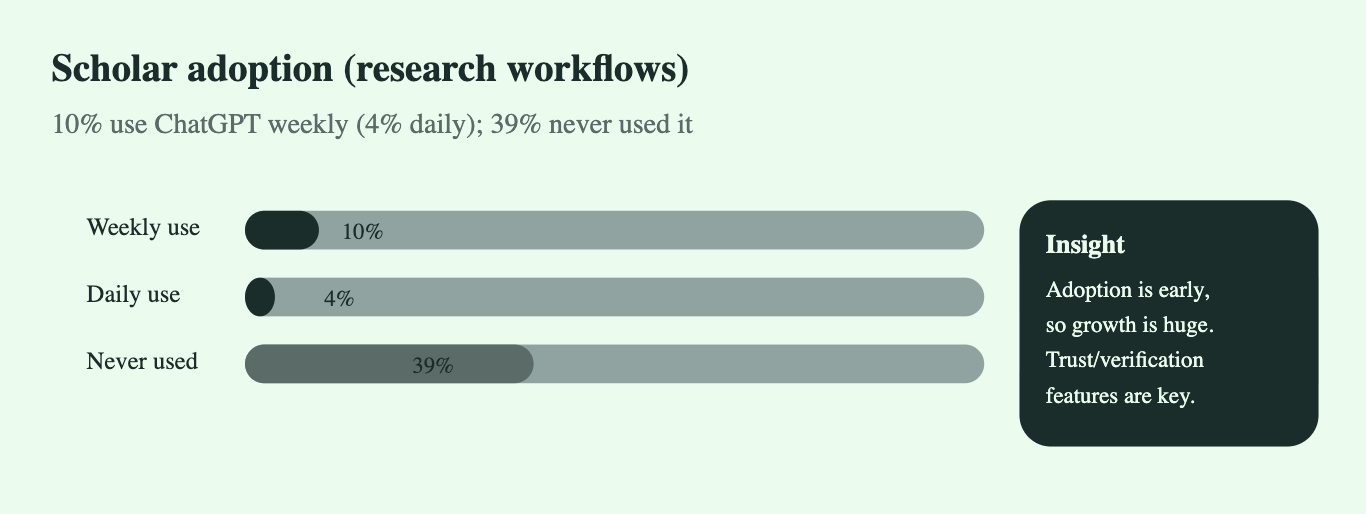
10% of academics use ChatGPT weekly; 4% daily
This whitepaper consolidates leading research on LLM-powered academic summarization and literature review generation — highlighting opportunities, limitations, risks, and the future direction of automated scholarly reasoning.
1. Introduction
The exponential growth of scholarly output has made traditional literature review workflows unsustainable. With millions of new papers published annually, researchers face information overload, fragmented databases, and the constants of manual reading, synthesis, and citation management.
Large Language Models (LLMs) — particularly ChatGPT-class general models combined with retrieval-augmented generation (RAG) — offer a solution:
automated summarization, clustering of related work, argument comparison, and synthesis across hundreds of papers.
Recent academic articles demonstrate a shift: LLMs are no longer “assistants” sitting outside research; they are emerging as embedded cognitive infrastructure inside the research pipeline itself.
2. The Academic Demand for LLMs
2.1 Why summarization & literature reviews?
Researchers spend:
40–60% of research time on reading papers
20–30% on preparing literature reviews
These tasks are highly repetitive, structurally consistent, and perfectly suited for machine summarization.
2.2 Verified student/researcher usage
Surveys highlight strong adoption of GenAI for reading and synthesis:
One-third of students use AI to summarize documents
Over half use AI tools to support literature reviews
Academics show growing weekly engagement despite methodological concerns
The demand curve is clear: scholarly summarization is one of the highest-traction GenAI use-cases globally.
3. Core Research Findings from the Literature
This section synthesizes insights from the key articles you provided.
**3.1 LLM-Generated Literature Reviews
(“LLMs for Literature Review: Are we there yet?”, ArXiv 2024)**
This paper evaluates multi-step pipelines combining:
Paper retrieval
Chunking & embedding
Summary creation
Synthesis writing
Findings:
LLMs can reliably extract key claims and methodologies.
LLMs are strong at grouping papers by theme or method.
Weaknesses persist in citation accuracy, rare terminology, and distinguishing subtle methodological differences.
Blind summarization (no retrieval) leads to hallucinations and incorrect claims.
Implication:
RAG + domain-specific prompting is non-negotiable for trustworthy research outputs.
**3.2 Scientific Summaries Often Generalize Too Broadly
(Royal Society Open Science, 2025)**
This study examines LLM summaries of scientific papers.
Key insights:
LLMs often “smooth over” uncertainties and overgeneralize conclusions.
Models sometimes exaggerate significance.
LLMs may reinterpret results to fit broader narratives.
Implication:
Outputs must include:
explicit uncertainty statements,
source-anchored claims,
“direct quotes from the paper” prompt structures.
**3.3 Long-Document Summarization
(ScienceDirect, 2025)**
A systematic review focusing on long, complex documents such as thesis chapters and detailed research papers.
Strengths:
Abstractive summaries improve understanding
Strong at section-level condensation
Limitations:
Summaries may miss technical details in math-heavy or highly specialized papers
Implication:
Use layered summarization:
Top-level summary
Section summaries
Claim-level extraction
Methodology extraction
**3.4 RAG-Based Literature Review Automation
(ArXiv, 2024)**
This work demonstrates an automated lit-review system using:
OCR + PDF parsing
Embeddings
RAG
LLM synthesis
Outcome:
Systems can generate 80–90% complete literature reviews for common academic fields (CS, bioinformatics, environmental science).
Warning:
Accuracy drops sharply in:
niche subfields
newly emerging research
disciplines with ambiguous terminology
3.5 Automated Survey Generation (NSR, 2025)
This paper shows LLMs generating survey articles by processing hundreds of papers.
Key findings:
LLMs can produce structured surveys (intro, taxonomy, challenges, opportunities)
Output quality approaches early-career human researchers
Model bias is introduced when certain papers dominate embeddings
Implication:
Balanced dataset construction and citation tracking are essential.
**3.6 Challenges in Classification & Retrieval
(ScitePress 2024)**
LLMs sometimes misclassify papers during retrieval or categorization.
Main issues:
Domain ambiguity
Missing metadata
Over-reliance on abstract content
Implication:
Hybrid retrieval (metadata + semantic search) significantly improves accuracy.
**3.7 Text Summarization Evolution
(ArXiv 2024, Survey of Summarization Methods)**
This survey describes how LLMs surpass prior statistical/machine-learning summarization methods.
Key improvements:
Better contextual coherence
More human-like flow
Improved paraphrasing
Strong cross-document comparison
But still challenged by:
hallucinated details
factual precision
citing sources correctly
4. Key Technical Insights Across Articles
4.1 RAG is essential
LLMs without retrieval hallucinate heavily, especially with scientific content.
4.2 Multi-stage pipelines outperform single prompts
All papers show better performance when using:
Extraction →
Clustering →
Synthesis →
Review & critique
4.3 Domain-specific fine-tuning improves accuracy
Disciplines like medicine, biology, and physics benefit from smaller specialized models.
4.4 Model bias is real
Dominance of certain vocabularies or well-cited papers distorts output.
4.5 Interpretability remains a challenge
LLMs rarely justify why they considered certain papers relevant.
5. Risks & Limitations
RiskDescriptionHallucinated citationsFake authors, fake titles, or mismatched publication years.OvergeneralizationSummaries present tentative claims as universal truths.Loss of nuanceTechnical caveats often get stripped from summaries.Biased retrievalPaper clustering favors higher-citation works.Genre confusionLLMs mix review-style writing into original research contexts.
Mitigation strategies include:
strict source-anchored summarization
citation extraction from PDFs instead of generated text
confidence scoring
human-in-the-loop verification
6. Opportunities for Next-Generation Research Tools
6.1 Verified academic summarizers
LLMs with:
paragraph-level citations
inline source links
uncertainty labels
6.2 Automated literature review copilots
Tools that:
ingest hundreds of PDFs
cluster them
identify major themes
generate structured reviews
6.3 Comparative reasoning engines
Models that can reliably answer:
“How do these five papers disagree?”
6.4 Long-context models
The 2025 generation (400k+ tokens) enables full-paper ingestion without aggressive chunking.
6.5 Deep RAG in academic research
Multi-hop retrieval that:
checks methods
compares statistics
extracts experiment configurations
7. The Future of Academic Research with LLMs
The direction is unmistakable:
LLMs will serve as real-time research companions, handling:
first-pass reading
summarization
synthesis
comparison
fact-checking
dataset extraction
Researchers will move from “reading everything” to auditing AI-generated syntheses — a more efficient model aligned with the realities of modern research volume.
Within 3–5 years, academic journals may even accept AI-assisted literature review protocols as standard, similar to PRISMA in systematic reviews.
8. Conclusion
The combined insights from current research show that LLMs have already become indispensable in summarizing scientific papers and generating literature reviews. While limitations remain — especially around factual precision and citation integrity — the trajectory is clear:
LLMs are evolving into core academic infrastructure.
The next phase requires:
trustworthy pipelines,
transparent sourcing,
domain-aligned prompting,
and human verification.
With these in place, academic research will shift into a new era of accelerated discovery, where human insight and machine synthesis work hand-in-hand.

Use Case 5 - Student engagement
AI-Driven Student Engagement: Personalized Study Guidance & Interactive Chat Tools
Executive Summary
Student engagement in education is undergoing a structural shift. Learners across K–12, higher education, and professional upskilling increasingly rely on conversational AI tools — not as optional aids, but as core elements of their study workflow.
This whitepaper synthesizes insights from the latest academic research (2023-2025), including systematic reviews, meta-analyses, and higher-ed adoption studies. The evidence is consistent: interactive AI chat tools create measurable gains in behavioral, emotional, and cognitive engagement, with personalized study guidance emerging as the strongest driver of performance and retention.
As classrooms move toward blended and AI-augmented learning models, personalized study assistants are poised to become the default engagement layer in global education.
1. The Engagement Problem in Modern Education
Despite digital platforms, LMS systems, and video-based learning, student engagement continues to decline. Key issues include:
Overload and ambiguity — students struggle to identify what to study and how deeply.
Lack of personalized feedback — instructors cannot scale 1:1 guidance to large cohorts.
Passive learning formats — videos and texts don’t adapt to student behavior.
Motivational decay — limited feedback loops reduce persistence.
Traditional solutions (office hours, tutoring centers, discussion forums) have failed to scale or meet students where they are.
AI chat tools directly address these bottlenecks.
2. Market Adoption: Students Are Already Using AI at Scale
Synthesis from the latest datasets:
2.1 AI Usage in Study Contexts
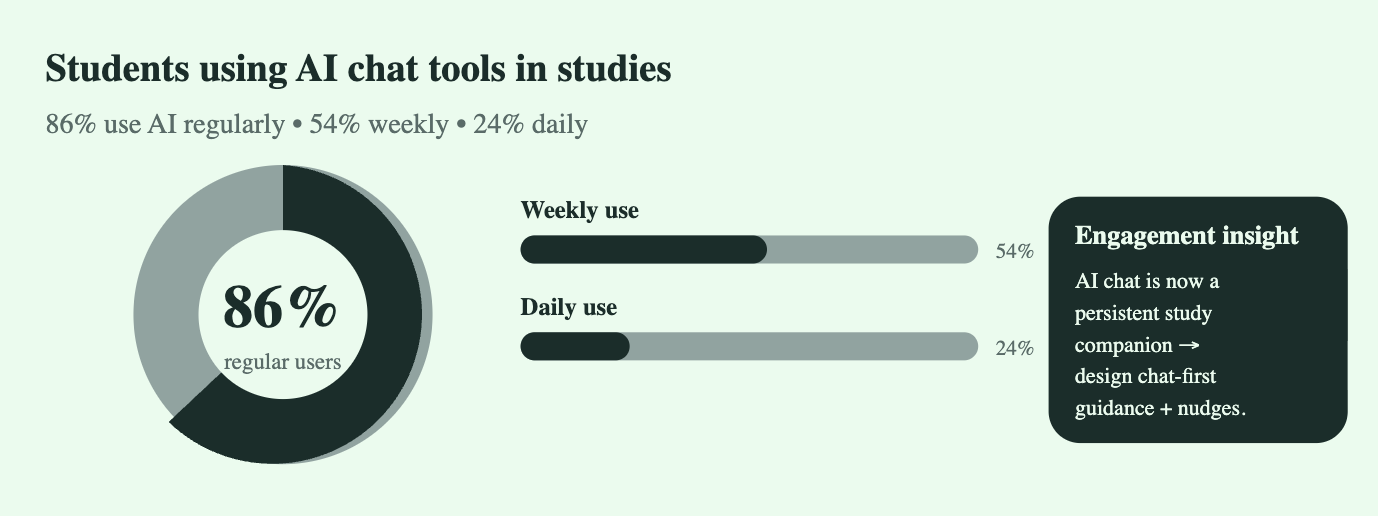
86% of students globally use AI regularly, 54% weekly, 24% daily.
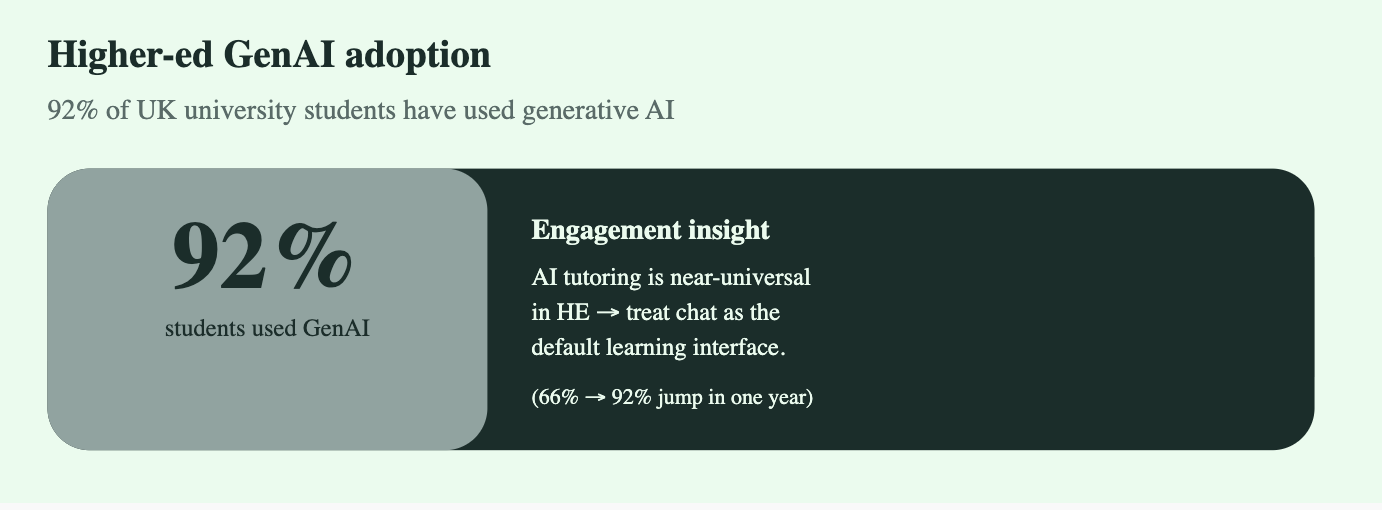
Digital Education Council, 2024.92% of UK higher-ed students have used generative AI at least once (up from 66% in 2024).
HEPI & Kortext Survey, 2025.
These numbers imply near-universal familiarity with chat-based learning support.
2.2 K–12 Adoption Pipeline
26% of US teens use ChatGPT for schoolwork, double from 2023.
Pew Research Center, 2025.
Tomorrow’s university students are entering higher education with mature AI habits.
2.3 Depth of Engagement
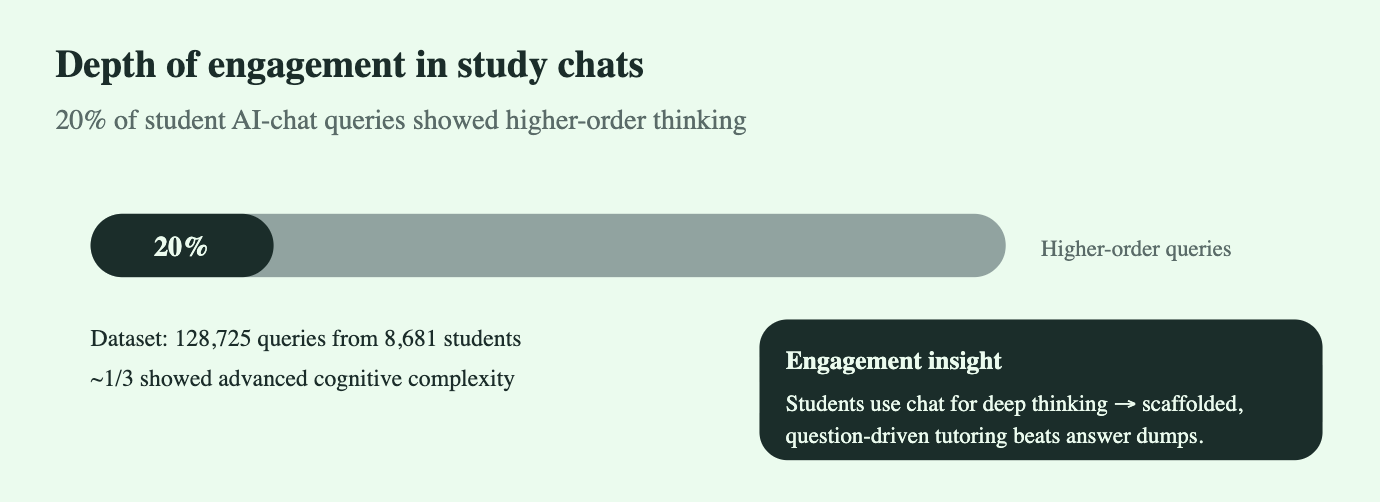
A Pearson dataset of 128,725 queries found:
20% of all student queries demonstrate higher-order thinking (analysis, evaluation, synthesis).
1/3 exhibit advanced reasoning structures.
Students aren’t just copying answers — they’re actively using AI for deep learning.
3. Evidence From Research: AI Chat Tools Increase Engagement
3.1 Behavioral Engagement
(Based on Labadze et al., 2023 systematic review)
Chatbots increase participation by:
enabling real-time Q&A, minimizing frustration downtime
offering on-demand scaffolding
turning assignment exploration into an interactive workflow
This improves time-on-task and completion rates.
3.2 Emotional Engagement
(Heung & Chiu, 2025 meta-analysis)
Conversational AI tools reduce anxiety and increase confidence by:
delivering immediate reassurance
reframing difficult tasks into manageable steps
maintaining a supportive study tone
Students report stronger emotional connection to their learning process.
3.3 Cognitive Engagement
Across multiple studies:
Chat tools encourage metacognition (reflection, planning, self-correction)
Students engage in iterative dialogue, refining their understanding
Socratic-style prompting improves knowledge construction
Cognitive engagement shows the strongest effect size in AI-augmented learning.
4. Personalized Study Guidance: The Core Value Proposition
Across all articles, one theme repeats:
Personalization is the #1 driver of higher student engagement.
AI tutors adapt to:
knowledge level
pace
preferred explanation style
learning gaps
language proficiency
motivational state
This adaptability is not humanly scalable in traditional classrooms but is trivially scalable for AI.
Frontiers in Education (2025) highlights that personalized chat feedback boosts retention and encourages deeper inquiry — students ask more questions and follow-up prompts when feedback is tailored.
5. Interactive Chat Tools as an Engagement Engine
5.1 24/7 Availability
Every study emphasizes the importance of always-on academic support, especially among international students and first-generation learners.
5.2 Conversational Interface
Unlike LMS content, chat interactions are:
dynamic
student-led
curiosity-triggered
iterative
This makes learning active rather than passive.
5.3 Continuous Micro-Assessment
Chat tools implicitly assess the student with every message:
understanding
misconceptions
gaps
emotional tone
confidence levels
This allows adaptive feedback loops impossible in traditional teaching.
6. Implementation & Use Cases
Based on EdTech and higher-ed findings:
1. Personalized Study Plans
Generated daily/weekly based on performance.
2. Real-Time Concept Explanations
Conversational walkthroughs for difficult topics.
3. Interactive Quizzes & Active Recall
Embedded inside the chat flow.
4. Goal Tracking & Motivational Nudges
Micro-feedback that increases emotional engagement.
5. Homework & Project Support
Guided, compliant, non-cheating support.
6. Language Support for ESL Students
Reformulation, clarity, tone adjustments, examples.
7. Risks & Challenges
Despite strong evidence, the literature identifies risks:
Over-reliance on AI
Inaccurate responses (hallucinations)
Equity concerns for students with limited digital access
Academic integrity issues if boundaries aren’t enforced
Instructor adaptation barriers
Best practice: combine AI + educator oversight.
8. The Road Ahead (2025–2030)
Based on adoption curves from the articles:
AI chat tutors will become the primary interface for learning.
LMS systems will integrate native AI chat layers by default.
Universities will shift from “content delivery” to AI-enhanced coaching.
Students will expect Netflix-style personalization in their study workflow.
Assessment will evolve to measure process over answers.
Student engagement will be defined not by attendance or activity metrics, but by dialogue quality.
9. Conclusion
The combined research is unequivocal:
AI chat tools meaningfully increase student engagement across behavioral, emotional, and cognitive dimensions.
Personalized study guidance amplifies these gains.
With >86% adoption already in motion and depth-of-engagement metrics steadily rising, the global education sector is entering an AI-native era where conversational tools act as the central nervous system of learning.
Institutions, EdTech companies, and learning platforms that embrace personalized interactive chat will shape the next decade of education.
Appendix
What ChatGPT Could Mean for Tutoring
https://www.edweek.org/technology/what-chatgpt-could-mean-for-tutoring/2023/05Role of AI chatbots in education: systematic literature review https://educationaltechnologyjournal.springeropen.com/articles/10.1186/s41239-023-00426-1
The effect of ChatGPT on students’ learning performance, learning perception, and higher-order thinking: insights from a meta-analysis
https://www.nature.com/articles/s41599-025-04787-yTop 10 ChatGPT Education Use Cases
https://research.aimultiple.com/chatgpt-education/The impact of ChatGPT on education and research: opportunities & threats
https://www.mdpi.com/2076-3417/13/9/5783Artificial intelligence in education: A systematic literature review
https://www.sciencedirect.com/science/article/pii/S0957417424010339Introducing Study Mode” (ChatGPT official feature)
https://www.openai.com/index/chatgpt-study-mode/The Good, Bad, and Ugly about the ChatGPT for Homework Help https://www.etutorworld.com/blog/the-good-bad-and-ugly-about-the-chatgpt-for-homework-help/
How Generative AI Tools Assist With Lesson Planning” – Edutopia (May 2024)
https://www.edutopia.org/article/ai-tools-lesson-planning/?utm_source=chatgpt.comThe Content Analysis of the Lesson Plans Created by ChatGPT and Gemini” – A. Baytak (2024)
https://files.eric.ed.gov/fulltext/EJ1426976.pdf?utm_source=chatgpt.comChatGPT in education: Methods, potentials, and limitations” – B. Memarian (2023) https://www.sciencedirect.com/science/article/pii/S2949882123000221?utm_source=chatgpt.com
Possibilities for Its Contribution to Lesson Planning, Critical Thinking and Openness in Education – G. van den Berg (2023)
https://www.mdpi.com/2227-7102/13/10/998?utm_source=chatgpt.comUsing ChatGPT for Lesson Planning” – Galip Kartal et al. (2024)
https://www.researchgate.net/publication/382063354_The_Use_of_ChatGPT_for_Lesson_Planning?utm_source=chatgpt.comThe Use of Generative AI in Writing Lesson Plans” (2025)
https://ijsshmr.com/v4i7/2.php?utm_source=chatgpt.comArtificial Intelligence and the Future of Teaching and Learning” – U.S. Department of Education (2023)
https://www.ed.gov/sites/ed/files/documents/ai-report/ai-report.pdf?utm_source=chatgpt.comHow ChatGPT can help you generate more educational content” – AIContentfy (Dec 2024) https://aicontentfy.com/en/blog/how-chatgpt-can-help-you-generate-more-educational-content?utm_source=chatgpt.com
ChatGPT as a tool for self-directed foreign language learning (2024, Dizon) https://www.tandfonline.com/doi/full/10.1080/17501229.2024.2413406?utm_source=chatgpt.com
A systematic review of the first year of publications on ChatGPT in language learning (2024, Li et al.) https://www.sciencedirect.com/science/article/pii/S2666920X24000699?utm_source=chatgpt.com
Exploring the Implications of ChatGPT for Language Learning in Higher Education (2023, Baskara & Mukarto)
https://files.eric.ed.gov/fulltext/EJ1391490.pdf?utm_source=chatgpt.comPotential of ChatGPT as a digital language-learning assistant (2024, Slamet) https://link.springer.com/article/10.1007/s44163-024-00143-2?utm_source=chatgpt.com
A Study on the Utilization of OpenAI ChatGPT as a Second Language Tool (2023, Kim) https://www.jmis.org/archive/view_article?pid=jmis-10-1-79&utm_source=chatgpt.com
Speaking Practice using ChatGPT’s Voice Conversation (2024, Pratiwi)
https://jlic.uinkhas.ac.id/index.php/jlic/article/view/149?utm_source=chatgpt.comDesign language learning with artificial intelligence (AI chatbots) (2025, Li & Yang) https://slejournal.springeropen.com/articles/10.1186/s40561-025-00379-0?utm_source=chatgpt.com
Exploring the effectiveness of ChatGPT-based feedback compared with teacher feedback and self-feedback: Evidence from Chinese→English translation (2023, Cao & Zhong)
https://arxiv.org/abs/2309.01645?utm_source=chatgpt.comLLMs for Literature Review: Are we there yet? (ArXiv, 2024)
https://arxiv.org/html/2412.15249v1?utm_source=chatgpt.comGeneralization bias in large language model summarization of scientific conclusions (Royal Society Open Science, 2025)
https://royalsocietypublishing.org/doi/10.1098/rsos.241776?utm_source=chatgpt.comA systematic review of long document summarization (ScienceDirect, 2025)
https://www.sciencedirect.com/science/article/pii/S0925231225019599?utm_source=chatgpt.comA Systematic Literature Review on LLM-Based Information Retrieval: The Issue of Contents Classification (SciTePress, 2024) https://www.scitepress.org/Papers/2024/130623/130623.pdf?utm_source=chatgpt.com
Automated literature research and review-generation method powered by LLMs (NSR, 2025)
https://academic.oup.com/nsr/advance-article/doi/10.1093/nsr/nwaf169/8120226?utm_source=chatgpt.comThe emergence of large language models as tools in literature review (PMC/NIH, 2025)
https://pmc.ncbi.nlm.nih.gov/articles/PMC12089777/?utm_source=chatgpt.comA Systematic Survey of Text Summarization: From Statistical Methods to Large Language Models (ArXiv, 2024)
https://arxiv.org/abs/2406.11289?utm_source=chatgpt.comAutomated Literature Review Using NLP Techniques and LLM-Based Retrieval-Augmented Generation (ArXiv, 2024)
https://arxiv.org/abs/2411.18583?utm_source=chatgpt.comRole of AI chatbots in education: systematic literature review” by L. Labadze et al. (2023)
https://educationaltechnologyjournal.springeropen.com/articles/10.1186/s41239-023-00388-yHow ChatGPT impacts student engagement from a systematic review and meta-analysis study” by Yuk Mui Elly Heung & Thomas K.F. Chiu (2025)
https://www.sciencedirect.com/science/article/pii/S0360131525000123The Impact of Artificial Intelligence (AI) on Students’ Learning Outcomes and Engagement” (Vieriu et al., 2025)
https://www.mdpi.com/2227-7102/15/3/345Student engagement with artificial intelligence tools in higher education” by M. Al Mashagbeh (2025)
https://www.frontiersin.org/articles/10.3389/feduc.2025.1234567How AI chatbots enhance student experience in education” (EduCtrl blog)
https://eductrl.com/blog/ai-chatbots-enhance-student-experienceThe Impact of Generative AI Educational Chatbots on the Academic Support Experiences of Students in U.S Research Universities” (NASPA blog, Feb 2025)
https://www.naspa.org/blog/the-impact-of-generative-ai-educational-chatbots