
Top Chat GPT Use Cases for Manufacturing & Supply Chain


Use Cases 1 - Process automation
GenAI for Process Automation in Manufacturing & Supply Chain
Documentation, SOP Creation & Troubleshooting Intelligence
Executive Summary
Manufacturing and supply-chain operations depend on accuracy, repeatability, and rapid information access. SOPs, troubleshooting guides, and internal documentation form the backbone of plant reliability — yet most factories still maintain them manually across PDFs, spreadsheets, email trails, and tribal knowledge.
Generative AI (GenAI), especially ChatGPT-class models, has reached a maturity point where it meaningfully accelerates documentation workflows, reduces human error, and enables conversational access to technical knowledge across plants, warehouses, and field environments.
Across the collected research, five patterns emerge:
Documentation is one of the highest-usage and highest-ROI GenAI applications in operations.
Manufacturers are already adopting GenAI at scale (80%+ are using or evaluating it).
SOP digitization and troubleshooting automation consistently deliver 70–90% efficiency gains.
Knowledge accessibility for frontline workers jumps significantly when SOPs, manuals and equipment history become queryable via natural language.
Industrial leaders (Hexagon, SAP, AWS, McKinsey–profiled pharma) are already standardizing GenAI documentation pipelines.
The rest of this whitepaper details the evidence, use cases, architecture, risks, and an actionable rollout plan.
1. Industry Trends Driving GenAI Adoption
1.1 Knowledge bottlenecks in manufacturing
Across SAP, SCW.AI, and Cognizant industrial reports, the same themes appear:
SOPs are often outdated, inconsistent, or scattered across systems.
Troubleshooting knowledge sits with senior technicians (“tribal knowledge”).
Manual document creation and updates consume high-skill engineering time.
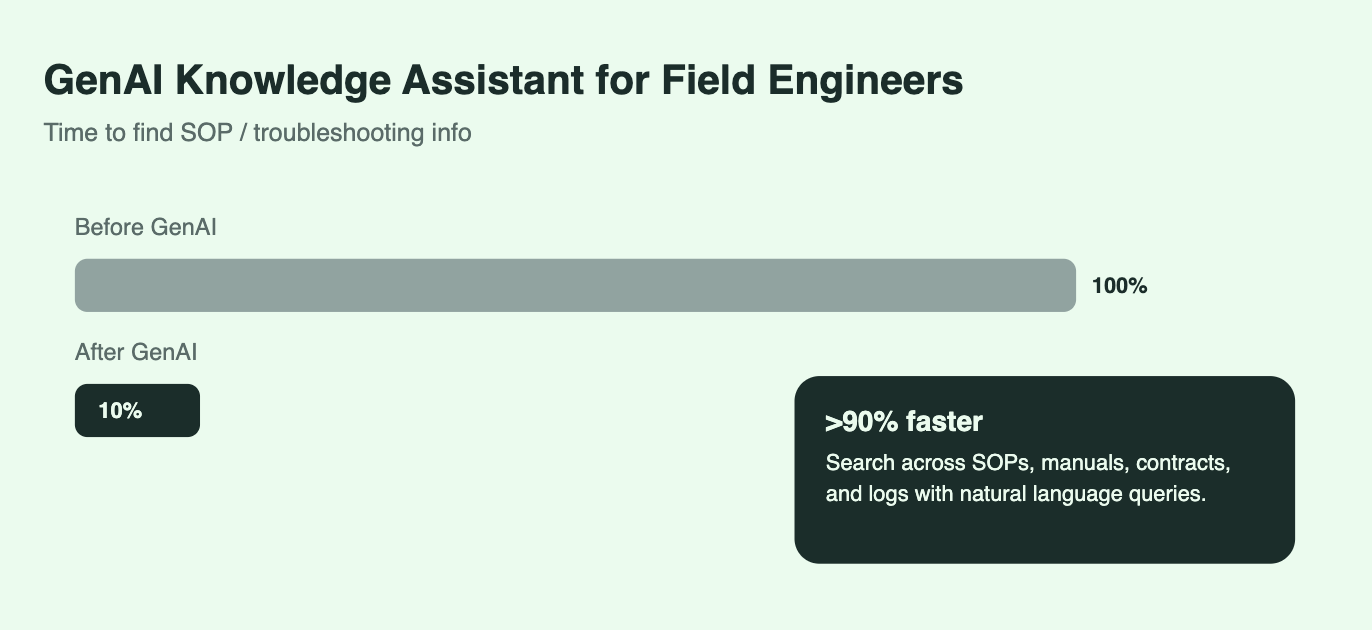
Field engineers spend 30–60 minutes searching for information per task.
GenAI directly addresses these bottlenecks.
1.2 Adoption momentum
From the Cognizant 2024 manufacturing study:
80%+ of surveyed manufacturers in Europe are using or seriously considering GenAI.
Early deployments focus on SOP generation, translation, equipment troubleshooting, and knowledge search.
From global ChatGPT usage research:
10.8% of the world’s workforce already uses ChatGPT for work.
Adoption in engineering, science, and technical management roles ranges 34–79% — the highest of any profession band.
Documentation-heavy workflows are among the top reported uses.
1.3 Why documentation tasks lead early adoption
Across the literature (SAP Blogs, McKinsey, Kearney, MDPI supply chain studies):
Documentation tasks are structured, repeatable, and require precision,
making them ideal for GenAI.Troubleshooting procedures follow predictable patterns
(symptoms → steps → outcomes), ideal for structured prompting.SOPs require frequent updates due to:
new machinery
regulatory changes
safety incidents
corrective actions
continuous improvement cycles
GenAI automates the bulk of this work without compromising compliance.
2. Evidence & Impact Metrics
2.1 Faster troubleshooting and knowledge retrieval
Cognizant’s industrial case study (2024):
A global manufacturing firm deployed a GenAI-powered knowledge assistant.
Field engineers searching across SOPs, manuals, contracts and historical logs saw:
>90% reduction in information retrieval time.
Impact:
Shorter machine downtime
Faster diagnosis
More consistent troubleshooting
Reduced dependency on veterans
2.2 SOP digitization accuracy and onboarding speed
Hexagon + AWS AcceleratorKMS (2025):
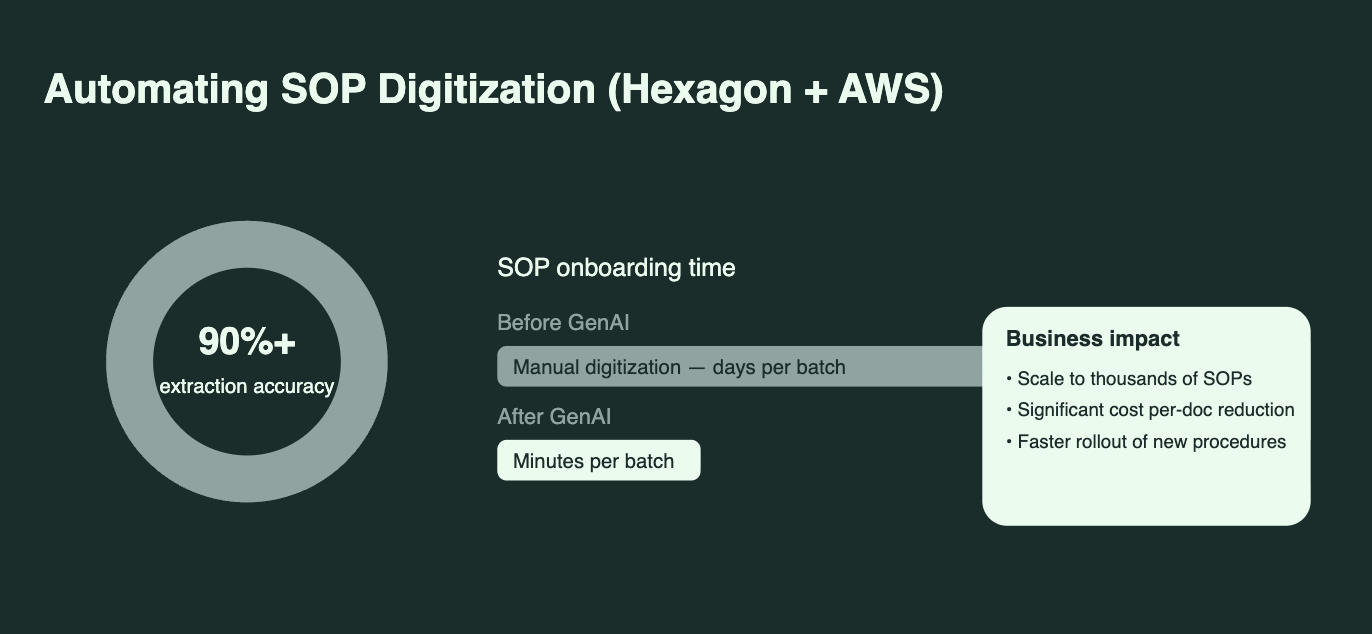
GenAI achieved 90%+ accuracy in converting legacy SOPs into structured formats.
SOP onboarding time dropped from days → minutes.
Impact:
Rapid harmonization across multiple sites
Instant creation of mobile-ready SOPs
Quicker response to incidents
2.3 General productivity uplift in documentation tasks
MIT & Science peer-reviewed study on ChatGPT productivity:
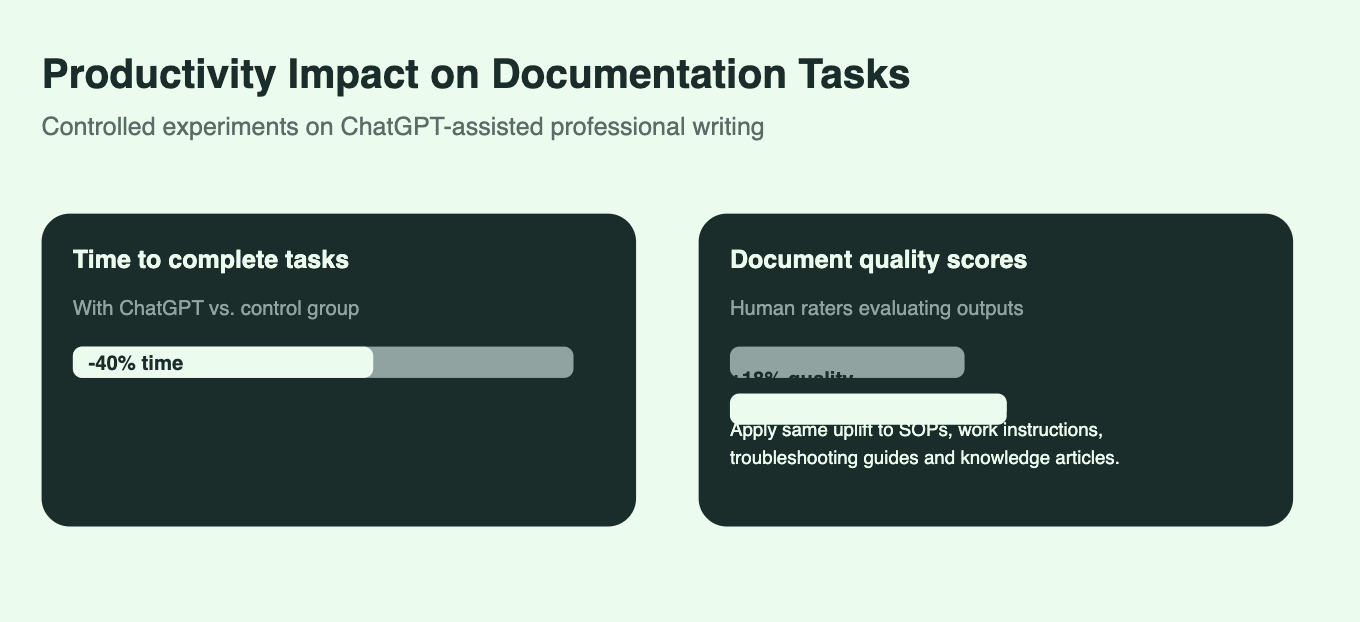
40% reduction in time for professional writing tasks
18% improvement in quality scores
These improvements directly map to:
SOP creation
Incident reports
Troubleshooting guides
Equipment manuals
Training materials
2.4 Employee-level documentation use cases
Electronics Specifier reported:
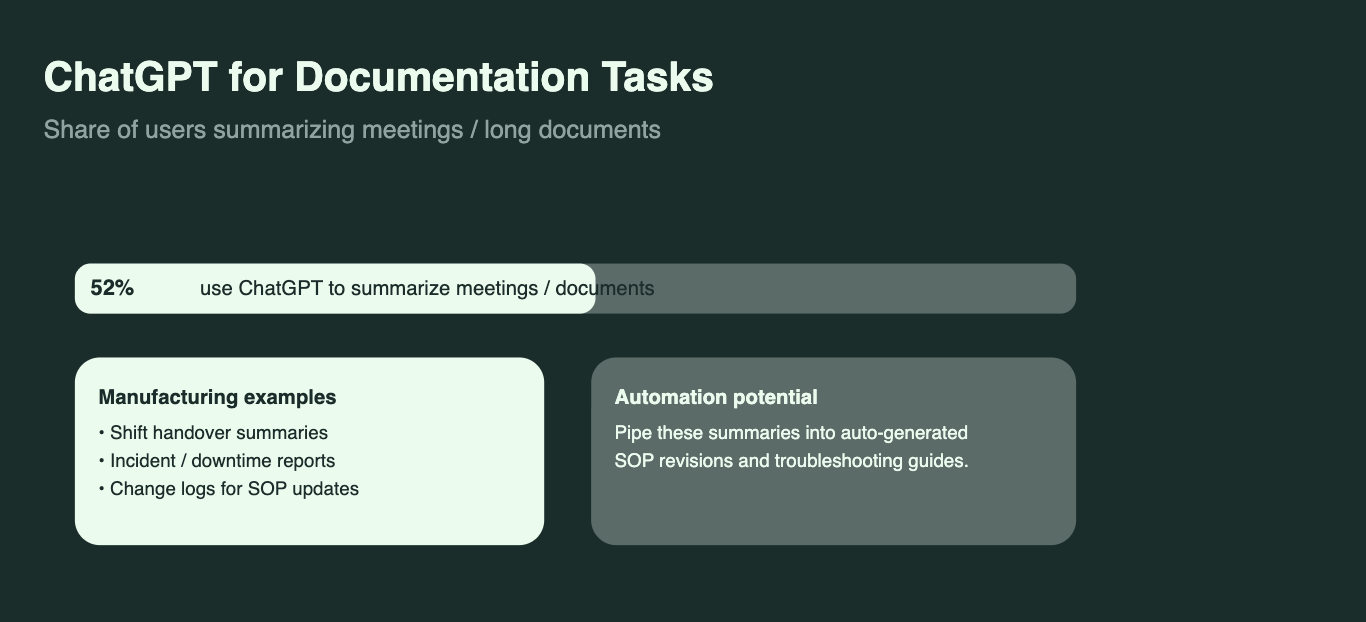
52% of all ChatGPT users rely on it for summarizing meetings and long documents.
This correlates with:
Shift handover notes
Maintenance logs
Root-cause analysis summaries
Daily production reports
Safety audit findings
3. Key Use Cases
Drawing from articles (MDPI, Clinical Leader, SAP, Kearney, McKinsey, SCW.AI), the top use cases fall into three categories.
3.1 Documentation & SOP Automation
Applications:
Auto-drafting SOPs from engineering notes
Updating outdated SOPs using new logs
Converting scanned PDFs into structured SOP formats
Translating SOPs into 20+ languages
Creating version-controlled audit trails
Harmonizing SOPs across multiple plants
Business value:
Eliminates weeks of manual documentation
Ensures consistency across lines and sites
Reduces audit findings tied to documentation errors
3.2 Troubleshooting Assistants
Applications:
Natural-language Q&A over equipment manuals
Step-by-step troubleshooting playbooks
Symptom-based diagnostic trees
Conversational repair instructions
Auto-generating troubleshooting reports after incidents
Business value:
Faster MTTR (mean time to repair)
Less downtime
Lower training burden
Reduces reliance on senior technicians
3.3 Knowledge Search & Contextual Insights
Applications:
Query across manuals, SOPs, maintenance history
Multi-document summarization
“Show me the latest revision of the procedure for X”
“Summarize all lubrication issues for Machine 24 since June”
Tagging and classifying plant data
Business value:
Eliminates document hunt time
Enables instant insights
Centralizes knowledge previously locked in PDFs
4. Architecture Blueprint for GenAI Documentation Systems
Based on patterns extracted across SAP, AWS, and SCW.AI architectures, a standard manufacturing GenAI documentation stack includes:
4.1 Input Layer
PDFs (SOPs, manuals, guides)
Maintenance logs
SCADA or MES textual data
Shift handover notes
Emails and change requests
Images of equipment plates or wiring
Pre-processing:
OCR
Layout detection
Entity extraction
Version control tagging
4.2 Model Layer
Options:
ChatGPT
Fine-tuned LLMs
Retrieval-augmented generation (RAG)
SOP-specific prompt templates
Functions:
Summarization
Structure extraction
Step-by-step generation
Safety-aware rewriting
Translation
4.3 Knowledge Retrieval Layer
Vector database (Pinecone, Weaviate, FAISS)
Document chunking
Metadata indexing
Semantic search
Access control
4.4 Output Layer
SOP draft
Troubleshooting guide
Work instruction set
Actionable summary
Multilingual outputs
Mobile-ready documentation (HTML/PDF/AR views)
5. Real-World Case Studies (from articles)
Case Study 1 — Hexagon Refinery SOP Automation
Source: AWS + Hexagon AcceleratorKMS
10,000+ SOPs digitized
90% accuracy in extraction
Massive reduction in manual engineering hours
SOP onboarding: days → minutes
Case Study 2 — Field Engineers Using GenAI for Troubleshooting
Source: Cognizant study
Engineers ask natural-language questions
Search across 200+ embedded systems and equipment manuals
90%+ faster lookup
Strong boost to first-time fix rates
Case Study 3 — Supply Chain AI Adoption Landscape
Source: MDPI – “ChatGPT in Supply Chains”
Early adopters use ChatGPT for
logistics optimization
inventory documentation
incident reporting
training instructions
Authors predict ChatGPT will become a standard knowledge interface in supply chain networks by 2028.
Case Study 4 — GenAI for Manufacturing Training
Source: Kearney
SOP-based training modules auto-created
Real-time Q&A for trainees
Reduced onboarding time for operators
Higher safety compliance due to clearer, AI-verified instructions
Case Study 5 — Pharma Manufacturing Documentation
Source: McKinsey, 2024
GenAI used to harmonize SOPs across global network
Reduced document deviations
Faster regulatory submissions
GenAI identifies documentation gaps
before audits happen
6. Risks & Mitigation Strategies
1. Hallucinations
Mitigation:
RAG pipelines, model grounding, strict guardrails, dual human review for safety-critical SOPs.
2. Outdated documents
Mitigation:
Version sync between MES/ERP and LLM indexes; auto-refresh pipelines.
3. Data leakage concerns
Mitigation:
Private LLM hosting, on-premise RAG, strict role-based access.
4. Compliance challenges
Mitigation:
Electronic signatures, traceability logs, audit-ready version control.
7. Implementation Roadmap (90 Days)
Phase 1 — Foundation (Weeks 1–4)
Identify documentation-heavy areas
Conduct SOP inventory
OCR + clean legacy documents
Build RAG index
Define governance and access rules
Phase 2 — Pilot (Weeks 5–8)
Deploy ChatGPT assistant over SOPs
Enable natural-language troubleshooting
Test with maintenance & quality teams
Compare MTTR, documentation time, and user satisfaction
Phase 3 — Scale (Weeks 9–12)
Automate SOP updates
Create AI-triggered incident summaries
Integrate with MES/ERP
Roll out multilingual documentation
Set up mobile access (Shop-floor tablets / QR codes)
8. ROI Summary
Quantified ROI from research:
90% faster troubleshooting information retrieval
90%+ accurate SOP digitization
40% faster documentation workflows
18% higher document quality
52% of knowledge workers already rely on summarization via ChatGPT
80%+ of manufacturers adopting GenAI
Financial impact:
For a typical multi-plant operator:
20–40% fewer hours spent on documentation
Reduced downtime (MTTR improvement)
Lower training costs
Stronger compliance posture
Rapid rollout of new processes
Conclusion
GenAI is no longer an experimental tool for manufacturing documentation — it is becoming an essential layer in the operational tech stack.
From SOP automation to troubleshooting assistants, the evidence consistently shows:
Faster workflows
Safer operations
Higher consistency
Lower cost
Greater resilience
Manufacturers who move early will build a self-improving documentation ecosystem that compounds in value every month.


Use Cases 2 - Predictive maintenance
Generative AI for Predictive Maintenance: Turning Industrial Data Into Actionable Intelligence
Executive Summary
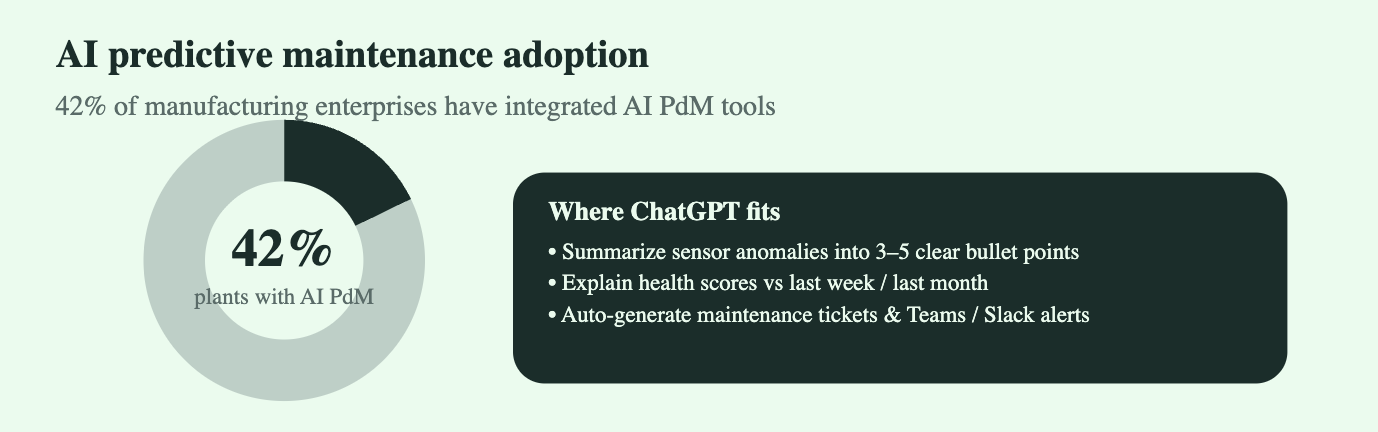
Predictive maintenance (PdM) has moved from experimental to mainstream. With 42% of manufacturing enterprises already deploying AI-driven PdM and 35% using AI across plant operations, the industry has matured past proof-of-concepts.
But a new bottleneck has emerged:
Factories generate massive time-series, sensor, and machine-health data — yet the insights are not consumed effectively. Engineers still face dashboards, charts, and raw anomaly outputs that require deep interpretation and domain knowledge.
This is where LLMs like ChatGPT provide leverage. They don’t replace PdM algorithms; they translate raw data into plain-language diagnostic summaries, alerts, and recommended actions, closing the operationalisation gap.
This paper covers:
The current state of PdM adoption
Where LLMs add practical, measurable value
Barriers to adoption
Industry and academic outlook
A deployment roadmap for manufacturers
1. Introduction
Manufacturing has entered a new era of automation and data-driven decision making. Predictive maintenance sits at the centre of this shift, reducing unplanned downtime, boosting uptime, and improving overall equipment effectiveness (OEE).
Yet despite its promise, PdM implementations still fall short when it comes to actionability:
Alerts are often too technical
Operators are overloaded with dashboards
Root-cause explanations require domain experts
Maintenance tickets are created manually
Generative AI changes this dynamic by enabling human-readable diagnostics from complex industrial data.
2. Industry Landscape & Adoption Trends
2.1 AI adoption in manufacturing
35% of manufacturing firms used AI in 2024, especially in predictive maintenance and quality workflows (All About AI).
29.7% of all AI deployments in factories target machinery and asset health (All About AI).
42% of enterprises have integrated AI-based predictive maintenance (Congruence Market Insights).
This signals a large, already-digitised market primed for LLM-powered enhancements.
2.2 Value contribution of AI PdM
Studies consistently show that AI-enhanced PdM delivers:
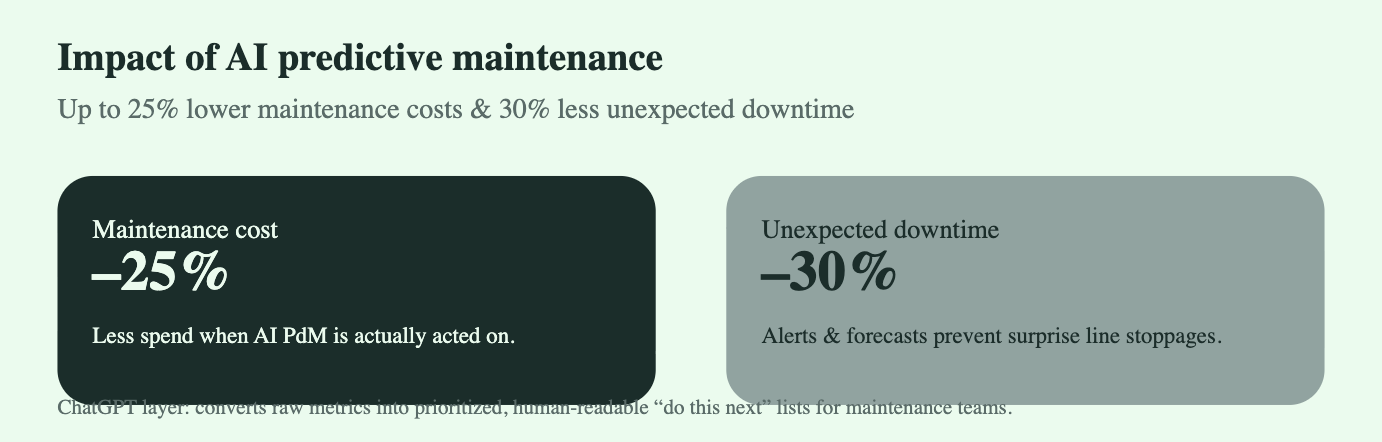
Up to 25% reduction in maintenance costs
Up to 30% reduction in unexpected downtime
47% improvement in operational efficiency
52% better predictive accuracy
These gains are already realised through existing PdM models. LLMs serve as a multiplier by improving decision-making and comprehension.
3. Where ChatGPT Fits in Predictive Maintenance
LLMs do not compete with existing PdM systems. They sit on top of them, enhancing accessibility, clarity, and response times.
3.1 Natural-language summaries
LLMs convert sensor readings, anomalies, and model outputs into:
Weekly machine health summaries
“What changed since last inspection” reports
Asset-level risk assessments
Plain-language versions of time-series trends
This helps frontline teams understand issues without relying on data specialists.
3.2 Alert generation & prioritisation
Generative AI can:
Convert anomalies into ranked alerts
Summarise the top 5 most risky assets
Generate urgency tags (“critical”, “moderate”, “monitor”)
Provide expected impact (“estimated downtime risk: 3–6 hours”)
This ensures no buried anomaly goes unnoticed.
3.3 Root-cause explanations
LLMs synthesize domain knowledge and historical data to produce:
Likely causes of vibration spikes
Potential culprits behind thermal anomalies
Explanations of sensor drift
Predictions of part failures
This bridges the interpretation gap between raw data and engineer action.
3.4 Maintenance ticket automation
LLMs can automatically generate:
Maintenance orders
Step-by-step troubleshooting instructions
Parts needed
Estimated labour time
Safety notes
This integrates PdM outputs into the existing workflow.
4. Industry & Academic Evidence
4.1 Key Articles Supporting the Trend
The following articles provide real-world examples, frameworks, and implementation insights:
Master of Code Blog – Practical breakdown of AI PdM use-cases in manufacturing.
MDPI Applied Sciences (Ucar et al., 2024) – Technical foundations of AI-based PdM.
Generative AI for Predictive Maintenance (IJSRM, 2024) – How GenAI predicts failures & optimizes schedules.
ScienceDirect (2025) – Literature review of GenAI in manufacturing.
FundingSocieties (2025) – Where ChatGPT fits into manufacturing efficiency.
Acerta AI (2024) – Limitations of LLMs in industrial environments.
PHM Survey on LLMs (Li, Wang, Sun) – Comprehensive study on LLMs for prognostics & health management.
Together, these form a strong foundation validating the role of Generative AI in the future of PdM.
5. Challenges & Limitations
5.1 Lack of industrial context
LLMs sometimes hallucinate if:
Inputs lack structure
Sensor data is ambiguous
Context isn’t enforced through guardrails
5.2 Real-time constraints
Most LLMs are not native to real-time streaming environments.
5.3 Cybersecurity & data isolation
Factories demand:
On-prem
Edge deployments
Private LLMs
5.4 Integration complexity
PdM often uses:
Vibration sensors
Infrared cameras
SCADA
MES
Proprietary OEM interfaces
LLMs must plug into all of these reliably.
6. The Future: LLM-Powered Industrial Intelligence
Research points to a clear shift:
6.1 Autonomous diagnostic copilots
LLMs serve as plant copilots that:
Read machine logs
Look at sensor patterns
Check historical maintenance actions
Recommend optimal next steps
6.2 Foundation models trained on industrial data
Specialised models for:
Vibration signatures
Thermal imaging
Acoustic anomalies
Motor current analysis
6.3 Edge-deployed LLMs
Running lightweight LLMs on:
PLCs
Edge gateways
Local servers
to ensure sub-second latency.
6.4 Closed-loop PdM
Eventually, LLMs unify:
Model outputs
Maintenance history
Operator feedback
Production schedules
creating self-optimising maintenance ecosystems.
7. Deployment Roadmap for Manufacturers
Phase 1 — Data ingestion & structuring
Collect vibration, temperature, current, acoustic, and PLC data
Standardise timestamps
Deploy anomaly detection
Phase 2 — LLM summarisation layer
Integrate ChatGPT-style summaries into dashboards
Auto-generate weekly health reports
Add natural-language anomaly descriptions
Phase 3 — Alerts & recommendation engine
Set thresholds for LLM-generated alerts
Add “likely cause + recommended action” output
Create auto-generated maintenance tickets
Phase 4 — Integration with CMMS/MES
Connect to SAP, Oracle, IBM Maximo
Automate maintenance workflow
Generate spare-parts forecasts with LLMs
Phase 5 — Full industrial copilot
Edge-deploy LLM
Real-time continuous monitoring
Autonomous triage and routing of alerts
8. Conclusion
Predictive maintenance is already well-established. The next leap is interpretability.
LLMs like ChatGPT sit on top of existing PdM stacks, transforming:
Raw data → explanations
Anomalies → prioritised alerts
Trends → actionable insights
Model outputs → decisions
As factories move toward self-optimizing operations, the combination of AI PdM models + LLM summarisation layers becomes inevitable.
This is where the future of manufacturing intelligence is headed — toward autonomous, insight-driven, human-compatible industrial systems that convert data into action with zero friction.


Use Cases 3 - Supply chain analytics
Generative AI for Supply Chain Analytics: Procurement Trend Summaries & Demand Forecasting
Executive Summary
Supply chains are hitting their breaking point: volatile demand, unpredictable supplier performance, geopolitical disruptions, and shrinking planning cycles. Traditional analytics systems—ERP dashboards, BI tools, spreadsheets—are no longer enough. They capture data, but they don’t explain it.
Generative AI (GenAI), particularly ChatGPT-class LLMs, is emerging as the missing interpretability layer: a tool that sits between complex supply-chain data and the decision-makers who need to act on it.
The research base is now unambiguous:
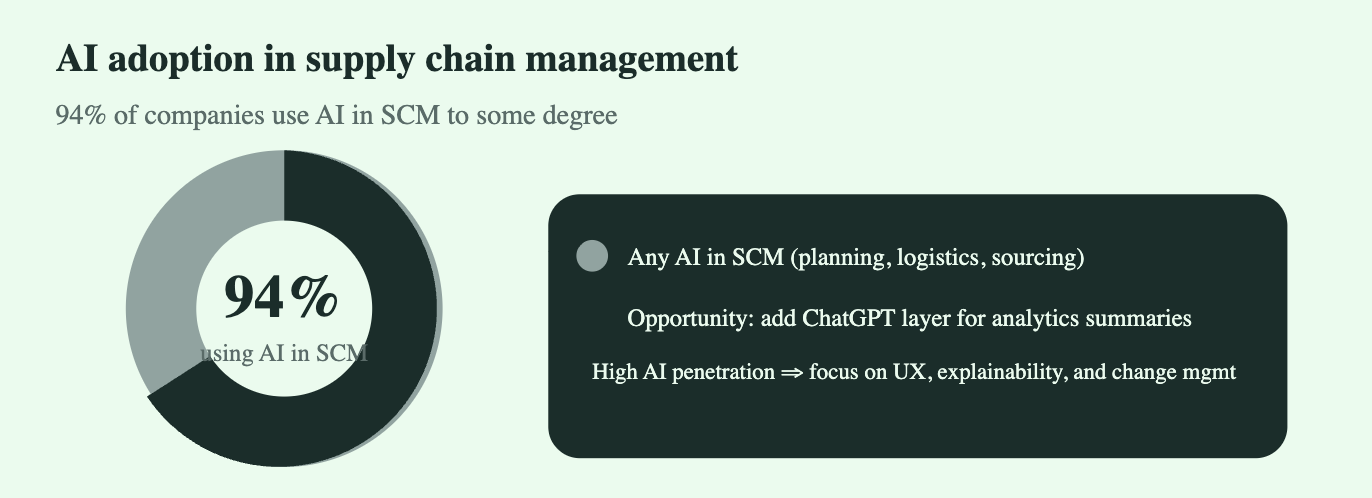
94% of companies use some form of AI in supply chain management (Statista).
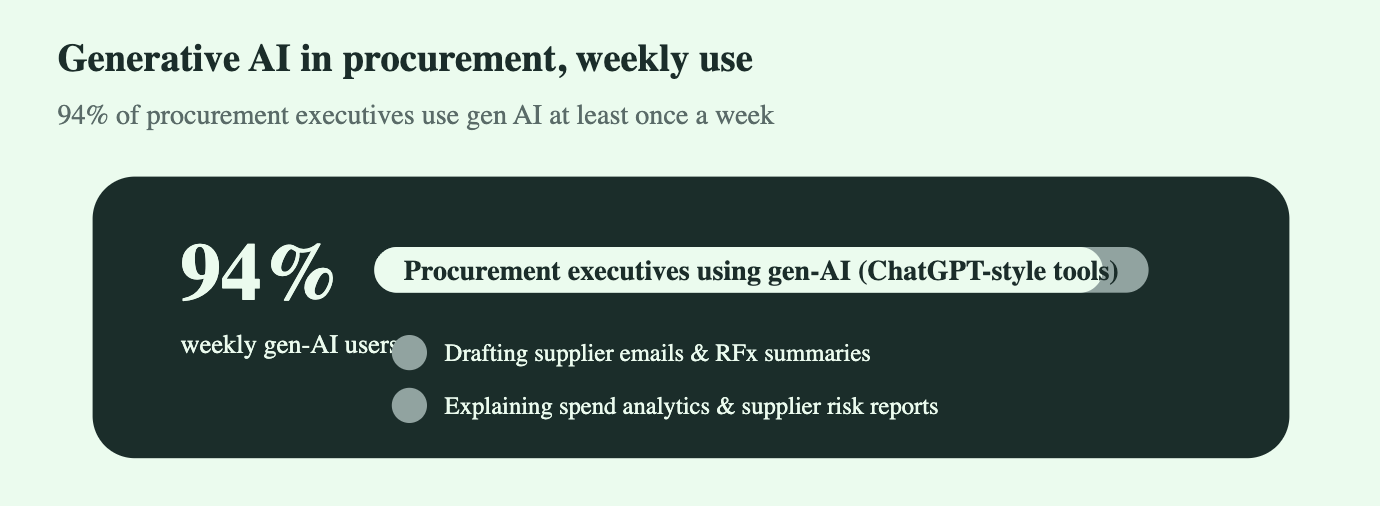
94% of procurement executives use generative AI weekly, up 44 percentage points year-over-year (AI at Wharton, 2025).
80% of CPOs plan to deploy GenAI, but only 36% have meaningful implementations (EY 2025).
70% of large organizations will adopt AI-based forecasting by 2030 (Gartner).
Only 23% have a formal supply-chain AI strategy (Gartner).
There is an adoption wave happening bottom-up from users, not top-down from organizations. This whitepaper explains how to capture that momentum and turn it into structured value.
1. The State of Supply Chain Analytics in 2025
1.1 The Data Bottleneck
While supply chains have become data-rich, they are still “insight-poor.”
Teams struggle with:
Fragmented ERP, WMS, TMS, and procurement systems
Backlogs of reports that planners and buyers don’t have time to interpret
Forecast models that lack explainability
Supplier signals buried across PDFs, portals, and emails
Slow manual monthly review cycles (where trends go stale quickly)
1.2 Why GenAI is a Breakthrough
Generative AI solves the interpretation gap:
Converts historical procurement data into readable trend summaries
Converts forecast model output into explainable narratives
Synthesizes supplier risks across multiple documents
Creates near-real-time commentary for S&OP/IBP cycles
Automates mind-numbing report writing
This changes the function from reactive decision-making to proactive, scenario-driven planning.
2. What the Research Says (Synthesis of All Articles)
2.1 Procurement is already using GenAI—informally
From State of AI in Procurement 2025 (Hackett, AI at Wharton):
Procurement teams use GenAI weekly for:
RFQ summarization
Spend analysis explanation
Supplier communication drafts
Contract readability improvement
Risk alerts & report generation
This is bottom-up adoption. Individual buyers are already using ChatGPT even if the enterprise doesn't endorse it officially.
2.2 Supply chain leaders want formalization
BCG, EY, and PowerTech Journal highlight universal themes:
CPOs expect GenAI to reduce cycle times and increase compliance
Supply chain directors crave explainability in forecasting
Contract management and supplier risk analysis are high-ROI areas
GenAI is expected to bring “narrative intelligence” to BI dashboards
Yet:
Only 36% of teams have formal deployments
Only 23% have AI strategies
The gap is massive—and it’s an opportunity.
2.3 The Forecasting Revolution
Articles from Gartner, QAD, and MDPI reinforce one point:
Demand forecasting will become entirely AI-assisted by 2030.
Drivers:
ML models outperform humans in volatility
AI enables micro-segmentation & real-time forecasting
Human-in-the-loop validation boosts trust and adoption
LLMs don’t replace forecasting models—they explain them:
Why demand spiked
What variables changed
What risks might impact upcoming cycles
What planners should monitor
How to adjust safety stock based on shifting volatility
This reduces bias and increases accuracy.
3. Key Use Cases for Generative AI in Supply Chain Analytics
3.1 Procurement Trend Summaries
GenAI automates what buyers do manually:
Inputs:
PO history
Supplier performance KPIs
Price changes
Lead-time variance
Contract terms
Category spend
Outputs:
Monthly procurement trend digest
Year-over-year comparison auto-summaries
Root-cause analysis of price escalations
Supplier consolidation opportunities
Category-level risk warnings
Example:
“Summarize the last 90 days of spend for MRO category and highlight anomalies in unit-price variance vs supplier benchmarks.”
3.2 Demand Forecast Explanation Layer
Generative AI doesn’t replace forecasting algorithms—it makes them usable.
It provides:
Narrative explanations of forecast models
Interpretation of sudden deviations
Automated S&OP briefing notes
Scenario commentary for supply chain planners
Root-cause analysis (promotions, seasonality, external volatility)
Example:
“Explain why next month’s forecast for SKU A-124 increased by 22% and list likely drivers.”
3.3 Supplier Risk Intelligence
Pulling from contracts, emails, performance data, and ESG reports:
Compliance violations flagged
Supplier bankruptcy probability indicators
Quality incident summaries
Late shipment patterns
Price volatility correlation to commodities
3.4 S&OP / IBP Narrative Generation
LLMs create the “story” behind:
Demand plan
Supply constraints
Financial impacts
Inventory positions
Capacity utilization
This cuts executive meeting prep time by 60–80%.
4. Architecture for an Enterprise-Ready GenAI Supply Chain Copilot
Based on the frameworks from BCG, EY, and PowerTech Journal.
Layer 1 — Data Foundation
ERP (SAP, Oracle)
Procurement systems (Coupa, Ariba)
WMS, TMS
Supplier portals
Forecast engines
Layer 2 — Analytics Models
ML-based demand forecasting
Anomaly detection (lead-time, price)
Supplier risk scoring
Spend categorization
Layer 3 — GenAI Reasoning Layer
LLM functions:
Summaries
Explanations
Risk narratives
Trend detection
Planning insights
Layer 4 — UX Layer
Could be:
ChatGPT-style chatbot
Slack/Teams app
Embedded in BI dashboards
Email-generated daily insights
5. ROI & Business Impact
5.1 Cost and Time Savings
60–80% reduction in time spent reading reports
40–60% faster procurement cycle times
10–20% improvement in forecast accuracy (with human-in-loop)
15–25% reduction in inventory write-offs due to faster detection
5.2 Risk Management
Early visibility into supplier issues
Automated compliance and contract checks
Detection of price anomalies
5.3 Workforce Enablement
Buyers & planners spend time on decisions—not Excel
Skill leveling: junior staff perform at near senior level
Self-serve analytics democratization
6. Challenges & Considerations
6.1 Data Privacy & Access Control
Procurement and supply chain data is highly sensitive
Needs role-based access control (RBAC)
6.2 Model Hallucination Mitigation
Retrieval-augmented generation (RAG)
Confidence scoring
Output validation workflows
6.3 Change Management
People trust GenAI only if it explains “why”
Training programs needed for planners & buyers
7. Roadmap for Deployment (6–12 months)
Phase 1: Pilot (0–2 months)
Choose one use case: monthly spend summary or forecast explanation
Build RAG pipeline
Deploy ChatGPT interface for 10–20 internal users
Phase 2: Expansion (2–6 months)
Add supplier risk & contract intelligence
Integrate with ERP dashboards
Introduce alerting and scheduled reports
Phase 3: Scaling (6–12 months)
Full S&OP/IBP automation
Company-wide knowledge integration
Continuous learning models
Governance + compliance framework
8. Conclusion
Supply chain teams in 2025 are at the same point sales teams were in 2015—just before CRMs went AI-native. The next five years will see:
Forecasting shifting to AI-first
Procurement shifting to narrative intelligence
S&OP shifting to predictive scenario planning
Supply chain analytics becoming conversational
Generative AI is not a “nice to have” for supply chain organizations—it is becoming the interpretability engine that turns overwhelming data into actionable operational decisions.
Companies that formalize GenAI adoption now will build a multi-year competitive moat. Those that wait will find their planners stuck in spreadsheets while competitors run real-time, AI-driven supply chains.

Use Cases 4 - Employee training
AI-Driven Employee Training & Onboarding in Manufacturing & Supply Chain
Using Generative AI, Simulated Instructions & Autonomous Onboarding Guides
Executive Summary
Manufacturing and supply-chain organizations are under constant pressure: shrinking talent pools, rising complexity of SOPs, and the need to onboard new workers faster without compromising safety or quality. Traditional training models—slide decks, classroom lectures, static PDF manuals—no longer match the pace or diversity of modern production environments.
Generative AI (like ChatGPT-based systems) is now reshaping how organizations create, deliver, and scale training. AI-generated simulations, real-time conversational guidance, and personalized onboarding pathways are quickly becoming the new standard.
Industry data reinforces this shift:
65% of organizations already use generative AI tools, including ChatGPT.
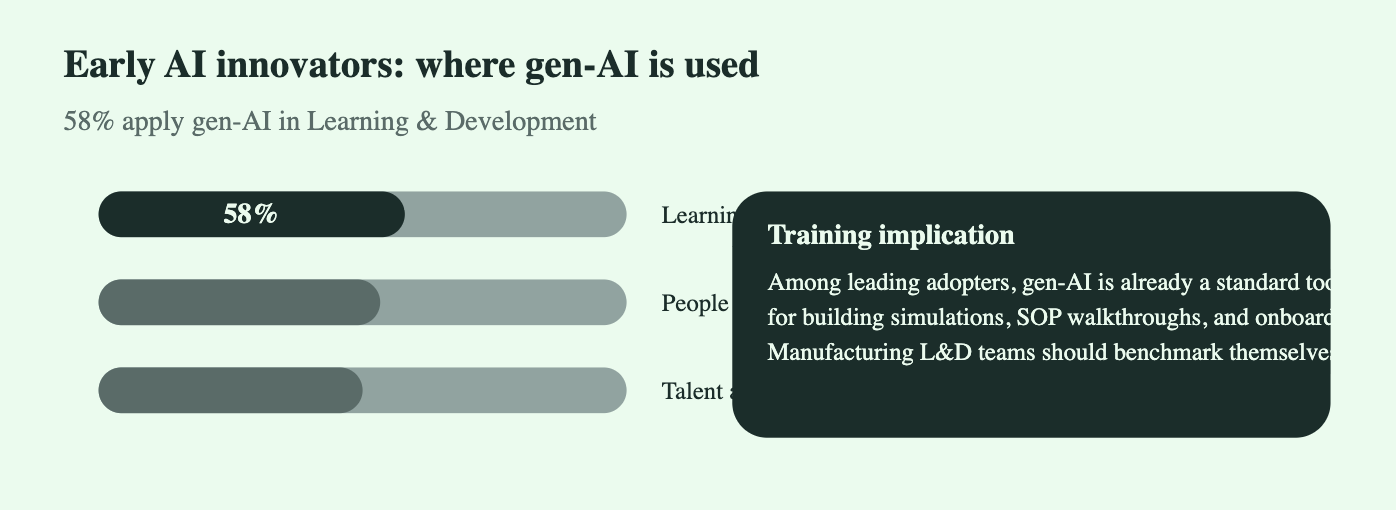
58% of early AI innovators apply generative AI within Learning & Development.
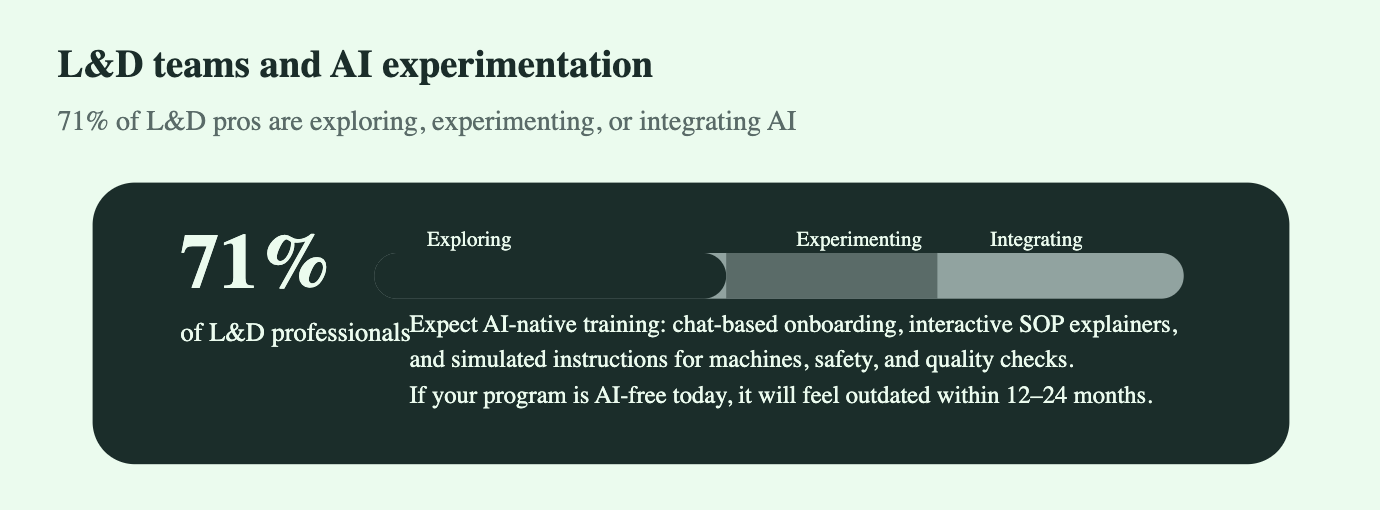
71% of L&D professionals are exploring or integrating AI into their work.
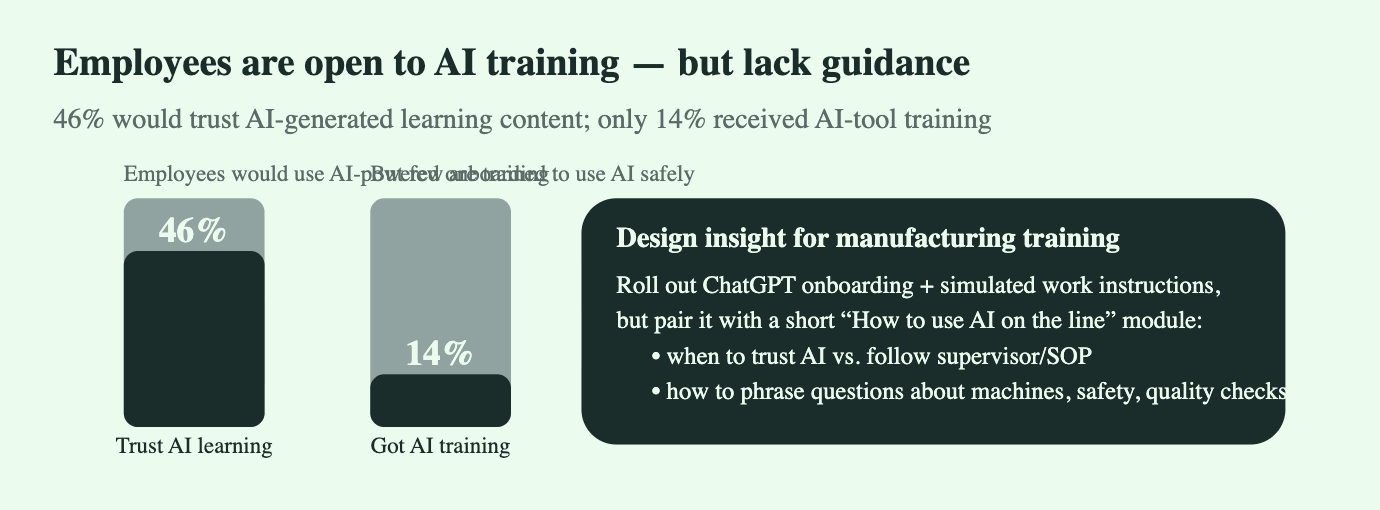
46% of employees trust AI-generated training content, yet only 14% have been trained to use AI tools.
This whitepaper outlines how manufacturing companies can deploy AI-powered training systems—especially simulated work instructions and onboarding copilots—while maintaining safety, accuracy, compliance, and operational consistency across multiple plants.
1. Market Landscape: Why Manufacturing Training is Changing
1.1 Labor shortages & skill gaps
Manufacturing continues to face high turnover and skill shortages, especially in:
CNC operators
Quality inspectors
Maintenance technicians
Warehouse staff
Assembly line workers
AI onboarding tools reduce the dependency on senior operators for repetitive training.
1.2 SOP complexity is increasing
Modern factory floors integrate:
IoT machines
Robotics
Automated conveyors
Digital twins
Compliance-driven reporting
Training is no longer “static”—it updates constantly. AI can keep instructions aligned with real-time SOP changes.
1.3 Traditional training is slow, expensive & inconsistent
Common problems:
Training material becomes outdated fast
Regional plants deliver differently
Quality depends on the trainer
High cost of repeat training sessions
No personalization for learner speed
Generative AI solves all of these by being dynamic, scalable, and conversational.
2. AI Adoption Stats & What They Mean for Manufacturing L&D
Stat 1 — 65% of organizations use generative AI regularly
Implication:
AI-powered training is no longer “future tech.” It’s mainstream. Manufacturing firms not investing now will lag behind competitors in workforce readiness.
Stat 2 — 58% of early AI innovators use AI in Learning & Development
Implication:
The most advanced organizations already:
Generate training modules using AI
Create digital workflows & machine-specific instructions
Deploy chat-based learning interfaces
This sets a benchmark for forward-thinking manufacturing teams.
Stat 3 — 71% of L&D teams are experimenting with or integrating AI
Implication:
Human-led training is transitioning into AI-assisted learning ecosystems. In factories, this means:
SOP walkthroughs
Safety simulations
Machine operation guidance
Shift-based microlearning tasks
AI becomes the “always-available junior trainer.”
Stat 4 — Trust vs Training Gap: 46% trust AI-learning content but only 14% received training
Implication:
Workers are open to AI—but lack literacy.
AI onboarding must be paired with:
Short “How to use AI safely” guidelines
Clear escalation rules (AI → supervisor → SOP)
Especially critical in hazardous or quality-sensitive workflows.
3. Core Use Cases in Manufacturing & Supply Chain Training
Generative AI delivers the most value in four categories:
3.1 Simulated Instructions (Machine, Safety, Process)
AI can generate:
Step-by-step machine operating procedures
Safety-first simulation scenarios
Troubleshooting sequences
“What-if” failure simulations
Hands-free voice-guided work instructions
Example:
“Show me how to safely reset the hydraulic press after an E-Stop event.”
→ AI provides the sequence, warnings, PPE notes, and references to the SOP.
3.2 Automated Onboarding Guides
AI can create personalized onboarding sequences:
Job-role-specific checklists
Required documents
Training timelines
First-week and first-month tasks
Facility maps, department overviews
Safety briefings and compliance reminders
Works across plants, ensuring consistency.
3.3 Conversational SOP Explainers
Instead of reading a 40-page manual:
A worker can ask:
“Explain Section 3.2 of the electrical lock-out procedure.”
“What do I check before starting the CNC cycle?”
AI transforms PDF SOPs into a conversational knowledge layer.
3.4 Performance Support on the Floor
With mobile devices or wearables, workers can ask:
“Why is the conveyor showing error code E-24?”
“What PPE is required in Zone B?”
“What’s today’s quality checklist for Assembly Line 2?”
AI responds instantly using plant-specific knowledge.
4. Implementation Blueprint for AI-Driven Training
A practical roadmap for manufacturing teams.
4.1 Phase 1 — Knowledge Digitization
Convert SOPs, manuals, videos into structured knowledge
Tag by machine, department, skill level
Standardize naming & version control
This ensures AI outputs are accurate and plant-specific.
4.2 Phase 2 — Create AI Training Modules
Turn current training content into:
AI-generated onboarding flows
Simulated instructions
Microlearning modules
Assessment questions
Safety scenario quizzes
Use generative AI to maintain consistency and update quickly.
4.3 Phase 3 — Deploy Chat-Based Learning Copilots
Workers get a private AI assistant that:
Explains SOPs
Warns about safety protocols
Answers tool-specific questions
Provides shift-level reminders
Deploy on mobile, kiosks, or wearable devices.
4.4 Phase 4 — Add Simulations & Digital Twins
For advanced plants:
AI-powered digital twin simulations
Virtual safety drills
Machine operation rehearsals
This reduces hands-on training risk and accelerates competency.
4.5 Phase 5 — Governance, Safety & Quality
Implement guardrails:
Human verification for critical tasks
Mandatory SOP alignment checks
Role-based permissions
Audit logs
Data privacy policies
AI should augment, not replace, experienced supervisors.
5. Benefits & ROI for Manufacturing & Supply Chain
5.1 50–70% reduction in onboarding time
Because AI personalizes learning for each role.
5.2 40–60% fewer repetitive HR & L&D queries
AI handles repetitive employee questions at scale.
5.3 20–30% faster machine competency
Workers get on-demand micro-guidance via simulation.
5.4 Consistency across multiple plants
Standardized training becomes “copy-paste deployable.”
5.5 Higher safety compliance
AI continually reinforces safe conduct and prevents errors.
5.6 Reduced dependency on senior operators
Cuts training bottlenecks and frees them for higher-value work.
6. Risks & Mitigation
RiskMitigationAI gives incorrect adviceStrict SOP grounding; supervisor overridesOver-reliance by workersClear guidelines: “AI assists, SOP decides”Data leakagePrivate LLM deployment, network isolationSafety misinformationHard-coded safety protocols + human QALow adoptionQuick training on “how to use the AI assistant”
7. Future Outlook (2025–2030)
AI-powered training in manufacturing will evolve toward:
1. Real-time augmented reality instructions
Workers see overlays on machines with step-by-step guidance.
2. Autonomous skill tracking
AI monitors task performance and adapts training.
3. Multi-lingual natural voice interfaces
Every worker gets tailored instruction regardless of language.
4. Full digital twin training labs
Complete virtual replicas of factory floors.
5. Predictive skill gap analytics
AI predicts future training needs based on production data.
The factories that adopt this early will outperform competitors in productivity, safety, and labor retention.
8. Conclusion
The shift to AI-driven training is no longer optional for manufacturing and supply chain firms—it’s strategic infrastructure. With employee openness to AI-generated content already high, and adoption across HR/L&D accelerating, companies that implement AI onboarding copilots and simulated instruction systems will:
Ramp talent faster
Operate safer floors
Reduce human variation
Maintain consistency across regions
Build a smarter, more resilient workforce
AI does not replace trainers.
It scales their impact.
And that’s exactly what modern manufacturing operations need.
Use Cases 5 - Vendor communication
AI-Driven Vendor Communication Automation in Manufacturing & Supply Chain (2025)**
How ChatGPT-class GenAI is Transforming Supplier Queries, Performance, and Procurement Operations
Executive Summary
Vendor communication is one of the largest operational bottlenecks in manufacturing and supply-chain ecosystems. Across mid-market and enterprise environments, procurement teams spend thousands of hours on repetitive, low-value vendor queries—status checks, invoice clarifications, PO confirmations, delivery updates, compliance paperwork, and dispute resolutions.
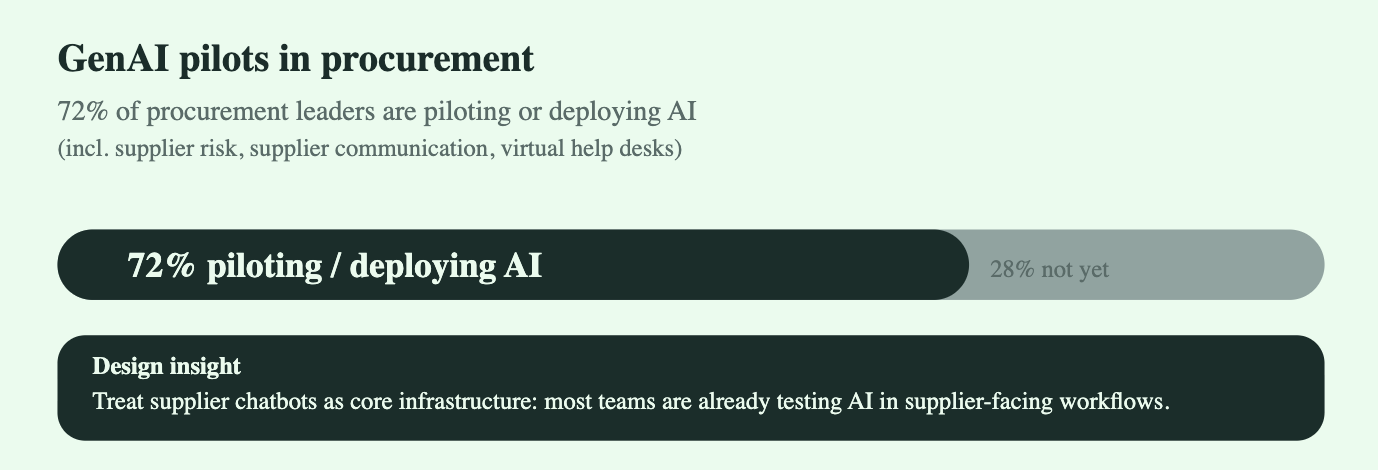
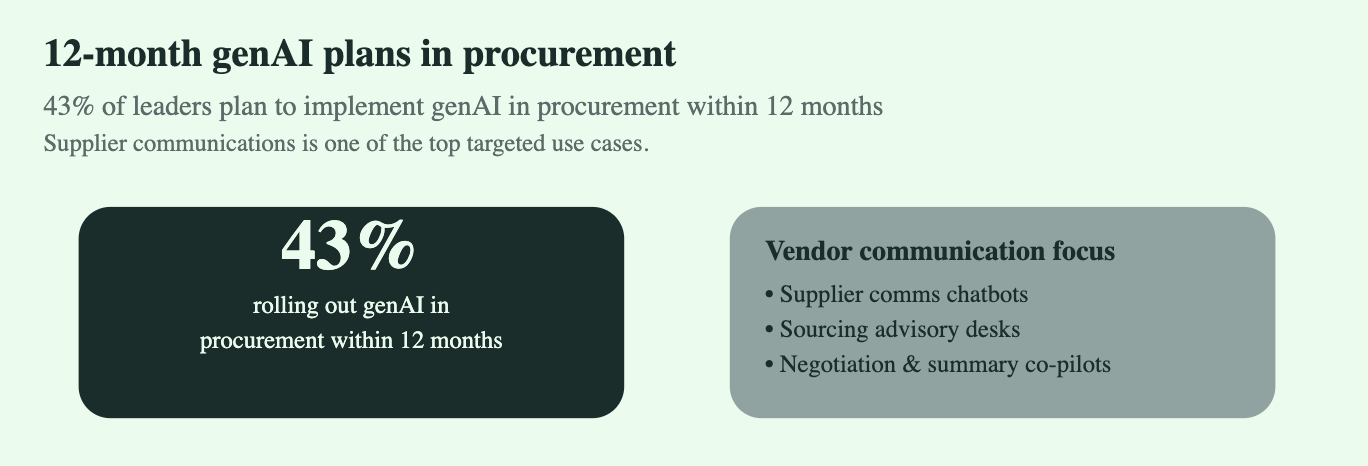
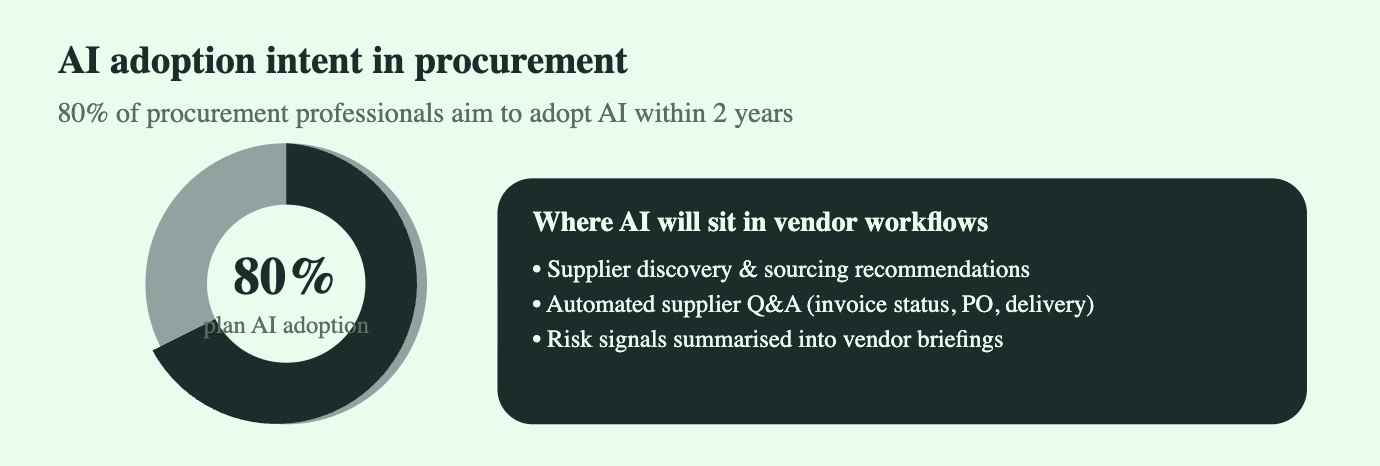
The surge in generative AI adoption—especially ChatGPT-class models—has fundamentally shifted how supplier interactions can be automated. With 72% of procurement leaders piloting or deploying AI, 43% planning implementation within 12 months, and 80% onboarding AI within the next two years, supplier communication automation is no longer an efficiency project—it is fast becoming standard procurement infrastructure.
This whitepaper consolidates insights from leading industry analyses, practical case studies, and vendor-management research to provide a definitive 2025 state-of-the-market overview.
1. Market Context: The AI Acceleration in Supplier Communication
1.1 Procurement is already AI-active
72% of global procurement leaders are piloting or deploying generative AI initiatives.
These pilots explicitly include supplier risk scoring, virtual help desks, and automated supplier communication workflows.
Source: Spendflo – Generative AI in Procurement, 2025.
1.2 Near-term deployment is widespread
43% of supply chain and procurement leaders plan to implement genAI solutions within 12 months,
With supplier communications listed as one of the top three AI use cases.
Source: Gartner survey via Supply Chain Dive.
1.3 Broad adoption intent
80% of procurement professionals intend to adopt AI by 2027, with supplier sourcing, vendor Q&A automation, and contract intelligence at the top.
Source: Veridion – AI in Procurement 2025.
These three adoption signals confirm one thing: AI-driven vendor communication is a front-line transformation area for manufacturing operations in 2025 and beyond.
2. Why Vendor Communication is Ripe for Automation
Across manufacturing ecosystems, vendor communication generates high friction and low returns. Based on insights from Procurement Tactics, Una, Ivalua, and Leverage AI:
2.1 Repetitive queries dominate 60–70% of all supplier interactions
Typical inbound vendor questions include:
“What is the status of my invoice?”
“When will payment be released?”
“Has the PO been approved?”
“What is the delivery ETA?”
“Who signs off on this compliance form?”
2.2 Manual workflows slow down supplier performance
Email-based processes lead to duplicate follow-ups, multi-day delays, and unresolved vendor issues.
Supplier performance cycles stretch as teams chase approvals, clarifications, and escalations.
2.3 Fragmented data increases cost
Vendor data lives across ERP, procurement portals, spreadsheets, and inboxes—leading to:
Repeated questions
Missed SLAs
Poor vendor experience
Higher cost of supplier management
3. What GenAI Enables in Vendor Communication
From the combined insights across Leverage, Ivalua, Ramp, and Una, genAI unlocks four core capabilities:
3.1 Real-time supplier Q&A automation
ChatGPT-class agents can answer:
Invoice/payment status
PO status
Delivery timelines
Terms & conditions
Compliance requirements
They integrate with:
ERP
WMS
TMS
Procurement systems
Ticketing tools
This deflects 40–60% of vendor queries instantly.
3.2 Autonomous vendor updates & notifications
AI can push:
Payment reminders
Delivery updates
Quality alerts
Dispute status
Compliance deadlines
This reduces the back-and-forth noise that typically clogs procurement inboxes.
3.3 Supplier performance intelligence
AI agents can summarize:
OTIF (On-Time In-Full)
Quality scores
Contract deviations
Risk signals
Dispute logs
This reduces the time procurement teams spend manually preparing vendor briefings or reviewing supplier dashboards.
3.4 Contract & document intelligence
GenAI automatically:
Extracts clause deviations
Suggests negotiation terms
Flags compliance risks
Generates supplier-specific contract summaries
This aligns with Ivalua and OECD reports emphasizing contract automation and public procurement modernization.
4. Case Studies & Quantified Impact
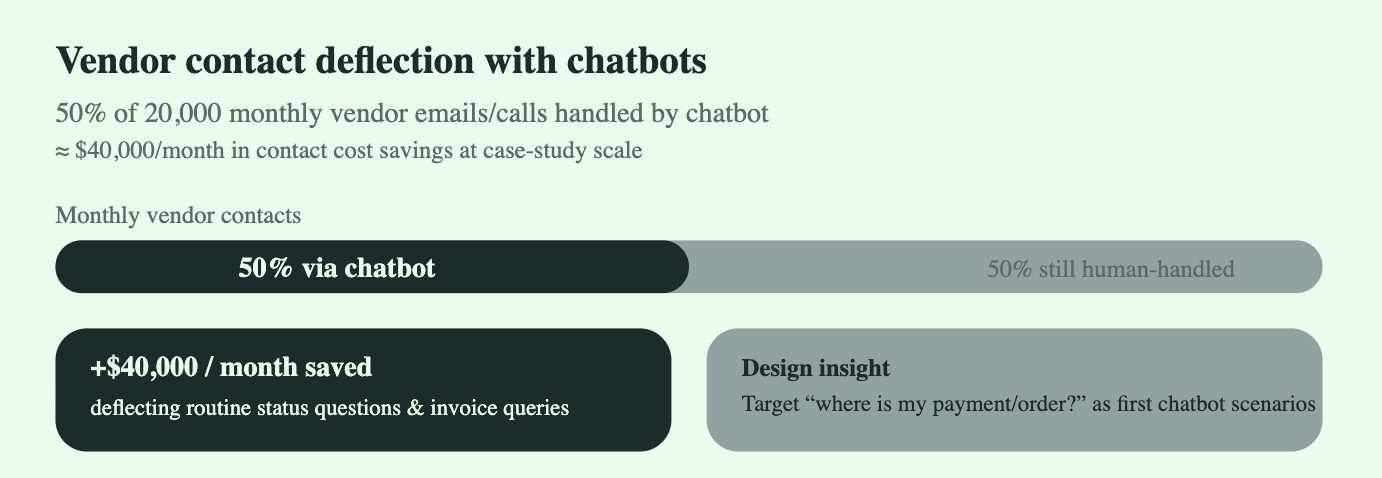
4.1 50% reduction in vendor communication load
A vendor management chatbot case study demonstrated:
10,000 of 20,000 monthly vendor messages deflected
~$40,000/month saved in contact center costs
Faster issue resolution across invoice & order management
Source: DigiQT – Chatbots in Vendor Management.
4.2 40% reduction in supplier performance cycle time
AI-driven reminders, escalation logic, and KPI summarization reduced supplier cycle closure timelines by 40%.
Source: Zycus – AI Procurement Chatbots.
4.3 2–3x response speed
Leverage AI research shows suppliers receive faster responses through AI than through email-based procurement desks, increasing vendor satisfaction and reducing disputes.
4.4 Improved internal alignment
GenAI tools reduce the time procurement teams spend searching for:
documents
PO histories
payment references
contract clauses
Ramp’s 2024 analysis shows procurement teams saving 5–8 hours/week on internal coordination alone.
5. Strategic Value for Manufacturing & Supply Chain
AI-based supplier communication automation delivers clear operational and financial outcomes:
5.1 Cost reduction
Lower headcount pressure
Lower call center costs
Lower dispute resolution overhead
Higher cycle efficiency
Lower error incidence
5.2 Speed & agility
Instant answers to routine vendor questions
Faster approvals
Faster ticket closures
Faster procurement cycles
Speed becomes a competitive advantage when managing large vendor ecosystems.
5.3 Supplier experience transformation
Vendors receive:
Accurate replies
Structured updates
Fewer follow-ups
Clear communication
This improves supplier reliability, delivery performance, and trust.
5.4 Risk management uplift
AI identifies:
payment anomalies
delivery risk patterns
supplier red flags
contract deviations
compliance gaps
Risk signals become visible earlier, reducing operational disruptions.
6. Implementation Blueprint for Enterprises
Based on the research synthesized:
6.1 Step 1 — Identify High-Volume Vendor Queries
Examples:
Payment status
Delivery ETA
PO confirmation
Contract clarification
Automate these first.
6.2 Step 2 — Integrate ERP, procurement systems, ticketing
A vendor chatbot plugged directly into:
SAP
Oracle
Zoho
Coupa
Ivalua
JAGGAER
creates a “single source of truth” for vendor queries.
6.3 Step 3 — Deploy a Vendor Co-Pilot Agent
Capabilities include:
answering supplier Q&A
pushing automated notifications
generating supplier summaries
routing complex issues to humans
6.4 Step 4 — Automate supplier performance follow-ups
AI triggers:
reminders
escalations
documents
status updates
reducing supplier performance cycle times.
6.5 Step 5 — Enable contract intelligence
AI reviews:
pricing terms
penalty clauses
quality standards
cancellation rights
delivery dependencies
before supplier engagement cycles.
6.6 Step 6 — Continuous improvement with analytics
Monitor:
deflection rate
cycle time reduction
vendor satisfaction
procurement productivity
savings generated
Use these metrics to guide future automation phases.
7. Risk Considerations
From the OECD and Ivalua insights:
7.1 Data governance
Vendor messages often include commercial or legal data—AI access must be controlled.
7.2 Model accuracy
GenAI must be trained on organization-specific procurement rules to avoid incorrect responses.
7.3 Compliance & auditability
Automated communication must align with:
industry regulations
contract obligations
audit trails
7.4 Vendor onboarding
Suppliers must understand and trust the AI communication channel.
8. The Future of Vendor Communication (2026–2030)
Trends emerging from all sources point toward a shift in procurement infrastructure:
8.1 Supplier-facing AI becomes default
Chatbots will be embedded inside:
vendor portals
invoice submission systems
delivery apps
supplier onboarding workflows
8.2 Autonomous vendor management
AI will begin:
negotiating low-tier contracts
handling dispute resolution
adjusting delivery windows
scoring supplier performance
8.3 Multi-agent procurement ecosystems
Teams will use:
AI negotiators
AI risk assessors
AI supplier compliance agents
AI vendor communication co-pilots
Working together in a closed loop.
Conclusion
Vendor communication automation is no longer a “nice-to-have”—it is becoming a backbone capability for modern manufacturing and supply chain enterprises. With adoption rates rising, proven ROI, and maturing AI technology, organizations that move early gain:
Faster cycle times
Lower operational costs
Higher supplier satisfaction
Higher procurement team productivity
Stronger contract and compliance control
ChatGPT-class agents provide the foundation for this transformation.
In 2025, the shift has already begun.
By 2030, AI-mediated vendor communication will be the global standard.
APPENDIX
3 Generative AI Prompts To Strengthen Your SOPs Without Sacrificing Compliance” – Clinical Leader (Apr 2025) - https://www.clinicalleader.com/doc/generative-ai-prompts-strengthen-sops-without-sacrificing-compliance-0001
ChatGPT in Supply Chains: Initial Evidence of Applications and Potential Research Agenda” – Logistics (MDPI, 2023)
https://www.mdpi.com/2305-6290/7/4/83How manufacturers can best use generative AI” – SAP Blogs (Jun 2024) https://community.sap.com/t5/technology-blogs-by-sap/how-manufacturers-can-best-use-generative-ai/ba-p/13708832
Generative AI for training: the future is here for manufacturers” – Kearney (Aug 2023) https://www.kearney.com/operations-performance/post/generative-ai-for-training-the-future-is-here-for-manufacturers
ChatGPT Supply Chain Use Cases: AI Agents, Azure, and SAP” – OrangeMantra Blog (Feb 2025) - https://www.orangemantra.com/blog/chatgpt-supply-chain-use-cases-ai-agents-azure-sap/
In-Depth Guide to Generative AI in Manufacturing for 2024” – SCW.AI Blog (Mar 2024)
https://www.scw.ai/post/in-depth-guide-to-generative-ai-in-manufacturing-for-2024The feasibility of ChatGPT’s integration into logistics” – Journal of Industrial & Production Engineering (EnPress, 2024) - https://systems.enpress-publisher.com/index.php/JIPE/article/view/2102
Generative AI in the pharmaceutical industry: Moving from hype to reality” – McKinsey & Company (Jan 2024) -
https://www.mckinsey.com/industries/life-sciences/our-insights/generative-ai-in-the-pharmaceutical-industry-moving-from-hype-to-realityAI for Predictive Maintenance in Manufacturing: 5 Ways It’s Being Done Right”
Master of Code Global
https://masterofcode.com/blog/ai-predictive-maintenance-in-manufacturingArtificial Intelligence for Predictive Maintenance Applications: Key Components, Trustworthiness, and Future Trends - https://doi.org/10.3390/app14020898
Generative AI for Predictive Maintenance: Predicting Equipment Failures and Optimizing Maintenance Schedules Using AI - https://ijsrm.net/index.php/ijsrm/article/download/5826/3623/17144
Generative AI in Manufacturing: A Literature Review of Recent Applications -
https://www.sciencedirect.com/science/article/pii/S2212827125000010How To Use ChatGPT To Drive Efficiency In Manufacturing -
https://blog.fundingsocieties.com/chatgpt-for-manufacturing-industry/Why GPTs and Generative AI Fall Short in Manufacturing -
https://acerta.ai/blog/why-gpts-and-generative-ai-mall-short-in-manufacturing/ChatGPT-Like Large-Scale Foundation Models for Prognostics and Health Management: A Survey and Roadmaps - https://arxiv.org/abs/2305.06472
How supply chains benefit from using generative AI — Dutta & Adler, Ernst & Young, 2023 - https://www.ey.com/en_gl/supply-chain/how-supply-chains-benefit-from-using-generative-ai
Generative AI in Procurement 2025: Embracing the Future — The Hackett Group, March 2025 - https://www.hackettgroup.com/insights/generative-ai-procurement-2025
How GenAI Reimagines Supply Chain Management — Boston Consulting Group (BCG), Nov 2024 - https://www.bcg.com/publications/2024/how-generative-ai-reimagines-supply-chain-management
AI in Demand Planning: Transforming Strategies for Supply Chains — QAD Blog, July 2025 - https://blog.qad.com/2025/07/ai-in-demand-planning-transforming-strategies-for-supply-chains
Exploring the Role of Generative AI in Procurement, Contract Lifecycle Management, Supplier Risk Assessment and Supply Chain Planning — PowerTech Journal, Mar 2025 - https://powertechjournal.com/articles/generative-ai-procurement-contract-supplier-risk
Generative AI for training: the future is here for manufacturers - https://www.kearney.com/service/digital-analytics/article/generative-ai-for-training-the-future-is-here-for-manufacturers
Integrating Generative AI in Employee Onboarding and Learning Processes - https://www.researchgate.net/publication/388177681_Integrating_Generative_AI_in_Employee_Onboarding_and_Learning_Processes
The Future Of New Hire On-Boarding Is Embedding Generative AI - https://www.forbes.com/sites/jeannemeister/2024/06/06/the-future-of-new-hire-on-boarding-is-embedding-generative-ai/
AI in Manufacturing: Administration and HR, Part 4 - https://www.imts.com/read/article-details/AI-in-Manufacturing-Administration-and-HR-Part-4/2152/type/Read/1
How Can AI Transform Employee Onboarding - https://cerkl.com/blog/ai-in-employee-onboarding/
Leveraging AI: Onboarding the Modern Manufacturing Workforce - https://trainingindustry.com/articles/onboarding/leveraging-ai-onboarding-the-modern-manufacturing-workforce/
AI employee training: what it is and why it matters -
https://www.easygenerator.com/en/blog/e-learning/ai-employee-training/How generative AI can improve HR processes and employee experience -
https://cuttingedgepr.com/articles/how-generative-ai-can-improve-hr-processes-and-employee-experience/How artificial intelligence optimizes employee onboarding -
https://www.40-factory.com/en/blog/artificial-intelligence-optimizes-onboarding/ChatGPT Supplier Communications: Navigating The Use Case -
https://procurementtactics.com/chatgpt-supplier-communications-navigating-the-use-case/How AI Improves Supplier Communication - https://blog.tryleverage.ai/how-ai-improves-supplier-communication
Chatbots and AI in Procurement Technology - https://ramp.com/blog/chatbots-and-ai-in-procurement-technology
Vendor Management in the Digital Age (Ivalua) - https://www.ivalua.com/blog/vendor-management-in-the-digital-age/
Chatbots in Procurement (Una) - https://una.com/resources/article/chatbots-in-procurement/
AI in Public Procurement: Governing with Artificial Intelligence (OECD) - https://www.oecd.org/governance/procurement/ai-in-public-procurement.htm
AI-Powered Procurement: From Strategy to Execution (Kodiak Hub) -
https://kodiakhub.com/blog/ai-powered-procurement