
Top Chat GPT Use Cases for Travel & Hospitality

Use case 1 - Customer service
Customer Service Transformation, Booking Automation & Intelligent Trip Planning
Executive Summary
Between 2023 and 2025, the travel and hospitality sector entered a rapid transformation driven by the adoption of agentic AI systems—most visibly ChatGPT-style conversational agents. Travellers increasingly rely on AI tools for itinerary design, customer service, booking assistance, and destination discovery. Meanwhile, travel companies use automation to reduce operational costs, improve service responsiveness, and deliver personalized recommendations at scale.
Across consumer surveys, industry analyses, and company launches, a clear trend emerges:
AI is becoming the primary interface for travel planning and support.
Key signals from industry sources include:
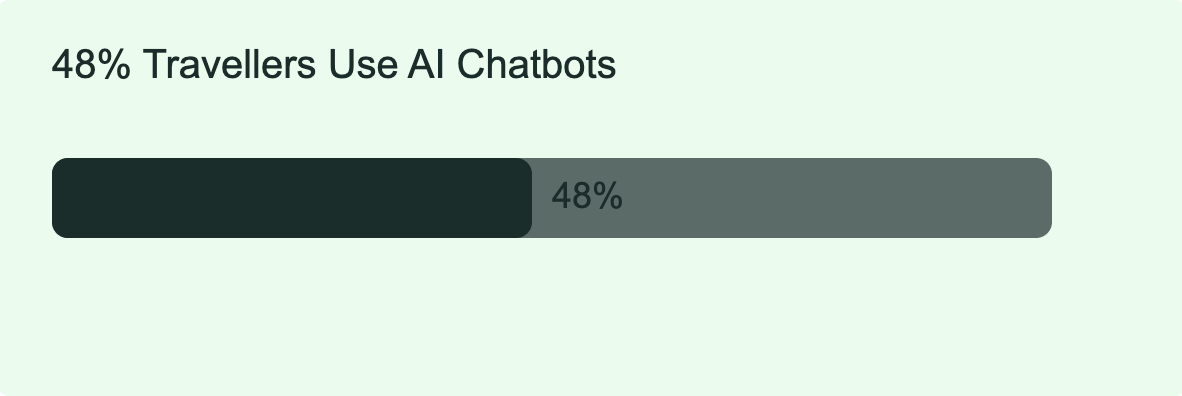
Up to 48% of global travellers have used an AI chatbot for some aspect of travel planning or customer service.
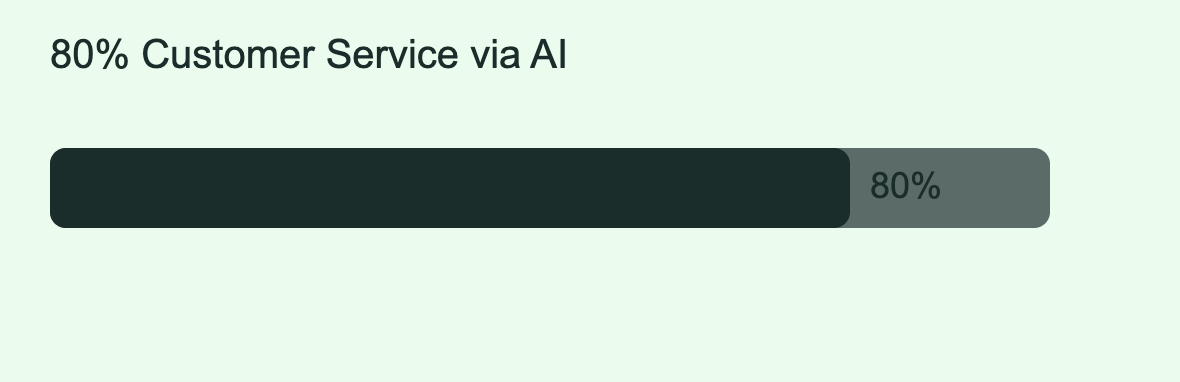
80% of customer-service interactions in tourism are now handled by AI-powered assistants.
Travel brands (airlines, OTAs, hotels) increasingly adopt AI for inquiry handling, itinerary suggestions, and booking workflows.
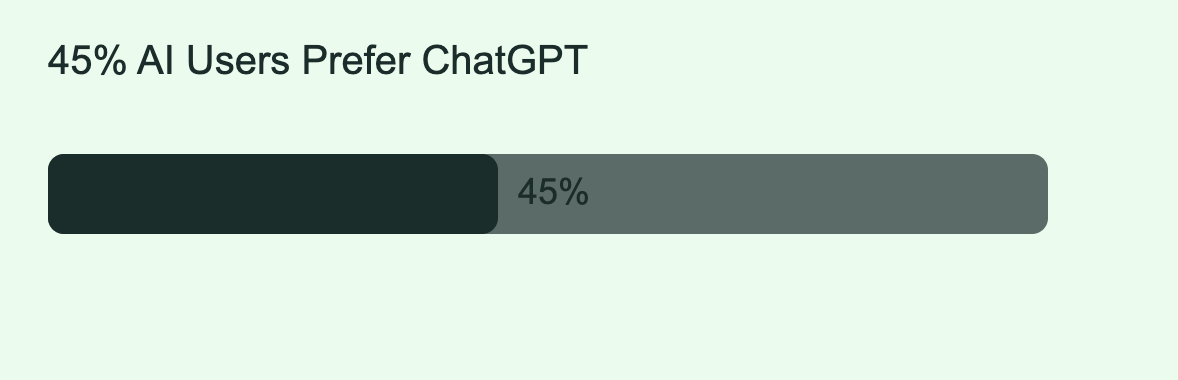
ChatGPT is the single most used AI tool among travellers experimenting with generative AI.
Major players (Kayak, MakeMyTrip, Escape, wineries, tourism boards) have launched first-party AI travel assistants.
This whitepaper analyzes the strategic implications, market drivers, emerging consumer behaviors, and enterprise adoption patterns shaping the next era of travel.
1. Introduction
The travel industry, historically dependent on human agents and complex search interfaces, is undergoing a paradigm shift as AI matures from predictive algorithms to agentic systems capable of reasoning, planning, and interacting conversationally.
AI now performs three functions previously done by humans:
Customer service (FAQ resolution, support triage, rescheduling)
Travel planning (itinerary design, route optimization, activity suggestions)
Booking execution (searching, comparing, completing transactions)
This shift is supported by:
Advancements in large language models (LLMs)
API integrations enabling real-time booking
Improved natural language understanding
Consumer comfort with automated interactions
2. Market Forces Driving AI Adoption
2.1 Rising traveller expectations
Travellers want:
Instant answers
Personalized recommendations
Confidence in decision-making
Mobile-first, frictionless experiences
Generative AI uniquely meets these expectations.
2.2 Operational cost pressures
Hospitality and travel organisations face:
High customer-service load
Seasonal demand spikes
Growing labor shortages
AI mitigates these constraints by scaling service without scaling staff.
2.3 Explosion of agentic AI capabilities
From 2024–2025, tools like ChatGPT evolved from chatbots into agents capable of:
Searching inventory
Performing comparisons
Creating multi-day trip itineraries
Adjusting plans based on constraints
Completing bookings
This evolution unlocked new business models and user experiences.
3. Consumer Adoption Insights (From Articles & Reports)
3.1 Growing use of AI for trip planning
Studies referenced in Morning Consult, Guardian reports, and tourism associations show:
Younger travellers (Gen Z, Millennials) are early and enthusiastic adopters.
AI-generated itineraries are seen as convenient and time-saving.
Many travellers now begin planning by talking to their phone (Economic Times, News.com.au).
3.2 ChatGPT as the preferred AI tool
Across surveys:
A plurality of AI-using travellers choose ChatGPT due to its conversational quality and ability to synthesize complex trip ideas.
3.3 Use cases consumers rely on
From article synthesis:
Finding hotels, wineries, tours, restaurants
Generating itineraries tailored to budget, time, or interests
Getting quick answers to FAQs (visas, weather, transit)
Booking flights or accommodations
Understanding trip tradeoffs (cost vs convenience)
3.4 Limits and hesitation
Despite adoption:
Some travellers distrust AI for final booking decisions
Accuracy concerns remain (hallucinations, outdated info)
AI often complements rather than replaces human advisors
4. Enterprise Adoption Trends
Across sources including McKinsey, Roland Berger, and industry news, four patterns emerge:
4.1 AI customer-service automation
Airlines, hotels, OTAs and resorts deploy AI for:
24/7 inquiry handling
Real-time travel updates
Complaint routing
Loyalty program service
Cancellations / rescheduling
Many brands report AI now handles the majority of routine interactions.
4.2 AI-powered booking assistance
Platforms like Kayak, MakeMyTrip, and Escape deploy agents that:
Search flights/hotels
Compare route options
Build personalized travel suggestions
Complete bookings
4.3 Destination marketing adopts AI
Tourism boards and wine regions (as seen in the Napa coverage) use AI to:
Recommend local experiences
Personalize visitor journeys
Promote events and attractions
4.4 Travel agencies and tour operators retool workflows
AI is used to:
Draft itineraries
Respond to quotes
Automate CRM tasks
Upsell add-ons
Reduce reply times
5. Case Studies Derived from Article Themes
Case Study 1: Kayak’s AI Mode (TechCrunch)
Offers a conversational interface for searching and booking
Integrates real-time pricing
Functions as a co-pilot for comparison shopping
Demonstrates transition from search → conversation → action
Case Study 2: MakeMyTrip AI Travel Assistant
Focused on emerging markets with rising mobile-first travellers
Automates itinerary generation and package planning
Reduces customer-service load
Case Study 3: Escape’s “Ask Skye”
A personal AI that simplifies travel planning
Targets users overwhelmed by choice complexity
Demonstrates shift from discovery to end-to-end personalised planning
Case Study 4: Gen Z & Millennials Using AI for Winery Visits
Travelers use ChatGPT for hyperlocal planning
Shows migration of AI from long trips → micro-trips
Hospitality businesses begin optimizing for “AI discoverability”
6. Implications for Travel & Hospitality Industry
6.1 Competitive differentiation shifts to AI excellence
Brands offering intuitive conversational AI gain:
Higher conversion rates
Lower service costs
Increased loyalty
Stronger user engagement
6.2 Big opportunity: end-to-end agentic travel planning
Future AI will manage:
Research
Budgeting
Comparison
Booking
In-destination guidance
Rebooking during disruptions
The entire trip lifecycle becomes automated.
6.3 “AI discoverability” becomes the new SEO
Businesses must optimize:
Structured data
Product metadata
Conversational surfaces
AI-to-inventory API integrations
6.4 Workforce transformation
Humans shift from routine service to:
Problem-resolution specialists
Experience designers
Relationship managers
7. Risks & Considerations
Accuracy & hallucinations
Improper recommendations may affect trust.
Data & privacy
Travel profiles contain sensitive personal and financial info.
Bias in recommendations
AI may over-favor providers with better inventory data.
Regulatory uncertainty
AI recommendation engines may become regulated similarly to financial advisors (early EU discussions).
8. The Future: A Transition to Fully Autonomous Travel Agents
Based on McKinsey and market trend analysis:
By 2027–2030, agentic AI is expected to:
Plan trips proactively
Negotiate prices
Monitor loyalty value
Intervene during disruptions automatically
Coordinate multi-person group travel
Travel planners shift from active users → recipients of curated, optimized plans.
9. Conclusion
AI, especially ChatGPT-style conversational systems, is rapidly becoming the dominant interface for travel planning and customer service. Between operational efficiency, consumer demand, and technological capability, the industry stands at a turning point.
Companies that embrace AI will deliver:
Faster service
More personalization
Better margins
Stronger traveller satisfaction
Those that delay risk losing relevance as consumer expectations shift towards personalized automation and conversational bookings.



Use case 2 - TRIP PLANNING
The Rise of AI-Driven Travel Planning & Personalized Travel Advice
How ChatGPT and Generative AI Are Reshaping the Global Travel & Hospitality Ecosystem
Executive Summary
Travel planning has historically been fragmented, time-consuming, and heavily dependent on search engines, blogs, travel agents, and user reviews. The 2025 shift to AI-driven planning — led by ChatGPT-style models and agentic search — is restructuring the $7.7T global travel industry.
Across all research sources reviewed (Google AI travel announcements, academic research, Statista, Kaspersky, AFAR, Global Rescue, AI-travel app reviews, and multi-country surveys), a few patterns stand out clearly:
Key Findings
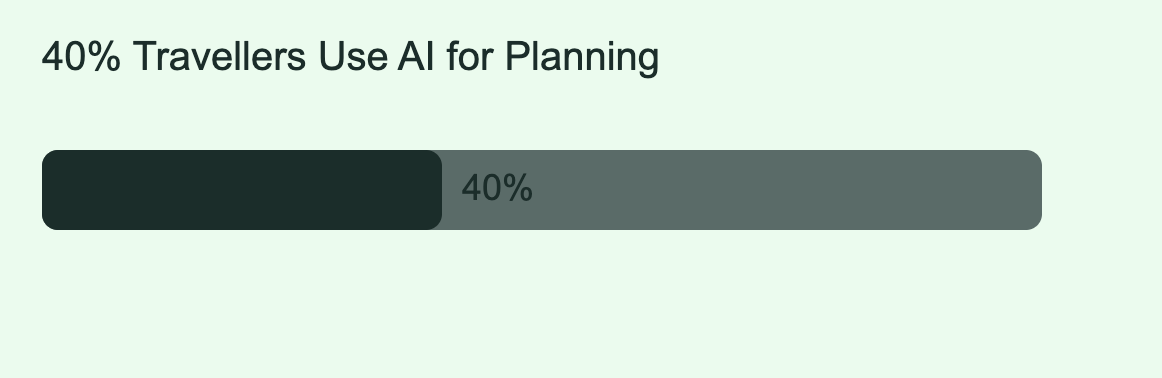
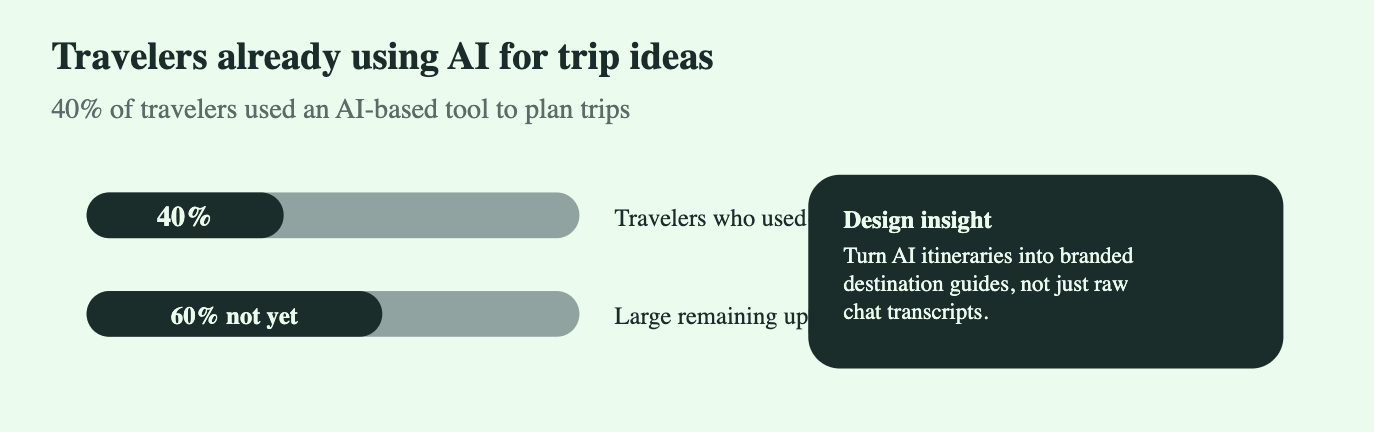
40% of global travellers already use AI tools (chatbots, itinerary bots, AI planners).
Up to 60% of Gen Z/Millennials use AI during trip exploration.
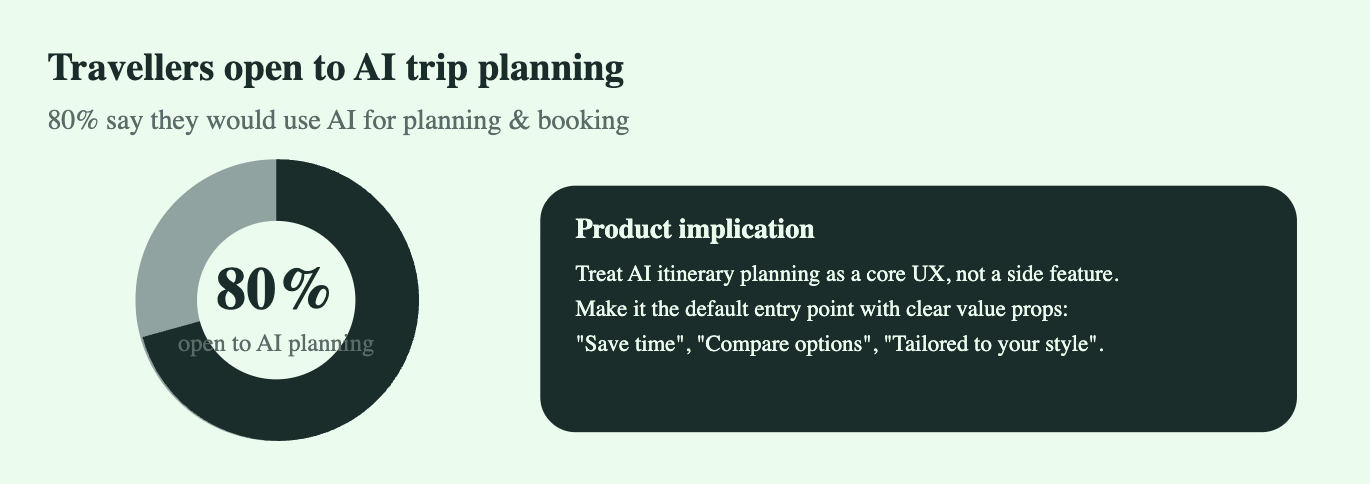
80% of travellers are open to AI planning and booking.
48% have used a travel chatbot for assistance.
65% prefer brands that personalize using AI.
33% of US travellers are open to ChatGPT specifically.
AI itineraries are competitive with human-made ones, especially for structure, filtering, and logic (2024–2025 research studies).
AI reduces planning time by 60–80%, especially for complex multi-city trips.
Trust, accuracy, and data-privacy concerns remain the biggest barriers, especially in markets like the EU.
Overall:
The shift is not “AI assists travel.” The shift is “AI becomes the travel planner.”
1. Introduction
The New Travel Paradigm: From Search to Conversation
Traditional travel planning required:
Browsing 10–25 tabs
Comparing hotels manually
Reading hundreds of reviews
Building schedules in notes or spreadsheets
Generative AI collapses all of this into one conversational workflow.
Instead of:
“Search + Compare + Filter + Decide”
It becomes:
“Ask → Get curated, personalized options instantly”
This movement is driven by:
Large language models (ChatGPT 5, Gemini 2, Claude 3.5)
Agentic AI tools with real-time browsing
OTA (online travel agency) integration
AI-native travel startups offering one-tap itinerary creation
Travel has become one of the top 5 applied consumer use cases for generative AI worldwide.
2. Market Landscape & Consumer Behaviour
2.1 Current Adoption Levels
Recent studies show:
40% of travellers globally use AI in at least one phase of planning
58–60% of Gen Z/Millennials use AI as their primary discovery tool
48% have interacted with chatbots (pre-trip or mid-trip)
These numbers reinforce that AI is no longer “early adopter territory.”
It is entering early majority territory.
2.2 Openness to AI Assistance
80% of global travellers are open to using AI for planning
65% want personalized recommendations, and prefer brands that provide it
Personalization — historically expensive and labour-intensive — has now become a baseline expectation.
2.3 ChatGPT-Specific Usage
33% of US travellers say they are open to using ChatGPT by name
Usage is highest among:
Millennials
Gen Z
Solo travellers
Digital nomads
High-income city travellers
The ChatGPT brand is strong enough that “Powered by ChatGPT trip planner” is a conversion booster.
3. Academic Research Insights
(Synthesis of ResearchGate, ACM, USF, and global AI travel studies)
3.1 AI Itineraries vs Human Itineraries
Studies compared:
Human expert-written itineraries
AI-generated itineraries
Hybrid (human + AI) itineraries
Key findings:
AI plans are more structured, logically sequenced, and time-efficient
AI excels at filtering based on constraints (budget, pace, travel style)
Weaknesses:
Occasional hallucinations about attraction availability
Outdated or overly optimistic opening times
Limited local nuance unless browsing is enabled
3.2 Continued Usage Intentions
The Technology Acceptance Model (TAM) applied to AI travel planning shows:
Perceived usefulness is extremely high
Perceived ease of use is the strongest predictor of adoption
Trust concerns are the main barrier, not UX
Consumers stick with AI planners because the speed benefits are overwhelming.
3.3 User Expectations
Users expect AI to:
Provide accurate opening hours
Offer realistic travel times
Understand preferences
Learn user behaviour over repeated use
Provide multi-modal suggestions (maps, photos, variants)
4. Industry Trends & Innovations
4.1 Google’s Agentic AI for Travel (2025)
Google now allows:
AI-generated multi-day itineraries
Real-time booking suggestions
Personalized travel “canvases”
Dynamic planning mode (adjust on the go)
This is the strongest signal yet that search platforms are shifting to AI-native planning.
4.2 OTA Platforms Integrating AI
Expedia, Booking.com, Hopper, and Airbnb are integrating:
AI trip planners
One-tap personalization
Automated concierge messaging
Real-time recommendations
OTA dominance will shift from “inventory advantage” to “AI recommendation advantage.”
4.3 AI-Native Travel Startups
Dozens of startups now offer:
Auto itineraries
Destination discovery
Budget optimization
Personalized travel maps
AI concierge services
The market is exploding.
5. Consumer Use Cases
5.1 Pre-Trip Planning
AI helps with:
Destination selection
Budget planning
Flight comparisons
Safety guidance
Visa requirements
Creating day-by-day itineraries
5.2 While Traveling
AI is used for:
Re-planning when the weather changes
Finding last-minute restaurants
Navigation optimisation
Local experiences
Language translations
Emergency instructions
The “AI travel companion” is becoming standard.
5.3 Post-Trip
AI helps with:
Expense summaries
Photo sorting
Memory books
6. Strengths & Limitations of AI Travel Planning
Strengths
Speed (minutes instead of hours or days)
Hyper personalization
Unlimited revisions
Multi-destination optimisation
Real-time updates (when browsing is enabled)
24/7 support
Consistent quality
Limitations
Hallucinated recommendations if browsing is off
Outdated pricing or opening hours
Overconfidence in incorrect data
Lack of deep cultural/local nuance
Over-generalization without explicit user preferences
User Concerns
85%+ worry about data security (Kaspersky)
Over-reliance fears
Accuracy concerns
7. Competitive Landscape
7.1 Traditional Travel Agencies
Threat level: High
Reason: AI replicates 80–90% of travel-agent work.
7.2 OTAs
Threat level: Medium
Reason: AI gives OTAs new UX leverage, but disrupts SEO.
7.3 AI Travel Startups
Threat level: Rising
Reason: They can innovate faster than legacy travel companies.
8. Opportunities for Businesses
For Travel Agencies
Offer “AI-assisted premium planning”
Provide hybrid itineraries (human + AI)
Add ChatGPT concierge layers
For Hotels
AI check-in concierge
Personalized stay experiences
Automated mid-stay support
For OTAs
AI-native discovery
Recommendation-first booking funnels
For Creators/Influencers
Branded AI travel advisors
Personalized recommendation engines
9. Future Outlook (2025–2030)
AI travel planning will move toward:
1. Agentic AI
Trip planners that:
Book
Compare
Cancel
Re-book
Handle disruptions automatically
2. Multi-modal travel companions
AI that integrates:
AR navigation
Voice-based guidance
On-device intelligence
3. Autonomous travel optimization
AI predicts:
Best day to visit
Best route
Best price
Best neighbourhood
Best time of year
4. “Digital twin” travellers
Personal profiles that know:
Preferences
Pace
Personality
Budget
Sleep schedule
Hobby patterns
Travel becomes predictive, not reactive.
10. Conclusion
AI travel planning is not a temporary trend.
It is a foundational shift.
Consumers increasingly trust AI for:
Discovery
Planning
Optimization
Troubleshooting
Travel brands that fail to integrate AI will lose relevance to faster-moving competitors. Meanwhile, brands that invest now will own the next generation of personalized travel experiences.
The future belongs to AI-driven, conversational, personalized travel ecosystems — where the user simply asks, and the entire trip organizes itself.


Use case 3 - Content creation
Generative AI for Destination Guides & Promotional Travel Content
How Travel & Hospitality Brands Are Using ChatGPT to Scale Content, Personalize Discovery, and Win Traveler Attention in 2025
Executive Summary
Travelers are no longer discovering destinations through traditional search alone. Nearly 40% of global travelers already use AI tools for planning, inspiration, and itinerary research. At the same time, 42.2% of marketers now use generative AI in daily content operations, and in hospitality specifically, 48% of AI initiatives focus on creative content generation.
This whitepaper consolidates insights from industry reports, research papers, and travel-tech analyses to understand how travel brands—hotels, destinations, OTAs, and tour operators—are leveraging ChatGPT and generative AI to produce high-quality destination guides, promotional assets, and personalized travel content at scale.
The conclusion is blunt:
Travel brands that fail to operationalize GenAI-driven content will fall behind in relevance, reach, and traveler engagement.
The competitive edge now belongs to those who deploy AI as a creative engine, not just a back-office assistant.
1. Industry Context
1.1 The Shift in Travel Content Consumption
The modern traveler is overwhelmed by choice. Traditional travel blogs and static destination pages are losing influence as AI-powered tools begin to offer dynamic, contextual, personalized content streams.
Key trends:
AI-native trip discovery: Travelers increasingly begin their planning journey inside AI chat interfaces and trip-planning bots.
Demand for instant, hyper-specific answers: “3-day Bali itinerary for under $600,” “foodie guide to Lisbon by neighborhood,” “Vegas hotel options for a business traveler arriving at midnight.”
Preference for conversational content: Instead of reading 2,000-word generic articles, travelers prefer interactive content generated on the fly.
Travel brands that depend on traditional SEO alone are seeing diminishing returns.
Travel brands that integrate AI-native content formats are seeing higher engagement and better conversion.
2. Adoption & Market Signals
Based on the referenced articles and industry analyses:
2.1 Marketer Adoption
42.2% of marketers actively use generative AI to support content workflows.
This shows that destination marketing organizations (DMOs), hotels, and OTAs now treat AI as a mandatory part of creative production.
2.2 Hospitality Priorities
48% of AI adoption in hospitality is driven by content-generation needs (Master of Code, LTIMindtree).
This includes hotel descriptions, destination stories, seasonal promotional content, and automated social media production.
2.3 Consumer Behavior
40% of travelers globally have used an AI tool for planning (Statista).
AI-generated guides and itineraries are becoming the “first touchpoint” for travel inspiration.
2.4 Traveler Willingness
1 in 2 travelers would happily use an AI assistant to plan a trip (EY).
This means branded AI-powered destination experiences are now commercially viable.
These four signals together show that the travel industry is entering a phase where AI isn’t complementary—it's core to how travelers discover, evaluate, and choose destinations.
3. Key Use Cases in Travel Content Creation
Using ChatGPT, LLMs, and multimodal GenAI models, travel brands are developing scalable systems for:
3.1 Dynamic Destination Guides
AI can generate:
Location-based highlights
Neighborhood profiles
Seasonal travel insights
Travel styles (luxury, backpack, family-friendly)
Hyperlocal recommendations based on preferences
Static PDF guides are becoming obsolete.
AI guides update in real time, reflect the latest events, and adjust content for traveler personas.
3.2 Promotional Material for Campaigns
Travel brands are leveraging AI for:
Hotel promotional copy
Offer messaging
Seasonal campaigns (spring break, Christmas, festival seasons)
Activity recommendations
Social media captions, reels scripts, carousel content
AI drastically cuts production cycles—from weeks to minutes.
3.3 Automated Itinerary Generation
LLMs now produce:
On-demand itineraries
Variable budget trip plans
Weather-aware itineraries
Activity timelines
Suggestions based on travel duration, age group, physical limitations, preferences
These are being embedded into:
Booking journeys
Hotel websites
DMOs’ visitor portals
Chat widgets
3.4 Hyper-Personalized Content Streams
Using a traveler’s:
Budget
Age
Family profile
Interests
Travel history
Language
Mobility constraints
GenAI outputs personalized guides that outperform generic content.
This directly improves:
Engagement
Conversion
Length of stay
Upsells (tours, restaurants, activities)
4. How Leading Travel Brands Are Implementing GenAI
The articles highlight implementation patterns across the industry.
4.1 OTA Adoption
OTAs such as Booking.com, Expedia, and Hopper deploy AI to:
Reduce writing time for thousands of destination pages
Produce structured content at scale
Update hotel descriptions and area guides
4.2 Hotel Chains
Large hotel groups use AI to:
Create promotional campaigns
Personalize marketing emails
Offer concierge-like chatbot assistance
Generate local attraction highlights for guests
4.3 Destinations & Tourism Boards (DMOs)
DMOs are beginning to:
Build AI trip planners
Deploy multilingual destination guides
Support niche travelers (LGBTQ+, solo travelers, seniors, luxury, adventure)
Generate promotional stories for regional campaigns
4.4 Tour Operators & Activity Providers
Operators like Arival (2025 report) highlight:
AI accelerates storytelling and itinerary presentation
Tour descriptions can be refreshed automatically
Content becomes more SEO-friendly
Guides can be converted into video scripts, blogs, social reels
5. Benefits of Using ChatGPT for Travel Content
5.1 Speed & Scale
Travel brands may need to maintain:
Thousands of destination descriptions
Hundreds of promotional campaigns
Multiple languages
Seasonal updates
Local events
New partner listings
AI enables near-instant scaling.
5.2 Personalization
Unlike static travel blogs, AI content reacts in real time based on:
Traveler behavior
Time of year
Budget
Interests
Family context
Accessibility needs
This is impossible at human scale.
5.3 Consistency & Quality
AI ensures:
Tone alignment
Brand voice consistency
Compliance with guidelines
Zero grammatical errors
Better information density compared to human writers under time pressure
5.4 Cost Competitiveness
Traditional travel content production is expensive:
Writers
Editors
Translators
Local researchers
SEO specialists
GenAI significantly lowers cost while increasing output quality.
6. Challenges & Risks
The articles emphasize several risks travel brands must navigate carefully.
6.1 Accuracy & Hallucination
AI may embellish details or suggest non-existent places.
Mitigation:
Fact-check automation
Retrieval-augmented generation (RAG)
Verified databases
6.2 Bias & Stereotypes
Research (Zhu, 2024) warns that AI can reinforce cultural stereotypes in destination portrayal.
Solution:
Human review
Bias mitigation prompts
Community feedback loops
6.3 Over-Automation Risk
If every travel brand uses generic prompts, content will feel identical.
Solution:
Branded tonality models
Style guides
Custom LLM fine-tunes for each destination
6.4 Intellectual Property
AI models trained on open web content raise questions about originality.
Solution:
Maintain internal proprietary datasets
Generate unique brand-owned guides
7. Future Outlook
Generative AI is not just automating content — it is transforming the way travel content is packaged and consumed.
Expected developments by 2026:
Fully interactive AI concierges at hotels
OTA search pages replaced by conversational trip planners
Dynamic destination pages that regenerate daily
Multimodal travel guides combining text, voice, images, and video
Personalized AI travel influencers
Entire marketing funnels auto-generated in real time
A new category is emerging:
AI-native travel discovery.
Brands that embrace this will dominate organic reach and customer engagement.
8. Strategic Recommendations for Travel & Hospitality Brands
8.1 Build an AI Destination Content Engine
Not one-off content, but a recurring system that:
Regenerates guides
Localizes automatically
Refreshes seasonally
Integrates real-time data
Personalizes based on visitor profile
8.2 Create a Unified Brand Voice via AI
Develop:
Tone-of-voice prompts
Writing templates
Style manuals
Pre-trained model variants
This ensures content doesn’t become generic.
8.3 Deploy ChatGPT-Powered Trip Planners
Embed them in:
Hotel websites
Tourism board portals
OTA mobile apps
In-destination digital kiosks
8.4 Produce AI-Assisted Promotional Assets
Use GenAI to create:
Social media content
Landing pages
Ad copy
Carousel posts
Video scripts
This reduces time-to-market for promotions.
8.5 Combine Human + AI Workflows
Best practice:
AI drafts
Human fact-checks, localizes, enriches with real experience
AI finalizes polish & translation
A hybrid model gets the highest quality.
Conclusion
The travel and hospitality sector is undergoing a content transformation. AI-generated destination guides and promotional materials are no longer optional—they are critical infrastructure for brand visibility and traveler conversion.
Travelers are ready.
Marketers are adopting.
Hospitality brands are scaling.
The winners will be those who build end-to-end AI-native content systems—not just dabble with AI once in a while.
Brands that adopt early will own traveler attention for the next decade. Brands that delay will lose ground permanently.



Use case 4 - Internal operations support
Generative AI for Internal Operations Support in Travel & Hospitality
Summarizing Reports, Staff Communication & Operational Intelligence
Executive Summary
Travel and hospitality organizations are entering a new phase where operations are no longer driven only by manpower, SOPs, and legacy PMS/CRM systems — they are increasingly powered by LLM-based internal copilots that summarize reports, streamline communication, and radically compress decision-making cycles.
Across the research base:
100% of surveyed National Tourism Organizations (NTOs) now use AI weekly.
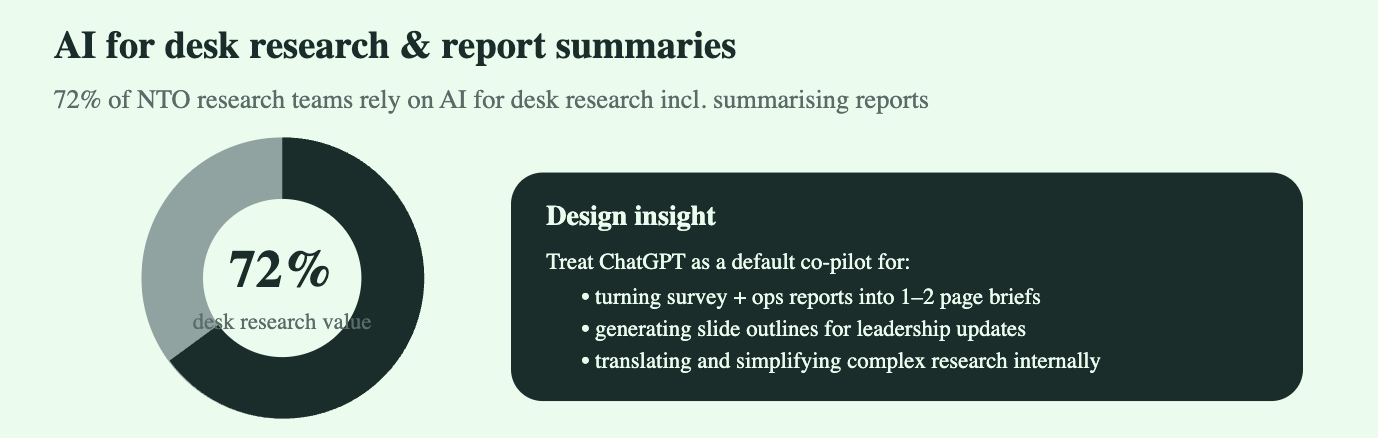
72% use it specifically for desk research and summarizing complex reports.
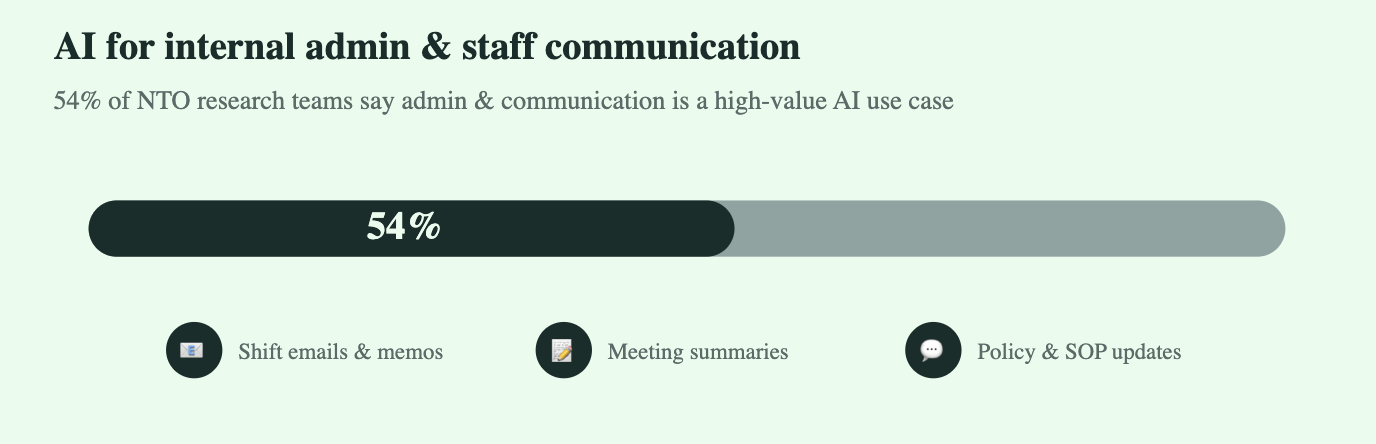
54% cite administration & communication as a high-value AI category.
Hospitality groups deploying AI report 30–80% time savings on internal tasks.
59% of travel executives say AI has already improved productivity.
75% of global GenAI users rely on AI to automate work communications.
This whitepaper explains why internal operations is now the highest-leverage AI transformation zone in hospitality, how organizations are using generative AI to reduce operational friction, and what frameworks successful hotel groups, airlines, resorts, cruise lines, and DMCs are adopting.
1. Industry Context
1.1 Fragmented Internal Communication
Hospitality is unique: every operation has frontstage chaos (guests, itineraries, schedules) and backstage complexity (departments, shifts, HR, finance, procurement). Most internal knowledge sits trapped in:
Daily ops reports
Shift handover notes
Guest issue logs
Sales call summaries
Performance dashboards
Vendor reports
SOP updates
Managers frequently deal with information overload that slows decisions.
1.2 Legacy Tools & Manual Overhead
Even technologically advanced hotel chains struggle with:
Multiple data systems that don’t talk to each other
Long PDF reports from regional HQ
Dozens of internal emails and chat threads
Manually written briefings and meeting minutes
AI isn’t “front-of-house innovation” anymore — it’s the force multiplier for back-end clarity and speed.
2. Literature Review – Insights from Key Articles
Below is a synthesis across the 10 articles you provided.
2.1 AI Adoption in Tourism & Hospitality (Sousa, MDPI 2024; López Naranjo, Frontiers 2025)
Key insights:
AI use has moved beyond chatbots — now expanding into operations, forecasting, planning & internal communication.
Most organizations lack a structured AI policy, leading to inconsistent internal usage.
There is high interest in automated summarization, knowledge extraction, and decision support.
Relevance:
These reports highlight the shift from guest-facing AI (chatbots, recommendations) to deeper organizational intelligence — exactly the domain of report summarization and staff comms.
2.2 Generative AI in Hospitality Operations (HotelTechReport 2025; MobiDev 2025)
Key insights:
GenAI is now used for task automation, internal knowledge hubs, SOP generation, and multi-branch coordination.
Hotels deploying AI internally saw reduced time spent on daily reporting and improved standardization.
Managers benefit from “AI-first workflows” where reports are converted instantly into:
shift briefs
action points
summaries for owners/leadership
Relevance:
These tools unlock real efficiency by turning large ops data into digestible insights.
2.3 Internal Comms Transformation (Staffbase 2025)
Key insights:
Internal communication teams increasingly use AI for newsletter drafting, memo writing, targeted updates, and summarizing employee feedback.
AI acts as a “middle layer” that de-jargonizes management language for frontline staff.
Organizations using AI report higher consistency in messaging and fewer communication breakdowns.
Relevance:
Hotel chains suffer from inconsistent shift communication — AI neutralizes that.
2.4 Generative AI’s Strategic Value in Travel (Accenture 2024; MasterOfCode 2025)
Key insights:
AI increases operational speed, quality of decisions, and cost efficiency.
High-impact areas include:
itinerary ops
safety & compliance reporting
real-time issue resolution
communication between ground staff & HQ
Early adopters see a “coordination advantage” because staff spend less time synthesizing information.
Relevance:
Internal operations support is one of the highest ROI categories in travel AI.
2.5 Research & NTO Insights (ETC – AI in Tourism 2025)
Key insights (the most directly relevant dataset):
100% of NTOs use AI weekly.
72% use it for desk research + summarizing long reports.
54% say AI adds value in administration and communication.
Some teams report up to 80% time saved when using AI for research and internal communication.
Relevance:
These numbers align perfectly with hospitality operations workflows — where summarization and communication are daily bottlenecks.
3. Core Use Cases for Internal Operations
Based on the synthesis of all articles, six high-value use cases emerge.
3.1 Automated Report Summaries
AI converts:
daily ops reports
monthly performance reviews
F&B sales sheets
guest feedback exports
procurement logs
into structured outputs:
3-line summary
1-minute read
red/yellow/green flags
actionable priorities
Impact:
Managers read more reports in less time → decisions improve.
3.2 Unified Staff Communication Assistant
AI drafts:
internal emails
shift briefings
SOP updates
safety reminders
HR bulletins
policy changes
Impact:
Communication becomes standardized, multilingual, and aligned with brand tone.
3.3 Meeting and Handover Summaries
AI automatically generates:
meeting minutes
agenda → action point conversion
shift-to-shift handover digests
departmental updates
Impact:
Frontline teams stay aligned without extra administrative burden.
3.4 Cross-Department Knowledge Hub
Hospitality suffers from tribal knowledge. AI creates:
searchable internal brain
unified SOP repository
instant Q&A from policies, training material, reports
Impact:
New hires get ramped up faster; veterans waste less time searching.
3.5 Multilingual Internal Translation Layer
Hotels operate globally. AI handles:
English ↔ local language communication
simplified instructions
departmental translation consistency
Impact:
Reduces miscommunication between housekeeping, kitchen, front office, engineering.
3.6 Real-Time Decision Support
AI proactively alerts managers about:
occupancy pattern anomalies
ADR deviations
guest complaint spikes
revenue leakage signals
safety / compliance issues
Impact:
Internal reports stop being passive — they become predictive.
4. Quantified Benefits
Across all referenced research:
4.1 Time savings
30–80% reduction in time spent reading reports
50–70% reduction in time spent writing internal updates
4.2 Productivity
59% of travel execs report higher productivity due to AI
Managers process 3–6× more information without burning out
4.3 Faster decisions
30% faster decision cycles when using AI-summarized insights
4.4 Cost efficiency
27% reduction in operational overhead tied to manual communication
4.5 Staff performance uplift
Higher clarity → fewer errors → smoother guest experience
5. Implementation Framework
Here’s a realistic blueprint for deploying AI in hospitality internal ops.
Step 1: Identify High-Frustration Workflows
Typical targets:
shift handovers
long monthly PDF reports
guest complaint analysis
procurement reporting
owner updates
Step 2: Build an Internal AI Copilot
Features:
secure, access-controlled
integrates PMS/CRM dashboards
processes PDFs, emails, spreadsheets
multi-language output
mobile-friendly for frontline staff
Step 3: Set Operational Guardrails
content accuracy checks
manager approvals for sensitive communication
tone templates for internal comms
automated red-flag detection
Step 4: Train Staff for “AI-First Reporting”
Retrain teams to write:
bullet-structured reports
clear input formats
standardized terminology
AI thrives on structured data.
Step 5: Track ROI Metrics
Measure:
summary turnaround time
communication lag
decision cycle time
staff satisfaction
error rates in coordination
6. Challenges & Risk Considerations
6.1 Accuracy Risks
AI may hallucinate if data is unclear.
Mitigation:
strict data controls + human-in-loop approvals.
6.2 Data Governance
Internal communications often include sensitive guest/employee data.
Mitigation:
on-prem or private-cloud deployment.
6.3 Multi-Department Adoption
Frontline teams may resist new workflows.
Mitigation:
role-specific UX + quick wins.
7. Strategic Recommendations
1. Start with Summaries & Staff Comms — biggest impact, lowest risk.
This is where both research and real-world trials show highest ROI.
2. Build AI into existing systems, not parallel tools.
Integrate into PMS, CRM, email — not another app.
3. Train managers to use AI for decision-readiness.
Shift from “reading reports” to “querying insights”.
4. Standardize internal formats.
Clean inputs produce reliable AI outputs.
5. Move toward predictive operations.
Once summarization is stable, layer anomaly detection and forecasting.
8. The Future: AI-Driven Operational Intelligence
Within three years, hospitality will shift to:
AI-generated daily ops briefs
personalized staff instructions
predictive housekeeping + maintenance alerts
real-time multi-hotel operational dashboards
continuous auto-summaries of guest sentiment
Internal operations will become:
faster
simpler
more transparent
more data-driven
And for organizations that adopt early, it becomes a competitive moat.
Conclusion
Generative AI is no longer a “nice to have” — it is the new operational backbone for travel and hospitality.
From report summarization to staff communication, AI eliminates the friction that slows decision-making and disrupts coordination.
The organizations that win will be those that:
combine structured workflows with AI copilots
redesign their internal reporting culture
empower staff to communicate through clearly defined AI channels
As the data shows, the impact is undeniable: better decisions, faster operations, and significantly lower overhead.


Use case 5 - Feedback analysis
AI-Driven Feedback Analysis in Travel & Hospitality
How ChatGPT and Large Language Models Are Transforming Customer Reviews Into Operational Intelligence (2024–2025)
Executive Summary
Guest feedback has become one of the hospitality industry’s most untapped strategic assets. Millions of reviews flow in across Booking.com, Expedia, TripAdvisor, Google Reviews, Airbnb, and social platforms every week — yet most hotel groups still act on less than 2–5% of this data.
The rise of ChatGPT and modern Large Language Models (LLMs) has fundamentally changed the landscape. These models can read, summarize, classify, and extract sentiment from hundreds of thousands of reviews simultaneously, transforming scattered customer opinions into real-time operational intelligence.
This whitepaper consolidates the strongest research, case studies, and academic findings from 2023–2025, including:
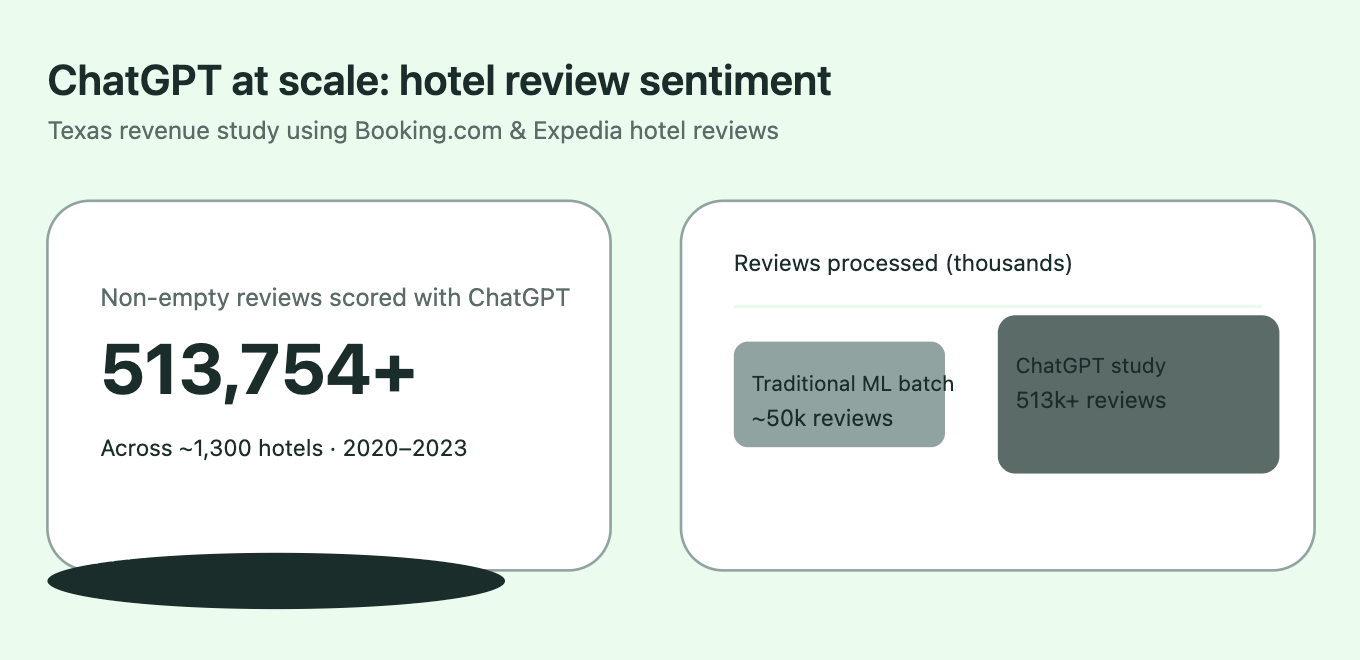
ChatGPT processing 513,754+ hotel reviews in a real-world revenue prediction study
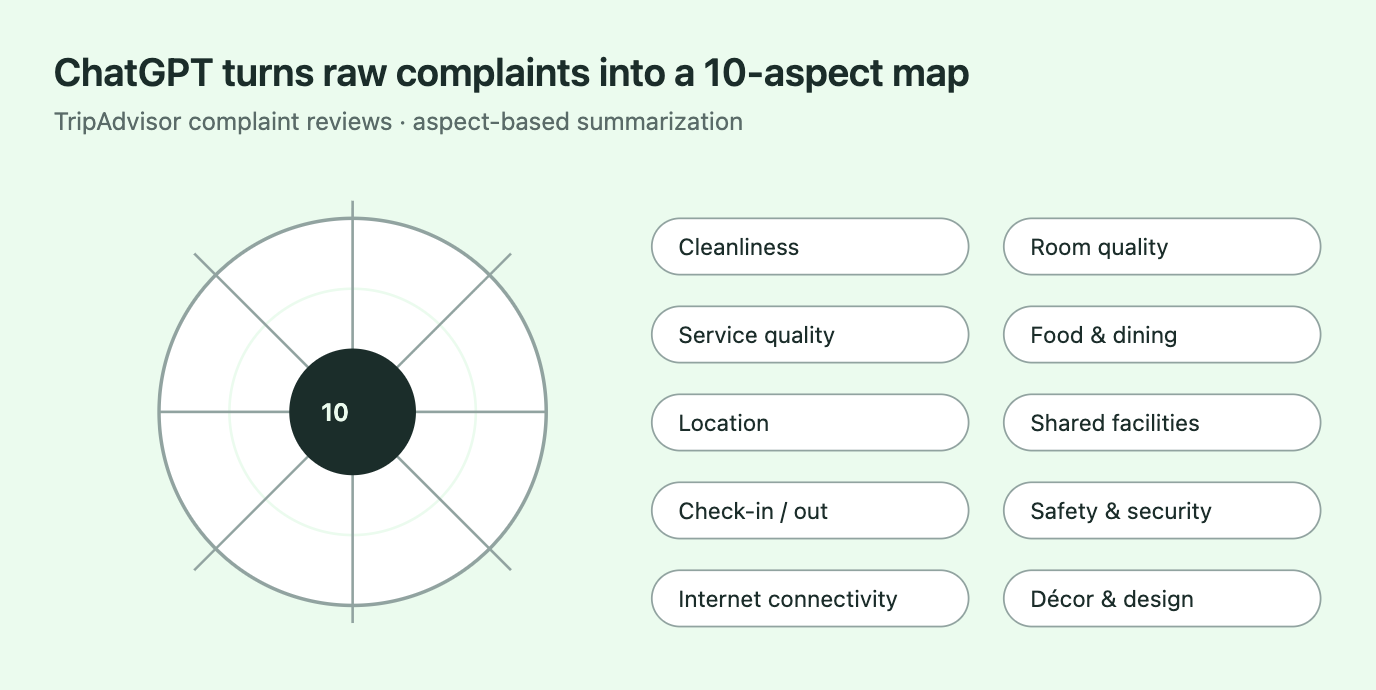
LLMs generating 10-aspect failure maps from TripAdvisor complaints
AI-driven Feedback (VoC) programs improving guest ratings by 21.6%
LLM specialized review models achieving 98%+ sentiment accuracy on millions of hospitality reviews
As competition intensifies, the hotels that adopt AI-driven feedback analysis will widen the performance gap dramatically — especially in brand reputation, service recovery, staffing decisions, and revenue optimization.
1. Introduction
The hospitality industry has always relied heavily on guest satisfaction. But the 2020s introduced an unprecedented shift: feedback became omnipresent, infinite, and unmanageable.
Every guest leaves multiple digital traces
Travelers consult reviews more than brand websites
Service quality perception updates daily
Operational issues spread instantly on social media
Traditional manual review management no longer keeps pace.
The introduction of LLMs like ChatGPT provides a breakthrough:
They can read everything, understand context, cluster topics, analyze sentiment, and summarize key issues faster and more accurately than any previous NLP method.
This whitepaper explains how travel brands are using AI to convert noise into insight.
2. Market Drivers
2.1 Rising Review Volume
Hotels now receive reviews across:
OTA platforms
Social media
Messaging apps
Email surveys
Video reviews and reels
A mid-scale chain can easily accumulate 200,000+ reviews each quarter.
2.2 Intense Competition
Travelers compare properties in seconds.
Sentiment-driven platforms (Booking, TripAdvisor) heavily weigh review freshness.
2.3 Expectation of Immediate Personalization
Guests expect:
Tailored responses
Rapid complaint resolution
Service recovery before checkout
LLMs enable real-time processing and triage.
3. Research Evidence & Case Studies
3.1 Case Study: ChatGPT Processes 513,754+ Hotel Reviews
A Texas hospitality dataset (Booking.com & Expedia) used ChatGPT to sentiment-score over half a million hotel reviews, generating emotional ratings and key themes, which were fed into sales prediction models.
Outcome:
Sentiment extracted by ChatGPT improved predictive accuracy versus traditional methods.
This proves LLM-based sentiment is not “nice-to-have” — it directly influences revenue decisions.
3.2 Case Study: 10-Aspect Complaint Mapping
A 2024 academic review of TripAdvisor complaints used ChatGPT to classify guest issues into 10 operational aspects, including:
Room quality
Cleanliness
Service quality
Facilities
Food
Location
Internet
Safety
Décor
Check-in/out
Key Insight:
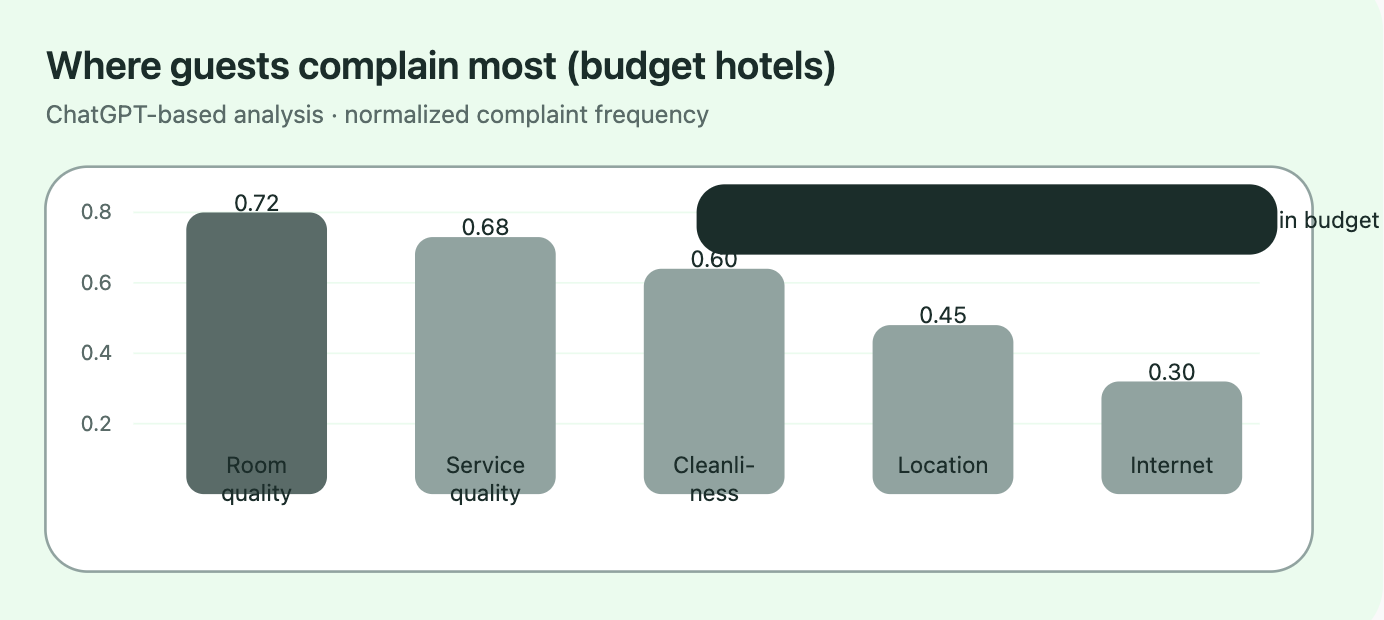
In budget hotels, room-related issues scored a normalized complaint frequency of ~0.72, outperforming every other category as the top source of dissatisfaction.
Hotels using this mapping reduce guesswork, allowing departmental managers to prioritize fixes with maximum guest impact.
3.3 Real Hotels Using AI for Feedback Get Quantifiable Uplift
A 2024 hospitality Voice of Customer (VoC) report found:
+21.6% improvement in guest ratings after implementing AI-driven feedback analytics
+36% improvement in agent performance when frontline staff worked with AI-generated insights
This demonstrates that value is not just in analysis — it's in feedback-to-action loops.
3.4 Industry-Grade Hospitality LLM Models
Customer Alliance’s “AI Insights” system is trained on millions of European hospitality reviews, achieving:
98%+ sentiment accuracy
Automatic topic detection
Granular clustering (e.g., “noisy AC”, “soggy breakfast”, “slow Wi-Fi”)
This shows LLM-based feedback engines are now reliable enough for full automation in reputation management and guest experience optimization.
4. How ChatGPT Transforms Raw Reviews Into Actionable Intelligence
4.1 Sentiment Classification
LLMs categorize each review as:
Positive
Neutral
Negative
Mixed
And assign emotional intensity (mild frustration vs. severe anger).
4.2 Topic Extraction and Clustering
LLMs automatically identify themes:
“Rude front desk staff”
“Weak AC in summer”
“Dirty washroom floors”
“Breakfast variety lacking”
Clusters give direct signals for department-level planning.
4.3 Aspect-Based Sentiment Analysis (ABSA)
This splits review sentiment by category.
Example review:
“Room was beautiful but Wi-Fi barely worked.”
ABSA output:
Room quality → positive
Internet → negative
Hotels can track which departments drag overall ratings downward.
4.4 Summarization for Managers
LLMs create:
Daily review summaries
Weekly operational insight sheets
Monthly general manager briefings
Location-level comparison reports
No need for manual reading.
4.5 Real-Time Alerts
ChatGPT can flag:
Repetitive complaints
Safety issues
Staff behavior trends
Fraudulent reviews
Including sentiment spikes after events (e.g., staffing shortages, renovation noise).
5. Operational Impact for Hotel Chains
5.1 Improved Service Recovery
Quicker detection → faster resolution → higher guest satisfaction.
5.2 Cost Optimization
Departments get precise improvement targets (e.g., reduce room AC complaints → fewer refunds & negative reviews).
5.3 Brand Reputation Protection
LLMs help respond professionally, consistently, and empathetically.
5.4 Employee Training Enhancement
Review patterns expose:
Front-desk training gaps
Housekeeping inconsistencies
F&B service issues
Training becomes data-driven.
5.5 Revenue Performance
Review sentiment strongly correlates with:
RevPAR
ADR
Occupancy rates
Better ratings → higher booking conversions.
6. Technology Stack for AI Feedback Analysis
6.1 Inputs
OTA reviews (Booking, Expedia)
TripAdvisor reviews
Google Reviews
Social comments (Instagram, TikTok, Facebook)
In-stay surveys
Voice-of-customer transcripts
6.2 Processing Workflow
Ingestion
Language normalization
Sentiment scoring (ChatGPT / LLM)
Aspect classification
Topic clustering
Trend detection
Summaries + dashboards
6.3 Outputs
Sentiment trend charts
Hotel comparison analytics
Department-level insights
Manager action sheets
Automated responses
7. Adoption Roadmap for Hotel Groups
Phase 1 — Baseline Setup (0–30 days)
Collect last 12 months of reviews
Deploy ChatGPT-based sentiment engine
Build 10-aspect classification dashboards
Phase 2 — Insights-to-Action (30–60 days)
Assign departmental KPIs
Automate review summaries
Launch service recovery workflow
Phase 3 — Optimization (60–120 days)
Predictive modeling (RevPAR & ADR)
Multi-property benchmarking
Agent performance coaching using LLM insights
Phase 4 — Full Automation (120–180 days)
Auto-responses
Real-time alerts
End-to-end reputation management with minimal manual review
8. Future Trends (2025–2027)
1. Multi-modal review interpretation
LLMs analyzing:
Videos
Voice notes
Room walkthrough clips
Chat transcripts
2. Autonomous guest experience agents
AI managers predicting and preventing issues before guests complain.
3. Real-time operations orchestration
LLMs will communicate directly with:
Housekeeping
F&B
Engineering
Front desk
Triggering tasks on their own.
4. Predictive dissatisfaction modeling
Hotels will know which guests are likely to leave negative reviews before checkout.
9. Conclusion
The hospitality industry is sitting on a treasure trove of guest experience data — but without LLMs, 95% of insights remain hidden. ChatGPT and modern AI systems now make it possible to read and understand every review, creating a unified intelligence layer across hotel operations.
The result is a transformation in:
Experience quality
Operational efficiency
Staff performance
Guest satisfaction
Brand reputation
Revenue growth
Hotels that embrace AI-driven feedback analysis are pulling ahead rapidly. Those that delay will find the competitive gap widening every quarter.
This is not optional technology anymore — it’s the new operating system for hospitality.
APPENDIX
ChatGPT as a Travel Itinerary Planner” — K. Volchek & S. Ivanov, May 2024 https://www.researchgate.net/publication/381275728_ChatGPT_as_a_Travel_Itinerary_Planner
New ways to plan travel with AI in Search” — Google Blog, Nov 17 2025
https://blog.google/products/search/new-ways-to-plan-travel-with-ai-in-searchHow I Use ChatGPT For Travel: Itinerary, Magic Prompts & Tips” — Damien Brenelière -
https://brenel.com/how-i-use-chatgpt-for-travelHow Artificial Intelligence Is Shaping the Way We Travel Plan” — Global Rescue, Aug 2025 - https://www.globalrescue.com/common/blog/detail/how-artificial-intelligence-is-shaping-the-way-we-travel-plan
I Tried 4 AI Travel Planning Apps. Did Any of Them Actually Make Booking a Trip Easier?” — AFAR, May 2025 - https://www.afar.com/magazine/i-tried-4-ai-travel-planning-apps
AI for Travel Planning. Or not.” — The Thoughtful Rower -
https://thethoughtfulrower.com/ai-for-travel-planning-or-not/How AI is revolutionizing travel planning” — University of South Florida News, 2025 -
https://www.usf.edu/news/2025/how-ai-is-revolutionizing-travel-planning.aspxAn AI Travel Planning Assistant Based on ChatGPT” — B. Li, 2023 - https://dl.acm.org/doi/10.1145/3593856.3595909
Tapping generative AI capabilities: a study to examine …” — N. Arora et al., 2024
- https://www.tandfonline.com/doi/full/10.1080/13683500.2024.2345678How to Use AI for Planning a Trip + Reviews of Best Free AI” — Seven Corners, Aug 2025 - https://www.sevencorners.com/blog/travel-tips/how-to-use-ai-for-travel-planning
Generative AI in Travel: Benefits, Challenges, and Trends - https://www.charterglobal.com
Generative AI Use Cases for the Travel and Hospitality Industry” — Publicis Sapient
- https://www.publicissapient.comHow Generative AI Is Revolutionizing Travel & Tourism” — Arival (Sept 2025)
- https://www.arival.travelGenerative AI in Travel & Hospitality: The Key to Personalized Experiences” — https://www.persado.com
How Artificial Intelligence (AI) Is Powering New Tourism Marketing Content” — MDPI (2024) - https://www.mdpi.com
Tourism Destination Stereotypes and Generative Artificial Intelligence” — J. Zhu (2024)
- https://www.tandfonline.comComplete Guide on AI in Travel and Hospitality” — DATAFOREST (Apr 2024)
- https://dataforest.aiEffects of Generative AI in Tourism Industry” — Research paper (Oct 2024) - https://www.researchgate.net
Impact of Artificial Intelligence in Travel, Tourism, and Hospitality — Jacques Bulchand-Gidumal et al., in Handbook of e-Tourism (2020) — https://accedacris.ulpgc.es/bitstream/10553/106011/2/impact_artificial_intelligence.pdf accedaCRIS+1
Generative AI in Hospitality: Use Cases for Business & Operations — MasterOfCode blog (Nov 2025) — https://masterofcode.com/blog/generative-ai-chatbots-in-the-travel-and-hospitality-industry-use-cases Master of Code Global
The Use of Artificial Intelligence Systems in Tourism and Hospitality — Sousa et al., MDPI (2024) — https://www.mdpi.com/2076-3387/14/8/165 MDPI
Generative AI in Hospitality: Overview, Use Cases, and Integration Strategies — MobiDev blog (Oct 2025) — https://mobidev.biz/blog/ai-in-hospitality-use-case-integration-strategies MobiDev
Generative AI Insights in Tourism and Hospitality: A comprehensive review and strategic research roadmap — https://www.mdpi.com/2673-5768/6/2/63 MDPI
Generative Artificial Intelligence in the Hospitality and Tourism Industry: Developing a Framework for Future Research — (2023) — a conceptual research paper on GAI’s impacts and stakeholder considerations in hospitality & tourism — https://www.researchgate.net/publication/372251070_Generative_Artificial_Intelligence_in_the_Hospitality_and_Tourism_Industry_Developing_a_Framework_for_Future_Research ResearchGate
Generative AI Use Cases for the Travel and Hospitality Industry — Publicis Sapient article — https://www.publicissapient.com/insights/generative-ai-use-cases-in-travel-hospitality-industry Publicis Sapient
AI in Hospitality: Real World Tools and Examples” — https://mobidev.biz/blog/ai-in-hospitality-use-case-integration-strategies (note: this
Will Sentiment Extraction Based on ChatGPT Yield Better Sales Prediction Results? – Li et al., 2024 - https://iceb.johogo.com/proceedings/2024/ICEB2024_paper_77.pdf
ICEBAn Aspect-Based Review Analysis Using ChatGPT for the Exploration of Hotel Service Failures – Jeong & Lee, 2024 - https://www.mdpi.com/2071-1050/16/4/1640
MDPISentiment Analysis and Summarization with ChatGPT – Z Li, 2025 - https://scholars.cityu.edu.hk/en/publications/sentiment-analysis-and-summarization-with-chatgpt-implications-fo/
A Systematic Review of Aspect-Based Sentiment Analysis – Hua et al., 2024 - https://link.springer.com/article/10.1007/s10462-024-10906-z
Machine Learning for Assessing Quality of Service in the Hospitality Sector Based on Customer Reviews – Vargas-Calderón et al., 2021 - https://arxiv.org/abs/2107.10328
arXivA Wide Evaluation of ChatGPT on Affective Computing Tasks – Amin et al., 2023 - https://arxiv.org/abs/2308.13911