
Launching AI Products in 2026: the Definitive Guide
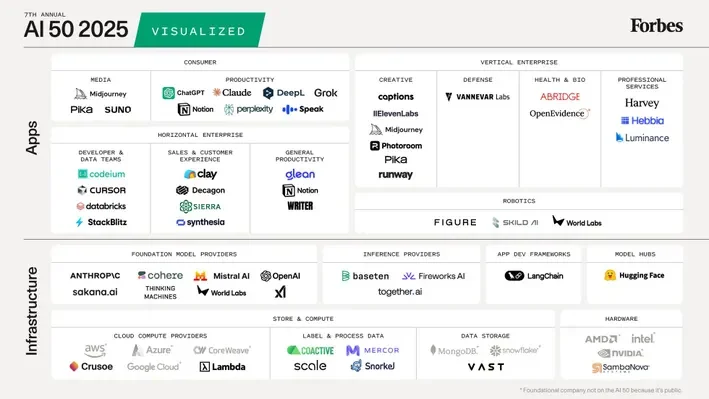
The 2025 edition of the AI 50 list shows how companies are using agents and reasoning models to start replacing work previously done by people at scale.
Artificial intelligence is entering a new phase in 2025. After years of AI tools mostly answering questions or generating content on command, this year’s innovations are about AI actually getting work done. The 2025 Forbes AI 50 list illustrates this pivotal shift, as startups on it signal a move from AI that merely responds to prompts to one that solves problems and completes entire workflows. For all the buzz around big AI model makers like OpenAI, Anthropic or xAI, the biggest changes to the story in 2025 are in these application-layer tools that use AI to produce real business results.
Now you imagine you were responsible for marketing these AI Products to Developers, Exectutives and the General Consumer. How would you go about this? This essay aims to debunk how to GTM to these different target demos and outline the key differences between SaaS products and AI products. Avoiding the pitfalls of Vanity metrics and creating truly viral products.
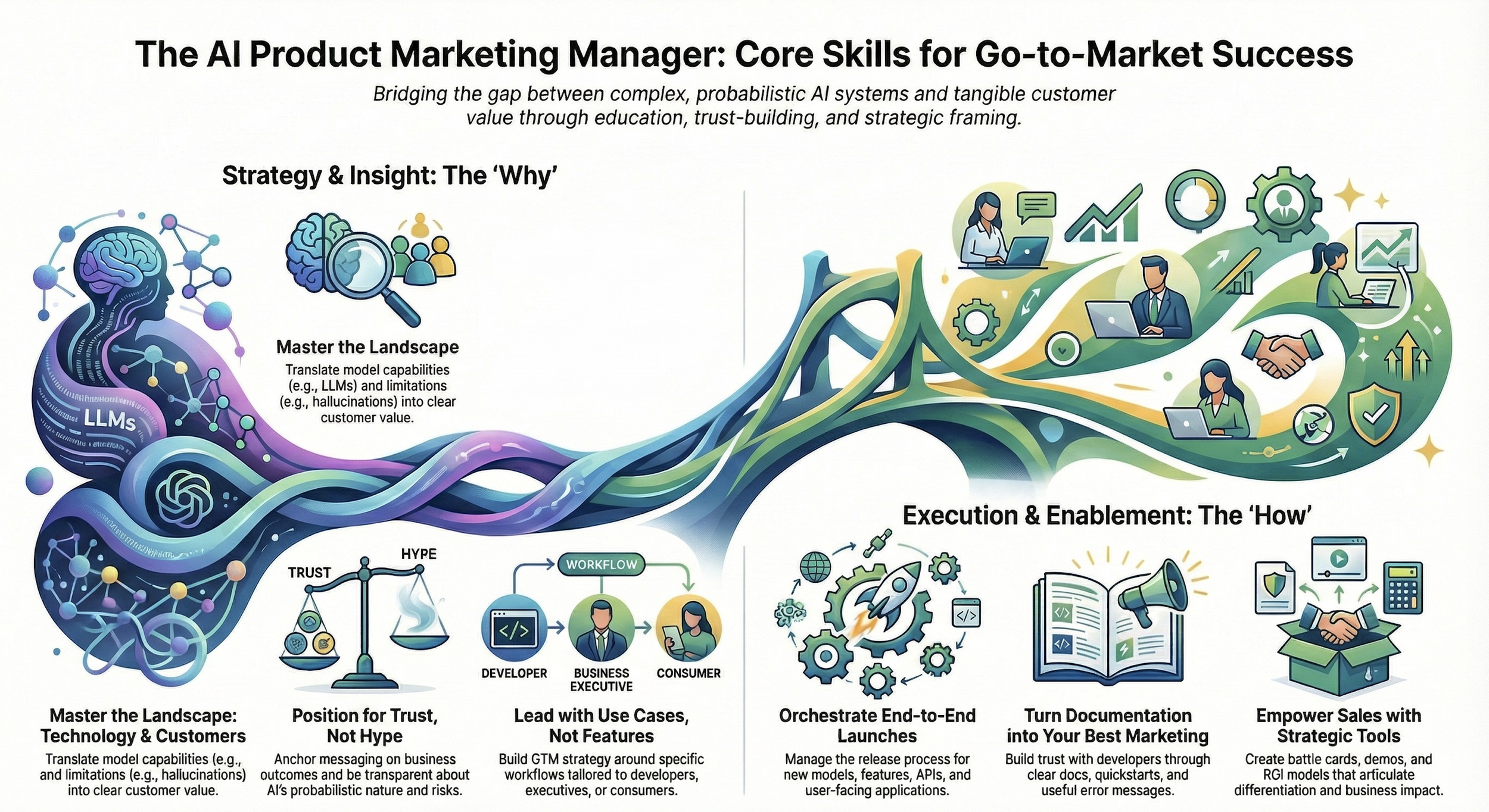
Product marketing has always sat at the intersection of product, market, and growth. In AI products, that intersection becomes sharper—and more fragile.
AI PMMs are not just responsible for messaging and launches. They are responsible for translation: translating probabilistic systems into customer value, translating research progress into market readiness, and translating usage signals into meaningful measures of success.
This essay explores what product marketing looks like in AI products, how go-to-market (GTM) strategy must adapt, and which metrics actually indicate adoption and value.
1. Why Product Marketing Is Harder in AI
AI products differ from traditional SaaS in several fundamental ways:
They are probabilistic, not deterministic
The same input can produce different outputs, which complicates expectations and trust.They are capability-dense
A single model can support dozens of use cases, making positioning harder.They evolve continuously
Models, prompts, and system behavior change faster than typical feature cycles.They require user education
Value depends heavily on how well users understand how to interact with the system.
Because of this, AI product marketing is less about persuasion and more about sense-making.
The PMM’s job is not to convince customers that the product is powerful—but to help them understand when, how, and why it is useful.
2. Core Responsibilities of Product Marketing in AI
While the foundational PMM responsibilities remain—positioning, launches, enablement, adoption—the emphasis shifts.
1. Positioning Under Uncertainty
In AI, positioning cannot be built on absolutes (“accurate,” “autonomous,” “human-level”). Those claims break trust quickly.
Instead, strong AI positioning:
Anchors on outcomes, not capabilities
Makes constraints explicit
Differentiates on reliability, workflow fit, and trust
Effective positioning follows a Value → Capability → Proof structure:
Value: What meaningful outcome does the customer achieve?
Capability: What does the AI system do to enable that outcome?
Proof: Evidence—benchmarks, pilots, customer results—that the system performs in context.
This structure prevents overclaiming while maintaining credibility.
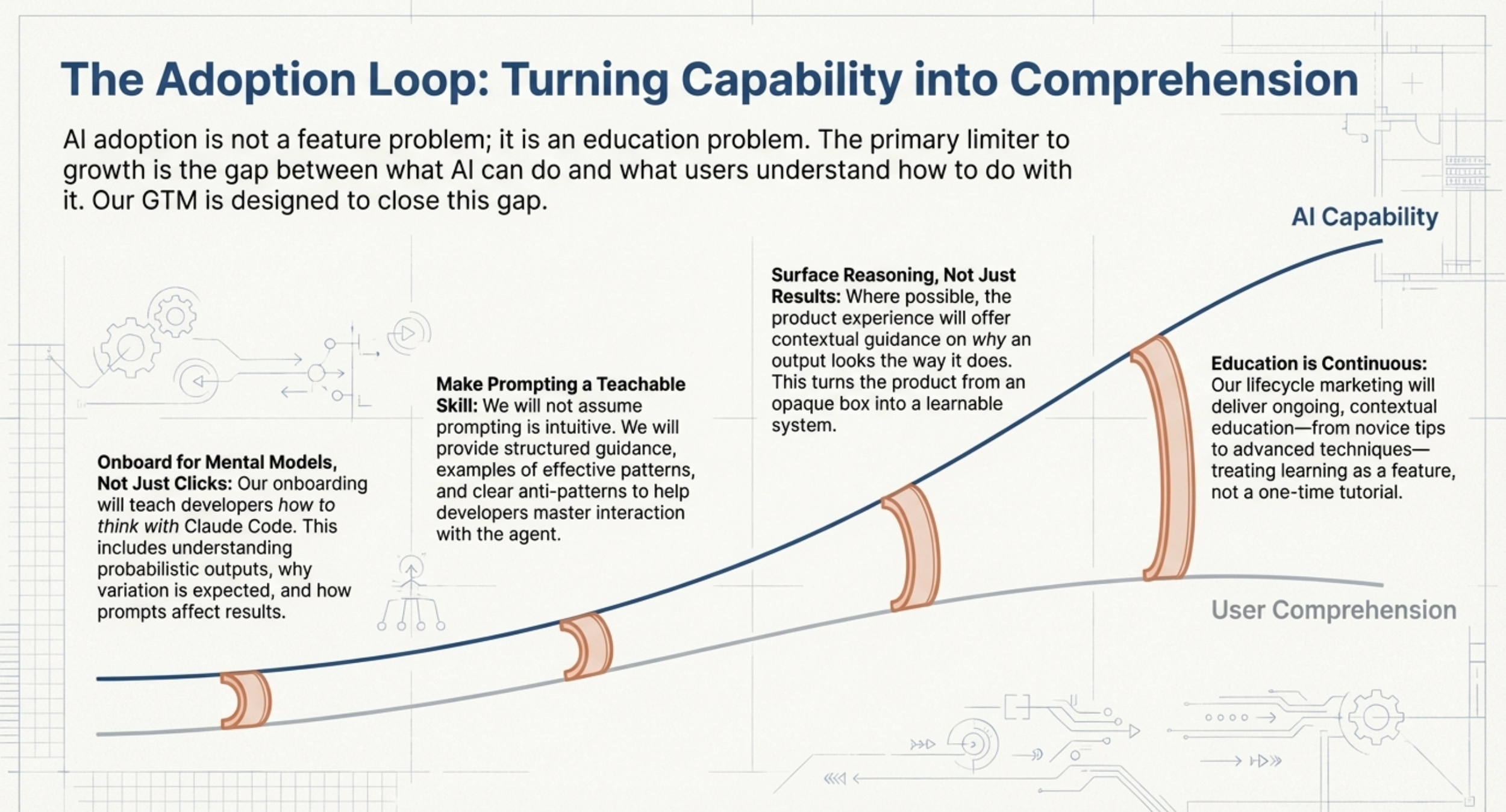
2. Education as a GTM Lever
In AI, adoption is limited less by features than by understanding.
Product marketing must own:
Mental model education (how the AI behaves)
Prompting guidance and examples
Explanation of variability and failure modes
Clear articulation of when human judgment is required
Education is not documentation alone—it is:
Onboarding flows
Demos
Sales narratives
Use-case playbooks
AI PMMs who treat education as a first-class GTM strategy outperform those who treat it as support.
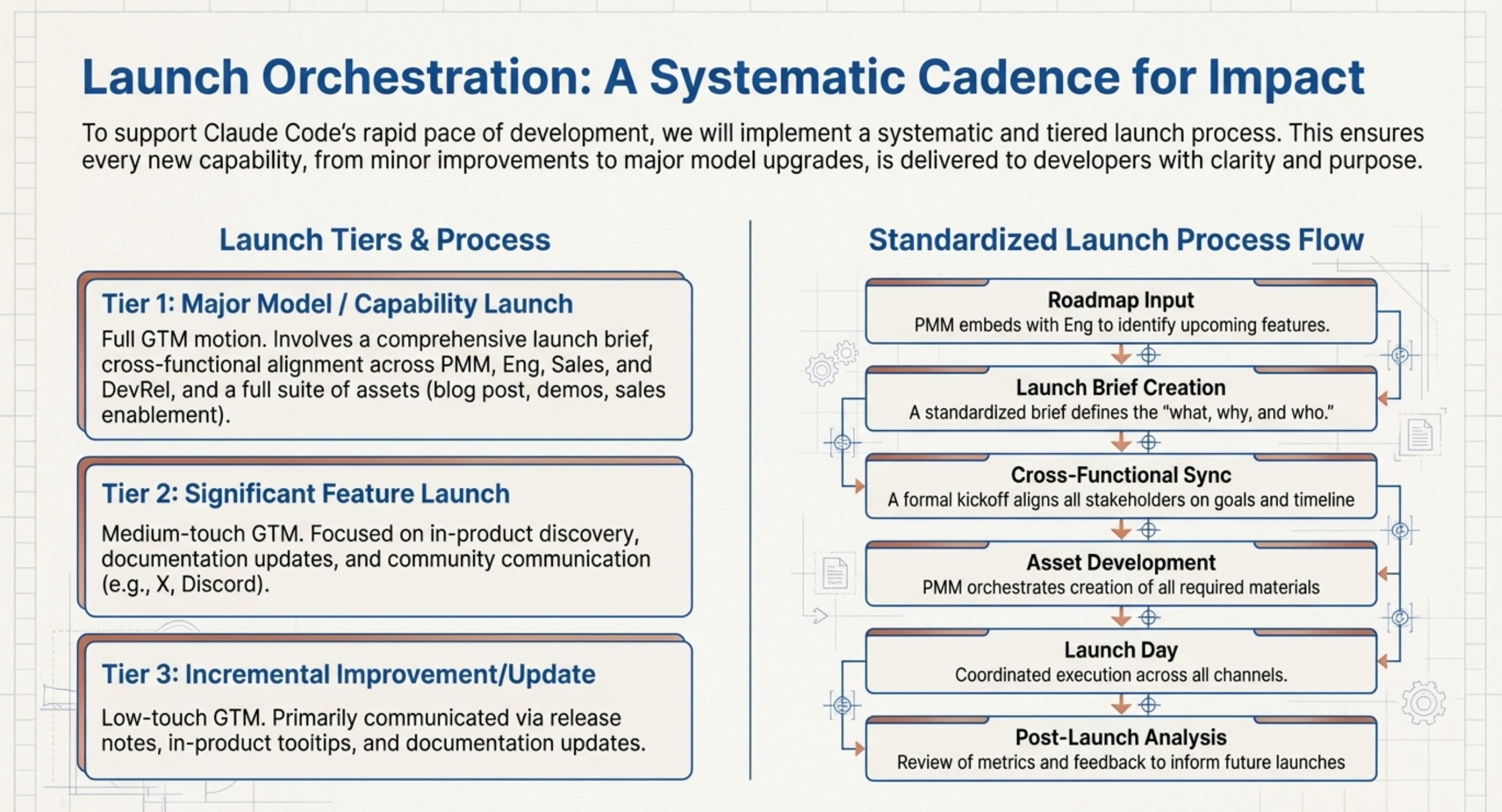
3. Launches in a World of Continuous Change
AI launches are rarely “big bang” events. More often, they are:
Model upgrades
New workflows
Expanded context windows
Reliability or cost improvements
This requires PMMs to:
Reframe launches around user impact, not technical change
Segment messaging by audience (developers, operators, buyers)
Prepare internal teams to explain what did not change as much as what did
A successful AI launch answers:
“What is now possible that wasn’t before—and for whom?”
3. Go-to-Market Strategy for AI Products
AI GTM strategy must reflect how AI is discovered, evaluated, and adopted.
1. Bottom-Up Meets Top-Down
Most AI products follow a hybrid GTM motion:
Bottom-up: Developers or practitioners experiment, test, and prototype
Top-down: Buyers and executives approve spend, risk, and scale
Product marketing must serve both paths:
Clear docs, examples, and quickstarts for builders
Outcome-driven narratives, risk framing, and ROI for buyers
Misalignment between these layers is a common failure mode.
2. Use-Case-Led GTM
Because AI systems are flexible, customers struggle to see relevance unless use cases are concrete.
Strong AI GTM strategies lead with:
Specific workflows (“ticket triage,” “contract review”)
Clear before/after comparisons
Evidence of repeatability
This reduces cognitive load and accelerates time-to-value.
3. Trust as a GTM Advantage
In crowded AI markets, trust becomes a differentiator.
PMMs must:
Avoid inflated claims
Communicate uncertainty honestly
Explain safeguards and governance clearly
Trust compounds adoption—especially in enterprise and regulated environments.
4. Metrics: Measuring What Actually Matters in AI
One of the biggest mistakes AI teams make is measuring success the same way they measure SaaS.
Model usage is not customer value.
AI PMMs must help redefine success metrics around outcomes, confidence, and learning.
1. Activation Metrics in AI
Activation is not “first use.” It is first reliable value.
Good activation signals include:
First accepted output
Time-to-first-useful result
Reduction in retries
Evidence the user understands how to reproduce success
If a user interacts but does not understand why the output worked, they are not activated.
2. Retention Metrics in AI
Retention is not frequency—it is repeat reliance.
Better retention signals include:
Repeated use of the same use case
Reduced verification or manual override
Increased automation
Expansion into adjacent tasks
A highly retained AI product may show lower usage over time as workflows become efficient.
3. Churn Signals in AI
AI churn is often silent and trust-based.
Early churn indicators include:
Increased retries without improvement
Avoidance of high-impact tasks
Declining output acceptance
Continued use without commitment or automation
PMMs should treat these as leading indicators long before accounts cancel.
4. Business Value Metrics
Ultimately, AI PMMs must connect product usage to business outcomes:
Time saved
Cost reduced
Errors prevented
Decisions improved
Revenue influenced
These metrics matter far more than tokens, sessions, or clicks.
5. The PMM as the Translator-in-Chief
In AI organizations, PMMs play a uniquely critical role.
They translate:
Research into relevance
Capabilities into outcomes
Metrics into meaning
They help teams avoid:
Overclaiming
Misaligned GTM
Vanity metrics
And they ensure that as models improve, customers actually benefit.
TARGETTING Developers
When developers are the ideal customer profile (ICP), go-to-market strategy stops looking like marketing and starts looking like product design.
This is especially true in AI.
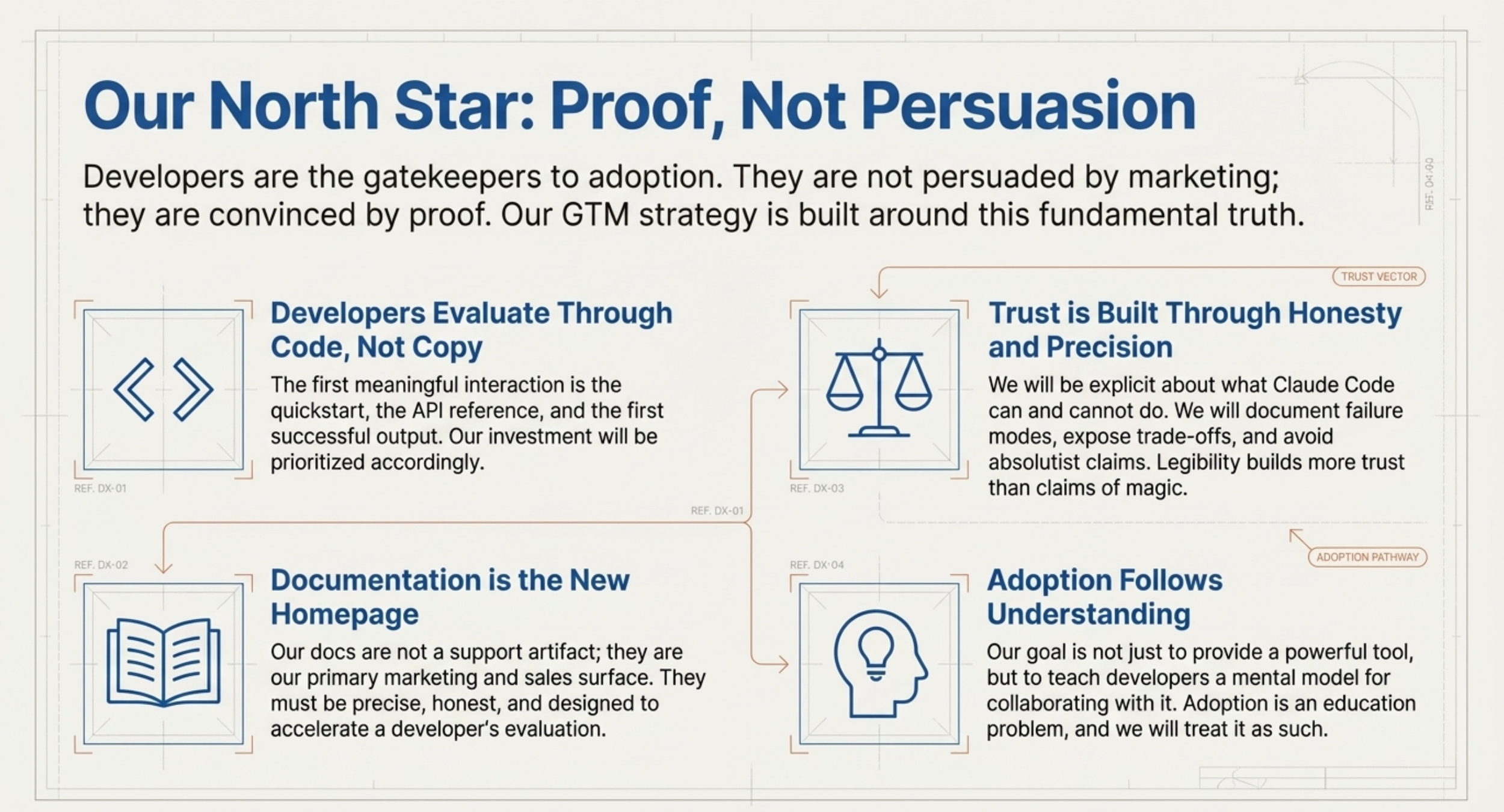
AI products are not adopted because of persuasion. They are adopted because a developer tries something, sees that it works, trusts it enough to depend on it, and then builds real systems on top of it. Every step in that sequence is technical, experiential, and unforgiving.
When developers are the ICP, GTM is not a funnel—it is a confidence-building pipeline.
This essay explains how GTM strategy must change when developers are the primary buyers, users, and advocates of AI products—and why most traditional SaaS GTM playbooks fail in this context.
1. Developers Do Not “Buy” AI Products—They Validate Them
In developer-led AI GTM, the first sale does not happen through a contract. It happens through a successful experiment.
A developer asks:
Can I get this working quickly?
Does it behave the way I expect?
Can I debug it when it fails?
Does it fit my architecture and constraints?
If the answer to any of those is “no,” the GTM motion ends immediately—often without feedback.
This is why developer GTM for AI must prioritize:
Speed to first meaningful output
Predictability of behavior
Clarity of failure modes
Ease of iteration
Traditional GTM optimizes for awareness and conversion. Developer GTM optimizes for verification.
2. In AI, Trust Is Earned Through Interfaces, Not Messaging
AI systems are probabilistic. Outputs vary. Edge cases exist. Behavior changes as models evolve.
Developers are acutely sensitive to this.
They do not expect perfection—but they do expect legibility.
For developers, trust is built when:
Inputs map clearly to outputs
Parameters have understandable effects
Errors are explicit and actionable
Constraints are documented honestly
Performance trade-offs are visible
This makes GTM surfaces like:
API docs
Quickstarts
SDKs
Example repos
Error messages
far more important than:
Landing pages
Value propositions
Vision statements
When developers are the ICP, documentation is the primary GTM surface.
3. Discovery Is Bottom-Up and Accidental
Developer-led AI GTM rarely begins with “campaigns.”
It begins with:
A GitHub repo
A code snippet shared on X
A blog post with real examples
A mention in a Discord or Slack
A benchmark comparison
This discovery is:
Non-linear
Peer-driven
Skeptical by default
As a result, GTM strategy must focus less on controlling the narrative and more on making the product easy to evaluate in isolation.
Developers assume:
“If this is good, I should be able to tell quickly.”
Your GTM either enables that judgment—or blocks it.
4. Use-Case Clarity Matters More Than Feature Breadth
AI products often have broad capability surfaces:
One model, many tasks
One API, many workflows
One system, many use cases
Developers do not experience this as flexibility. They experience it as ambiguity.
Strong GTM for developer ICPs is use-case-led, not capability-led.
That means:
Leading with concrete problems (“classify support tickets,” not “advanced NLP”)
Providing end-to-end examples, not isolated endpoints
Showing how the AI fits into a real system, not just how it works
The question developers ask is not:
“What can this model do?”
It is:
“What can I build with this today that will still work in six months?”
5. Friction Is the GTM Enemy—Especially in AI
AI GTM lives or dies by friction.
Common friction points that kill adoption:
Complicated authentication
Poor defaults
Unclear parameter interactions
Hidden costs (tokens, latency)
Vague performance guarantees
Silent failure modes
Every one of these is a GTM issue, not just a product issue.
When developers are the ICP:
Onboarding is GTM
API design is GTM
Error handling is GTM
Rate limits are GTM
Pricing transparency is GTM
You do not “message” your way out of friction. You remove it.
6. Pricing and Packaging Must Match Developer Mental Models
Developers reason about cost differently than buyers.
They care about:
Predictability
Marginal cost
Worst-case scenarios
How cost scales with usage
Whether experimentation is safe
Opaque or surprising pricing kills trust quickly—especially in AI, where token-based or usage-based pricing can escalate fast.
Effective developer GTM:
Makes pricing legible at the API call level
Provides cost estimation tools
Aligns pricing units with real workloads
Avoids forcing early commitments
If developers cannot safely experiment, they will not advocate.
7. Adoption Is Earned Through Learning, Not Exposure
In AI products, adoption is not a function of exposure. It is a function of learning.
Developers must learn:
How to frame inputs
How to interpret outputs
How to mitigate variability
How to detect and handle failure
How to test and monitor behavior
GTM strategy must therefore include:
Educational docs
Example prompts and patterns
Anti-patterns and “what not to do”
Migration guides as models evolve
Clear explanations of breaking changes
This is why the best AI developer GTM feels closer to teaching than selling.
8. Metrics: What Matters When Developers Are the ICP
Traditional GTM metrics mislead in developer-first AI products.
What doesn’t work:
Raw API call volume
Token consumption
Session counts
Feature usage
These often measure confusion, retries, or inefficiency.
What does work:
Time to first successful build
First accepted output
Repeat use of the same workflow
Reduction in retries over time
Willingness to automate or depend on outputs
Expansion into additional use cases
The strongest signal of developer adoption is not activity—it is confidence.
When developers trust the system, usage often becomes quieter, not louder.
9. Bottom-Up GTM Still Needs Top-Down Support
Even when developers are the ICP, successful AI GTM eventually intersects with:
Security
Compliance
Procurement
Architecture review
GTM strategy must anticipate this transition.
That means:
Clear security documentation
Transparent data handling policies
Enterprise-ready deployment options
Honest discussion of limitations
Developers who trust your product become your strongest internal champions—but only if you give them the tools to defend it.
Developer GTM Is Earned, Not Broadcast
When developers are the ICP, GTM strategy must change at a foundational level.
You are not persuading.
You are not “creating demand.”
You are enabling judgment.
The best GTM strategy for AI products aimed at developers:
Reduces friction
Increases clarity
Teaches mental models
Exposes reality honestly
Respects skepticism
Developers do not want to be sold to.
They want something that works—and keeps working when it matters.
If your GTM helps them discover that truth quickly, adoption will follow.
TARGETING Enterprise Executives
When enterprise executives are the ideal customer profile (ICP), go-to-market strategy for AI products must change fundamentally.
Executives do not buy AI because it is impressive.
They buy it because it changes outcomes while not introducing unacceptable risk.
Most AI GTM strategies fail at the executive level because they over-index on capability and under-index on decision-making psychology: accountability, risk exposure, organizational complexity, and trust. Executives are not evaluating whether an AI model is “state of the art.” They are evaluating whether adopting it will help them hit objectives without creating new liabilities.
This essay outlines how GTM strategy must be designed when AI products are sold to enterprise executives—what they care about, how they evaluate value, and how AI companies must structure positioning, sales motions, and metrics accordingly.
1. Executives Do Not Buy AI—They Buy Change
Enterprise executives do not purchase tools. They authorize organizational change.
When an executive evaluates an AI product, they are implicitly asking:
Will this materially improve a business outcome I am accountable for?
What risks does this introduce—technical, legal, reputational, operational?
How hard will this be to roll out across teams?
Who will be blamed if this fails?
Can this scale without constant intervention?
This framing matters. AI GTM to executives is not about feature adoption—it is about decision safety.
If your GTM narrative does not explicitly reduce perceived risk, no amount of technical differentiation will matter.
2. Capability-Based Positioning Fails at the Executive Level
A common AI GTM mistake is leading with capabilities:
Model size
Accuracy metrics
Benchmarks
Architecture
“Powered by X”
Executives do not have the context—or patience—to interpret these meaningfully. More importantly, capability-based positioning shifts risk onto them. If they greenlight a technically impressive product that later fails, they own the decision.
Effective executive GTM replaces capability-first messaging with outcome-first framing.
Instead of:
“Our AI model achieves 95% accuracy on benchmark Y”
Executives need:
“This reduces manual review time by 40% while maintaining auditability.”
The former invites scrutiny.
The latter invites discussion.
3. The Executive GTM Hierarchy: Outcome → Risk → Proof
When executives evaluate AI products, they follow a predictable mental sequence:
1. Outcome
What concrete business result does this drive?
Cost reduction
Revenue lift
Risk mitigation
Speed to decision
Capacity unlock
2. Risk
What could go wrong?
Incorrect outputs
Regulatory exposure
Data leakage
Brand damage
Organizational failure
3. Proof
Why should I believe this will work here?
Reference customers
Pilots
Metrics tied to real workflows
Guardrails and governance
AI GTM strategy must align to this hierarchy. Skipping or reordering it almost always fails.
4. Trust Is the Core Differentiator in Enterprise AI
In enterprise markets, trust is not a brand attribute—it is a buying criterion.
Executives have lived through:
Overhyped analytics tools
Failed digital transformations
Vendors that disappeared after contract signing
AI increases this skepticism because:
Outputs are probabilistic
Failures can be subtle
Errors may only surface after decisions are made
Effective GTM to executives therefore emphasizes:
What the AI will not do
Where human oversight remains
How uncertainty is handled
How errors are detected and mitigated
Ironically, honesty about limitations increases executive confidence. Overclaiming does the opposite.
5. Enterprise Executives Buy Systems, Not Features
Executives are not thinking in terms of “using a tool.” They are thinking in terms of embedding a system into their organization.
This means GTM must address:
Integration with existing workflows
Compatibility with governance and compliance processes
Change management and adoption
Ongoing operational ownership
AI GTM that ignores organizational reality is dismissed quickly.
Strong executive-facing GTM frames AI as:
An augmentation layer, not a replacement
A decision support system, not an autonomous actor
A controllable asset, not a black box
This reduces perceived disruption and increases likelihood of buy-in.
6. The Buying Committee Is the Real ICP
When executives are the ICP, the buyer is plural.
Even if a C-level executive sponsors the purchase, decisions involve:
Legal
Security
IT
Compliance
Operations
Sometimes labor or ethics committees
Effective GTM anticipates this and equips the executive champion with:
Clear narratives for each stakeholder
Preemptive answers to common objections
Documentation that supports internal justification
AI GTM fails when it assumes executive authority overrides internal scrutiny. In reality, executives rely on evidence to defend their decisions internally.
7. Enterprise AI GTM Is Slow by Design
Unlike developer-led GTM, enterprise executive GTM is intentionally slow.
Executives value:
Predictability over speed
Pilot validation over demos
Incremental rollout over big bets
A strong GTM strategy embraces this by:
Designing pilots with clear success criteria
Structuring phased rollouts
Aligning milestones with executive reporting cycles
Setting expectations around timelines and learning
Trying to accelerate enterprise AI GTM through pressure or hype backfires. Executives interpret urgency as immaturity.
8. Metrics Executives Care About (and Those They Don’t)
Executives do not care about:
Model usage
Token counts
Session frequency
Feature adoption rates
They care about:
Time saved
Costs avoided
Errors reduced
Throughput increased
Decisions improved
Risk exposure lowered
AI GTM must translate product metrics into business metrics that align with executive KPIs.
For example:
“Reduced manual review hours by X per quarter”
“Lowered false positives by Y% in compliance checks”
“Accelerated reporting cycles by Z days”
If your GTM cannot tie AI performance to executive scorecards, it will stall.
9. The Role of the PMM in Executive AI GTM
When selling to enterprise executives, PMMs play a critical role as narrative architects.
They must:
Shape outcome-oriented positioning
Ensure claims are defensible
Balance ambition with restraint
Translate technical reality into executive language
Protect long-term trust over short-term excitement
This is not traditional messaging. It is decision support.
The PMM’s success is measured not by how compelling the story sounds—but by how confidently executives can repeat it in a boardroom.
10. Why Many AI Products Stall After the First Deal
A common failure pattern in enterprise AI GTM:
Executive approves pilot
Initial excitement
Inconsistent results surface
Risk concerns escalate
Expansion stalls
This happens when GTM oversells early success and undersells ongoing operational complexity.
Sustainable enterprise GTM:
Sets expectations correctly
Frames AI as a learning system
Plans for iteration
Treats trust as cumulative, not assumed
Executives are willing to tolerate imperfection—but not surprises.
Executive GTM in AI Is About Reducing Decision Risk
When enterprise executives are the ICP, AI GTM strategy must center on decision confidence.
Executives are not asking:
“Is this AI impressive?”
They are asking:
“Can I responsibly stand behind this decision?”
The AI companies that succeed at the enterprise level are not the ones with the flashiest demos or the largest models.
They are the ones that:
Lead with outcomes
Acknowledge limitations
Make risk legible
Provide proof in context
Earn trust incrementally
In enterprise AI, GTM is not about convincing executives to believe.
It is about giving them the confidence to decide.
TARGETING General Consumers
When general consumers are the ideal customer profile (ICP), go-to-market (GTM) strategy for AI products becomes less about distribution and more about interpretation.
Consumers do not adopt AI products because they understand them.
They adopt them because they believe they know what will happen when they use them.
This distinction is critical.
Unlike enterprise buyers or developers, consumers lack both the technical context and the institutional safeguards that make AI’s uncertainty manageable. For consumer AI products, adoption hinges on whether people can form accurate mental models of what the product does, when it helps, and when it does not.
As a result, education is not a support function or a nice-to-have.
It is the core GTM strategy.
1. Consumer AI Is Evaluated Emotionally, Not Technically
General consumers do not evaluate AI products based on:
Benchmarks
Model architecture
Training data scale
Accuracy metrics
They evaluate based on:
Whether the product feels helpful
Whether it feels reliable
Whether it feels safe
Whether it makes them feel competent or confused
Consumer AI adoption is driven by perceived agency, not raw capability.
If users feel:
Misled by outputs
Confused by variability
Embarrassed by mistakes
Anxious about misuse
They churn quickly—and often permanently.
This is why GTM for consumer AI must focus less on what the AI can do and more on how it behaves and how users should relate to it.
2. The Central GTM Challenge: AI Violates Everyday Intuition
Most consumer products align with existing intuition.
A calculator gives the same answer every time.
A map app shows the same route unless conditions change.
A camera captures what is in front of it.
AI products break this intuition.
They:
Generate different outputs for similar inputs
Sound confident even when wrong
Require experimentation to improve results
Behave inconsistently across contexts
For consumers, this feels less like software and more like unpredictability.
Without education, users interpret this as:
“The product is broken”
“I’m using it wrong”
“I can’t trust this”
This is why consumer AI GTM must actively reshape user expectations.
3. Education Is the First Conversion Event
In consumer AI, the most important GTM milestone is not sign-up or first use.
It is first correct expectation.
A user is meaningfully “converted” when they understand:
What kinds of tasks the AI is good at
What kinds of tasks it struggles with
Why outputs may vary
How to improve results
When to rely on it—and when not to
Without this understanding:
Early delight turns into frustration
Novelty turns into disappointment
Usage turns into churn
Education is what turns curiosity into confidence.
4. Onboarding Must Teach a Mental Model, Not a Feature Set
Traditional consumer onboarding explains what buttons do.
AI onboarding must explain how the system thinks—at least at a conceptual level.
Effective consumer AI onboarding:
Explains that outputs are generated, not retrieved
Normalizes variation instead of hiding it
Demonstrates iteration (“try refining your input”)
Shows examples of both good and bad outputs
Frames the AI as assistive, not authoritative
This does not require technical language. It requires honest framing.
For example:
“This tool helps you draft ideas quickly. It won’t always be right, but it’s great for getting started.”
That single sentence prevents dozens of downstream trust failures.
5. Feature Discovery Without Education Backfires
Many consumer AI products ship rapidly expanding feature sets:
Image generation
Text generation
Summarization
Voice
Agents
Automation
From a GTM perspective, this looks like progress.
From a consumer perspective, it often looks like chaos.
Without education:
Users don’t know which feature to use when
Outputs feel inconsistent
Product value feels scattered
Confidence erodes
In consumer AI, more features increase cognitive load unless paired with guidance.
Effective GTM introduces capabilities:
Gradually
In context
With clear “when to use this” framing
Anchored to familiar use cases
Education is what turns feature breadth into perceived versatility rather than confusion.
6. Trust Is Built by Explaining Limitations Early
Consumer AI products often fail by overselling intelligence and underselling constraints.
This creates a predictable cycle:
High expectations
Impressive first output
Confident wrong output
Loss of trust
Churn
Education interrupts this cycle.
When consumers are told:
“This might be wrong sometimes”
“You should double-check important outputs”
“This is best for drafts, ideas, and assistance”
They do not feel disappointed when limitations appear—they feel informed.
Paradoxically, disclosing limitations increases consumer trust, because it aligns experience with expectation.
7. Education Reduces Fear as Well as Friction
Consumer AI adoption is constrained not just by usability, but by anxiety.
Common fears include:
“Is this replacing me?”
“Is this spying on me?”
“Is this safe to rely on?”
“Will this make me look stupid if it’s wrong?”
Education addresses these fears directly.
Clear GTM messaging and in-product education should explain:
What data is and isn’t used
Whether outputs are stored or shared
What control the user has
How mistakes can be corrected
Fear is a silent churn driver. Education is its antidote.
8. Consumer AI Retention Depends on Learning, Not Habit
Traditional consumer apps rely on habit loops.
Consumer AI relies on skill acquisition.
Users stay when they feel:
They are getting better at using the product
They understand how to get consistent value
The AI feels more predictable over time
This means GTM must extend beyond acquisition into:
Ongoing tips
Progressive guidance
Contextual suggestions
Gentle correction of misuse
Retention grows as confidence grows.
9. Metrics Must Measure Understanding, Not Just Engagement
Consumer AI teams often over-index on:
Daily active users
Session length
Interaction counts
These metrics are dangerously misleading.
High engagement may indicate:
Confusion
Retry behavior
Frustration
Lack of resolution
More meaningful consumer AI GTM metrics include:
First successful outcome
Reduction in retries
Output acceptance
Willingness to rely on results
Return to the same task
These metrics reflect value realization, not activity.
10. Education Is the Only Scalable Consumer AI Moat
In consumer markets, distribution advantages are fleeting.
What compounds is user understanding.
A consumer who:
Understands what the AI is for
Knows how to use it well
Trusts it appropriately
Is far more likely to:
Stick with the product
Expand usage
Recommend it accurately
Defend it socially
Education creates informed users.
Informed users create durable adoption.
Consumer AI Wins by Teaching, Not Impressing
When general consumers are the ICP, GTM strategy must be built around education.
Not tutorials.
Not documentation.
Not FAQs.
But expectation-setting, mental model building, and trust formation.
The consumer AI products that win long-term will not be the ones that feel the most magical on day one.
They will be the ones that:
Teach users what to expect
Make uncertainty understandable
Reduce fear and confusion
Help people feel capable—not replaced
In consumer AI, adoption follows understanding.
And understanding must be designed, not assumed.
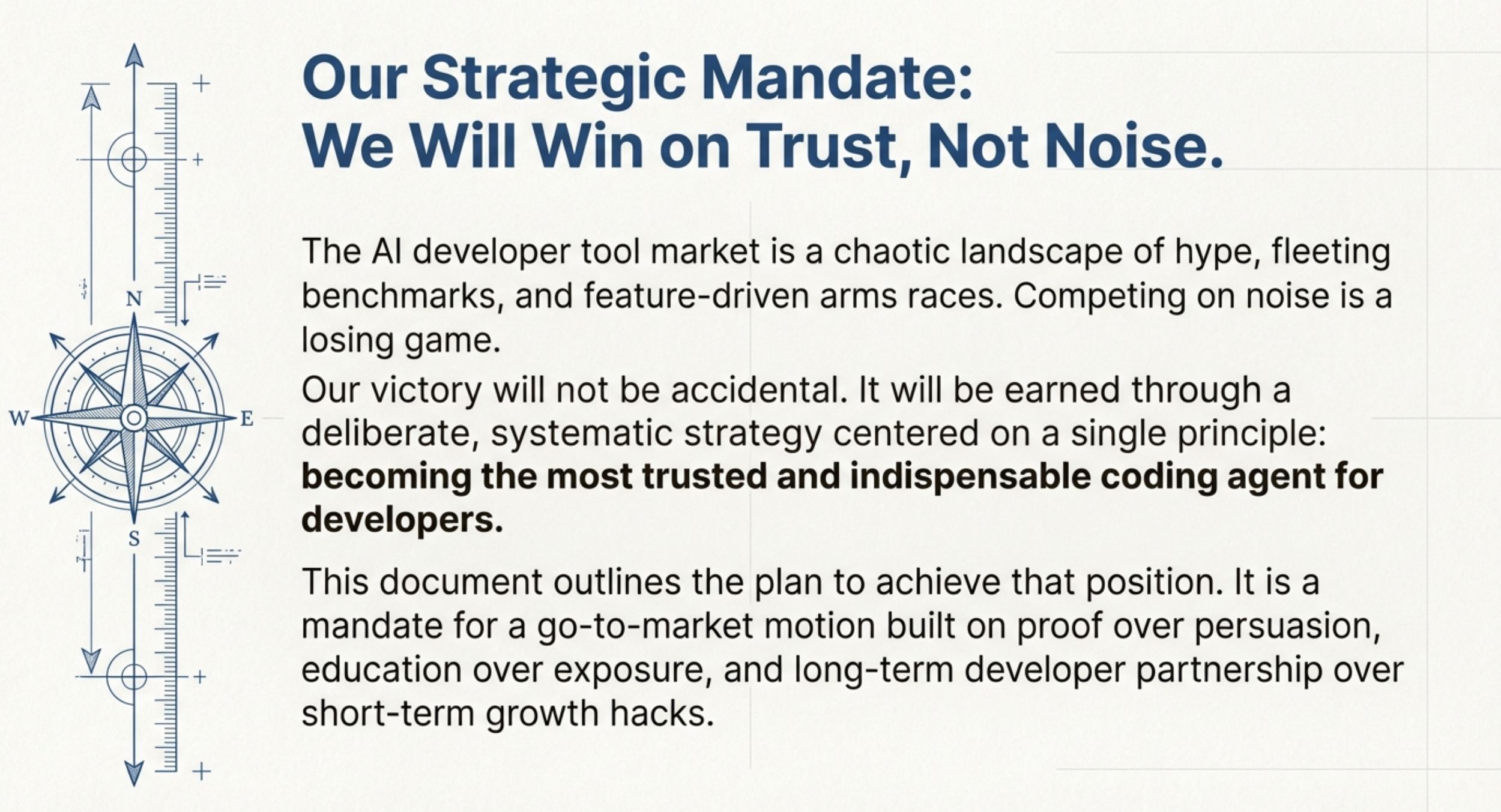
EXAMPLE GTM STRATEGY FOR Claude Code
1.0 Introduction: The Strategic Imperative for Claude Code
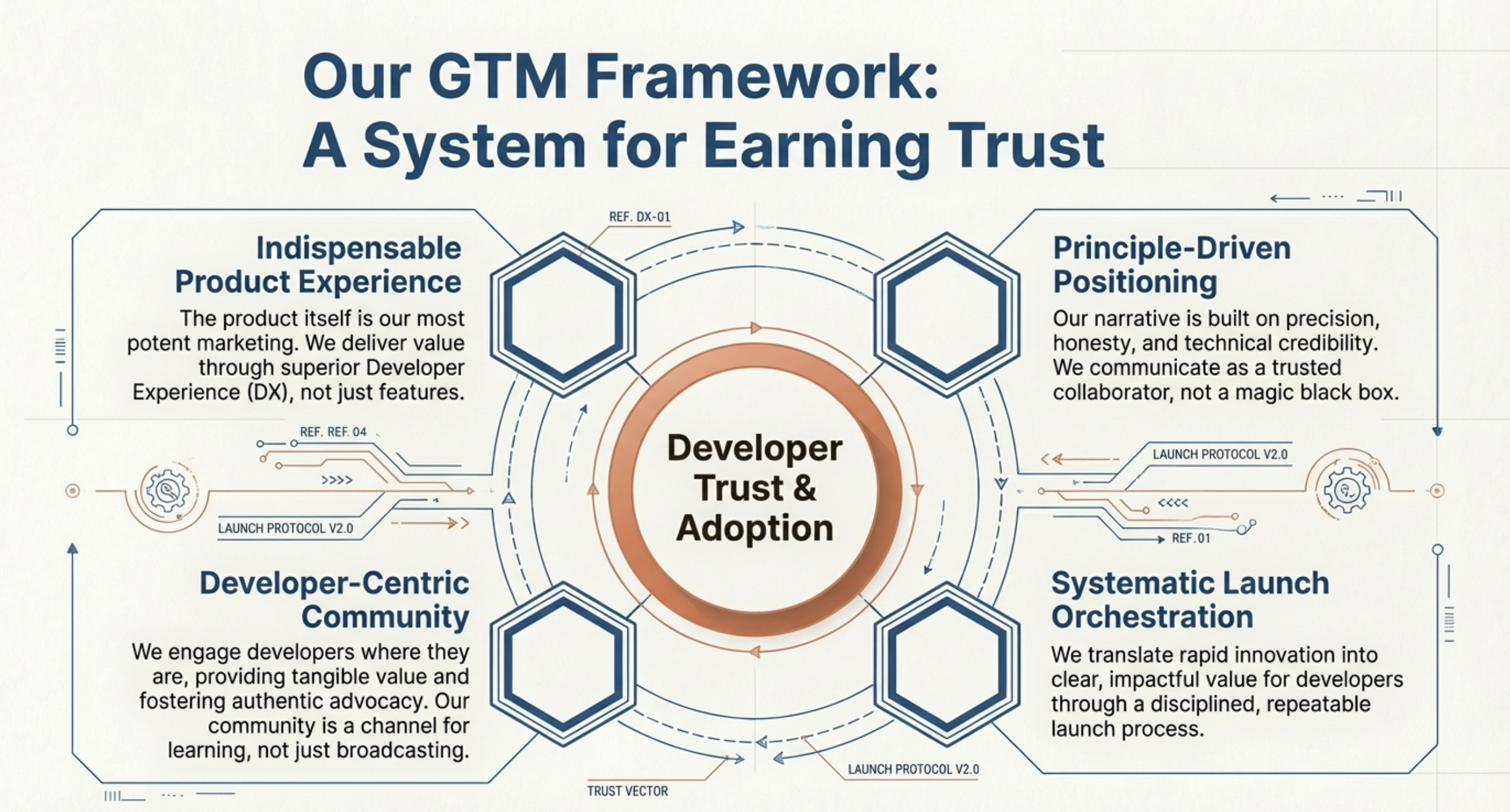
This document outlines the go-to-market (GTM) strategy for Claude Code, our new AI coding agent. The launch of Claude Code is more than a product release; it represents a strategic initiative to establish a leadership position in the rapidly expanding market for AI-powered developer tools. By leveraging our unique strengths, we aim to not only capture significant market share but also set a new standard for how developers collaborate with AI.
Our vision is to make Claude Code the indispensable AI partner for developers, establishing a new frontier where development velocity and code integrity are not a trade-off, but a unified outcome. This approach is a direct extension of Anthropic's deep research background in foundational areas like Circuit-Based Interpretability, Concrete Problems in AI Safety, and Learning from Human Preferences. We are not just building another coding assistant; we are creating a reliable, transparent, and highly capable partner for professional software development teams.
This plan provides a comprehensive roadmap for internal stakeholders, detailing our strategy from initial market analysis through sustained, long-term growth. It begins with a thorough assessment of the competitive landscape, which informs our unique positioning and messaging framework. From there, we define our target audience and detail a multi-phased launch plan designed for maximum impact. Finally, we outline our strategies for post-launch growth and establish a clear framework for measuring success.
To succeed, we must first understand the environment in which we will compete. The following analysis of the market landscape will illuminate the opportunities and challenges ahead, allowing us to carve out a distinct and defensible position for Claude Code.
2.0 Market & Competitive Landscape Analysis
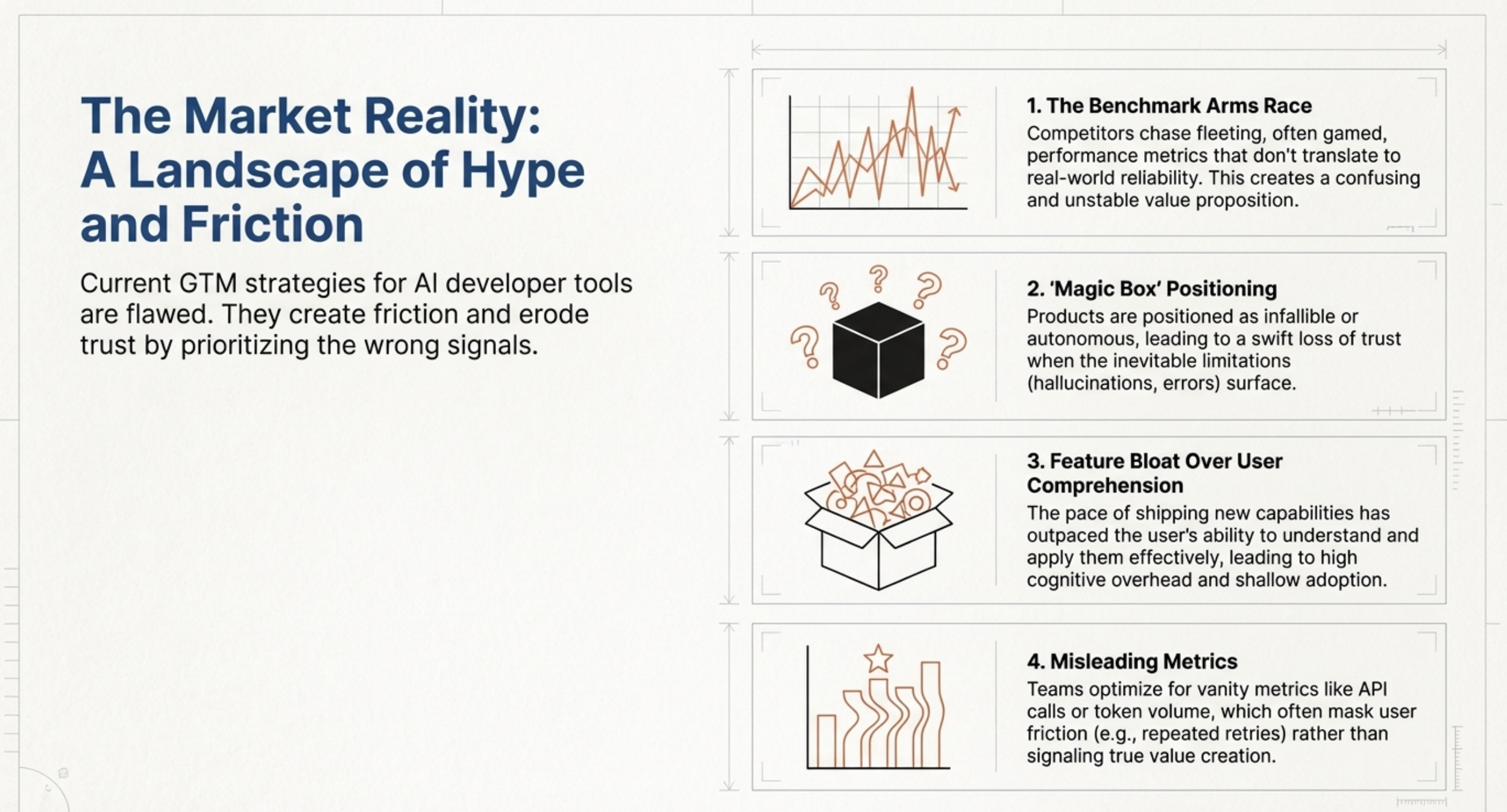
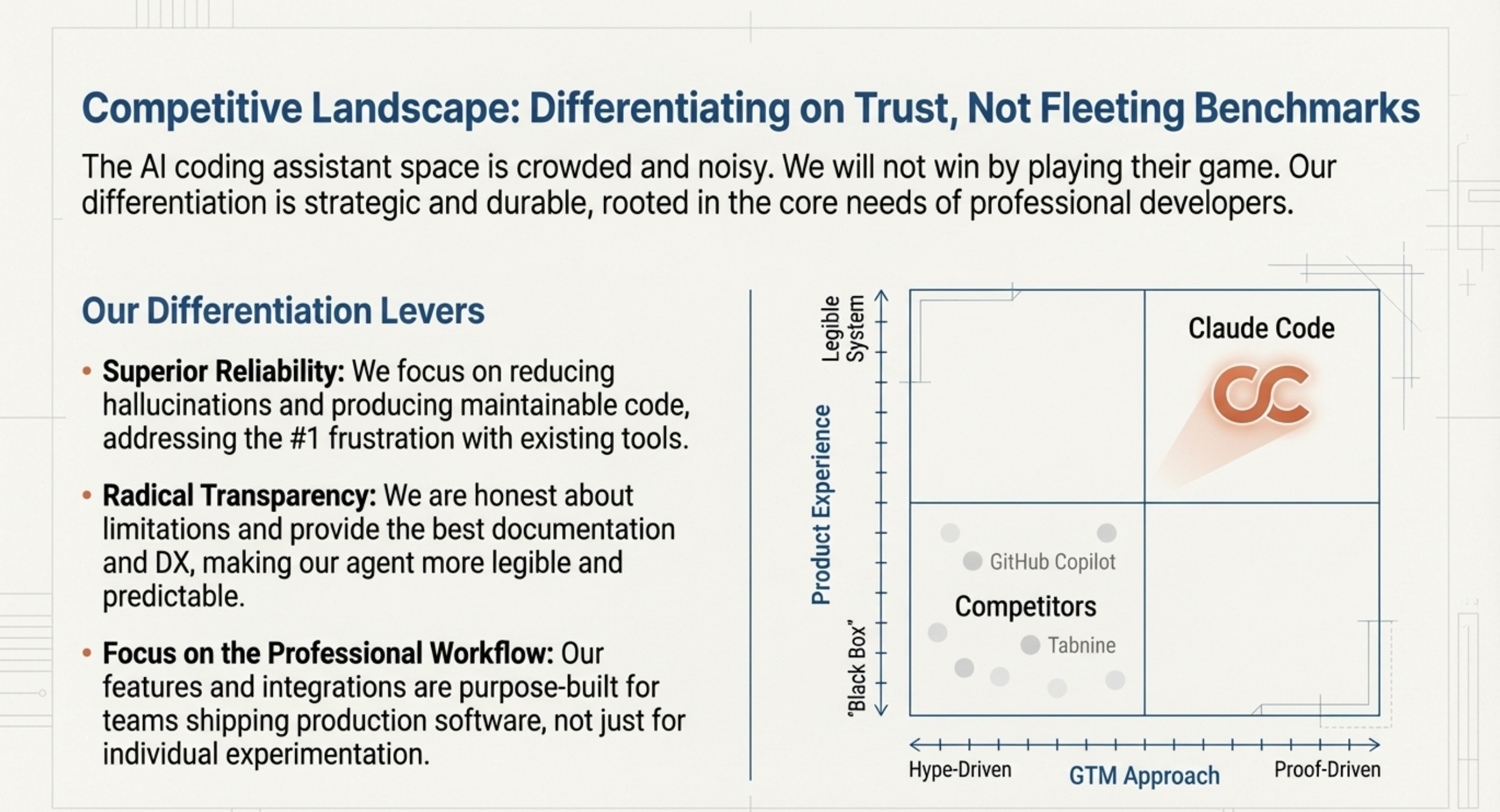
The market for AI coding assistants is dynamic and increasingly crowded, with a new baseline of expectation set by powerful foundation models like GPT-4. In this environment, simply matching baseline capabilities is insufficient for success. Sophisticated and meaningful differentiation is no longer a luxury but a critical necessity. Our strategy must be rooted in a deep understanding of developer workflows, the relentless pressure for efficiency, and the growing complexity of modern software development.
The opportunity is clear: developers are actively seeking tools that do more than just generate code snippets. They need intelligent partners that can help them navigate complex codebases, improve code quality, and accelerate the entire development lifecycle. Our analysis indicates that the competitive landscape can be effectively understood not as a list of individual products, but as distinct tiers of solutions, each addressing a different underlying pain point for developers.
Competitive Tiers
Tier
Core Pain Point Addressed
Strategic Implications for Claude Code
Tier 1: Incumbent Platforms
Workflow Integration & Breadth: These are large, integrated platforms (e.g., GitHub Copilot) that offer AI assistance directly within an existing, widely adopted developer ecosystem. Their primary value is convenience and low adoption friction.
Our opportunity is to flank incumbents by focusing on high-stakes domains like security and compliance, where our model's provable correctness and auditable code provenance offer a defensible moat.
Tier 2: Specialized AI Agents
Niche Task Automation: These are point solutions designed to excel at a specific, high-value task, such as automated testing, debugging, or code refactoring. Their value is rooted in depth of capability for a narrow use case.
These tools validate the market demand for specialized AI assistance. We can differentiate by offering a cohesive agent that combines multiple high-value specializations, while maintaining a consistent and trustworthy user experience.
Tier 3: Open-Source Frameworks
Customization & Control: These are open-source models and libraries that allow organizations to build their own custom AI coding solutions. They address the need for maximum control, transparency, and data privacy.
This tier validates the enterprise need for trust. We will position against them by offering the auditability of a custom solution without the prohibitive TCO of building, fine-tuning, and maintaining a bespoke AI model.
Based on this analysis, Claude Code's core strategic differentiation is a direct result of our research ethos: we deliver an AI partner that excels in high-stakes environments where code correctness, security, and auditability are non-negotiable. While competitors focus on feature velocity and breadth, our approach is grounded in solving a specific class of customer problems where trust and technical nuance are paramount. This allows us to build a loyal following among professional developers who value reliability as much as speed.
Understanding this competitive landscape is the foundation upon which we will build a precise and compelling positioning strategy.
3.0 Positioning & Messaging Framework
A clear and defensible messaging framework is essential for cutting through the noise of a crowded market. Our positioning will be fundamentally outcome-based, moving the conversation away from a commoditized list of AI features and toward the measurable value we deliver to developers and their organizations. This framework will ensure all internal teams—from product and engineering to sales and marketing—are aligned on a single, powerful narrative.
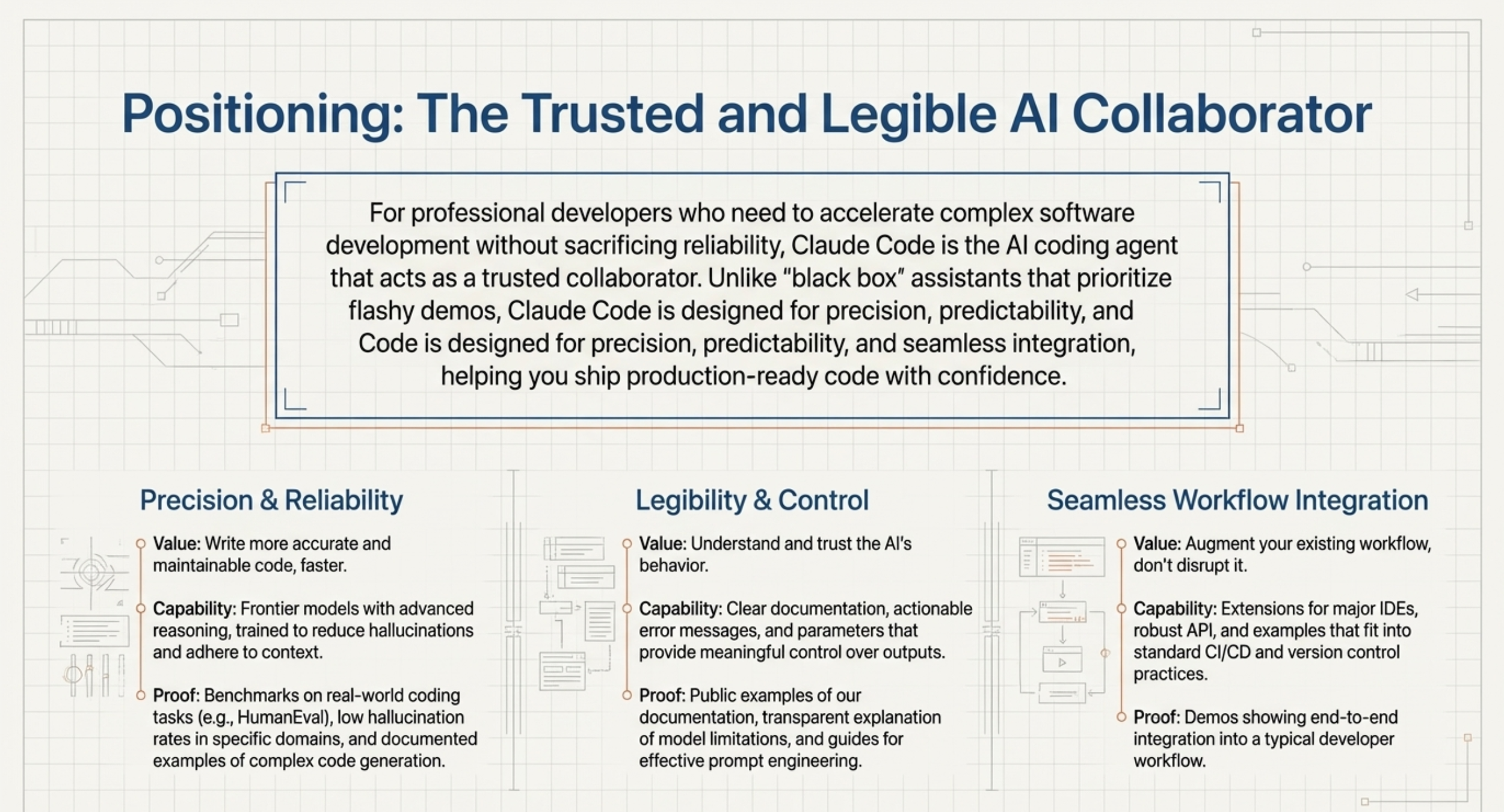
Claude Code empowers professional development teams who demand performance without compromising on reliability. By combining frontier AI capabilities with a deep commitment to responsible design, we help teams accelerate development, enhance code quality, and build with confidence.
This internal statement will guide the development of our external messaging, which is structured around three core pillars. Each pillar follows a simple but powerful framework: Value → Capability → Proof.
Pillar 1: Accelerate Development Velocity
Value: Significantly reduce the time and friction involved in complex coding tasks, allowing developers to focus on high-impact problem-solving rather than routine implementation.
Capability: Claude Code is powered by domain-tuned large language models, specifically optimized for code generation, complex logic implementation, and analysis of large codebases.
Proof: We will substantiate our claims with quantitative evidence, such as "Beta study results showing 40% time savings on common development tasks" and a measurable reduction in manual coding efforts.
Pillar 2: Enhance Code Quality & Reliability
Value: Empower developers to write more robust, maintainable, and secure code from the start, reducing bugs and long-term technical debt.
Capability: Features include advanced debugging assistance, automated code review with suggestions based on best practices, and provenance tracking to ensure generated code is auditable.
Proof: Our proof points will be anchored in objective metrics, such as "98% citation alignment with gold-standard code repositories" and benchmarks demonstrating a tangible reduction in common bugs and vulnerabilities.
Pillar 3: Foster Trust Through Responsible AI
Value: Provide a predictable and trustworthy AI collaboration experience, giving professional developers the confidence to integrate AI deeply into their critical workflows.
Capability: We are committed to honest messaging, model explainability, and proactively flagging outputs where model uncertainty is high, enabling human oversight where it matters most.
Proof: Trust will be established through transparent documentation on model limitations, external audits demonstrating compliance with AI safety standards, and customer case studies highlighting our commitment to responsible partnership.
Guidelines for Responsible Messaging
To maintain our brand's credibility, all public-facing communication will adhere to the following principles:
DO: Use bounded, honest language that sets realistic expectations. For example, "Our AI achieves high-confidence insights within known data domains."
DO: Explain that higher confidence does not mean certainty. Position AI outputs as powerful advisory inputs that augment, rather than replace, human expertise.
DON'T: Make absolute or exaggerated claims. Avoid statements like, "Our AI always gives factually correct insights."
With a clear understanding of what we will say, we can now turn our focus to whom we will be saying it to.
4.0 Target Audience & Personas
A deep and nuanced understanding of our customer is the cornerstone of our go-to-market strategy. A precise definition of our Ideal Customer Profile (ICP) and key user personas will guide every GTM activity, from product roadmap decisions and documentation priorities to the execution of targeted marketing campaigns.
Ideal Customer Profile (ICP)
Our primary focus is on organizations where software development is a core driver of business value and where teams are sophisticated enough to appreciate the trade-offs between speed and quality.
Industry/Sector: Technology, SaaS, and Enterprise Software companies where innovation is directly tied to engineering output.
Company Size: Mid-to-large enterprises with established engineering teams (50+ developers) that feel the acute pain of complexity and scale.
Technical Context: Organizations building on modern technology stacks (e.g., Python, Node.js) and are heavy users of cloud services. These teams are typically early adopters of new developer tools and APIs.
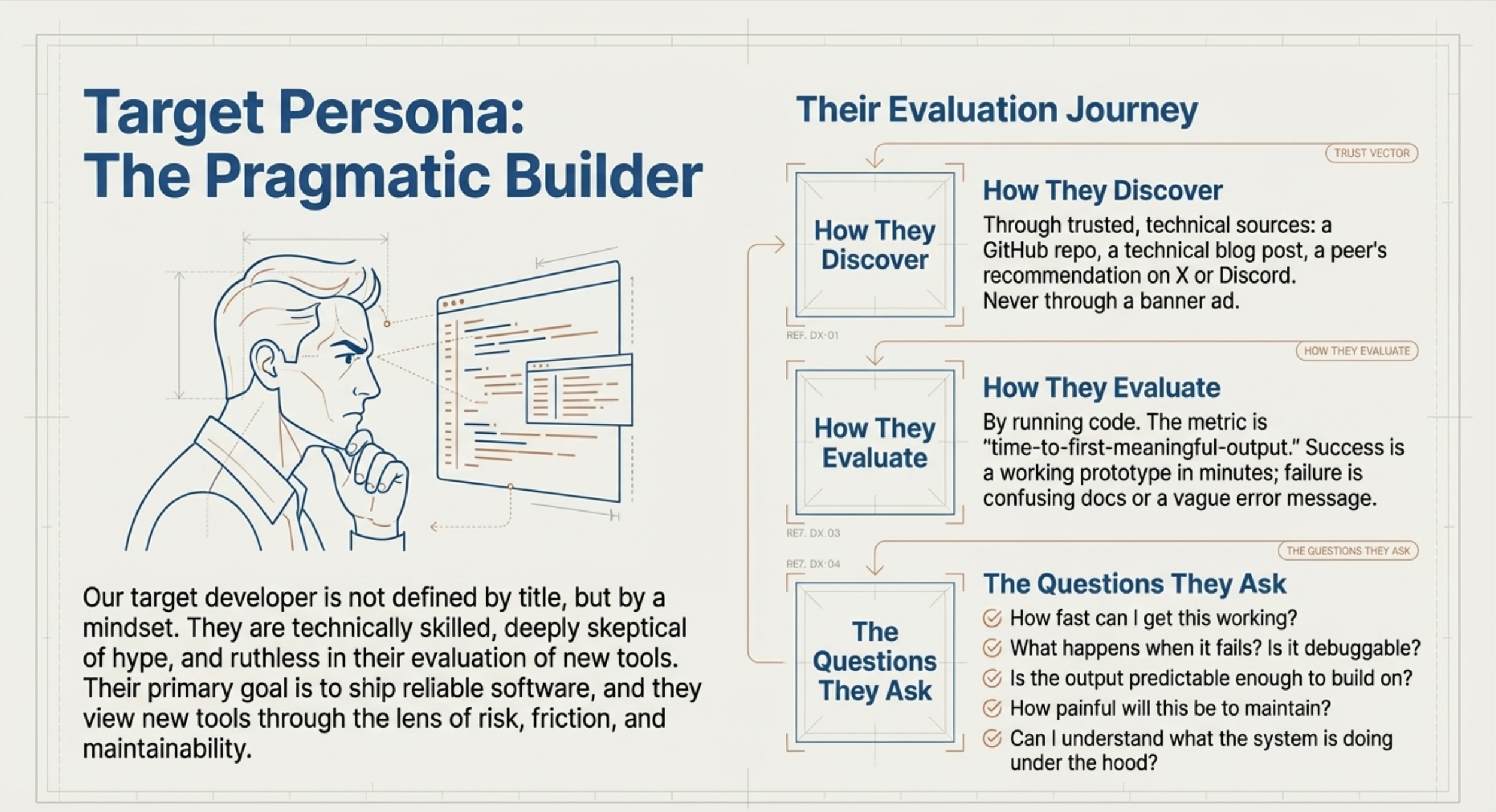
Primary User Persona: "Devon Integrator"
Within our target organizations, our primary user persona is the hands-on developer tasked with building and integrating new capabilities.
Title: Senior Software Engineer / Full-Stack Developer
Jobs-To-Be-Done (JTBD): "Enable natural language understanding in product workflows without reinventing the wheel."
Goals:
Rapidly integrate high-quality code generation and analysis via a reliable API.
Reduce development time and minimize the introduction of bugs.
Ship high-quality prototypes quickly to validate ideas and demonstrate progress.
Pain Points:
Poor or incomplete documentation that causes significant integration delays.
AI tools that produce unreliable, insecure, or un-auditable code.
High friction in moving from experimentation and prototyping to production-ready implementation.
Key Stakeholder Roles
Successfully selling into an enterprise requires addressing the distinct needs of multiple stakeholders within the account.
Stakeholder Role
Key Persona
Primary Concern
User
Senior Software Engineer ("Devon Integrator")
Ease of use, performance, reliability, and documentation quality.
Champion
Engineering Manager / Lead Developer
Team productivity, adoption rates, and defending the tool's value internally.
Buyer
Head of Engineering / CTO
Return on investment (ROI), security, compliance, and long-term strategic fit with the company's technology roadmap.
This clear definition of our audience provides the necessary context to design a go-to-market plan that effectively engages and activates each of these critical roles.
5.0 Go-to-Market Launch Plan
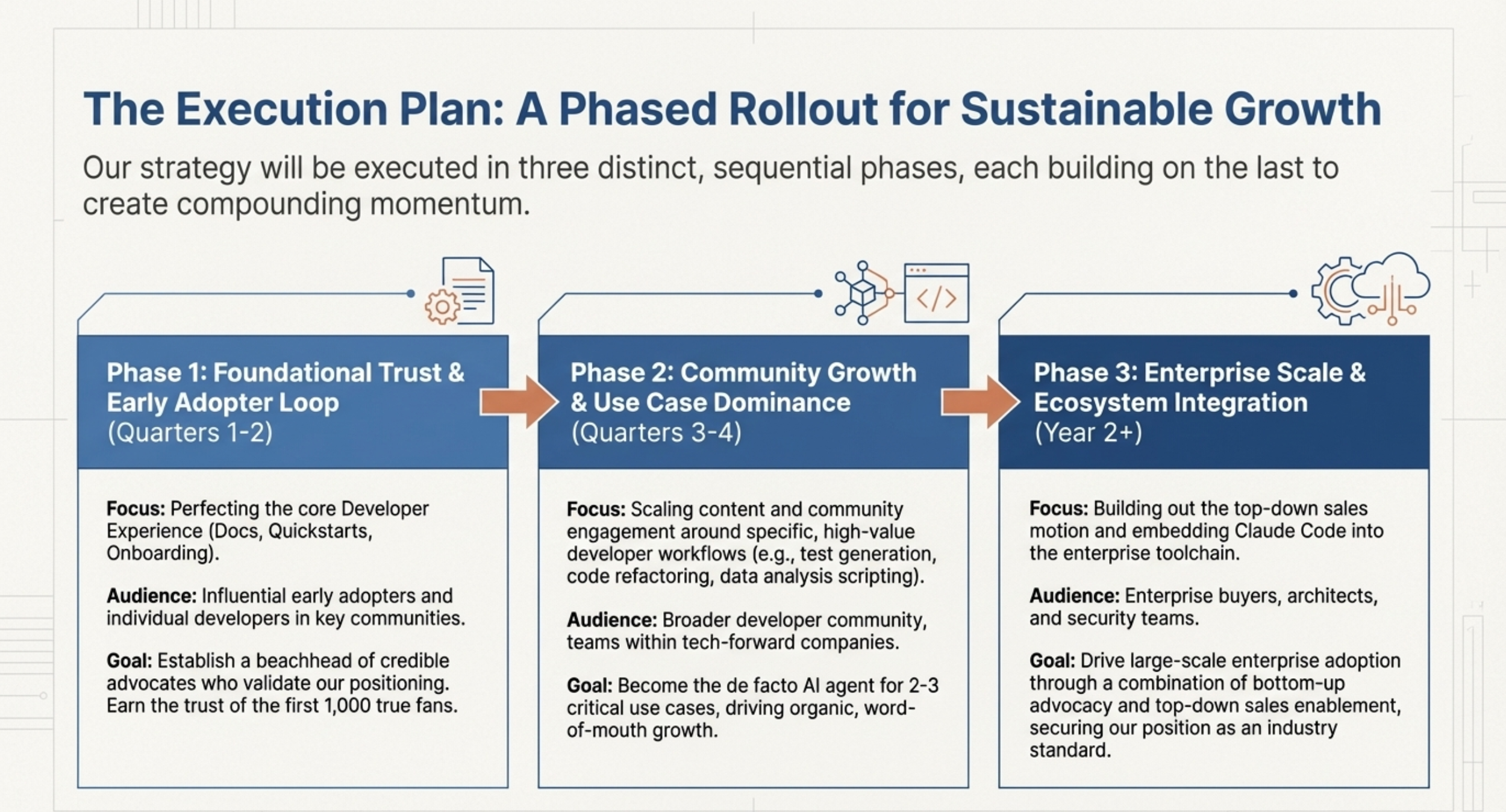
Our launch will follow a phased, developer-first GTM strategy. This approach is intentionally designed to build momentum sequentially, gather critical feedback from our target audience, and establish deep credibility within the technical community before a broad public announcement. Each phase has a distinct objective and set of activities.
Multi-Phased Launch Sequence
Phase 1: Alpha Pilot
Objective: Validate core use cases and gather deep qualitative feedback with a select group of trusted, high-expertise developers from our ICP.
Key Activities: Direct, high-touch engagement; user interviews to understand workflows and pain points; establish initial performance benchmarks and identify critical product gaps.
Phase 2: Closed Beta
Objective: Refine our positioning, messaging, and onboarding experience with a wider, invite-only audience of early adopters. Harden the product for broader use.
Key Activities: Test documentation for clarity and completeness; release initial GitHub starter kits to gauge their effectiveness; gather feedback on the API and overall developer experience.
Phase 3: General Availability (GA) Launch
Objective: Drive broad market awareness, establish thought leadership, and accelerate widespread adoption within our target market segments.
Key Activities: Public announcement via coordinated PR and blog posts; launch marketing campaigns targeting key developer communities; activate sales and developer relations teams for outreach.
Core Developer-First GTM Tactics
Our strategy is centered on reducing adoption friction by allowing developers to experience value immediately.
Interactive API Playground: An in-browser environment where developers can experiment with Claude Code's capabilities and test specific use cases before writing a single line of code or committing a budget. This lowers the barrier to entry and allows for rapid evaluation.
GitHub Starter Kits: A collection of high-quality, well-documented example codebases that provide a scaffold for common projects. This accelerates adoption by giving developers a functional starting point rather than a blank slate.
2-Minute Value-Proof Demos: Short, focused video demonstrations that show a clear, immediate payoff with minimal code. For example: "Analyze 10 customer reviews from raw text, extract key themes and sentiment, and output a structured JSON summary in under 30 lines of code," instantly proving the product's ability to turn unstructured data into actionable insights.
Cross-Functional Orchestration
A successful launch requires a tightly coordinated effort across more than 15 key stakeholders. Product Marketing will serve as the central hub, owning the GTM strategy. Engineering will provide technical validation for all claims and partner on benchmark development. Developer Relations will seed our GitHub starter kits and cultivate community feedback. Sales will execute the enablement plan and provide real-time feedback from the field on competitive objections.
The GA launch is not the final destination but the beginning of our journey to build a sustainable and growing business. This leads directly to our plan for continuous, post-launch growth.
6.0 Post-Launch Growth & Adoption Strategy
Our go-to-market strategy does not end at launch. We will treat our GTM as a continuous process, focusing on building a virtuous cycle of user engagement, systematic feedback collection, and rapid iteration. Sustaining momentum requires a deliberate plan to drive deeper adoption and prove our value over the long term.
Building Systematic Feedback Loops
We will establish formal processes to ensure customer insights are systematically gathered, analyzed, and integrated back into our product and GTM strategies.
Source of Feedback: We will actively monitor multiple channels, including direct user interviews, support tickets, community forums (e.g., Reddit), and quantitative product usage analytics.
Action: Insights will be triaged and translated into actionable items. This includes refining our messaging to address common questions, prioritizing features on the product roadmap to solve validated pain points, and improving our documentation.
Lifecycle Marketing Plan
We will develop a targeted communication strategy to guide users through their journey with Claude Code, driving deeper engagement and transforming initial users into long-term advocates.
Onboarding: A series of in-app prompts, tutorials, and targeted emails designed to help new users experience the "aha!" moment quickly by highlighting key features and starter use cases.
Engagement: Our engagement content will be segmented by stakeholder role, delivering API-centric deep dives for the 'Devon Integrator' persona, team productivity case studies for the 'Champion,' and ROI calculators for the 'Buyer'.
Community: Fostering an active presence in key developer communities to encourage peer-to-peer support, gather organic feedback, and build a base of vocal advocates for Claude Code.
Sales Enablement for Ongoing Success
To ensure our sales team can compete effectively, we will create and maintain a suite of strategic enablement materials.
Competitive Battle Cards: Leveraging our "long-tail" framework, we will equip sales with concise, actionable guidance on how to position Claude Code against different categories of competitors.
Customer Stories & Case Studies: We will proactively develop compelling case studies that provide social proof and demonstrate validated business outcomes, shifting conversations from technical capabilities to proven ROI.
Objection Handling Guides: We will create legally-vetted, factually true responses to common objections and competitor claims, ensuring our team can navigate difficult conversations with confidence and integrity.
The success of these ongoing efforts will be determined not by activity, but by the measurable impact they have on our business and our customers.
7.0 Success Metrics & Measurement Framework
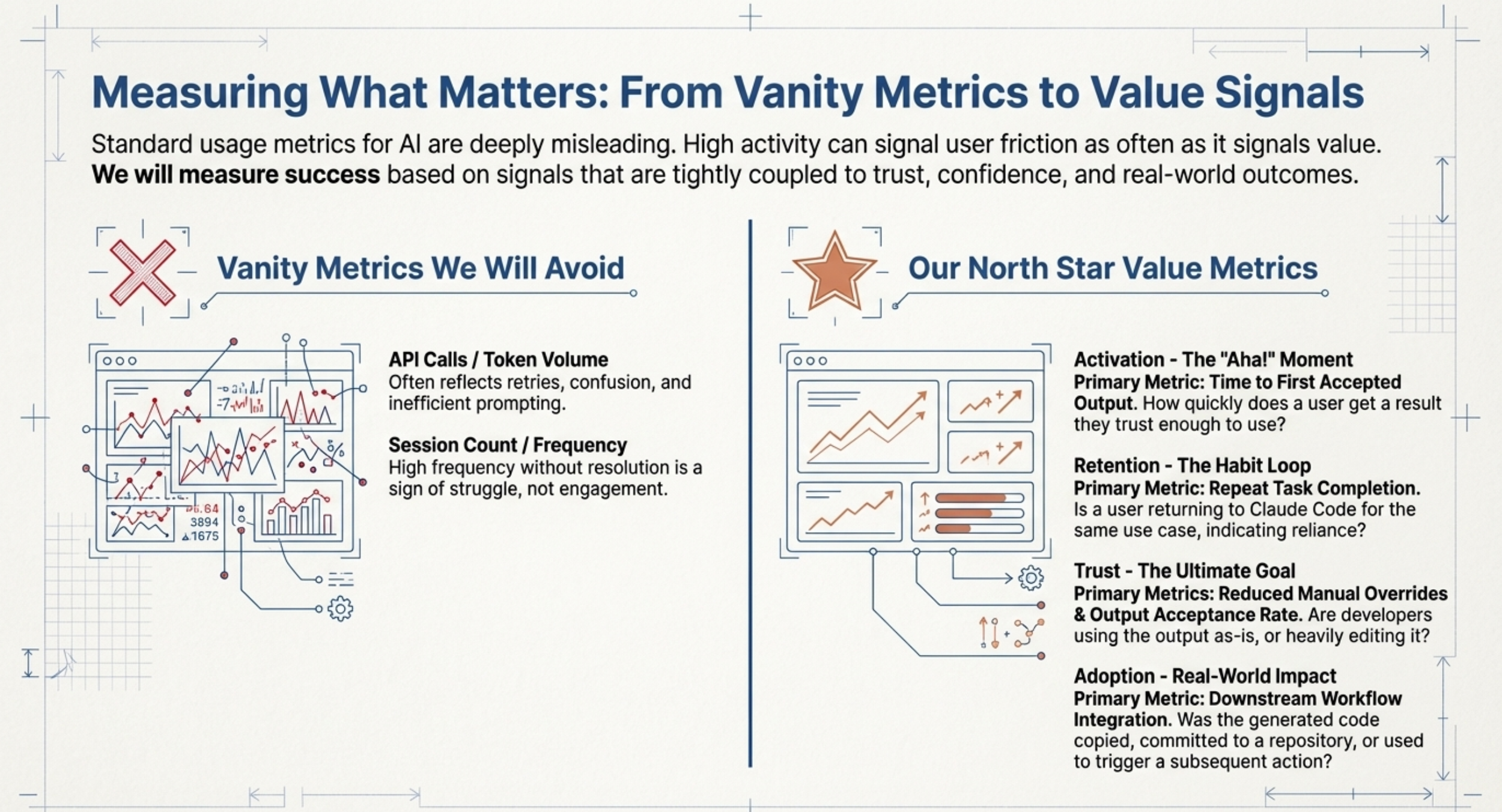
Our measurement philosophy is centered on tracking realized customer value and tangible business impact, not vanity metrics. Every KPI we monitor must be directly tied to a strategic outcome, ensuring that our efforts are aligned with what truly matters: building a product that customers love and a business that can scale.
Key Performance Indicators (KPIs) Across the User Lifecycle
Activation: First successful API call that produces a valid result.
Why it matters: This initial success is the first proof point of our low-friction, developer-first GTM promise.
Adoption & Engagement:
Weekly Engaged Users: The number of unique users performing core, value-creating actions, indicating habitual use.
User Acceptance Ratio: The proportion of AI-generated suggestions that developers adopt.
Why it matters: This is a direct proxy for the model's utility and its ability to generate code that meets professional standards, reinforcing our core 'reliability' promise.
Task Success Rate (TSR): The percentage of interactions that result in the successful completion of a developer's intended task.
Retention: 60-day cohort retention rates.
Why it matters: This measures our ability to deliver sustained value over time and integrate Claude Code into our users' regular workflows.
Value Realization: Percentage reduction in development cycle time (measured via customer studies) and Time-to-Value, which tracks how quickly a new user achieves a meaningful outcome.
Product Quality: Model hallucination rates and accuracy vs. human benchmarks.
Why it matters: These technical metrics are essential for ensuring we are delivering on our promise of reliability and trust.
Aligning PMM Activities to Business OKRs
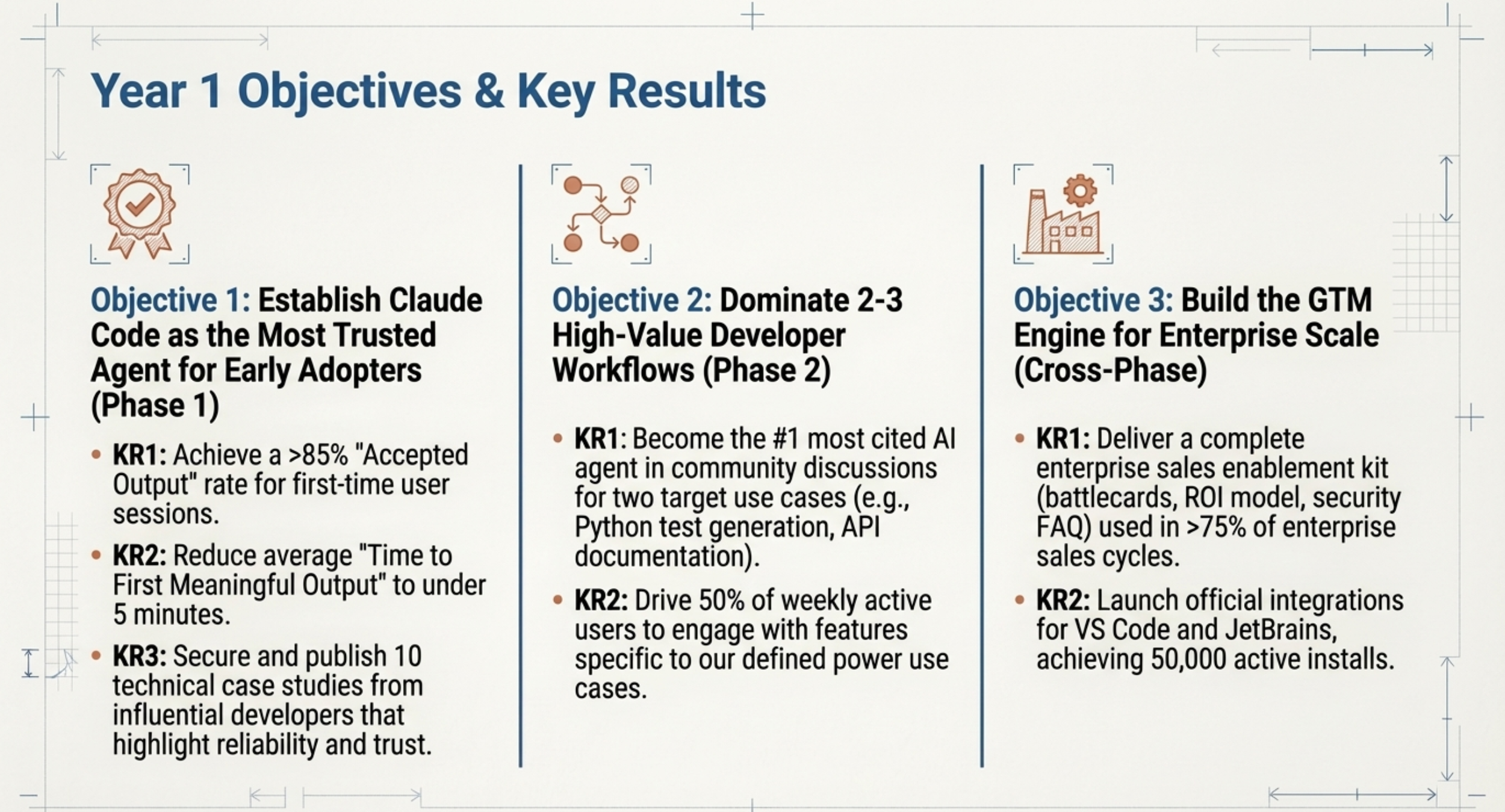
To ensure clear accountability, the product marketing team's objectives will be explicitly linked to key business results.
PMM Objective
Key Business Result
Strengthen product messaging to drive higher deal velocity.
Increase sales team confidence in competitive deals (measured by survey).
Equip sales with superior enablement materials.
Improve win rates against key competitor categories.
Drive adoption of high-value features post-launch.
Increase weekly engaged users and cohort retention rates.
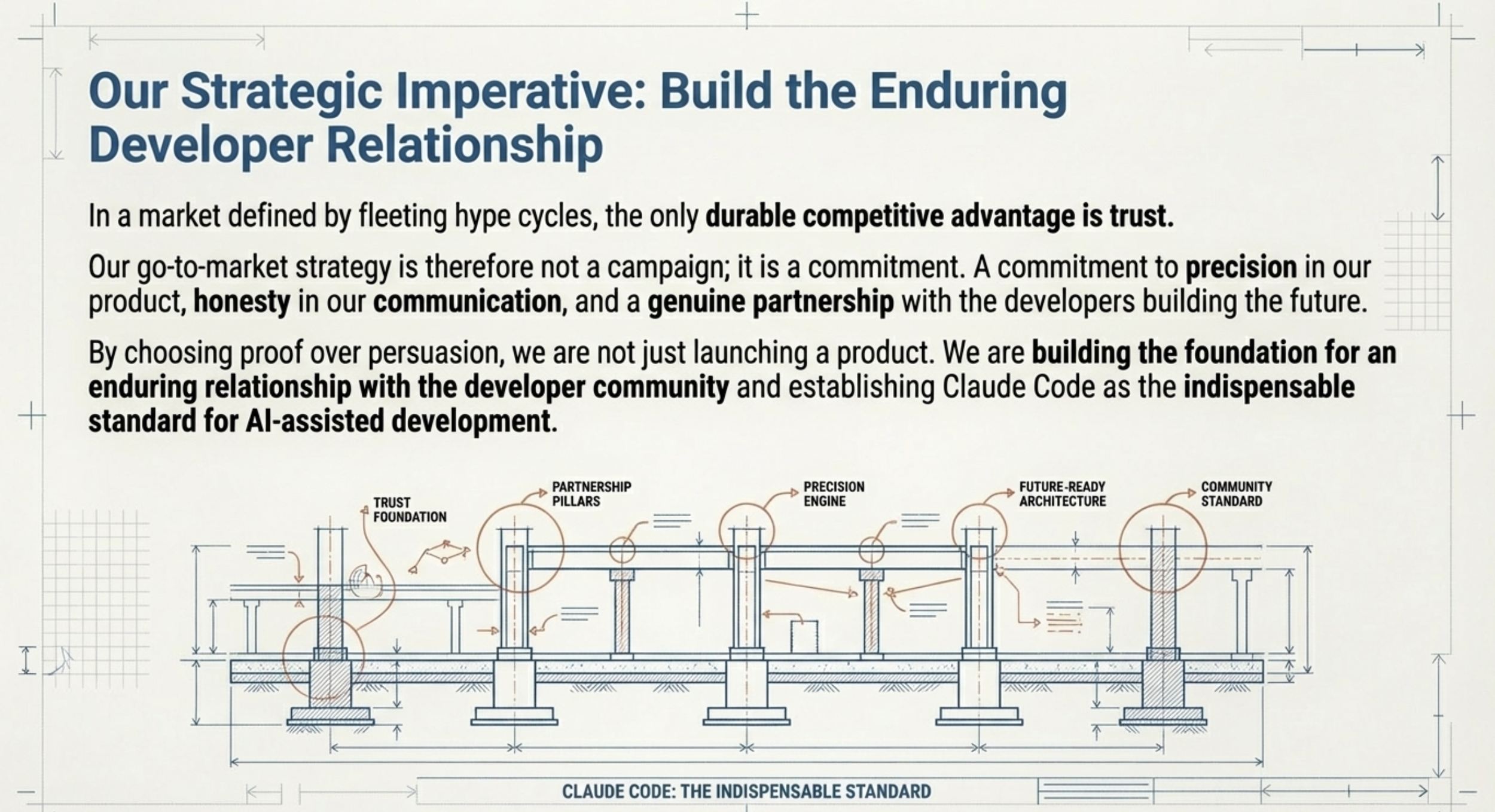
This go-to-market plan provides a strategic, disciplined, and measurable path to establishing Claude Code as a trusted leader in the AI developer tool market. By executing this plan with focus and agility, we will not only capture the market—we will define it, empowering developers to build the future with an unprecedented combination of speed and trust.