
International Reactions to the U.S. Invasion of Venezuela: A Global Snapshot
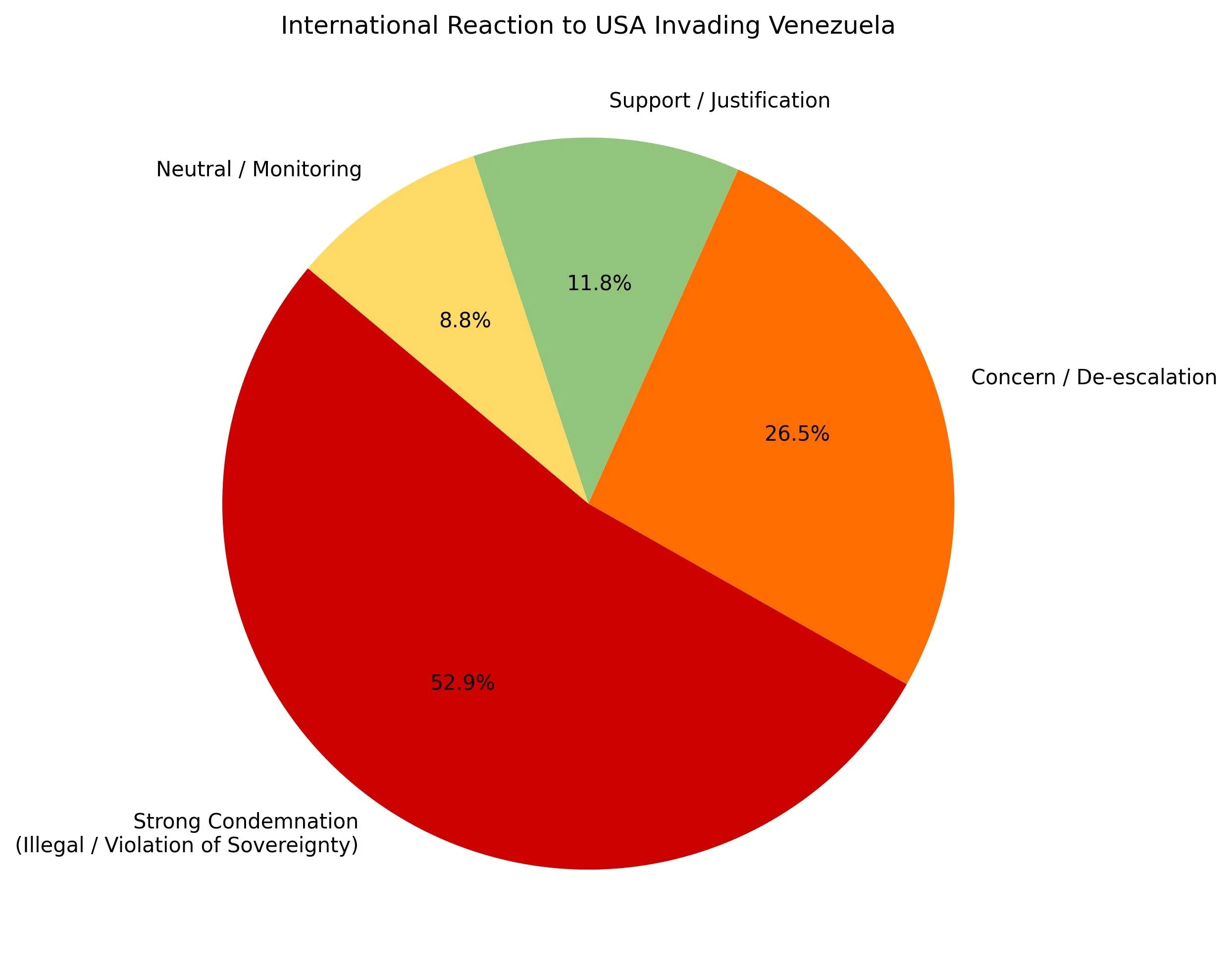
This chart summarizes how governments and public actors around the world have responded to recent U.S. actions in Venezuela, grouped by sentiment:
🔴 Strong Condemnation (52.9%) — Explicit statements calling the action illegal or a violation of sovereignty
🟠 Concern / De-escalation (26.5%) — Calls for restraint, diplomacy, and respect for international law
🟢 Support / Justification (11.8%) — Expressions of backing or legal justification
🟡 Neutral / Monitoring (8.8%) — Statements focused on observation without clear judgment
What stands out is the scale of international condemnation, particularly from Latin America, parts of Europe, Asia, and the Global South. Even among close allies, many responses stop short of endorsement and instead emphasize international law and de-escalation.
Whatever one’s view of the Maduro government, this moment raises important questions about:
• The role of international law
• Sovereignty and precedent
• Congressional and democratic oversight
• Long-term regional stability
Data is based on publicly reported government statements and major media coverage.
I’m interested in how others interpret this distribution — especially what it signals for future multilateral norms and U.S. foreign policy credibility.
The United States’ military action in Venezuela has triggered a wide spectrum of responses across the international community. Governments, international organizations, and domestic political actors have weighed in with positions ranging from strong condemnation to calls for de-escalation, neutral monitoring, explicit support, and, in some cases, no official statement at all.
This article synthesizes publicly reported reactions across Asia, Europe, Latin America, the Middle East, North America, and the United Nations, drawing on official statements and major international media coverage. Together, these responses illustrate how the action is being interpreted through the lenses of international law, sovereignty, regional stability, and constitutional authority.
Asia: Condemnation and Strategic Silence
Asian responses reveal a sharp divide between vocal condemnation and deliberate restraint.
China issued one of the strongest rebukes, with its Foreign Ministry stating:
“中方强烈谴责美国对主权国家使用武力。”
(“China strongly condemns the U.S. use of force against a sovereign country.”)
This framing explicitly situates the U.S. action as a violation of sovereignty and international norms, consistent with Beijing’s longstanding opposition to unilateral military interventions.
North Korea echoed this position even more starkly, calling the action:
“주권에 대한 가장 심각한 침해”
(“The most serious encroachment on sovereignty.”)
In contrast, Japan and India issued no official statements. Japan’s Chief Cabinet Secretary provided no formal position, while India’s Ministry of External Affairs likewise refrained from comment. These silences suggest strategic caution, reflecting diplomatic balancing acts rather than endorsement or opposition.
Europe: Law, Restraint, and De-escalation
European reactions largely avoided explicit endorsement and instead emphasized international law and diplomatic solutions.
Germany’s Federal Foreign Office stated:
“Das Völkerrecht muss respektiert werden. Eine politische Lösung ist notwendig.”
(“International law must be respected. A political solution is necessary.”)
This places Berlin firmly in the concern category—critical of escalation without directly labeling the action illegal.
France adopted a similar posture, urging respect for international law and restraint, aligning with a concern / de-escalation stance.
Spain, through Prime Minister Pedro Sánchez, was more explicit:
“España no reconocerá una intervención que viole el derecho internacional.”
(“Spain will not recognize an intervention that violates international law.”)
Meanwhile, the United Kingdom struck a notably neutral tone. Prime Minister Keir Starmer stated that it was for the United States to justify its actions under international law, avoiding either condemnation or endorsement.
Latin America: Strong Regional Opposition, with One Exception
Latin America has been the region with the strongest and most unified condemnation, reflecting historical sensitivities around intervention and sovereignty.
Mexico’s President Claudia Sheinbaum stated:
“Rechazamos categóricamente la intervención en los asuntos internos de otros países.”
(“We categorically reject intervention in the internal affairs of other countries.”)
Brazil’s President Lula da Silva described the action as:
“Es una grave afrenta a la soberanía venezolana.”
(“A grave affront to Venezuelan sovereignty.”)
Cuba’s President Miguel Díaz-Canel went further, calling it:
“Esto es terrorismo de Estado contra Venezuela.”
(“This is state terrorism against Venezuela.”)
Colombia, while stopping short of outright condemnation, expressed deep concern. President Gustavo Petro said:
“Expreso profunda preocupación y llamo a la paz.”
(“I express deep concern and call for peace.”)
The notable outlier is Argentina, where President Javier Milei issued no formal condemnation and was widely reported as supportive of regime change in Venezuela. Argentina is therefore categorized as supportive, despite the absence of a formal government declaration.
Middle East (MENA): Condemnation and Silence
In the Middle East, reactions again split between strong opposition and silence.
Iran’s Foreign Ministry condemned the action as:
“نقض فاحش حاکمیت ملی ونزوئلا”
(“A blatant violation of Venezuela’s national sovereignty.”)
Saudi Arabia, by contrast, issued no official statement, maintaining diplomatic silence.
North America: Divergence Within the United States
Canada took a cautious but clear position. Foreign Minister Anita Anand stated:
“Le Canada exhorte toutes les parties à respecter le droit international.”
(“Canada urges all parties to respect international law.”)
Within the United States, however, the reaction is deeply divided.
The White House framed the action as justified under national security grounds, placing the executive branch firmly in the supportive category.
At the same time, a significant bloc of U.S. lawmakers, legal scholars, and civil society organizations expressed strong condemnation:
Bernie Sanders warned against “unauthorized wars or regime-change interventions.”
Alexandria Ocasio-Cortez argued the action violated the Constitution without congressional authorization.
Ro Khanna, Ilhan Omar, and Pramila Jayapal emphasized illegality, civilian harm, and the need for diplomacy.
Constitutional scholar Bruce Ackerman called the action unconstitutional.
The American Civil Liberties Union and Code Pink condemned the expansion of executive war powers and violations of international law.
United Nations: Institutional Alarm
The UN Secretary-General summarized institutional concern succinctly:
“Las normas del derecho internacional no han sido respetadas.”
(“The rules of international law have not been respected.”)
This places the United Nations firmly in the concern / de-escalation category, reflecting alarm without direct enforcement power.
Conclusion: A World Largely Critical, Rarely Supportive
Across regions, the dominant international response to the U.S. invasion of Venezuela has been negative. The largest share of actors either strongly condemn the action as illegal and a violation of sovereignty or express concern and call for de-escalation. Explicit support is limited, and in many cases, silence appears to be a strategic choice rather than approval.
The pattern suggests a broader tension between unilateral military action and the post–World War II international legal order—one that continues to shape global reactions far beyond Venezuela itself.