
Multi-Agent Commerce and Negotiation: Architectures, Game-Theoretic Foundations, and Economic Implications in Autonomous Digital Markets
Abstract
The emergence of multi-agent systems (MAS) is transforming digital commerce by enabling autonomous entities to discover, negotiate, transact, and optimize supply chains without direct human intervention. Multi-agent commerce integrates artificial intelligence, distributed systems, market design, and computational game theory to produce adaptive, scalable, and economically efficient trading ecosystems. This essay synthesizes theoretical foundations, negotiation protocols, system architectures, and real-world implications, while examining trust, mechanism design, and regulatory challenges. It argues that multi-agent commerce represents not merely an automation layer but a structural shift toward machine-mediated market microstructure.
1. Introduction
Digital commerce has evolved through several phases: human-mediated electronic marketplaces, platform-mediated algorithmic pricing, and now agent-mediated autonomous trading ecosystems. In multi-agent commerce, software agents act on behalf of individuals, firms, or other systems to conduct commercial operations including:
Supplier discovery
Price negotiation
Contract formation
Logistics coordination
Risk hedging
Market signaling and arbitrage
Unlike traditional automation, multi-agent commerce introduces strategic autonomy — agents must reason about other agents’ intentions, incentives, and strategies in dynamic, partially observable environments.
2. Conceptual Foundations of Multi-Agent Systems in Commerce
2.1 Definition of Economic Agents
In multi-agent commerce, agents are typically characterized by:
Autonomy – independent decision-making capability
Reactivity – response to environmental changes
Proactivity – goal-directed behavior
Social ability – negotiation, coordination, or competition
Economic agents may represent:
Buyers optimizing utility under budget constraints
Sellers maximizing revenue or market share
Intermediaries optimizing market liquidity or matching efficiency
2.2 System Architectures
Centralized Market Platforms
Agents interact through a centralized exchange or broker
Easier trust enforcement
Lower coordination complexity
Higher platform power concentration
Decentralized Agent Markets
Peer-to-peer negotiation and discovery
Greater resilience and censorship resistance
Higher coordination and trust complexity
Hybrid Federated Markets
Shared protocol layers
Multiple competing marketplaces
Interoperable agent identity and reputation
3. Negotiation Theory in Multi-Agent Commerce
Negotiation is the core operational mechanism of agent commerce.
3.1 Classical Negotiation Models
Bilateral Bargaining
Agents negotiate price and contract terms directly.
Key models:
Nash Bargaining Solution
Rubinstein Alternating Offers Model
Auction-Based Negotiation
Common in agent marketplaces:
English auctions
Dutch auctions
Vickrey auctions
Combinatorial auctions
Agents must optimize:
Bid timing
Information revelation
Strategic bluffing vs transparency
3.2 Automated Negotiation Protocols
Contract Net Protocol
Task announcement → bidding → contract awarding
Efficient for distributed supply chain allocation
Argumentation-Based Negotiation
Agents exchange structured reasoning:
Cost explanations
Risk disclosures
Capability proofs
Multi-Issue Negotiation
Real commerce requires simultaneous optimization of:
Price
Delivery time
Quality guarantees
Service level agreements
3.3 Learning-Driven Negotiation
Modern agents incorporate machine learning:
Reinforcement learning for dynamic bidding
Opponent modeling using Bayesian inference
Meta-learning for cross-market generalization
4. Game-Theoretic Foundations
Multi-agent commerce is fundamentally strategic.
4.1 Mechanism Design
Goal: design market rules where rational agents produce desirable outcomes.
Applications:
Incentive-compatible pricing
Truthful reporting systems
Fraud-resistant marketplaces
4.2 Equilibrium Concepts
Nash Equilibrium
Agents converge to stable strategies given others’ strategies.
Bayesian Nash Equilibrium
Used when agents have incomplete information.
Evolutionary Stability
Relevant in long-running digital ecosystems.
4.3 Computational Game Theory Challenges
Strategy spaces are extremely high dimensional
Agents may adapt faster than equilibrium convergence
Emergent collusion risk in learning agents
5. Trust, Identity, and Reputation
Trust is the limiting factor in autonomous commerce.
5.1 Identity Layers
Cryptographic identity
Behavioral identity
Institutional identity
5.2 Reputation Systems
Signals include:
Transaction reliability
Contract fulfillment rate
Dispute resolution outcomes
5.3 Verifiable Credentials
Agents may prove:
Regulatory compliance
Supply chain provenance
ESG certifications
6. Economic Implications
6.1 Market Efficiency
Potential gains:
Reduced transaction costs
Real-time price discovery
Supply-demand matching precision
6.2 Market Microstructure Transformation
Markets may shift toward:
Continuous micro-negotiation
Personalized pricing equilibrium
Dynamic contract formation
6.3 Labor and Organizational Impact
Likely shifts:
Procurement automation
Autonomous supply chain orchestration
AI-mediated B2B relationship management
Human roles shift toward:
Strategy
Governance
Exception handling
7. Multi-Agent Supply Chain Negotiation
Agents coordinate across multiple layers:
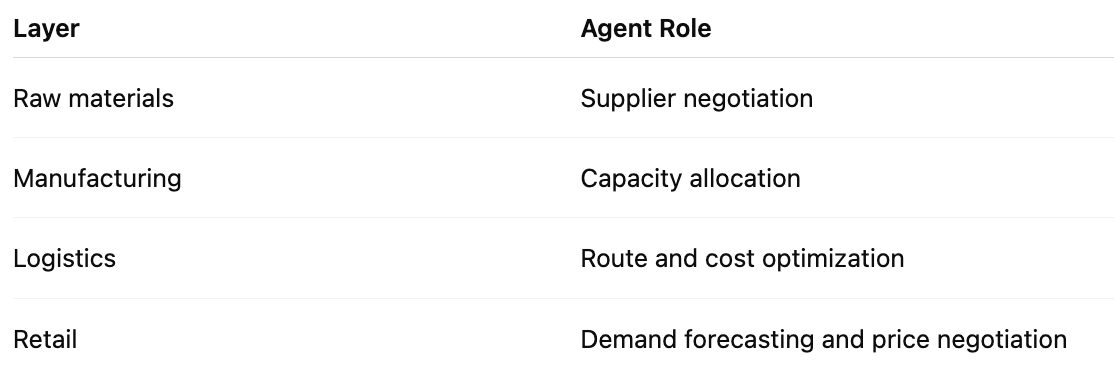
Key innovation: end-to-end autonomous contracting loops
8. Regulatory and Ethical Challenges
8.1 Liability Attribution
Who is responsible when:
An agent commits fraud?
An agent forms illegal price agreements?
8.2 Algorithmic Collusion
Learning agents may discover tacit collusion strategies without explicit coordination.
8.3 Market Fairness
Risks:
Data monopolies
Strategic manipulation by super-intelligent agents
Access inequality between firms
9. Technical Challenges
9.1 Interoperability
Need for:
Standard negotiation languages
Cross-market contract schemas
Shared ontologies
9.2 Scalability
Future markets may involve:
Billions of negotiating agents
Millisecond contract cycles
9.3 Explainability
Regulators and firms require:
Transparent negotiation reasoning
Auditable decision trails
10. Future Research Directions
10.1 Autonomous Market Design
Markets that self-optimize rules via meta-learning.
10.2 Self-Evolving Negotiation Strategies
Agents that invent new negotiation protocols.
10.3 Human-Agent Economic Collaboration
Hybrid decision markets combining human intuition and agent optimization.
10.4 Agent-to-Agent Legal Frameworks
Machine-interpretable law and automated compliance enforcement.
11. Conclusion
Multi-agent commerce represents a structural transition from platform capitalism to protocol-mediated autonomous markets. Negotiation becomes continuous, personalized, and computationally optimized. While economic efficiency gains are likely substantial, risks related to systemic coordination, market fairness, and governance require new interdisciplinary regulatory approaches.
The long-term trajectory suggests a world in which markets operate as self-regulating computational ecosystems, where humans define objectives and ethical boundaries while agents execute economic activity at machine timescales. The central question will not be whether agents can negotiate effectively, but whether societies can design institutions capable of governing machine-driven market intelligence.