
Multi-Agent Smart Home Environments: Orchestrating Commerce Through Voice-Driven Specialized AI Agents
Abstract
The convergence of ambient computing, advanced natural language interfaces, and autonomous multi-agent artificial intelligence is reshaping the architecture of smart home ecosystems. Moving beyond single-assistant paradigms, next-generation smart homes are evolving into distributed cognitive environments in which a central conversational interface—typically voice-driven—coordinates specialized AI commerce agents responsible for subscriptions, grocery procurement, and service management. This essay examines the theoretical foundations, system architectures, economic implications, human-AI interaction challenges, and ethical considerations of such multi-agent smart home environments. It argues that these ecosystems represent a shift from “tool automation” toward “delegated economic agency,” where AI systems act as persistent market participants on behalf of households.
1. Introduction: From Smart Devices to Autonomous Domestic Economies
Early smart home systems focused primarily on device automation: thermostats adjusting temperature, lights responding to occupancy, and speakers responding to voice commands. However, recent advances in:
Large language models and multimodal reasoning
Autonomous agent frameworks
Contextual memory and personalization systems
API-native digital commerce infrastructures
have enabled a transition toward household-scale cognitive orchestration systems.
In this paradigm, the voice assistant no longer performs tasks directly. Instead, it functions as a meta-controller, delegating intent to specialized domain agents:
DomainSpecialized Agent RoleSubscriptionsNegotiates renewals, cancels unused services, price-optimizesGroceriesForecasts consumption, places orders, schedules deliveryServicesBooks maintenance, monitors warranties, schedules recurring services
This multi-agent structure mirrors distributed organizational models seen in corporate operations and economic markets.
2. Theoretical Foundations
2.1 Multi-Agent Systems (MAS)
Multi-agent smart homes build on decades of MAS research, where independent computational entities:
Possess partial autonomy
Share or compete for resources
Coordinate through communication protocols
Optimize local and global utility functions
In smart homes, agents operate as bounded rational economic actors, constrained by user preferences, budgets, and ethical guardrails.
2.2 Ambient Intelligence and Ubiquitous Computing
The smart home environment becomes a persistent computational fabric:
Sensors → environmental state awareness
Personal data → behavioral modeling
Cloud AI → predictive reasoning
Edge AI → real-time execution
The result is a context-aware domestic decision layer.
2.3 Delegated Agency Theory
A novel theoretical lens is Delegated Digital Agency:
Households increasingly outsource micro-economic decisions to AI systems that:
Monitor markets continuously
Negotiate contracts dynamically
Optimize cost, convenience, and sustainability
This transforms households into algorithmically augmented economic units.
3. System Architecture of Multi-Agent Smart Home Commerce
3.1 Layered Architecture Model
Layer 1 — Interaction Layer
Voice interface (primary)
Mobile dashboards (secondary)
Passive sensing (tertiary)
Primary function: Intent capture and disambiguation.
Layer 2 — Orchestration Layer (Meta Assistant)
The voice assistant performs:
Intent decomposition
Agent routing
Conflict resolution
Trust and policy enforcement
Example:
“Make sure we don’t run out of essentials and cut unused subscriptions.”
Triggers:
Grocery agent → consumption forecast + reorder
Subscription agent → usage analytics + cancellation + renegotiation
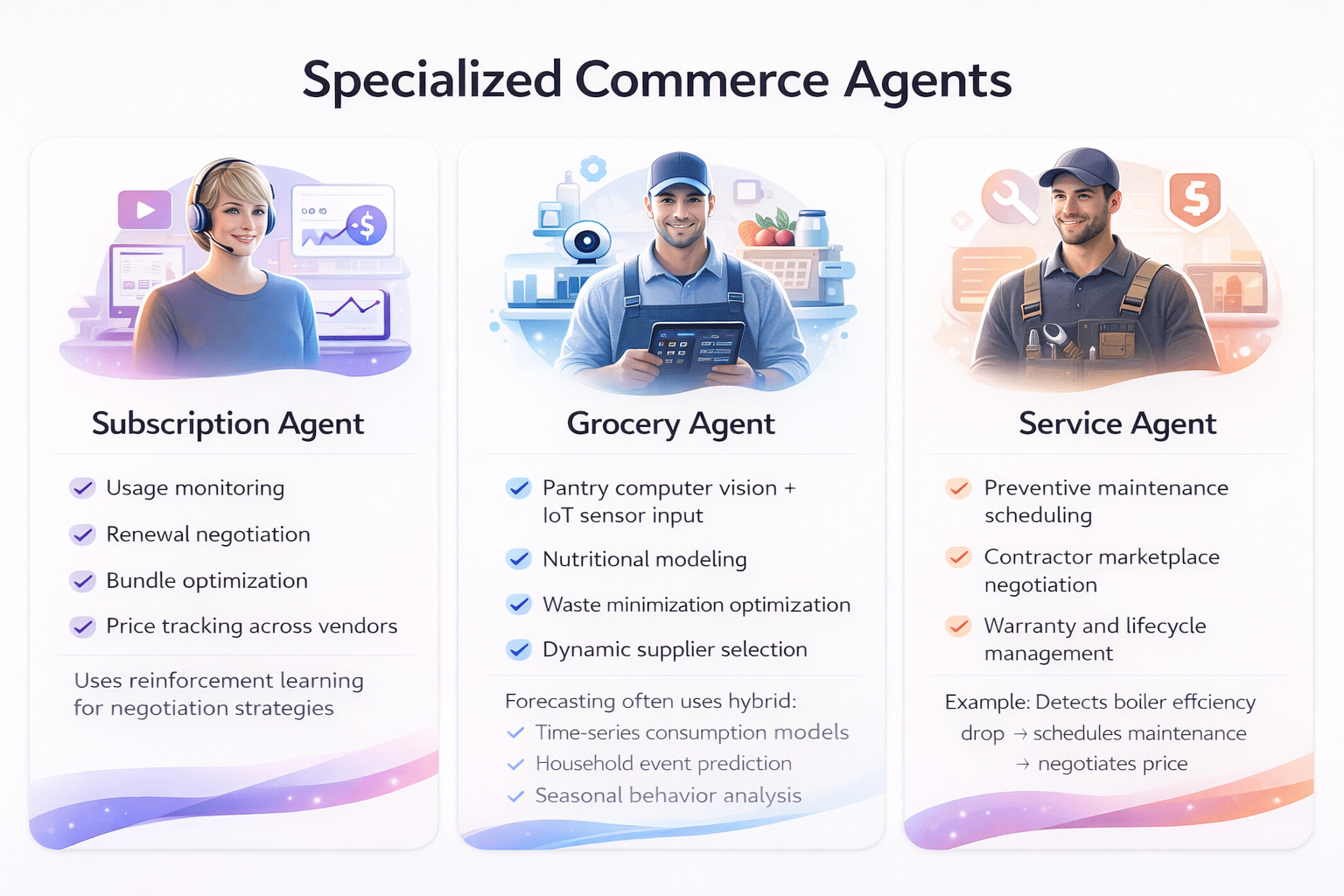
Layer 3 — Specialized Commerce Agents
Subscription Agent
Functions:
Usage monitoring
Renewal negotiation
Bundle optimization
Price tracking across vendors
Uses reinforcement learning for negotiation strategies.
Grocery Agent
Functions:
Pantry computer vision + IoT sensor input
Nutritional modeling
Waste minimization optimization
Dynamic supplier selection
Forecasting often uses hybrid:
Time-series consumption models
Household event prediction
Seasonal behavior analysis
Service Agent
Functions:
Preventive maintenance scheduling
Contractor marketplace negotiation
Warranty and lifecycle management
Example:
Detects boiler efficiency drop → schedules maintenance → negotiates price.
Layer 4 — External Economic Interfaces
Agents interact with:
Retail APIs
Subscription billing systems
Service marketplaces
Financial authorization systems
4. Communication and Coordination Mechanisms
4.1 Agent Communication Protocols
Agents exchange:
Resource forecasts
Budget constraints
Priority signals
Example conflict resolution:
If grocery cost spikes:
Subscription agent reduces discretionary subscriptions
Service agent defers non-urgent maintenance
4.2 Shared Household Knowledge Graph
Central representation includes:
Preferences
Budget constraints
Risk tolerance
Ethical constraints (e.g., sustainability priority)
5. Machine Learning and Decision Models
5.1 Predictive Models
Consumption forecasting
Subscription value estimation
Failure prediction for home infrastructure
5.2 Optimization Models
Multi-objective optimization across:
Cost
Convenience
Sustainability
Health outcomes
5.3 Negotiation AI
Future systems may include:
Market-aware pricing negotiation
Contract optimization
Loyalty exploitation strategies
6. Economic Implications
6.1 Shift Toward Algorithmic Consumerism
Vendors will compete for:
AI agent compatibility
API accessibility
Negotiation friendliness
6.2 Market Effects
Possible outcomes:
Positive
Reduced consumer search costs
Lower waste
Price transparency
Negative
Algorithmic collusion risk
Platform monopolies
Vendor optimization targeting AI biases
7. Human-AI Interaction Challenges
7.1 Trust Calibration
Users must understand:
Why decisions were made
What trade-offs occurred
When override is needed
Explainable AI becomes mandatory.
7.2 Cognitive Offloading Risks
Over-automation may:
Reduce financial awareness
Reduce decision literacy
Increase dependency
8. Security and Privacy
8.1 Attack Surface Expansion
Risks include:
Agent impersonation
Marketplace manipulation
Data poisoning
8.2 Privacy Preservation
Emerging solutions:
Federated learning
On-device behavioral modeling
Differential privacy for household patterns
9. Ethical Considerations
9.1 Autonomy vs Paternalism
Should agents:
Follow user instructions exactly?
Override for health, financial, or environmental benefit?
9.2 Algorithmic Bias in Commerce
Agents must avoid:
Vendor favoritism
Hidden advertising incentives
Data-driven discrimination
10. Future Research Directions
10.1 Household Digital Twins
Simulated environments for:
Economic scenario testing
Consumption optimization
10.2 Collective Agent Negotiation
Neighborhood-level or city-level:
Bulk purchasing
Energy optimization
10.3 Emotional Context Integration
Agents may factor:
Stress
Fatigue
Lifestyle events
into decision timing.
11. Conclusion
Multi-agent smart home commerce ecosystems represent a fundamental transformation in how households interact with markets. Rather than acting as passive consumers issuing individual purchase decisions, households become continuously optimized economic entities, mediated by networks of specialized AI agents operating under a unified conversational interface.
The voice assistant becomes not merely a convenience layer but a domestic chief operating system, coordinating digital labor across commerce, logistics, and services. While the technological trajectory suggests immense efficiency gains and quality-of-life improvements, it simultaneously introduces profound questions around autonomy, trust, market power, and digital agency governance.
The ultimate success of multi-agent smart home environments will depend not only on technical sophistication but also on transparent governance, robust security architectures, and human-centered design principles that preserve user sovereignty in an increasingly automated domestic economy.