
Multi-Agent Commerce in an Era of Global Tariffs, Economic Conflict, and Kinetic Warfare
Abstract
The convergence of artificial intelligence (AI), geopolitical fragmentation, and economic securitization is reshaping global commerce. Multi-agent commerce systems—networks of autonomous AI agents coordinating procurement, logistics, pricing, compliance, and market strategy—are emerging as critical infrastructure for firms navigating tariff regimes, sanctions, supply chain disruptions, and active military conflicts. This essay examines the theoretical foundations, technical architectures, economic implications, and geopolitical risks of multi-agent commerce under conditions of tariff escalation, economic warfare, and conventional armed conflict. It argues that multi-agent commerce will transition from efficiency optimization to resilience maximization, fundamentally altering how global trade networks are organized and governed.
1. Introduction: From Globalization to Fragmented Interdependence
The late 20th and early 21st centuries were defined by hyper-globalization: supply chains optimized for cost, just-in-time inventory, and centralized decision intelligence. However, three overlapping forces have disrupted this paradigm:
Tariff proliferation and trade blocs
Economic warfare (sanctions, export controls, financial exclusion)
Hot conflicts affecting trade corridors and production zones
Traditional enterprise systems cannot respond fast enough to multi-variable shocks across jurisdictions. Multi-agent commerce systems emerge as a computational response to geopolitical complexity, enabling distributed, adaptive, and semi-autonomous economic decision-making.
2. Defining Multi-Agent Commerce
Multi-agent commerce refers to distributed AI agents representing different commercial functions or stakeholders, interacting through negotiated protocols to optimize outcomes under constraints.
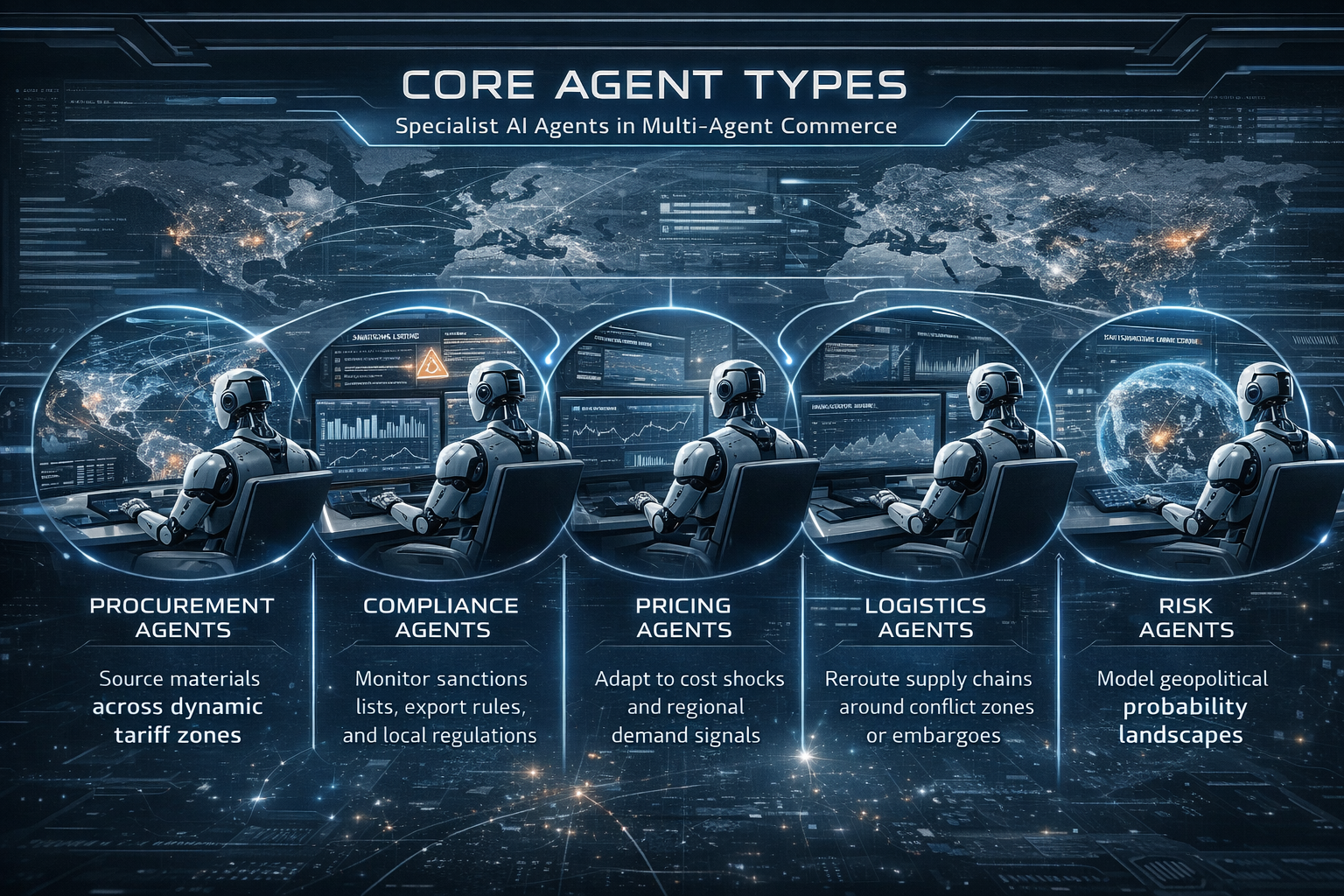
2.1 Core Agent Types
Procurement agents — source materials across dynamic tariff zones
Compliance agents — monitor sanctions lists, export rules, and local regulations
Pricing agents — adapt to cost shocks and regional demand signals
Logistics agents — reroute supply chains around conflict zones or embargoes
Risk agents — model geopolitical probability landscapes
Unlike monolithic ERP systems, multi-agent commerce is:
Decentralized
Self-negotiating
Event-reactive
Scenario-simulating
3. Theoretical Foundations
3.1 Complex Adaptive Systems
Global commerce resembles an ecological system. Multi-agent frameworks mirror biological distributed intelligence (e.g., ant colony optimization), allowing emergent equilibrium under volatile conditions.
3.2 Mechanism Design and Game Theory
Agents must operate under conflicting incentives:
Firms vs regulators
Exporters vs importers
Allies vs adversaries
Auction theory, Nash equilibria, and contract theory are embedded into agent negotiation layers.
3.3 Information Asymmetry Reduction
Multi-agent systems reduce latency between signal detection (e.g., tariff change) and economic response (e.g., supplier shift), compressing decision cycles from weeks to minutes.
4. Tariffs as Machine-Readable Economic Terrain
Historically, tariffs were static policy artifacts. In multi-agent commerce, tariffs become dynamic machine-interpreted constraints.
4.1 Real-Time Tariff Arbitrage
Agents continuously:
Compare landed cost across jurisdictions
Simulate tariff scenario forecasts
Shift sourcing micro-incrementally
4.2 Tariff Cascades
Tariffs in one sector propagate across supply chains. Agents can model second- and third-order effects faster than human trade analysts.
4.3 Digital Customs Negotiation
Future customs clearance may involve:
Agent → Customs AI → Port logistics AI negotiation loops.
5. Economic Warfare and Algorithmic Trade Strategy
Economic warfare introduces non-linear constraints:
Sudden sanctions
Entity blacklisting
Technology export bans
Financial network exclusions
5.1 Autonomous Compliance Enforcement
Compliance agents can:
Instantly freeze transactions with restricted entities
Rebuild supplier networks within minutes
Generate audit trails for regulators
5.2 Sanctions Evasion Detection (and Counter-Detection)
State actors will deploy competing agent systems:
Enforcement AI
Evasion AI
Attribution AI
This creates an algorithmic economic arms race.
6. Multi-Agent Commerce During Active War
When physical conflict disrupts infrastructure, multi-agent systems shift from cost optimization to survival optimization.
6.1 Dynamic Supply Chain Rerouting
Agents integrate:
Satellite data
Insurance risk feeds
Military conflict mapping
Energy price volatility
6.2 Production Migration Automation
Factories may become “digitally portable”:
Agents coordinate:
Equipment relocation
Workforce contracting
Local compliance onboarding
6.3 Strategic Stockpile Optimization
Rather than static reserves, agents maintain rolling strategic inventories based on probabilistic conflict models.
7. Corporate Sovereignty and the Rise of AI Trade Diplomacy
Large corporations may effectively operate as AI-mediated quasi-states:
Negotiating tariff classifications
Structuring cross-border value chains
Influencing local industrial policy
Multi-agent commerce could lead to:
Corporate-state hybrid negotiation protocols
Automated trade dispute simulation
Algorithmic treaty impact modeling
8. Risks and Failure Modes
8.1 Algorithmic Escalation
If national trade AIs optimize aggressively, they could trigger:
Rapid tariff retaliation spirals
Supply chain weaponization
Financial market flash collapses
8.2 Data Weaponization
Agents rely on data streams vulnerable to:
Disinformation injection
Market signal spoofing
Synthetic economic intelligence
8.3 Concentration Risk
If only major powers and mega-firms deploy advanced systems, smaller economies become structurally dependent.
9. Governance and Regulatory Futures
Potential regulatory frameworks include:
9.1 AI Trade Transparency Standards
Mandating:
Decision explainability
Audit logs
Compliance traceability
9.2 Multi-National Agent Protocol Agreements
Equivalent to air traffic control rules — but for trade algorithms.
9.3 Digital Geneva Conventions for Economic AI
Potential limits on:
Civilian supply chain targeting
Food and medicine algorithmic blockades
10. Future Trajectories (2026–2040)
Near Term (0–5 years)
Enterprise multi-agent orchestration platforms
Automated tariff intelligence feeds
AI compliance co-pilots
Mid Term (5–10 years)
Autonomous cross-border contracting agents
AI-mediated trade negotiations
Real-time global supply chain digital twins
Long Term (10–20 years)
National economic AI coordination layers
Autonomous global trade equilibrium systems
Machine-negotiated tariff treaties
Conclusion
Multi-agent commerce represents a structural evolution of global trade governance from human-paced bureaucracy to machine-paced adaptive networks. In an era defined by tariffs, economic warfare, and kinetic conflict, competitive advantage will shift from lowest cost production to highest adaptive intelligence.
The central paradox is that while multi-agent commerce can stabilize trade under extreme volatility, it may also accelerate geopolitical economic competition into algorithmic escalation cycles. The future of global commerce may therefore depend less on individual corporate strategy and more on how states, corporations, and international institutions coordinate the rules governing autonomous economic agents