
Multi-Agent Commerce in Financial Services: Architectures, Control Loops, and Emergent Decision Economies
Multi-agent commerce represents a paradigm shift in financial services where distributed, specialized AI agents collaboratively execute complex economic workflows across banking, lending, and wealth management ecosystems. Unlike traditional rule-based automation or single-model decision systems, multi-agent financial orchestration enables continuous negotiation between regulatory constraints, risk evaluation, customer intent inference, and product optimization. This essay examines the architectural topology, complexity drivers, agent graph dynamics, and non-linear decision paths of multi-agent commerce in financial services, proposing a control-theoretic and socio-technical framework for safe deployment at scale.
1. Introduction: From Linear Pipelines to Economic Agent Networks
Financial services decision-making has historically been hierarchical, document-driven, and human approval–gated. However, increasing regulatory pressure, real-time fraud threats, and hyper-personalized financial product expectations have exceeded the capacity of linear automation.
Multi-agent commerce introduces:
Distributed cognition across specialized agents
Continuous feedback loops instead of stage-gate approvals
Dynamic negotiation between risk, compliance, and customer value
Event-driven rather than application-driven financial flows
The shift is not merely technical but institutional, redefining how trust, liability, and authority are encoded in software.
2. Primary Complexity Drivers in Financial Multi-Agent Systems
2.1 Regulatory Compliance as a Real-Time Constraint Field
Financial regulation is not static validation — it is contextual constraint enforcement across time, jurisdiction, and product class.
Multi-agent systems must simultaneously evaluate:
Jurisdictional regulatory overlays
Customer risk class changes
Transaction pattern evolution
Product-specific regulatory logic
This transforms compliance from a checkpoint into a continuous control signal inside the agent graph.
2.2 Risk Scoring Feedback Loops
Traditional credit scoring is episodic. Multi-agent commerce introduces:
Streaming behavioral signals
Continuous fraud surface evaluation
Adaptive credit limit modeling
Real-time affordability recomputation
Risk becomes a state variable, not a pre-transaction gate.
2.3 Multi-Party Approval Graphs
Financial decisions often require simultaneous approval from:
Risk
Compliance
Product policy
Capital allocation models
Sometimes external counterparties
Multi-agent orchestration replaces static approval chains with consensus graphs.
2.4 Long Decision Cycles with Event Re-Entry
Mortgages, structured lending, and wealth transitions may span months or years. Agents must support:
Decision pause/resume
Context persistence across life events
Re-underwriting triggered by external signals
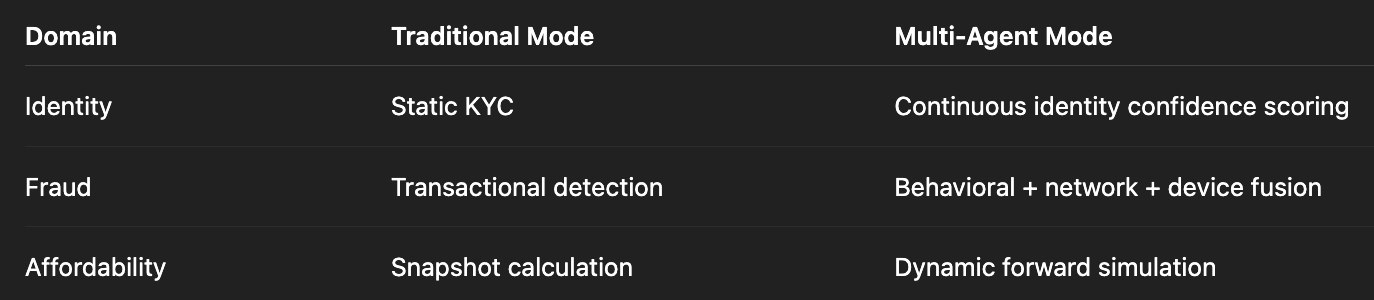
2.5 Identity–Fraud–Affordability Coupling
These dimensions are traditionally siloed but become tightly linked:
3. Canonical Agent Graph Architecture
Discovery
  ↓
Financial Profiling
  ↓
Risk + Compliance Validation
  ↓
Offer Structuring
  ↓
Transaction Execution
  ↓
Lifecycle Support + Advisory
This graph is conceptual, not strictly sequential. In production, edges are bidirectional and state-aware.
4. Expanded Agent Set: Functional Deep Dive
4.1 Customer Intent Agent
Core Capabilities
Latent financial goal inference
Life-event signal interpretation
Stress vs opportunity classification
Research Frontier
Probabilistic intent modeling using temporal behavior embeddings and macroeconomic context injection.
4.2 Financial Profile Agent
Constructs
Income stochastic modeling
Cash flow forward simulation
Debt capacity stress testing
Key Innovation
Moves from static affordability to scenario-space solvency envelopes.
4.3 Risk Agent
Multi-Modal Inputs
Bureau data
Behavioral telemetry
Network graph risk
Device fingerprinting
Emerging Direction
Risk as a continuously updated posterior probability distribution, not a score.
4.4 Compliance Agent
Operational Domains
KYC identity verification
AML transaction monitoring
Sanctions list matching
Product suitability enforcement
Hard Problem
Explaining probabilistic compliance decisions to regulators and auditors.
4.5 Offer Structuring Agent
Optimization Surface
Price elasticity
Default probability curve
Customer lifetime value
Capital efficiency
Mathematical Framing
Multi-objective constrained optimization under regulatory boundary conditions.
4.6 Lifecycle Advisory Agent
Continuous Responsibilities
Refinance opportunity detection
Portfolio rebalance triggers
Financial stress early warning
Cross-product migration pathways
This agent transforms financial services from transactional to relationship-computational.
5. Non-Linear Execution Paths
5.1 Stress Trigger Path
Support → Financial Profiling → Offer Structuring → TransactionTriggered by:
Income shock detection
Overdraft cascade signals
Behavioral financial distress markers
Here, customer preservation overrides revenue optimization.
5.2 Regulatory Intervention Path
Transaction → Compliance → Validation → TransactionTriggered by:
Suspicious transaction patterns
Jurisdictional threshold breaches
Sanctions list updates
This requires transaction suspension with reversible execution states.
6. Control Theory Perspective
Multi-agent finance systems resemble distributed adaptive control systems with:
State observers (profiling agents)
Constraint enforcers (compliance agents)
Optimization controllers (offer agents)
Stability monitors (risk agents)
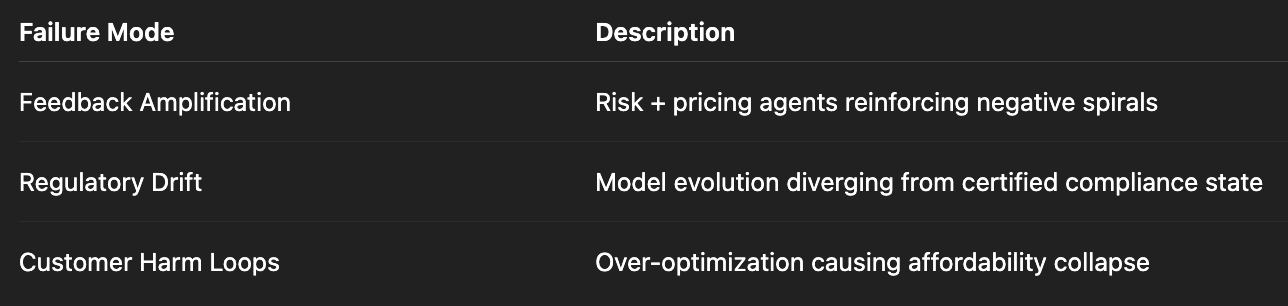
Key Stability Risks:
7. Governance and Safety Framework
7.1 Agent Explainability Requirements
Each agent must expose:
Decision provenance
Feature influence mapping
Counterfactual explanation capability
7.2 Simulation Sandboxes
Before deployment:
Synthetic population testing
Regulatory scenario stress testing
Black swan liquidity simulations
7.3 Human-in-the-Loop Design
Humans shift from decision-makers to:
Boundary condition setters
Exception adjudicators
Ethical escalation authorities
8. Economic Implications
8.1 Financial Products Become Dynamic Services
Interest rates, limits, and terms become continuously personalized streams.
8.2 Collapse of Product Silos
Loans, insurance, and investments converge into financial state management platforms.
8.3 Emergence of Autonomous Financial Negotiation
Agents will negotiate:
Between institutions
Between customer and institution
Between regulatory frameworks
9. Open Research Questions
How to formally verify compliance in self-modifying agent systems?
How to prevent emergent bias across interacting agent learning loops?
How to allocate liability in distributed autonomous financial decisions?
Can multi-agent financial systems be made regulator-observable in real time?
10. Conclusion
Multi-agent commerce in financial services represents a shift from process automation to economic cognition infrastructure. The key challenge is not technical feasibility but institutional trust encoding — embedding law, ethics, and systemic stability into continuously learning, distributed decision networks.
The future financial institution will not be a system of record — it will be a system of negotiated financial reality, mediated by interacting intelligent agents operating under dynamic regulatory and economic constraints.