
Introduction to Multi-Agent Commerce
Multi-Agent Commerce is an emerging paradigm where multiple autonomous or semi-autonomous AI agents collaborate to execute commercial activities on behalf of users, businesses, or platforms. Instead of a single system handling discovery, negotiation, purchase, and fulfillment, responsibility is distributed across specialized agents that coordinate through structured protocols.
This model is becoming increasingly relevant as digital commerce grows more complex. Consumers interact across channels, pricing changes dynamically, supply chains are multi-tiered, and regulatory requirements vary by region. Multi-agent architectures enable systems to adapt to this complexity by dividing intelligence into layers and roles.
At a high level, Multi-Agent Commerce typically operates across four foundational layers:
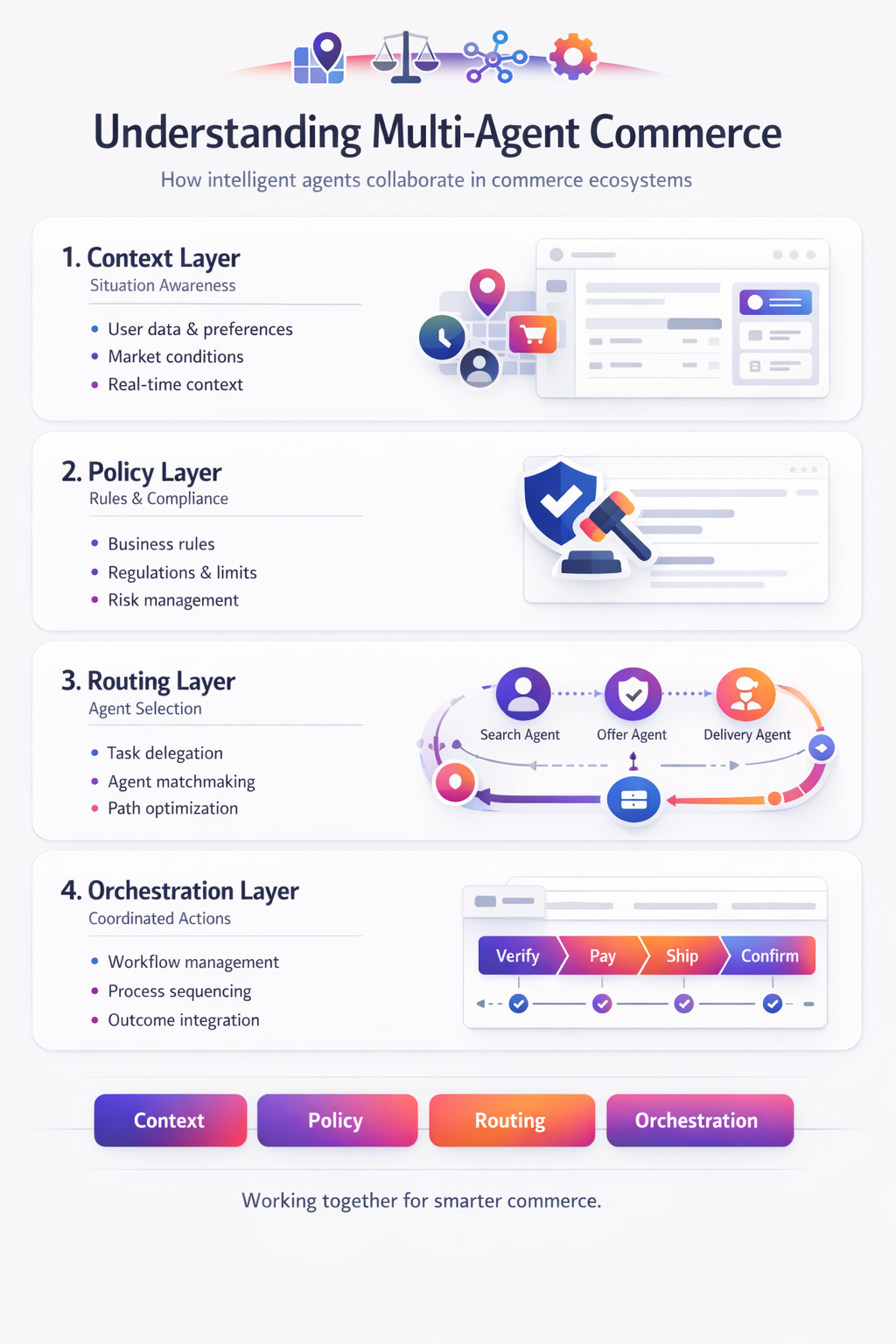
Context Layer
Policy Layer
Routing Layer
Orchestration Layer
Together, these layers allow agent ecosystems to act intelligently, safely, and efficiently in real-world commercial environments.
1. Context Layer
The Context Layer provides the situational awareness required for agents to make meaningful decisions. It answers the question: What is happening right now, and what matters?
Key Functions
User intent understanding
Environmental awareness (location, time, device, channel)
Historical behavior and preferences
Market and inventory state
Session continuity across touchpoints
Example in Commerce
A shopping agent may need to know:
The user’s past purchases
Current budget constraints
Delivery urgency
Loyalty memberships
Current promotions
Without context, agent decisions are generic. With context, they become personalized and situationally optimized.
Design Considerations
Real-time data freshness
Privacy boundaries and consent
Cross-platform identity resolution
Context decay (what expires and when)
The Context Layer is essentially the perception system of Multi-Agent Commerce.
2. Policy Layer
The Policy Layer defines what agents are allowed to do and how they should behave. It acts as the governance and compliance framework.
Key Functions
Business rules enforcement
Regulatory compliance
Risk thresholds
Ethical and brand constraints
Permission boundaries between agents
Example in Commerce
Policies may include:
Maximum discount an agent can negotiate
Geographic restrictions on product sales
Age or identity verification requirements
Payment authorization limits
Fraud risk scoring thresholds
Policy Types
Hard Policies
Must never be violated (e.g., legal compliance)
Soft Policies
Preferences or optimization goals (e.g., prefer eco-friendly shipping)
Dynamic Policies
Change based on market conditions or risk level
The Policy Layer is the immune system and legal framework of the ecosystem.
3. Routing Layer
The Routing Layer determines which agent (or service) should handle a task and how requests move through the system.
Key Functions
Agent selection
Capability matching
Load balancing
Cost optimization
Failover and redundancy
Example in Commerce
When a user says:
“Find me the best price on noise-cancelling headphones and deliver by tomorrow.”
Routing may:
Send discovery to a search agent
Send price negotiation to a marketplace bidding agent
Send logistics feasibility to a delivery optimization agent
Send payment preparation to a wallet agent
Routing Strategies
Capability-based routing
Cost-aware routing
Latency-aware routing
Trust-weighted routing
Routing ensures the system behaves like a specialized workforce, not a single monolithic brain.
4. Orchestration Layer
The Orchestration Layer coordinates how agents work together over time to complete multi-step commercial workflows.
If routing decides who does each step, orchestration decides when, in what order, and with what dependencies.
Key Functions
Workflow management
State tracking
Conflict resolution
Transaction integrity
Exception handling
Example in Commerce
For a complex purchase, orchestration might:
Validate user identity
Reserve inventory
Lock negotiated price
Execute payment
Confirm shipment
Update loyalty rewards
Trigger post-purchase support agents
Orchestration Models
Centralized orchestrator (single workflow brain)
Distributed orchestration (agents coordinate peer-to-peer)
Event-driven orchestration (reacts to state changes)
The Orchestration Layer is the conductor of the agent orchestra.
How the Layers Work Together
In a mature Multi-Agent Commerce system:
LayerRoleContextUnderstands the situationPolicyDefines allowed behaviorRoutingChooses the right agentsOrchestrationCoordinates execution
A simplified flow looks like:
User Intent → Context → Policy Validation → Routing → Orchestration → Outcome
Why Multi-Agent Commerce Matters
For Consumers
Hyper-personalized purchasing
Automated comparison and negotiation
Reduced cognitive load
Faster transactions
For Businesses
Modular commerce infrastructure
Faster experimentation
Improved risk control
Scalable automation
For Marketplaces
Dynamic supply/demand balancing
Automated partner coordination
Real-time pricing ecosystems
Future Outlook
As agent capabilities mature, we will likely see:
Autonomous procurement agents for enterprises
Consumer “personal CFO” agents
Supply chains negotiated entirely agent-to-agent
Real-time dynamic regulatory compliance
Cross-platform commerce without traditional checkout flows
The long-term vision is intent-driven commerce, where humans express goals and agent ecosystems execute them safely and efficiently.
Conclusion
Multi-Agent Commerce represents a shift from application-centric commerce to ecosystem-centric commerce, where networks of specialized AI agents collaborate under shared context, governed by policies, directed by routing, and synchronized through orchestration.
Organizations that master these four layers will be positioned to build adaptive, resilient, and intelligent commerce systems capable of operating in increasingly dynamic digital economies.