
Red Cloud's Commerce Intelligence Flywheel
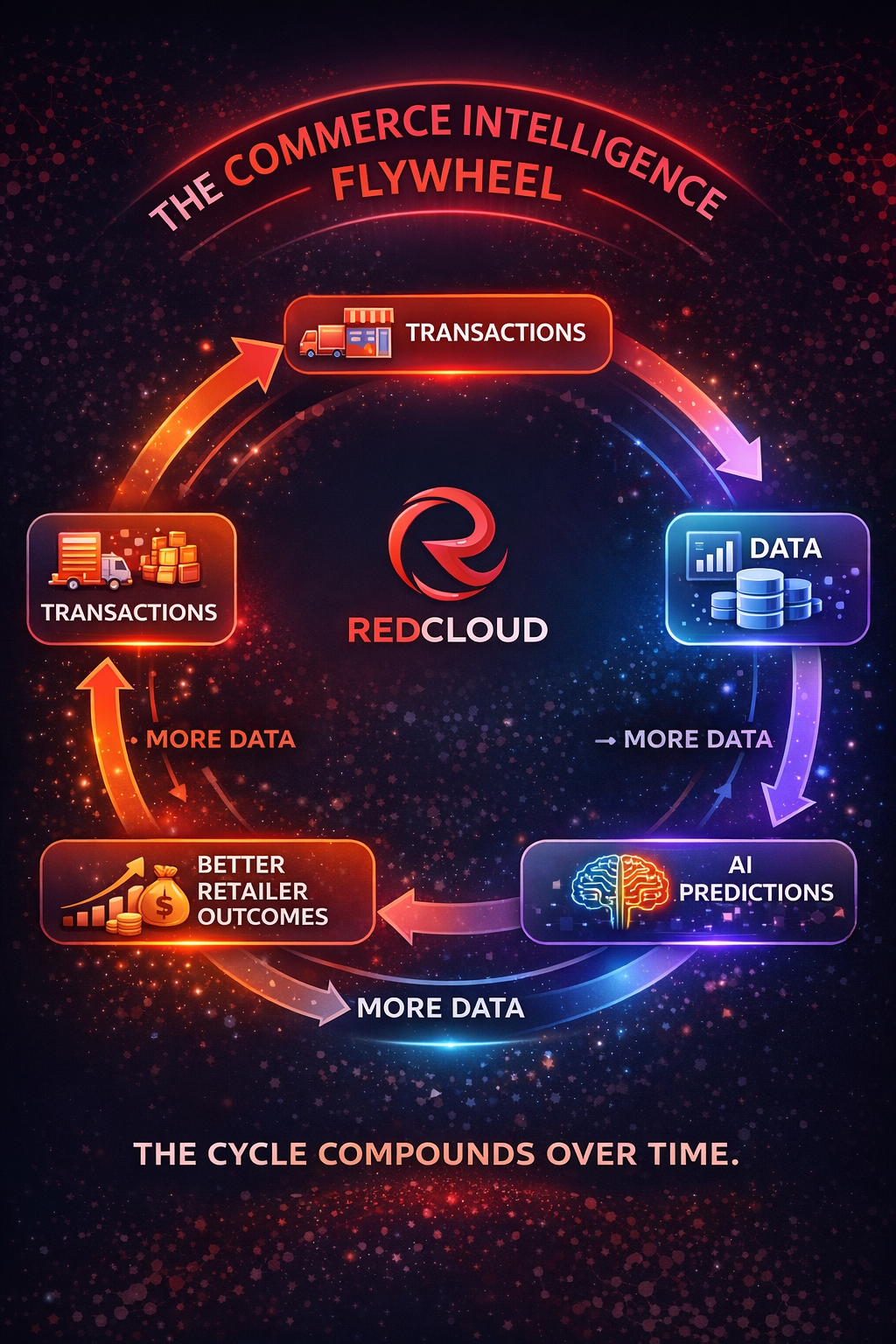
At its core, RedCloud is not just a marketplace. It’s building an AI intelligence layer that predicts and optimizes retailer decisions, making retailers more profitable — while making RedCloud more valuable and defensible. The model works in five reinforcing steps:
Step 1: Retailers transact on the platform → Data is generated
Every order creates valuable behavioral data:
What retailers buy
How often they buy
How much they buy
When they reorder
What sells fast vs slow
This is real economic behavior — the most valuable kind of data.
This data is proprietary and compounds over time. Red Cloud Intervew Q&A 2
Step 2: AI analyzes this data → Generates predictions
RedCloud uses AI to predict things like:
What each retailer should order
When they should reorder
How much they should order
Which products will sell fastest
Which retailers are high or low credit risk
This turns raw transaction data into actionable intelligence. Red Cloud Interview Prep 2
Step 3: AI improves retailer decisions → Retailers make more money
Better predictions help retailers:
Avoid stockouts (lost revenue)
Avoid overstock (wasted capital)
Sell more consistently
Increase profits
Reduce risk
Retailers become more successful because of RedCloud.
This is critical.
Step 4: Retailers rely more on RedCloud → More transactions occur
Because RedCloud helps retailers earn more, retailers:
Use the platform more often
Place more orders
Place larger orders
Stay longer (higher retention)
This increases RedCloud’s:
GMV (Gross Merchandise Volume)
Revenue
Market dominance
Step 5: More transactions → More data → Better AI
More usage generates more data.
More data improves predictions.
Better predictions improve retailer outcomes even further.
This creates a powerful reinforcing loop.
This is the flywheel.
Why this business model is extremely powerful
Most companies sell products.
RedCloud builds intelligence.
Intelligence improves with data.
Data grows automatically as the platform scales.
This creates three major advantages:
1. Revenue grows automatically with better predictions
Revenue increases because:
Retailers order more often
Retailers order more per transaction
Retailers stay longer
Even small prediction improvements create massive revenue impact. Red Cloud Intervew Q&A 2
2. Strong network effects
More retailers → more data → better predictions → better outcomes → attracts more retailers
Competitors without this data cannot catch up easily.
This creates a moat.
3. High switching costs
Retailers rely on RedCloud’s intelligence to run their business.
Leaving RedCloud means losing:
Demand predictions
Ordering optimization
Credit access
Operational insights
RedCloud becomes essential infrastructure.
What RedCloud is really selling
Not just products.
Not just marketplace access.
RedCloud is selling:
Better business decisions powered by AI
This is far more valuable.