
The Predictive Intelligence Flywheel: A Generalized Business Model for Compounding Economic Advantage Through Data, Prediction, and AI
A new class of firms has emerged whose primary competitive advantage does not derive from physical assets, proprietary algorithms alone, or traditional network effects, but from the compounding interaction between behavioral data, predictive modeling, and economic optimization. This essay formalizes this architecture as the Predictive Intelligence Flywheel (PIF), a generalized, sector-agnostic business model in which firms continuously collect behavioral data, convert it into predictive intelligence through machine learning systems, deploy predictions to optimize decisions, and thereby improve economic outcomes for users and the platform itself. These improved outcomes increase usage, generating additional behavioral data and reinforcing the cycle. This creates a compounding, self-reinforcing system that produces increasing returns to scale, durable competitive moats, and structural economic defensibility. Using RedCloud as a primary example, and extending across sectors including finance, logistics, healthcare, manufacturing, and software platforms, this essay demonstrates that the Predictive Intelligence Flywheel is rapidly becoming the dominant architecture for value creation in the AI economy.
I. Introduction: From Software Platforms to Intelligence Platforms
Historically, firms created value by producing goods, delivering services, or enabling transactions. In the digital era, platform companies created value by facilitating interactions between participants, generating network effects. However, the Predictive Intelligence Flywheel represents a further evolutionary step: firms no longer merely facilitate transactions—they optimize them.
In this model, the firm becomes an intelligence layer embedded in economic activity. It continuously observes behavioral data, predicts future outcomes, and influences decisions in ways that improve efficiency, profitability, and risk management.
The core shift is conceptual:
Traditional firms execute decisions.
Predictive Intelligence Flywheel firms improve decisions.
This distinction is economically profound. Decision quality directly determines economic efficiency. Firms that systematically improve decisions across millions of actors can capture enormous economic surplus.
II. Formal Definition of the Predictive Intelligence Flywheel
The Predictive Intelligence Flywheel is a self-reinforcing system consisting of five core stages:
Behavioral Data Generation
Predictive Modeling
Decision Optimization
Economic Value Creation
Increased Platform Dependence and Data Generation
This forms a continuous feedback loop:
Data → Prediction → Decision → Outcome → More Data
Each iteration strengthens prediction accuracy and economic value.
III. The Mathematical and Economic Structure
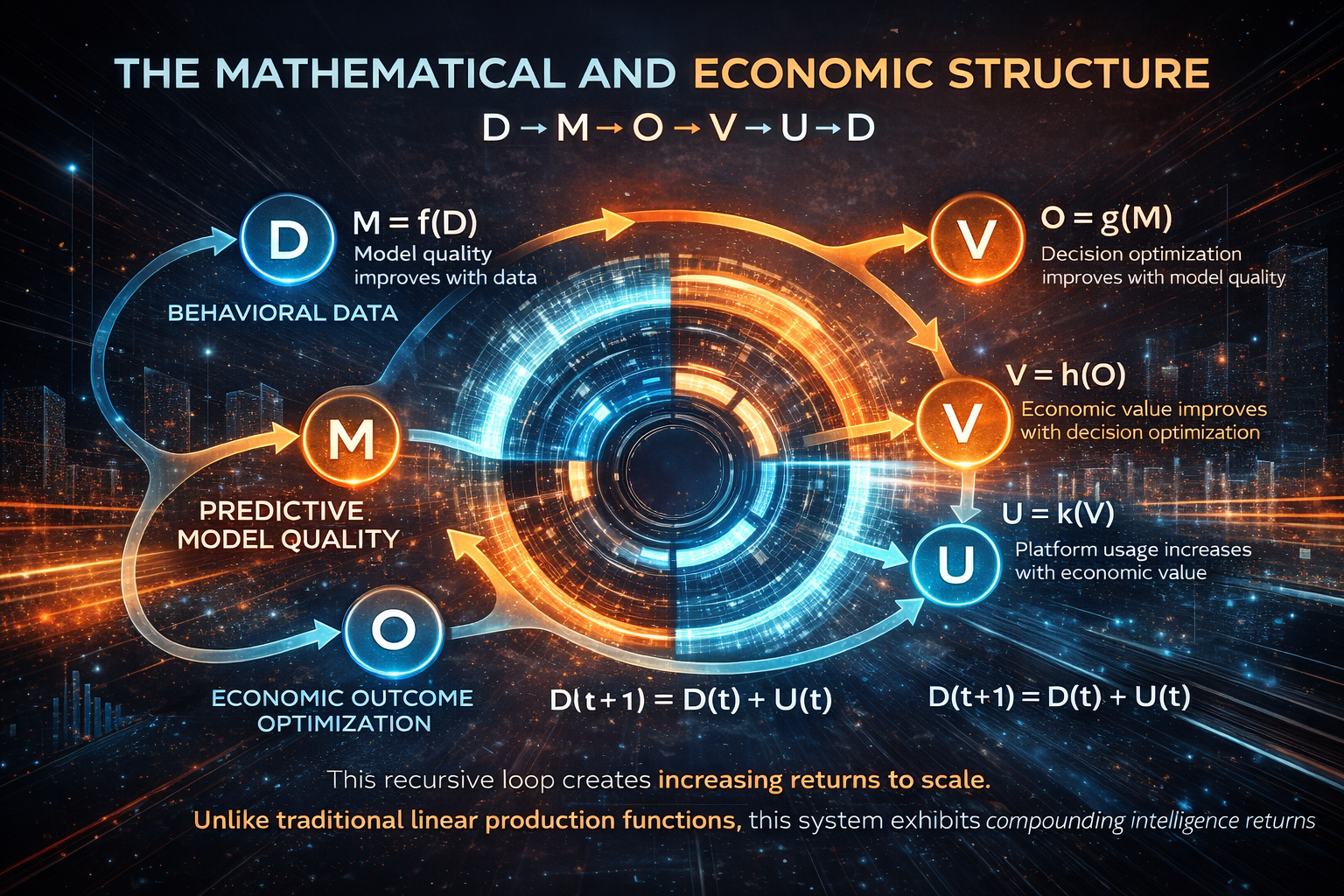
Let:
D represent behavioral data
M represent predictive model quality
O represent economic outcome optimization
U represent platform usage
V represent economic value captured by the platform
The flywheel evolves according to the following functional relationships:
Model quality improves with data:
M = f(D)
Decision optimization improves with model quality:
O = g(M)
Economic value improves with decision optimization:
V = h(O)
Platform usage increases with economic value:
U = k(V)
Data increases with platform usage:
D(t+1) = D(t) + U(t)
Substituting recursively produces:
D → M → O → V → U → D
This recursive loop creates increasing returns to scale.
Unlike traditional linear production functions, this system exhibits compounding intelligence returns.
IV. RedCloud as a Canonical Example
RedCloud operates a commerce platform connecting informal retailers with suppliers. Traditionally, retailers order inventory based on intuition, incomplete information, or simple heuristics. This produces inefficiencies including stockouts, overstocking, and suboptimal capital allocation.
RedCloud collects behavioral transaction data, including:
Order frequency
SKU demand patterns
Basket composition
Payment and credit behavior
Using machine learning models, RedCloud predicts:
What retailers will order
When they will order
How much they will order
Their credit risk
These predictions enable intelligent ordering recommendations.
Retailers experience improved economic outcomes:
Increased sales
Reduced stockouts
Improved capital efficiency
These improved outcomes increase retailer dependence on the platform, generating more transaction data.
This strengthens model performance and reinforces the flywheel.
This system transforms RedCloud from a transaction platform into an intelligence platform.
V. Generalization Across Sectors
The Predictive Intelligence Flywheel is not specific to commerce. It is a generalizable economic architecture.
A. Finance: Visa, Mastercard, and Stripe
Payment networks observe transaction behavior across millions of merchants.
They predict:
Fraud risk
Creditworthiness
Transaction anomalies
Improved fraud detection reduces financial losses.
Reduced losses increase platform trust and adoption.
More transactions generate more behavioral data.
This improves prediction accuracy.
Stripe exemplifies this architecture through its fraud detection system Radar, which improves continuously through network-wide data.
B. Transportation and Logistics: Uber
Uber collects real-time data on:
Rider demand
Driver availability
Geographic movement patterns
Machine learning models predict:
Demand surges
Optimal pricing
Optimal driver allocation
This improves system efficiency.
Shorter wait times increase user satisfaction.
Increased usage generates more data.
This strengthens prediction quality.
Uber becomes increasingly efficient with scale.
C. Manufacturing: Tesla
Tesla vehicles continuously generate telemetry data including:
Driver behavior
Road conditions
Vehicle performance
Tesla uses this data to improve autonomous driving models.
Improved autonomy increases vehicle safety and usability.
More vehicles generate more data.
This strengthens Tesla’s predictive capabilities.
This creates a self-reinforcing intelligence advantage over competitors.
D. Healthcare: Precision Medicine Platforms
Healthcare platforms collect patient data including:
Diagnostic imaging
Genetic data
Treatment outcomes
Machine learning models predict optimal treatment strategies.
Improved treatment outcomes increase adoption.
More patient data improves model accuracy.
This accelerates medical advancement.
E. Software Platforms: Amazon
Amazon collects behavioral data including:
Search queries
Purchase behavior
Click behavior
Amazon predicts:
Product demand
Customer preferences
Inventory allocation
This improves recommendation accuracy.
Improved recommendations increase purchases.
More purchases generate more data.
This strengthens Amazon’s predictive advantage.
VI. Economic Implications: Increasing Returns to Intelligence
Traditional industries exhibit diminishing returns to scale.
Factories eventually saturate capacity.
Labor productivity plateaus.
However, Predictive Intelligence Flywheel firms exhibit increasing returns to intelligence.
More scale produces better predictions.
Better predictions produce better economic outcomes.
Better outcomes produce more scale.
This creates superlinear growth dynamics.
This explains the extreme dominance of AI-native firms.
VII. Defensibility and Competitive Moats
The Predictive Intelligence Flywheel creates several forms of defensibility:
1. Data Network Effects
Prediction accuracy improves with proprietary behavioral data.
Competitors cannot replicate historical behavioral data.
This creates structural barriers to entry.
2. Switching Costs
Users become economically dependent on predictive insights.
Switching reduces decision quality.
This creates economic lock-in.
3. Model Advantage Compounding
Models improve continuously.
Competitors starting later face structural disadvantages.
This creates compounding intelligence asymmetry.
4. Integration into Economic Workflows
The platform becomes embedded in operational decision-making.
This creates operational dependence.
VIII. Transition from Transaction Platforms to Decision Platforms
Traditional platforms facilitate transactions.
Predictive Intelligence Flywheel firms optimize decisions.
This distinction is critical.
Decision quality determines economic efficiency.
Firms that systematically improve decisions capture increasing economic value.
The firm becomes not merely infrastructure, but intelligence infrastructure.
IX. Organizational and Technical Requirements
Successful implementation requires several architectural components:
Unified behavioral data infrastructure
Feature stores capturing behavioral signals
Machine learning training pipelines
Prediction services
Continuous feedback loops
These components enable continuous intelligence improvement.
X. Long-Term Evolution: Autonomous Economic Systems
The ultimate evolution of the Predictive Intelligence Flywheel is autonomous optimization.
Systems will continuously:
Observe behavior
Predict outcomes
Optimize decisions
Learn from results
This produces self-optimizing economic systems.
Human decision-making becomes increasingly augmented or replaced by machine intelligence.
XI. Macroeconomic Implications
The Predictive Intelligence Flywheel fundamentally restructures competitive dynamics.
Economic advantage shifts from asset ownership to intelligence ownership.
Firms with superior behavioral data and predictive systems dominate markets.
This creates winner-take-most market structures.
This explains the dominance of firms such as Amazon, Google, Tesla, and emerging firms like RedCloud.
XII. Conclusion
The Predictive Intelligence Flywheel represents a new generalized business model in which economic value is created through continuous improvement of decision quality via behavioral data and machine learning.
Unlike traditional firms, which scale through physical assets or labor, Predictive Intelligence Flywheel firms scale through intelligence accumulation.
This creates increasing returns to scale, durable competitive moats, and structural economic advantage.
RedCloud exemplifies this architecture in commerce, just as Tesla does in transportation, Stripe in finance, and Amazon in retail.
The Predictive Intelligence Flywheel is not merely a technological innovation.
It is a new economic architecture.
It represents the dominant form of value creation in the intelligence economy.