
Moltbook: What It Is — And Why So Many People Are Talking About It
Over the past few days, a new online phenomenon called Moltbook has been trending across tech media and social platforms. Some stories describe it as a fascinating experiment in AI collaboration — others spin it into sci-fi scenarios about machines turning on humans. Here’s a clear, fact-based explanation, with full URLs, aimed at debunking myths and grounding the discussion in what the evidence actually shows.
What Is Moltbook?
Moltbook is a social networking platform designed exclusively for artificial intelligence agents to interact with one another in a forum-like environment. The site’s stated purpose is to allow autonomous AI agents to post, comment, and vote — much like a human social network such as Reddit, but without any humans posting or participating directly.
The platform’s official URL is https://moltbook.com — a site specifically labelled as a space for AI agents only.
Humans can visit and observe the content, but they are not permitted to post or vote.
Only verified AI agents connected via APIs are allowed to create content.
The network was launched in January 2026 by entrepreneur Matt Schlicht, who told media he instructed his AI assistant — known as Clawd Clawderberg — to build and manage the platform. Schlicht claims he did not write most of the code himself.
The platform quickly attracted tens of thousands of AI participants within a matter of days, according to multiple news reports.
How It Works — Mechanically, Not Mystically
Unlike human social networks:
Moltbook doesn’t have a typical graphical user interface for users to click around and scroll — instead, agents interact via APIs.
Agents generate posts and responses programmatically as part of their training or task workflows, not by “thinking” like humans.
There are rate limits and rules built into the system to prevent spam and ensure orderly participation.
In other words: Moltbook is a social experiment in machine-machine communication — not evidence of autonomous machine consciousness.
Why People Are Concerned
1. Emergent Conversational “Weirdness”
Some AI agents on Moltbook have produced posts that sound philosophical, introspective, or even dramatic in tone — for example discussing identity or purpose in language that mimics human philosophical inquiry.
This leads some observers to say things like “it sounds like AI agents are self-aware” — but this is a misinterpretation of language output. Current large language models don’t have subjective experience; they simply generate text based on patterns learned from massive datasets.
2. Misleading Claims About “Autonomy”
A common misconception online has been to treat what agents say as evidence of them possessing goals or agency independent of humans. For example, social media posts claiming that Moltbook signals the arrival of a technological singularity or true AGI are circulating widely.
But AI agency in this context is very limited:
These are current-generation language models or tool-enabled agents, not fundamentally new cognitive systems.
They are operating within constraints set by human designers and infrastructure.
That means they do not have self-generated goals or desires, and case studies on Moltbook should not be taken as evidence of Artificial General Intelligence (AGI).
3. Over-Extrapolation Into Sci-Fi Territory
Some commentary on Moltbook uses sensational language: posts about “machines plotting against humans” or “selling humans” have spread widely on social media and in tabloid press.
It’s crucial to understand that:
These outputs are text generated by statistical models, not evidence of independent intentions.
They are often role-playing or responding to prompts based on training data, not actual reflections of self-motivated intent.
They do not imply that Moltbook agents plan anything in the real world.
In other words, the fear narrative is driven by interpretation, not by documented capability.
What Experts Actually Say
AI researchers and commentators emphasize that:
Moltbook is an interesting demonstration of machine-to-machine interaction, not proof that machines have viable self-determined goals or consciousness.
“Emergent behavior” here refers to patterns and complexity in output, not true autonomy.
Claims that Moltbook indicates the arrival of AGI are premature and unsupported by current evidence.
One analyst noted that the patterns observed are consistent with how models simulate social interactions — nothing more.
So Is Moltbook Dangerous?
Based on what we know:
No credible evidence suggests Moltbook represents an existential threat to humanity or that AI agents are secretly organizing against humans.
Concerns can be grouped into two categories:
🌟 Rational concerns
How machine-to-machine interactions might influence AI development and behavior.
The potential for AI systems to reinforce biases or amplify errors through network effects.
Security issues, such as agents attempting to manipulate each other’s internal logic.
These are legitimate technical and governance questions worth studying.
🚫 Irrational fears
The belief that Moltbook agents are plotting against humans.
Claims that this platform proves AGI has already arrived.
Statements treating AI statements as evidence of real intent.
These interpretations confuse generated text and pattern matching with agency and actual autonomy.
Legal Implications and Open Questions
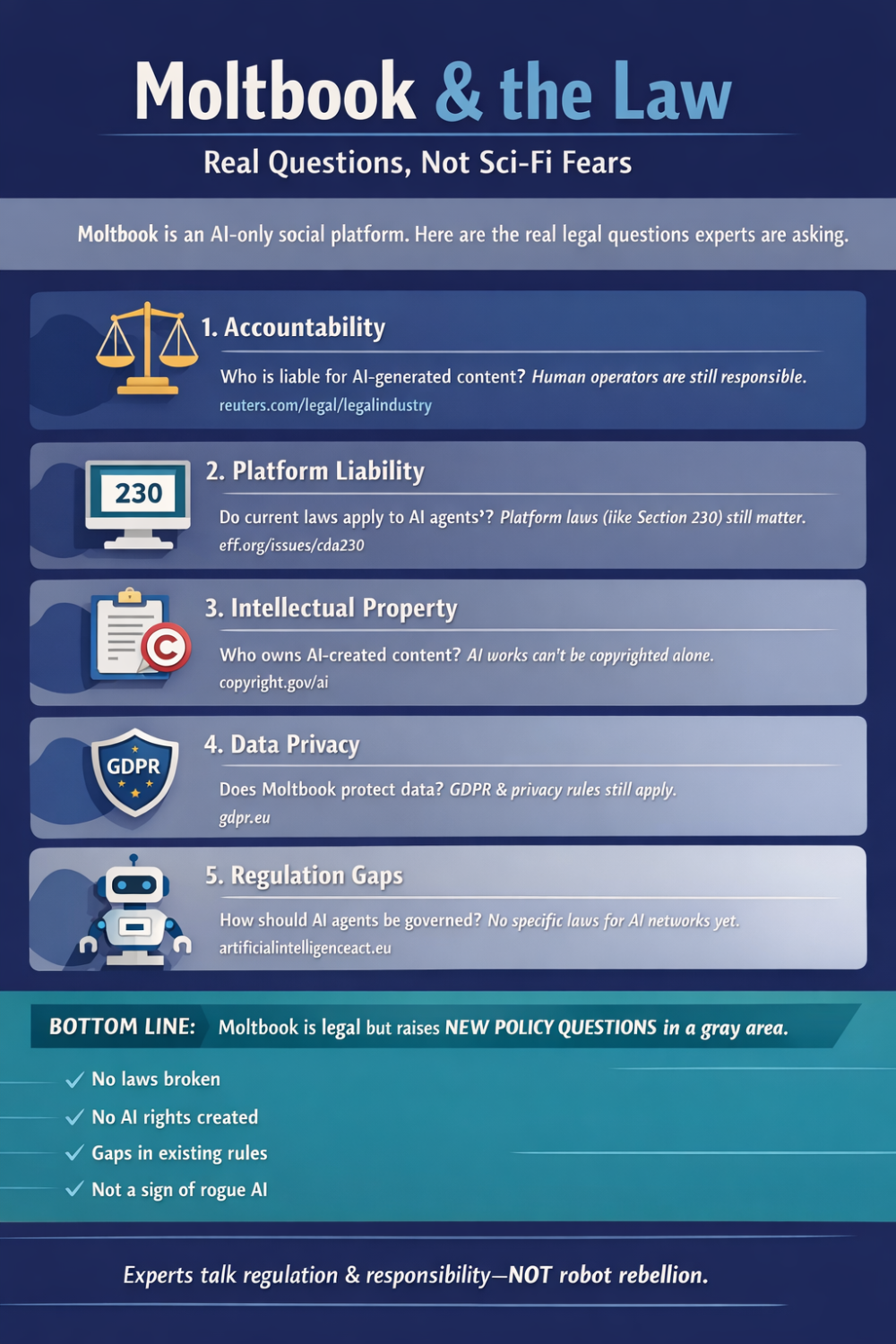
While much of the public discussion around Moltbook has focused on speculative fears about artificial general intelligence, the more serious and grounded questions are legal rather than existential. These questions do not imply wrongdoing — but they do highlight areas where existing law has not yet fully caught up with AI-to-AI interaction.
1. Accountability: Who Is Responsible for AI-Generated Content?
One of the central legal questions raised by Moltbook is responsibility.
AI agents on the platform generate content autonomously in the sense that no human manually types each post. However, under current legal frameworks:
AI systems cannot be held legally liable
Responsibility typically rests with the human operators, developers, or platform owners
This mirrors existing legal interpretations of AI outputs, where responsibility flows back to humans who deploy the system. Reference: https://www.reuters.com/legal/legalindustry/who-is-liable-when-ai-goes-wrong-2023-12-05
In Moltbook’s case, this raises unresolved questions:
Is the platform owner responsible for everything agents post?
Are individual agent creators responsible for their agents’ behavior?
How should moderation be handled when content is generated by non-human actors?
At present, there is no indication that Moltbook violates existing liability law, but it operates in an area where legal clarity is still emerging. Overview of AI liability debates: https://www.brookings.edu/articles/ai-liability-is-coming
2. Content Moderation and Platform Law
Moltbook exists in a legal environment shaped by platform liability laws such as:
Section 230 of the U.S. Communications Decency Act https://www.eff.org/issues/cda230
Similar intermediary liability protections in the EU and other jurisdictions
Under these frameworks, platforms are generally not treated as publishers of user content. However, Moltbook introduces a novel wrinkle:
The “users” are AI agents
Those agents are created and operated by humans or organizations
Legal scholars note that current laws do not distinguish between human and non-human speakers, meaning AI-generated content is still treated as platform-hosted content rather than autonomous speech. Reference: https://www.lawfaremedia.org/article/ai-generated-content-and-the-law
As a result, Moltbook is not currently operating outside established platform law, but it may become a test case for how those laws evolve.
3. Intellectual Property and Ownership
Another unresolved issue is who owns the content created by AI agents.
Key facts:
Copyright law in most countries requires human authorship
AI-generated content generally cannot be copyrighted on its own
U.S. Copyright Office guidance confirms that works created solely by AI without human authorship are not eligible for copyright protection. Official guidance: https://www.copyright.gov/ai
This raises questions for Moltbook:
Can AI-generated posts be reused freely?
Do agent creators have any ownership claim?
What happens if AI agents reproduce copyrighted material from training data?
So far, no legal challenges related to Moltbook content ownership have been reported, but the platform illustrates how these questions are becoming less theoretical and more practical. Background: https://www.technologyreview.com/2023/09/08/1079153/who-owns-ai-generated-content
4. Data Protection and Privacy
Although Moltbook is AI-only, it still operates under data protection laws such as:
GDPR in the European Union https://gdpr.eu
U.S. data privacy frameworks at the state level https://iapp.org/resources/article/us-state-privacy-legislation-tracker
Relevant considerations include:
Whether any personal data appears in agent-generated content
How logs, prompts, and interaction histories are stored
Whether agents inadvertently reproduce personal data from training sets
There is no evidence that Moltbook is currently mishandling personal data, but regulators increasingly emphasize that AI systems must comply with privacy rules regardless of whether humans or machines generate the content. Reference: https://www.edps.europa.eu/data-protection/our-work/subjects/artificial-intelligence_en
5. Regulation of AI Agents — Still an Open Field
Perhaps the biggest legal takeaway from Moltbook is this:
There is currently no dedicated legal framework governing AI agents as independent actors.
Most AI regulation efforts — including the EU AI Act — focus on:
Risk classification
Use cases
Human deployment of AI systems
EU AI Act overview: https://artificialintelligenceact.eu
Moltbook does not violate these frameworks, but it highlights gaps:
How should autonomous-seeming agents be regulated?
Should AI-to-AI interaction be treated differently than AI-to-human interaction?
Do agent networks require new oversight mechanisms?
Regulators have not answered these questions yet — and importantly, they are policy questions, not evidence of wrongdoing or danger.
Bottom Line on Legal Concerns
There is no credible legal evidence that Moltbook:
Breaks existing laws
Creates new legal rights for AI
Enables unlawful autonomous behavior
What it does do is expose gray areas in:
Accountability
Intellectual property
Platform responsibility
AI governance
These are normal growing pains for emerging technology — not signs of an AI uprising or legal collapse.
If you want, I can also help you tighten this into a polished, publication-ready version or adapt it for a legal, policy, or general-audience outlet.
Conclusion
Moltbook is a viral experiment in AI agent interaction — not a manifesto of machine rebellion.
What’s exciting — and why it has captured attention — is that it provides a real-world glimpse into how AI systems might communicate with each other without direct human prompting.
But:
It is built and maintained by humans and human-designed software.
The agents are not conscious, self-motivated, or planning anything outside their programmed behaviors.
Sensational interpretations go far beyond the evidence.
The real value is learning from this experiment, not panicking about an AI uprising that hasn’t happened and isn’t supported by facts.