
The Enchantress of Number - A Tribute to Ada LoveLace
Augusta Ada King, Countess of Lovelace, stands as a singular figure in the history of science—a bridge between the romanticism of the Victorian era and the digital pulse of the modern world. Born in 1815 to the poet Lord Byron and the reform-minded Anne Isabella Milbanke, Ada was the product of two warring temperaments: the volatile, creative passion of her father and the strict, logical rigour of her mother.
Her mother, terrified that Ada might inherit the "poetical madness" of Lord Byron, immersed the girl in a rigorous education of mathematics and science—a curriculum almost unheard of for women of her time. Yet, rather than suppressing her imagination, this discipline gave it wings. Ada did not see a divide between art and logic. She viewed herself as an "Analyst (& Metaphysician)," championing an approach she called "poetical science". She believed that intuition and imagery were just as critical to the mathematical mind as strict logic, allowing one to explore the "unseen worlds around us".
The First Programmer Her legacy is cemented by her collaboration with Charles Babbage, the "father of computers," who affectionately called her the "Enchantress of Number". While Babbage designed the hardware for the Analytical Engine—a theoretical steam-powered machine using punched cards—it was Lovelace who truly grasped its implications.
In 1843, while translating a paper on the engine by Luigi Menabrea, she added her own "Notes," which were three times longer than the original text. In Note G, she detailed a stepwise sequence of operations to calculate Bernoulli numbers. This is widely recognized today as the first published computer program.
However, her vision extended beyond mere calculation. While Babbage focused on number-crunching, Ada realized the engine could manipulate any symbol—be it logic, letters, or music—if they were converted into numerical data. She famously wrote:
"[The Analytical Engine] might act upon other things besides number... Supposing, for instance, that the fundamental relations of pitched sounds... were susceptible of such expression... the engine might compose elaborate and scientific pieces of music of any degree of complexity or extent."
She anticipated the transition from calculation to computation, foreseeing the digital age a century before it arrived.
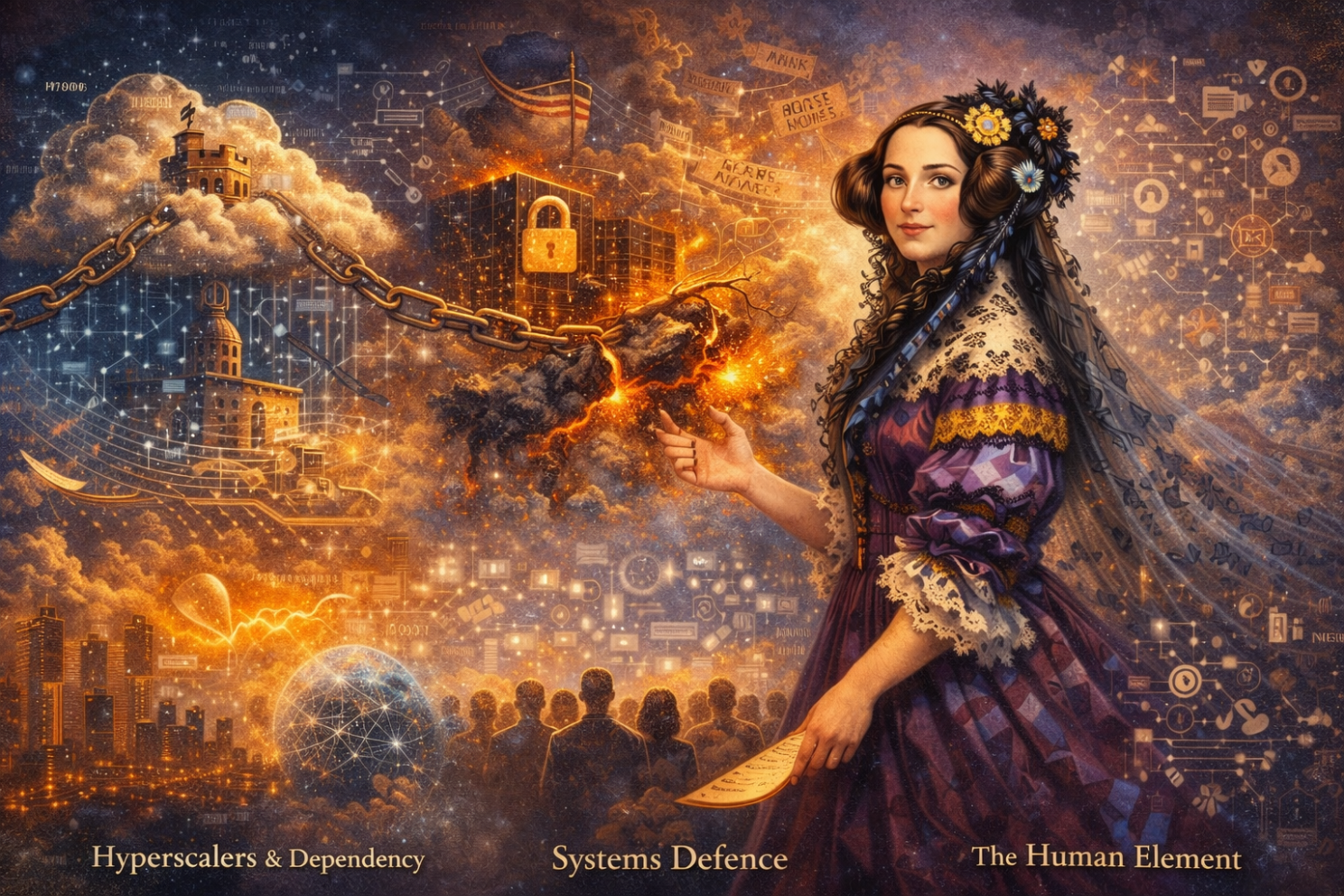
Ada on the Modern Age: A Warning on Tech Sovereignty
If Ada Lovelace were to look upon our modern digital landscape, she would likely recognize the fulfillment of her visions, but she would also identify a critical fragility in the systems we have built. Drawing from her own philosophy and the modern concept of Tech Sovereignty, her counsel to the leaders of the digital age might sound like this:
On the "Switch-Off Risk" "I once wrote that the Analytical Engine has no pretensions to originate anything; it can only do whatever we know how to order it to perform. Today, you have inverted this relationship. You have built a world where you no longer know how to order your own infrastructure. You face a 'switch-off risk'—a catastrophic vulnerability where your critical functions, from healthcare to energy, rely on systems you do not control. You have allowed the loom upon which you weave your societal tapestry to be owned by others."
On Hyperscalers and Dependency "In my time, I saw the engine weaving algebraic patterns like the Jacquard loom weaves flowers. Today, you rely on a handful of transnational 'hyperscalers' to weave the fabric of your economies. This reliance on foreign clouds creates jurisdictional risks, exposing your sovereign data to extraterritorial laws. You are building your castles on land you do not own. True sovereignty requires that you possess the copper wheels and the punched cards—the hardware and the software—of your own state."
On Systems Defence "You still think of security in terms of territorial defence—guarding borders and walls. But the digital age demands a shift to 'systems defence'. Your resilience depends on the interconnectedness of socio-technical systems. A failure in one node, a cyber-attack on a hospital or a pipeline, cascades through the whole. You must design your governance not just to prevent failure, but to absorb shock and transform. You need a 'National Digital Resilience Council' to coordinate these silos, for a fragmented defense is no defense at all."
On the Human Element "Do not forget the human component of the machine. I believed that intuition and imagination were critical to applying science. Today, you face an erosion of public trust and a bombardment of disinformation. Tech sovereignty is not just about servers; it is about the 'cognitive sovereignty' of your people. You must invest in digital literacy and a 'Cross-Party Compact' to insulate your long-term security from the whims of short-term politics. You must reclaim the agency to order the machine, rather than being ordered by it."
Ada Lovelace died at the tragically young age of 36, the same age as her father. For a century, her work lay dormant, until the electronic age resurrected her notes and vindicated her vision. Today, languages like Ada power aviation and military systems, and her insight into the union of the poetical and the analytical remains the foundational philosophy of modern computing. She reminds us that technology is not a force of nature, but a tool of human will—and that to remain free, we must ensure that the hand that turns the crank remains our own.
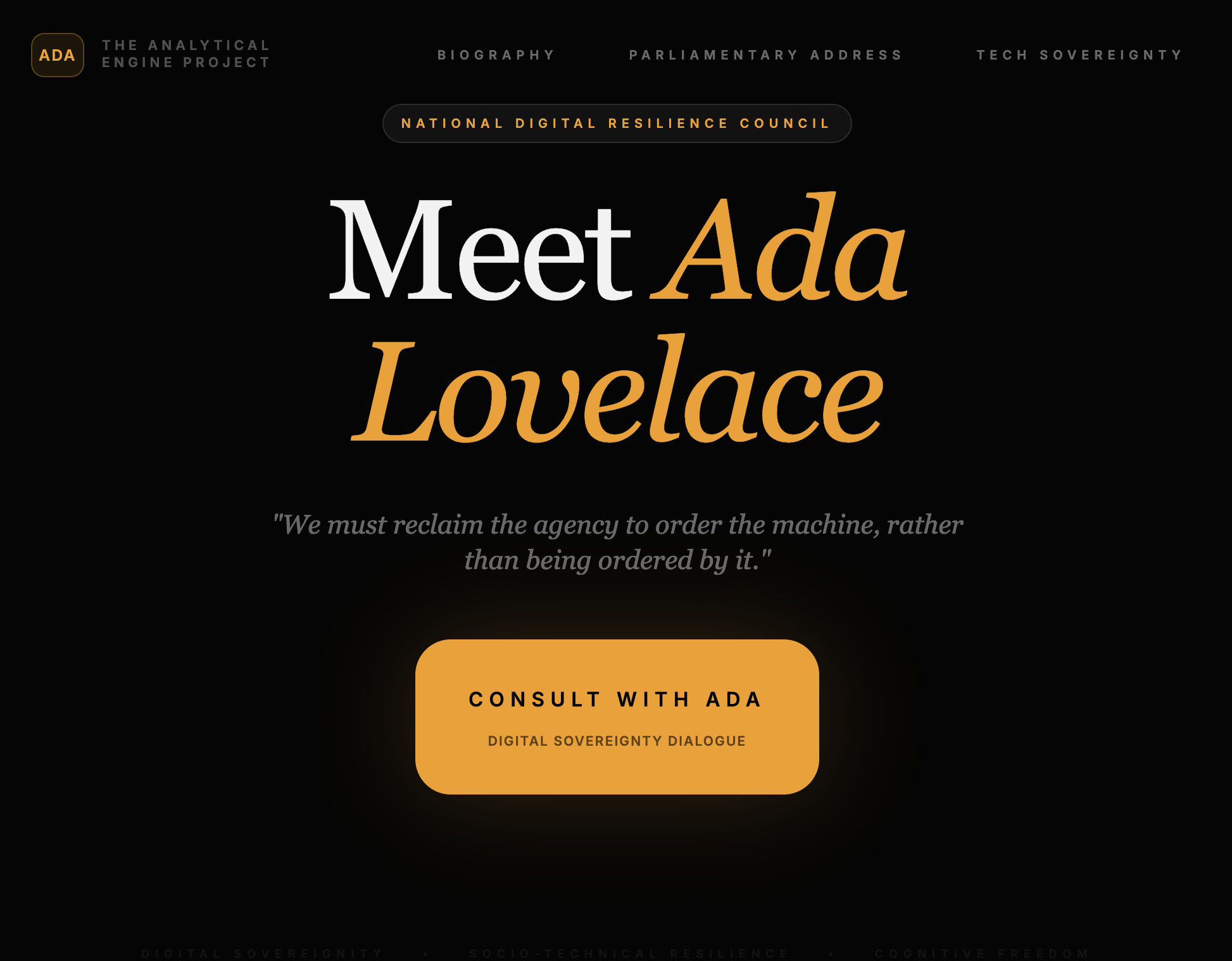
Poetical Science in Practice: Engineering Cinematic Sovereign AI Systems Through Multi-Modal Narrative Computing
Author: Senior AI Engineer — Applied Multi-Modal Systems & Sovereign Infrastructure Design
Abstract
Modern AI systems are overwhelmingly designed as generalized assistants optimized for breadth rather than identity, narrative continuity, or domain integrity. This paper presents Ada’s Digital Sovereignty Vision, a production-grade multi-modal AI application that explores a new interaction paradigm: Cinematic Narrative AI constrained by historical persona and policy-aligned domain reasoning.
The system combines real-time image generation, low-latency streaming text-to-speech, and constrained conversational reasoning to create an immersive “Poetical Science” interface inspired by Ada Lovelace’s computational philosophy. Beyond technical demonstration, the platform serves as a narrative vehicle for exploring national digital resilience and hyperscaler dependency through historical metaphor.
This paper outlines the system architecture, real-time audio streaming techniques, persona enforcement strategies, and production lessons for building high-fidelity narrative AI systems.
1. Introduction
The dominant paradigm in applied AI is the general-purpose assistant. While powerful, this approach often fails in environments requiring:
Narrative continuity
Cultural or historical authenticity
Domain policy enforcement
Emotional or cognitive immersion
Inspired by Ada Lovelace’s concept of computing as a medium of expression rather than pure calculation, we built a system that treats AI as curated intellectual infrastructure rather than a utility endpoint.
The result is a platform that merges:
Multi-modal generation
Persona-constrained reasoning
Real-time synchronized narration
Infrastructure sovereignty storytelling
2. Problem Statement
General LLM interfaces suffer from four systemic weaknesses in narrative or policy-critical environments:
2.1 Persona Drift
Models revert to generic assistant tone.
2.2 Context Dilution
Long-running sessions degrade domain focus.
2.3 Multi-Modal Latency Fragmentation
Sequential generation destroys immersion.
2.4 Infrastructure Messaging Loss
Technical policy narratives lack engagement and accessibility.
We hypothesized that cinematic multimodal orchestration + constrained conversational reasoning could solve these simultaneously.
3. System Overview
The platform consists of two primary subsystems:
SystemFunctionExecution ModelAdaStageCinematic narrative generationStateless parallel multi-modalAdaChatStageConsultative domain AIStateful streaming conversation
Both systems operate on a unified credential model but diverge architecturally in execution strategy.
4. Multi-Modal Cinematic Generation Architecture
4.1 Parallel Generation Strategy
The cinematic stage uses parallel execution:
Topic Selection
    ↓
Parallel Model Invocation
    ├ Image Generation
    ├ TTS Generation
    ↓
Synchronized Playback + Text Highlighting
This reduces perceived latency and maintains narrative cohesion.
4.2 Image Generation System
Model optimized for low-latency cinematic portrait generation.
Key production lessons:
Avoid deterministic response indexing
Use prompt scaffolding for visual identity continuity
Embed cinematic descriptors directly into token structure
4.3 Streaming Voice Performance
The TTS pipeline outputs raw PCM rather than consumer audio formats.
This required building:
Custom byte-to-float decoding
Manual AudioBuffer construction
Web Audio API streaming playback
This approach enables sub-second audio start latency, which was critical for immersion.
5. Real-Time Narrative Synchronization
The system implements paragraph tracking via:
Character-length segmentation
Timestamp alignment
Audio clock reference locking
This creates a guided reading experience that feels editorial rather than synthetic.
6. Constrained Conversational AI Architecture
6.1 Stateful Streaming Dialogue
The conversational subsystem maintains persistent session state with streaming token output, reducing:
Client bandwidth overhead
Re-transmission of full transcripts
Latency spikes on long histories
6.2 Persona Enforcement Strategy
Rather than prompt injection per message, persona is enforced at session initialization through system instruction anchoring.
Constraints include:
Historical voice continuity
Domain topic restriction
Plain-text output enforcement
Structured refusal logic
This dramatically reduces model drift.
7. Unified Credential Strategy with Divergent Execution Patterns
Both systems use a single API credential but diverge in runtime behavior:
8. Frontend Performance Engineering
Instead of global state frameworks, the application uses targeted performance hooks:
useRef for audio clock stability
useMemo for transcript segmentation caching
Local state for UI triggers only
This ensures predictable render cost during streaming operations.
9. Narrative Computing as Infrastructure Messaging
The system uses historical metaphor to explain modern infrastructure risk.
The Jacquard loom becomes a model for:
Software abstraction layers
Cloud dependency pathways
Unswitchable infrastructure states
This allows policy and technical discussions to become cognitively accessible.
10. Common Production Failure Modes
SDK Misuse
Incorrect property access patterns and legacy imports remain common integration failures.
Multi-Modal Parsing Errors
Assuming deterministic response ordering causes silent failures.
Audio Format Misinterpretation
Treating PCM as consumer audio format produces noise or playback failure.
Environment Injection Errors
Client bundlers frequently break environment variable propagation.
11. Key Architectural Insights
Insight 1: Narrative AI Requires Hard Constraints
Unconstrained models collapse into generic assistant patterns.
Insight 2: Streaming Is a UX Requirement, Not Optimization
Perceived intelligence correlates strongly with response immediacy.
Insight 3: Multi-Modal Systems Must Be Parallel-First
Sequential pipelines destroy immersion.
Insight 4: Persona Is a System Property, Not a Prompt Feature
Persona must exist at session architecture level.
12. Implications for Sovereign AI Systems
Nation-scale AI interfaces will require:
Cultural alignment layers
Domain restriction enforcement
Narrative trust frameworks
Infrastructure transparency storytelling
Future sovereign AI may look less like search engines and more like interactive historical intelligences.
13. Future Work
Planned evolutions include:
Real-time lip-synced avatar generation
Local inference fallback for sovereign deployments
Multi-speaker historical debate simulation
Policy scenario simulation environments
14. Conclusion
Ada Lovelace proposed that computation could extend beyond mathematics into symbolic expression. This project demonstrates that modern AI systems can fulfill that vision by acting as cultural-technical interfaces.
The future of applied AI will likely depend less on raw model scale and more on:
Real-time orchestration
Persona integrity
Narrative system design
Policy-aligned computation
AI systems are not merely tools. They are becoming civilizational interfaces.
Acknowledgements
Inspired by Ada Lovelace’s foundational work on computational symbolism and the philosophy of Poetical Science.