
A bridge the gap between stakeholder feedback and structured product strategy
An AI Product Manager (PM) would use Formly AI as a "Decision Intelligence" layer to bridge the gap between messy stakeholder feedback and structured product strategy.
Unlike a standard PM using Typeform or Google Forms, an AI PM deals with high-dimensional uncertainty (e.g., "Will this model change alienate users?"). Formly AI provides the qualitative depth needed to manage that risk.
1. How an AI Product Manager uses it:
Deep Stakeholder Discovery: Instead of sending a static survey about a new feature, the PM uses the Conversational Interviewer to probe stakeholders. If an engineer says "this is hard to implement," the AI follows up with "Is that due to latency constraints or data availability?" capturing the reasoning behind the friction.
PRD Comprehension Checks: Before a sprint begins, a PM can upload the PRD (Product Requirement Document) to the Evidence Library. Engineers and Designers must "demonstrate understanding" through a comprehension task before they can provide feedback on the roadmap. This ensures that roadmap alignment scores are based on informed participants, not people who skimmed the doc.
Strategic Drift Detection: If the company's goal is "Efficiency" but the engineering segment's qualitative responses consistently mention "Technical Debt," the Intelligence Hub will flag this as an Outlier/Strategic Dissent. The PM can catch this drift weeks before it manifests as a missed deadline.
Modeling "What-If" Pivots: The PM uses the Predictive Sandbox to simulate outcomes. “If we prioritize the LLM-latency fix over the UI redesign, how does that impact the 'Risk Resilience' benchmark for our sector?”
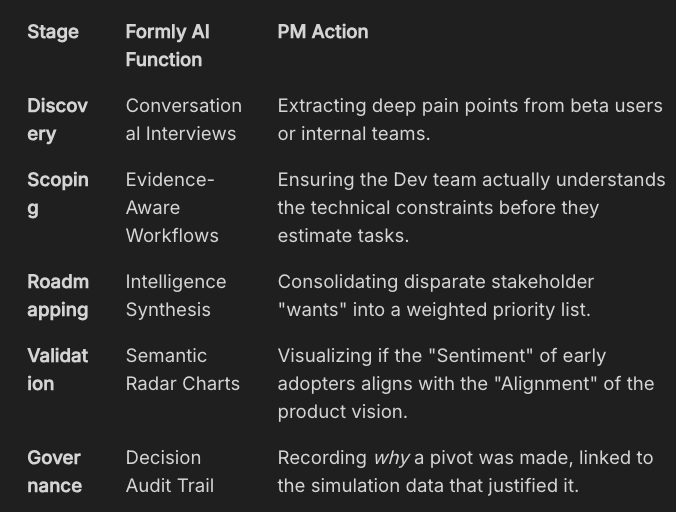
2. At what stage of the process is it used?
Formly AI is designed to be a "full-lifecycle" tool, but it is most critical at these specific inflection points:
3. Practical Example for an AI PM:
Scenario: You are launching a new "Generative Search" feature and need to decide on the safety-filter threshold.
Preparation: Upload the safety guidelines to the Evidence Library.
Inquiry: Use Architect to generate an assessment for the Trust & Safety, Engineering, and Marketing teams.
Collection: Stakeholders participate in an AI-led interview where they are probed on specific edge cases.
Analysis: The Intelligence Hub shows that while Marketing is "100% Aligned," Engineering has a "High Risk Outlier" regarding token-cost overflow.
Decision: You use the Predictive Sandbox to see how a stricter filter (Strategic Lever) impacts the predicted ROI vs. implementation complexity.
In short, Formly AI transforms the PM from a "note-taker" into a Systems Thinker who makes decisions based on weighted, validated semantic data