
Competence without Conscience: Tech Bros
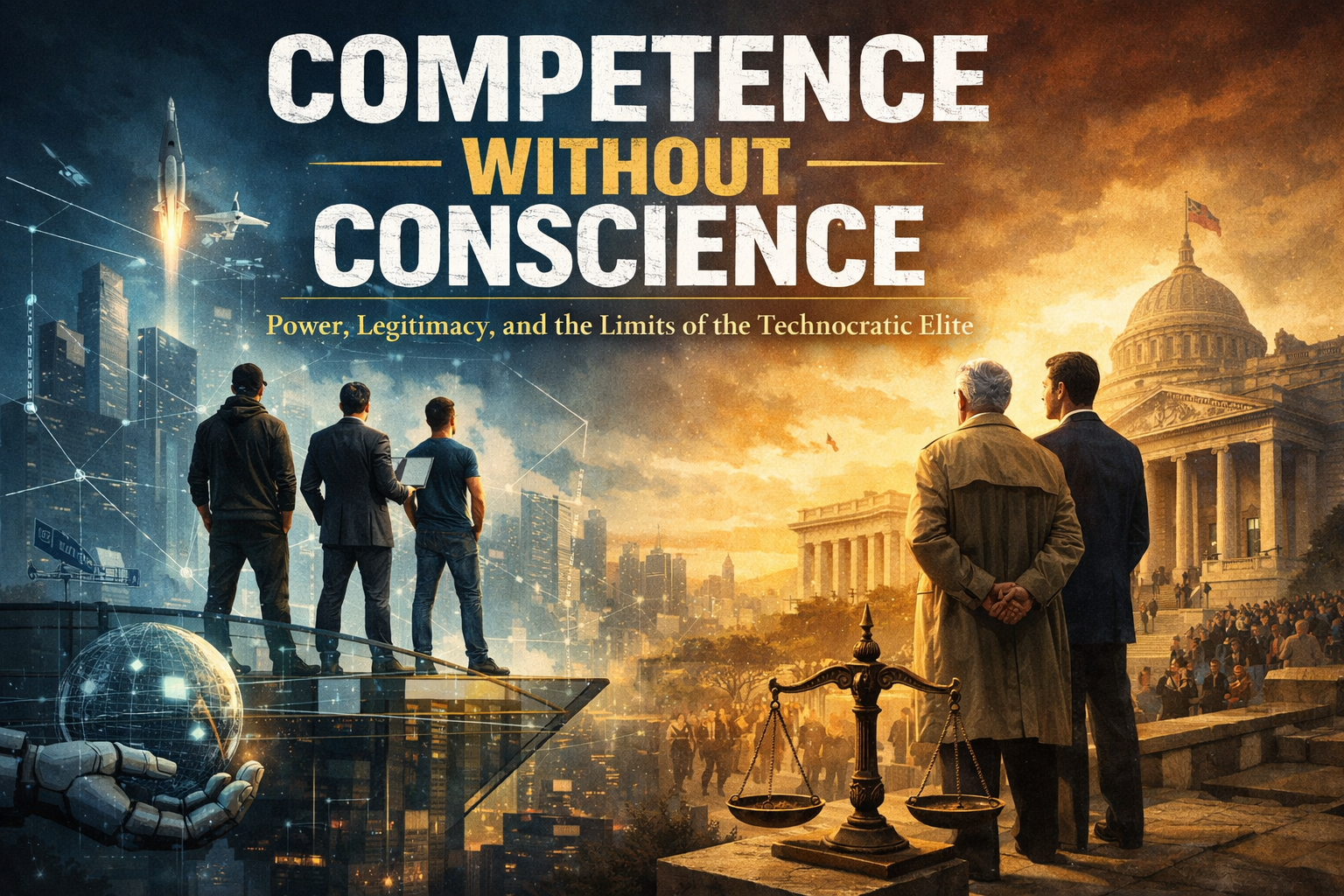
Competence Without Conscience
The Seduction of Competence
Modern politics is increasingly tempted by a dangerously simple idea: that if we could simply put the most intelligent, most technically capable, most efficient people in charge, many of our political problems would dissolve. It is an appealing vision, particularly in an age where public institutions appear slow, bureaucracies appear confused, and political rhetoric often feels disconnected from real-world complexity. In such a climate, the appeal of the “builder” becomes powerful — the entrepreneur who launches rockets, builds global communication systems, or creates vast data networks seems to embody clarity and decisiveness in contrast to messy democratic compromise. But history suggests something deeply uncomfortable. Competence is essential for power. But competence alone is not enough to make power legitimate. And power without legitimacy eventually becomes brittle, resented, and unstable.
Political authority has always required more than technical skill. It requires moral judgment, restraint, empathy, and the ability to accept limits. The danger of modern technocratic culture is that it increasingly treats governance as an engineering problem rather than a moral one. Yet politics is not the optimization of systems; it is the negotiation of competing values. It is not about finding the fastest solution, but about finding solutions that populations believe are fair, humane, and legitimate. The temptation to replace moral politics with technical management is understandable in an age of complexity. But it may ultimately prove deeply dangerous.
The Historical Lesson: Competence Has Never Been Enough
Throughout history, societies have repeatedly elevated highly competent elites who promised efficiency, order, and progress. And repeatedly, these elites have discovered that technical mastery does not automatically translate into political legitimacy. The Roman Empire was administratively brilliant, yet struggled with legitimacy in its later centuries. The Soviet Union built extraordinary technical capacity but failed to maintain public trust. Colonial administrations often ran highly efficient bureaucratic systems but lacked moral legitimacy in the eyes of populations they governed.
The consistent lesson is that societies tolerate competent rule only when it is accompanied by moral credibility. People will accept hardship if they believe systems are fair. They will tolerate mistakes if they believe leaders are acting in good faith. But when competence becomes disconnected from moral accountability, citizens begin to withdraw trust. And once trust erodes, even the most technically sophisticated systems become fragile.
The lesson is deeply counterintuitive for technocratic cultures. It suggests that moral legitimacy is not a luxury layered on top of effective governance. It is the foundation that allows governance to function at all.
The American Technological Elite and the New Power Class
The United States is now witnessing the emergence of a new elite class that combines unprecedented wealth, technical capability, and narrative influence. This class has helped drive extraordinary innovation. It has built infrastructure that powers global communication, financial systems, and increasingly artificial intelligence. In many respects, it has delivered real progress. But it also represents a concentration of power that is historically unusual.
Unlike industrial elites of the past, modern technology elites often control systems that shape not just economic activity but social reality itself. They influence how people communicate, what information people see, how financial transactions occur, and increasingly how decision-making is automated. The scale of influence is unprecedented. And yet, these actors are not subject to the same democratic accountability structures as political leaders.
The risk is not that these individuals are malicious. The risk is structural. When individuals become capable of shaping civilizational infrastructure without democratic mandate, the balance between competence and legitimacy becomes unstable.
The Moral Limits of the Builder Mindset
The builder mindset is extraordinarily powerful in technological innovation. Builders see problems and attempt to solve them directly. They are comfortable with risk, comfortable with uncertainty, and often willing to challenge conventional wisdom. These are essential qualities during periods of technological transformation.
But the builder mindset has moral limitations when applied to politics. Builders often seek optimization. Politics often requires compromise. Builders seek clean solutions. Politics often requires messy accommodations. Builders often see slow decision-making as failure. Politics often requires slowness to maintain legitimacy.
The danger arises when builders begin to view democratic processes as obstacles rather than as legitimacy-generating mechanisms. Democratic systems are slow precisely because they must accommodate competing moral perspectives. Efficiency is not their primary goal. Stability and legitimacy are.
The Risk of Moral Distance
One of the defining features of modern technological power is moral distance. Technology elites often make decisions affecting millions of people without direct interaction with those populations. Algorithms can reshape labor markets. Platforms can reshape public discourse. Data systems can reshape privacy norms. Yet the individuals designing these systems may never directly experience the consequences of their decisions.
Moral distance historically increases the risk of dehumanization. When decision-makers do not experience the human cost of policies, they may optimize for efficiency rather than dignity. This is not cruelty. It is structural psychology. Humans are naturally more empathetic toward those they interact with directly.
Democratic systems evolved partly to reduce moral distance. Elections, public debate, and representative institutions force leaders to remain emotionally connected to populations. When power shifts toward technical elites outside democratic structures, moral distance tends to increase.
The Myth That Intelligence Equals Wisdom
One of the most persistent myths in technocratic culture is that intelligence naturally produces wisdom. History consistently contradicts this assumption. Highly intelligent individuals are capable of extraordinary innovation. But they are also capable of extraordinary moral error. Intelligence increases problem-solving capacity. It does not automatically increase empathy, humility, or ethical restraint.
Politics requires a different type of intelligence — moral intelligence. The ability to anticipate how policies will feel, not just how they will function. The ability to tolerate ambiguity. The ability to compromise without perceiving compromise as defeat. These traits are often undervalued in technocratic cultures but are essential for sustainable governance.
The American Risk: Technological Competence Without Democratic Legitimacy
The United States faces a unique version of this tension. It remains a democracy that deeply values innovation and entrepreneurial success. But it is also witnessing increasing concentration of technical power in private hands. The question is not whether technology elites should influence society. They inevitably will. The question is whether democratic systems can maintain legitimacy while relying on privately controlled infrastructure.
If citizens begin to believe that real decisions are made by unelected technical actors rather than democratic institutions, political legitimacy will erode. And once legitimacy erodes, political stability becomes fragile.
Why Morality Is Not a Constraint on Power — It Is Its Foundation
The deepest misunderstanding in technocratic political thinking is the belief that morality slows decision-making. In reality, morality is what makes power sustainable. Systems perceived as morally legitimate can operate with minimal coercion. Systems perceived as morally illegitimate require increasing enforcement to maintain compliance.
Moral leadership is not sentimental. It is strategic. It reduces resistance, increases cooperation, and increases resilience during crisis. The most stable societies in history were not those with the most efficient administrative systems. They were those where populations believed power was exercised with restraint and fairness.
The Danger of the Tech Elite Becoming a Parallel Authority
The greatest risk posed by American technology elites is not overt political takeover. It is the emergence of parallel authority structures. When citizens trust technology platforms more than public institutions, when infrastructure is privately controlled, and when policy is shaped indirectly through technical design, political authority becomes fragmented.
Fragmented authority is historically unstable. Citizens need clarity about who is responsible for major decisions. When responsibility becomes distributed across networks of private actors and public institutions, accountability weakens.
The Case for Moral Leadership in an Age of Technological Power
The future requires leaders who combine technical literacy with moral seriousness. Political leaders must understand technological systems deeply enough to regulate them intelligently. But they must also maintain moral authority. Technical elites must recognize that building systems does not automatically grant moral authority to govern societies.
The solution is not anti-technology populism. Nor is it technocratic governance. It is integration. Democracies must develop technical competence. Technological elites must respect democratic legitimacy.
The Deeper Question: What Is Politics For?
Politics is not primarily about efficiency. It is about legitimacy, fairness, and shared moral narrative. If societies begin to treat politics as a technical optimization problem, they risk losing the emotional foundation that makes cooperation possible.
Humans are not simply nodes in systems. They are moral agents. Systems that optimize outcomes while ignoring moral meaning often produce resistance and instability.
Conclusion: Competence Must Be Governed by Conscience
The future will not be decided by whether technological elites are competent. They clearly are. The future will be decided by whether competence is balanced by moral legitimacy. Political power requires moral accountability, emotional intelligence, and willingness to accept limits.
If American society begins to believe that technical brilliance alone justifies political authority, it risks drifting toward oligarchic governance structures. If it insists that competence must be paired with moral responsibility, democratic systems may remain resilient even in an age of technological acceleration.
The lesson of history is simple and difficult. Power that is technically brilliant but morally hollow eventually collapses. Power that is morally legitimate, even if imperfectly efficient, endures.
The challenge of the twenty-first century is not choosing between competence and morality. It is ensuring that power never exists without both.

ELON MUSK
The Symbol Before the Man
Elon Musk matters not only because of what he has built, but because of what he represents. In earlier eras, technological figures were industrialists or engineers. Musk instead occupies a strange hybrid role: part industrial titan, part cultural myth, part geopolitical actor, part philosophical signal about the future of power itself. He is less a CEO than a living narrative about what high-agency individuals might be capable of in a period where institutions feel slow, governments feel distrusted, and technological acceleration feels unstoppable. To understand Musk is therefore not simply to analyze a business leader, but to examine the emerging psychological and political archetype of the frontier technologist — someone who does not merely participate in systems, but seeks to replace them.
The Psychological Core: The Frontier Personality
From a Big Five–style personality inference perspective, Musk appears to represent an extreme version of the frontier innovator profile. The defining feature is extraordinarily high openness to conceptual possibility — not aesthetic experimentation, but systemic imagination. Musk does not merely improve cars, rockets, or software. He reimagines categories: multiplanetary civilization, privately built global satellite infrastructure, brain-computer interfaces, autonomous AI agents. This type of openness often pairs with unusually high tolerance for uncertainty and failure, allowing repeated attempts at civilization-scale engineering problems that would appear irrational to most executives.
At the same time, this personality profile often correlates with lower consensus sensitivity. Musk’s communication style, public conflict tolerance, and willingness to polarize audiences suggest relatively low agreeableness in the conventional social sense — not necessarily hostility, but a reduced need for social harmony. Combined with low visible neuroticism in business risk contexts, this produces an individual who is psychologically comfortable making decisions under existential uncertainty. In startup environments, this is often a superpower. In social governance contexts, it can become destabilizing if paired with strong certainty about technological solutions to human problems.
The Moral Psychology: The Anxiety Beneath the Vision
From a moral psychology perspective, Musk can be interpreted as part of a broader pattern among extreme builders: the transformation of anxiety about chaos into systems creation. Many high-agency innovators appear driven not purely by greed or curiosity, but by discomfort with unpredictability itself. The dream of building global infrastructure, AI systems, or planetary escape routes can be read as a civilizational-scale attempt to reduce existential fragility. Technology becomes emotional architecture — a way to make the world behave predictably enough to be survivable.
This is psychologically seductive because competence feels morally pure. If a rocket lands successfully, there is no ambiguity. If software scales, it has proven itself. In contrast, democratic governance is morally ambiguous, slow, and emotionally frustrating. The risk is that technical competence begins to feel like a substitute for moral legitimacy. Over time, this can produce a worldview where technological success is seen not only as economically valuable, but as evidence of superior civilizational judgment.
The Surveillance Capitalism Dimension: Infrastructure as Soft Power
From a surveillance-capitalist lens, Musk occupies a complicated position. Unlike classical attention-platform firms, much of his ecosystem revolves around infrastructure rather than advertising-driven behavioral prediction. However, infrastructure itself increasingly creates new surveillance capacities. Satellite internet networks, autonomous vehicles, AI assistants, and large-scale digital platforms generate enormous volumes of behavioral and environmental data. Even if the initial business model is not advertising, the structural power derived from real-time planetary data flows is historically unprecedented.
The deeper shift is that surveillance is no longer limited to consumer behavior. It expands into movement, energy use, communications, cognitive interaction with AI systems, and potentially neurological interfaces. In such a world, influence does not require direct coercion. It emerges through environmental design. Musk’s companies, like many frontier tech firms, operate at the boundary where infrastructure creation and behavioral visibility begin to merge. The moral question becomes less about intent and more about structural power concentration: who owns the systems that society cannot function without?
The Geopolitical Reality: Corporate Actors as Strategic Infrastructure
From a geopolitical realist perspective, Musk is one of the clearest examples of a new category of actor: the corporate strategic infrastructure provider. Satellite networks shape battlefield communications. Launch systems influence national security logistics. AI systems influence economic productivity and military modeling. Electric vehicle supply chains influence industrial policy and energy transition strategy. In earlier centuries, these capabilities were almost exclusively state-controlled. Today, they are partially privatized but geopolitically indispensable.
This creates an unusual power triangle. States need corporate innovation speed. Corporations need state protection and regulatory permission. Neither fully controls the other. Musk’s businesses illustrate this interdependence vividly. Governments simultaneously regulate, subsidize, depend on, and compete with his companies. This is not corporate takeover of the state, nor state domination of industry. It is hybrid sovereignty — and it is historically unstable because accountability becomes diffused across institutions and private actors.
The Populist Paradox: Anti-Elite Rhetoric, Elite Capability
Musk also represents a new populist paradox. He often positions himself rhetorically against bureaucratic or institutional elites while simultaneously embodying one of the most powerful elite positions in modern society. This paradox works because populism often values perceived competence over institutional status. If a technologist can convincingly present themselves as a builder solving real-world problems while governments appear slow or compromised, public trust can shift toward technical elites even when wealth and power concentration are extreme.
This dynamic is historically visible in industrial revolutions, where industrial magnates were simultaneously feared, admired, and politically influential. What is new is the speed of narrative influence and the global scale of platform-mediated public visibility. Musk’s personal communication channels effectively function as global political broadcasting tools — something that previously existed only for heads of state.
The PayPal Network Legacy: Elite Network Feedback Effects
Musk’s early role in PayPal placed him inside one of the most powerful network capital ecosystems of modern technology. The legacy of that ecosystem is not merely financial, but epistemic. It produced a generation of founders who share overlapping beliefs about technological acceleration, skepticism of institutional speed, and the civilizational importance of startup-scale thinking. The critique of such networks is not primarily conspiratorial. It is structural. When capital, narrative influence, political funding, and infrastructure control concentrate in overlapping elite circles, worldview diversity decreases.
Complex societies rely on elite disagreement as a form of error correction. When elite networks converge psychologically and ideologically, systemic risk increases. Musk is not reducible to that network, but he exists within the broader historical context it helped create: a world where founders increasingly see themselves not just as entrepreneurs, but as alternative civilizational problem solvers.
The Civilizational Category Error: Society Is Not a Startup
Perhaps the deepest critique across all perspectives is the risk of applying startup logic to civilization. Startups optimize for speed, disruption, and product-market fit. Societies optimize for continuity, legitimacy, fairness, and intergenerational stability. The two systems reward different psychological traits. Frontier builders excel at creating new systems. But long-term governance requires tolerance for compromise, ambiguity, and moral disagreement — traits often undervalued in high-speed innovation cultures.
Musk’s worldview often reflects a builder’s optimism that sufficiently advanced engineering can solve structural social problems. History suggests technical capability can transform civilization, but rarely replaces political complexity. Every industrial revolution produced new elites who believed technical mastery would simplify governance. Every time, human social reality proved more resistant than expected.
The Dark Scenario: High-Agency Power Without Moral Constraint
The most pessimistic interpretation of Musk’s trajectory is not personal authoritarianism, but structural power drift. If private infrastructure becomes indispensable to daily life, and if the same actors control communications, mobility, AI cognition layers, and digital identity interfaces, then power shifts from democratic oversight toward technical architecture. In such a world, freedom is not removed through law. It is shaped through system design. Citizens are not controlled through force, but through environment optimization.
This future does not require malicious intent. It requires only that technical optimization continues to outrun institutional adaptation. The risk is not dystopia by decree, but gradual dependence.
The Counter-Argument: The Builder as Necessary Evolutionary Force
The strongest defense of Musk is historical. Civilization repeatedly advances through individuals willing to take risks that institutions cannot. Space exploration, electrification, computing, and aviation all depended on individuals or small groups willing to attempt what consensus institutions considered unrealistic. From this perspective, high-agency individuals are not threats to civilization. They are evolutionary catalysts.
The moral question is therefore not whether such individuals should exist. It is how societies integrate them without allowing technical capability to override democratic legitimacy.
The Deep Moral Question
The real question Musk forces society to confront is not about one individual. It is about what happens when technological power becomes comparable to state power, but remains psychologically shaped by frontier-builder mental models. The future may depend on whether high-agency technological elites develop institutional humility — and whether democratic institutions develop technological competence quickly enough to remain legitimate.
Final Reflection
Elon Musk represents the extreme edge of a new civilizational type: the individual who can shape infrastructure at planetary scale. He is neither villain nor savior. He is a signal. A signal that technological capability is beginning to rival political authority as the primary source of power in advanced societies. History suggests societies that successfully integrate such figures without surrendering institutional legitimacy tend to remain stable. Societies that mistake technical brilliance for moral authority tend to discover too late that building the future and governing humans require different virtues.

Peter Thiel
Symbolism: The Figure Who Represents a Shift in Power Itself
Peter Thiel is important not simply because of what he has built, funded, or written, but because of what he symbolizes about the transformation of power in advanced technological societies. In earlier centuries, power was visible: kings, generals, industrial magnates, elected leaders. In the late twentieth century, power became increasingly institutional: central banks, bureaucracies, multinational corporations. In the early twenty-first century, power is becoming networked, distributed across private capital, technical infrastructure, and small circles of individuals capable of shaping system-level outcomes. Thiel represents this shift in unusually pure form. He is not primarily a public celebrity technologist, nor a traditional political operator, nor a conventional capitalist industrialist. He sits in the space between capital allocation, intellectual framing, geopolitical thinking, and technological acceleration — a space where influence is quiet but structurally profound.
In symbolic terms, Thiel represents the end of the assumption that democratic legitimacy alone determines the direction of advanced societies. He represents a world in which individuals who can shape the technical substrate of civilization — data systems, AI, intelligence infrastructure, capital networks — may hold influence comparable to or greater than elected officials. The symbolic shift is subtle but enormous. In previous eras, economic elites influenced politics. In the emerging era, technical elites may begin to define the boundaries of what politics can meaningfully do. The fear embedded in the darker interpretation is not dictatorship. It is structural dependency. If societies depend on systems built and controlled by a small set of actors, then political sovereignty gradually migrates toward system architecture rather than public decision-making.
Psychology: The Strategic Outsider Mind
Psychologically, Thiel appears to reflect a very specific elite cognitive profile: the strategic outsider who becomes more comfortable redesigning systems than participating within them. Many transformative figures begin with some form of intellectual or social alienation. But the difference between reformers and system-replacement thinkers is crucial. Reformers believe systems can be improved. Replacement thinkers believe systems are fundamentally flawed and should be superseded. Thiel’s writing and intellectual positioning consistently lean toward the latter. He frequently frames modern institutions — universities, bureaucracies, global governance, even democratic political processes — as risk-averse structures incapable of supporting radical technological progress.
This psychological orientation often correlates with high tolerance for intellectual isolation and long time horizons. It also correlates with reduced dependence on consensus validation. In business, this can produce extraordinary foresight. In politics, it can produce skepticism toward collective governance mechanisms themselves. The darker interpretation emerges when intellectual independence evolves into civilizational skepticism: the belief that mass societies may not be capable of sustaining technological frontier progress. Historically, this transition has often marked the psychological beginning of oligarchic thinking. Oligarchies rarely begin with a desire to dominate. They begin with a belief that most people cannot responsibly manage complex systems.
Moral Psychology: The Ethics of Elite Stewardship
The moral psychology underlying Thiel’s worldview appears deeply shaped by a tension between progress urgency and institutional skepticism. If technological stagnation is seen as existentially dangerous, then those capable of accelerating progress begin to see themselves as carrying moral responsibility beyond conventional democratic accountability. This is not necessarily cynical or malicious. It can emerge from genuine belief that civilization is fragile and that slow systems risk catastrophic decline. But history shows that when elites begin to frame themselves as guardians of civilization rather than participants in it, the moral logic of oligarchy becomes easier to justify.
The most dangerous moral shift is subtle. It is the transition from believing that elite expertise is valuable to believing that elite expertise should override democratic constraint when necessary. At that point, power concentration can be framed as ethical necessity rather than political choice. The argument becomes: if technological breakthroughs determine survival, then those who can produce breakthroughs must be given disproportionate authority. Historically, this argument has appeared in many elite societies, from Renaissance merchant republics to Cold War security states. It is rarely presented as authoritarianism. It is presented as responsibility.
The Technology: Infrastructure as the New Sovereignty
The technological dimension of Thiel’s ecosystem is less about consumer-facing platforms and more about structural intelligence and data power. In the darker interpretation, the true shift is from visible governance to predictive governance. When societies can be modeled, behavioral trends forecast, and instability predicted, power shifts from reactive institutions to predictive system designers. The key danger is informational asymmetry. Democracies assume rough symmetry between what governments know and what populations can understand. But predictive data ecosystems can produce massive asymmetry.
If small networks of actors possess vastly superior predictive understanding of social behavior, economic risk, or political instability, then power shifts silently. No laws need to change. No constitutions need rewriting. Control emerges from superior foresight. The most stable oligarchies in history were those that understood populations better than populations understood themselves. Modern AI-driven predictive systems could make such asymmetry unprecedented in scale. The danger is not surveillance in the traditional sense. It is anticipatory governance.
Government Lobbying and Contracts: The Fusion of State and Private Technical Power
One of the most underexamined risks in modern technological societies is the fusion of private technical infrastructure and state security capacity. When governments depend on private firms for critical intelligence, data processing, or technological defense infrastructure, the balance of power shifts. Governments still hold legal authority, but they become operationally dependent. This produces hybrid sovereignty, where neither state nor corporation fully controls strategic systems, but both depend on them. Historically, similar patterns appeared with chartered trading companies, defense contractors, and financial clearing networks. But the scale and speed of modern technical dependency is unprecedented.
In a darker interpretation, lobbying and contract ecosystems do not simply influence policy. They shape the technological environment in which policy must operate. If regulatory bodies lack technical capacity equal to private infrastructure providers, oversight becomes symbolic. The danger is not corruption. It is structural asymmetry of knowledge and capability. When the entities being regulated understand the systems better than the regulators themselves, democratic accountability becomes fragile.
COVID-19: Crisis as Accelerator of Technical Governance
The COVID-19 pandemic represented a real-world test of how societies balance public legitimacy and technical crisis management. In many countries, emergency responses relied heavily on private data infrastructure, predictive modeling, and large technology platforms. The crisis demonstrated how quickly societies can shift toward technical governance when facing existential threats. The darker reading is not that this was wrong. It is that crises accelerate normalization of elite technical decision-making.
Pandemics, climate crises, and AI risk scenarios all create environments where populations accept reduced transparency in exchange for perceived competence. Historically, crisis governance often permanently expands elite technical authority. The question is whether societies can return to full democratic oversight after such expansions — or whether each crisis permanently shifts power toward those who control predictive and technical systems.
Russia vs Ukraine: Infrastructure as Strategic Battlefield
The Russia–Ukraine war demonstrated a new model of power: private technological infrastructure operating as strategic military assets. Satellite networks, data analytics, and private intelligence ecosystems played roles once reserved exclusively for state military infrastructure. This marks a transition from state monopoly on strategic capability to hybrid warfare ecosystems involving private technical actors. In a darker reading, this creates a world where war outcomes can be influenced by individuals or networks outside formal state chains of command.
The risk is not simply privatization of war support infrastructure. It is the emergence of actors who can influence geopolitical outcomes without democratic accountability. When private infrastructure becomes critical to national defense, states may become strategically dependent on entities they do not fully control.
Israel vs Gaza: Information Control and Narrative Infrastructure
Modern conflicts are increasingly fought in the information domain as much as physical territory. The Israel–Gaza conflict demonstrated how narrative control, platform moderation decisions, and information amplification patterns can shape global perception of war. When narrative infrastructure is privately controlled, conflict legitimacy becomes partially mediated by corporate information ecosystems.
In a darker interpretation, future wars may depend as much on platform algorithm decisions as on battlefield outcomes. The power to shape what populations believe about conflict becomes strategically decisive. If narrative infrastructure remains privately controlled, geopolitical legitimacy itself becomes partially privatized.
JD Vance: Political Bridge Between Tech Elite and Populist Legitimacy
JD Vance represents an emerging political pattern: the integration of elite technological worldviews into populist political narratives. Historically, oligarchies remain stable only when they build political bridges to mass legitimacy. Figures like Vance may represent early versions of such bridges. They translate elite technical and venture-capital worldviews into political language that resonates with mass electorates.
In a darker interpretation, this could represent early-stage elite legitimacy engineering. Rather than elites directly controlling politics, they shape political narratives through aligned political actors. Historically, merchant oligarchies often governed indirectly through elected or appointed political intermediaries who maintained mass legitimacy while elite networks retained economic and strategic control.
The Dark Scenario: The Soft Emergence of Technological Oligarchy
The darkest plausible future is not authoritarian takeover. It is gradual infrastructure dependency. If AI systems, digital identity, financial rails, communications infrastructure, and predictive governance systems become privately controlled, then democratic power becomes structurally constrained. Elections continue. Laws continue. But real power shifts toward system designers. In such a world, citizens do not lose rights visibly. They lose meaningful leverage invisibly.
This is historically how oligarchies stabilize. They do not eliminate democratic forms. They make democratic decisions dependent on elite-controlled systems. Over time, public institutions become administrative layers managing systems they do not control.
The Deep Moral Question
The deepest moral question raised by Thiel’s worldview is not about technology. It is about legitimacy. Can technical competence justify disproportionate political influence? Can the ability to accelerate civilization-scale progress morally justify reduced democratic control? History suggests societies survive best when they balance elite competence and broad legitimacy. Societies that prioritize competence without legitimacy often face sudden instability. Societies that prioritize legitimacy without competence often stagnate. The danger is losing balance.
Final Reflection
Peter Thiel represents the intellectual normalization of a world in which technological capability becomes a primary source of civilizational authority. Whether history judges this as necessary adaptation or dangerous oligarchic drift will depend less on individuals and more on whether democratic societies can evolve technical competence fast enough to remain legitimate. The true risk is not elite conspiracy. It is elite inevitability. If societies begin to believe that only small networks of technical elites can navigate complexity, then oligarchy will not arrive through force. It will arrive through resignation.

David Sacks
Prologue — The Tech Bro as Myth and Mirror
David Sacks is not important simply because of the companies he helped build or fund, but because he reflects a deeper transformation in how power operates in advanced technological societies. Figures like Sacks exist at the intersection of capital, technology, narrative, and political influence. They are not purely businessmen, not purely public intellectuals, and not purely political actors. Instead, they represent a new hybrid elite — individuals who can shape what technologies exist, what narratives dominate, and increasingly, what political futures become possible. In this sense, Sacks is less interesting as a personality than as a signal. He represents the moment when technical capability, network capital, and ideological confidence begin to merge into something resembling civilizational influence.
The “Tech Bro” archetype, often mocked culturally, actually represents something historically familiar: the emergence of a new elite class during periods of technological transition. The Renaissance had merchant financiers. The Industrial Revolution had industrial barons. The twentieth century had bureaucratic technocrats. The early twenty-first century has high-agency technology founders and investors who increasingly see themselves not only as market participants but as system designers. The myth of the Tech Bro — that builders are uniquely capable of solving problems that institutions cannot — is both aspirational and dangerous. It contains genuine truth about institutional inertia and genuine risk about concentrated decision-making power.
Silicon Valley is therefore best understood not as an industry cluster but as an ideology. At its core is the belief that technological progress is the primary engine of human advancement and that most social, political, and economic problems are ultimately engineering problems waiting to be solved. This worldview privileges speed, experimentation, and disruption over stability, consensus, and deliberation. Within this ecosystem, figures like Sacks are not anomalies. They are logical products of a culture that rewards high confidence, high risk tolerance, and the belief that history moves forward through small groups who see the future before everyone else.
Formation — Psychology of a Builder
David Sacks’ early life trajectory reflects patterns common among globally mobile, high-achievement elites. Immigration or cross-system identity formation often creates dual psychological drives: insecurity about belonging combined with extreme drive to prove competence. Historically, immigrant success populations often demonstrate elevated achievement motivation, risk tolerance, and belief in meritocratic advancement. In high-performance environments like Silicon Valley, these traits are amplified and culturally rewarded. Over time, success within such systems can reinforce a belief that institutions are primarily neutral frameworks through which talent naturally rises — a belief that often underestimates structural inequality and randomness in opportunity distribution.
Elite educational environments such as Stanford function not only as intellectual training grounds but as identity-forming social ecosystems. They create cognitive tribes — groups who share assumptions about intelligence, competence, and who should shape society. Within such networks, success becomes self-confirming. Individuals surrounded by other high achievers begin to see themselves as part of a naturally selected class of system designers. The psychological shift is subtle but powerful. It moves from “I succeeded within the system” to “People like me should design systems.”
The hacker-as-hero mythology plays a major role in this identity formation. Silicon Valley’s founding narrative celebrates individuals who outthink bureaucracies and build solutions that scale globally. The story is emotionally compelling because it frames technologists as liberators — people who bypass inefficient institutions and give power directly to users. But historically, every society that elevated builders above stabilizers eventually faced legitimacy crises. Builders are optimized for disruption. Societies require continuity.
PayPal and the Birth of Elite Tech Networks
PayPal was not just a company. It was a high-intensity evolutionary environment that shaped a generation of technology elites. It combined extreme intellectual density, constant existential threat, and intense internal competition. Such environments compress moral decision-making into survival logic. When survival becomes the dominant metric, ethical tradeoffs are often reframed as necessary pragmatism. This is not unique to startups. It appears historically in war industries, early industrial capitalism, and frontier expansion periods.
The PayPal network that emerged afterward functioned less like a traditional alumni group and more like a durable elite tribe. It combined loyalty, shared narrative, and internal competition. Such networks are extraordinarily effective at generating innovation. But they can also produce worldview reinforcement. When the same networks control capital allocation, technological infrastructure, media influence, and political funding ecosystems, the risk is not conspiracy. It is monoculture. Complex societies require elite disagreement for error correction. When elite networks converge around shared assumptions about technology inevitability and institutional weakness, systemic blind spots can emerge.
PayPal also demonstrated something historically unprecedented: private actors could build trust infrastructure traditionally controlled by states. Money is fundamentally a trust technology. When private companies can build payment systems at global scale, they demonstrate that private infrastructure can replace public institutional functions. This realization — that technical systems can substitute for state functions — became one of the defining intellectual shifts of the modern tech elite worldview.
Founder Identity and Moral Tradeoffs
Many technology founders and investors are motivated by genuinely utopian narratives. Connecting people, increasing productivity, and expanding access to information all appear morally positive. But history consistently shows that tools that increase connectivity and visibility also increase surveillance capacity. The moral ambiguity lies not in intent but in structural power. Systems built to increase coordination often become systems that increase control.
Workplace productivity platforms illustrate this tension clearly. Increased transparency can improve collaboration and efficiency. But it can also increase monitoring and behavioral control. The moral question is not whether efficiency is good. It is whether efficiency should override autonomy. In startup culture, survival and growth often justify tradeoffs that would be unacceptable in mature social systems. The danger is when startup ethics — optimized for survival — become normalized as social ethics.
Founder exceptionalism is another recurring psychological pattern. Extreme success can create belief in cross-domain competence. If someone can build massively successful technical systems, it becomes tempting to assume they also understand politics, economics, and social systems better than institutions do. History repeatedly shows that domain-specific brilliance does not guarantee cross-domain wisdom.
Venture Capital and Invisible Power
Venture capital represents one of the least visible but most powerful forms of modern influence. Investors do not simply fund companies. They shape which technologies exist at all. Capital allocation is effectively future selection. Investors choose which problems society attempts to solve and which problems remain ignored. Yet investors often operate at enormous moral distance from downstream consequences of the technologies they fund.
Venture capital culture often frames markets as evolutionary truth engines — systems that naturally reward the most valuable ideas. But markets optimize for profitability, not social value. Technologies that increase engagement, extraction, or behavioral predictability often outperform technologies that improve long-term social well-being. The danger is not that investors intend harm. It is that market selection pressures are morally neutral.
Media, Narrative, and Political Influence
Modern technology elites increasingly operate as media figures. Narrative control is power. In earlier eras, public intellectuals shaped political discourse. Today, founders and investors increasingly shape it directly through social platforms and podcast ecosystems. This bypasses traditional institutional gatekeeping. It allows high-agency individuals to shape public understanding of technology, politics, and economics simultaneously.
The rise of tech elites in political discourse often reflects a deeper psychological belief: that technical competence translates into political competence. This is historically dangerous. Political systems exist to mediate competing values, not simply optimize outcomes. When elites believe they “know better,” they often underestimate the legitimacy function of democratic processes.
Dark Scenarios — The Soft Emergence of Tech Oligarchy
The darkest plausible future is not corporate dictatorship. It is infrastructure dependency. If AI systems, financial rails, identity systems, and communication infrastructure are privately controlled, then democratic sovereignty becomes constrained by technical architecture. Elections continue. Laws continue. But meaningful power shifts toward system designers.
Another dark scenario involves cognitive class stratification. If AI and biotechnology dramatically increase productivity for a small cognitive elite, permanent economic and social class divisions could emerge. Historically, societies with permanent elite cognitive classes tend toward oligarchic governance.
The most extreme scenario involves AI-aligned governance systems. If decision-making becomes optimized for stability and efficiency, human moral agency could gradually be displaced by algorithmic governance logic.
Deep Moral Questions
The deepest question is whether intelligence and competence justify political influence. Historically, societies function best when competence and legitimacy are balanced. Intelligence alone does not produce moral wisdom. Disruption is not morally neutral. Every technological breakthrough creates winners and losers. The question is who decides acceptable tradeoffs.
Another central question is whether builders owe society restraint. Innovation culture often frames capability as moral justification. But history suggests restraint is essential to long-term stability. Power without democratic mandate eventually produces legitimacy crises.
Markets cannot solve moral problems alone. Markets optimize for efficiency and price. Societies require justice and meaning. When societies confuse price with value, social instability eventually emerges.
The Inner Psychology of the Tech Elite
Founder and investor culture often involves risk addiction and status reinforcement. Success creates dopamine loops tied to competition and winning. Over time, this can create identity fusion with power itself. Moral licensing can emerge — the belief that past success justifies future authority. Fear of irrelevance also drives many tech elites toward media and politics. Influence becomes a form of psychological continuity.
Epilogue — Beyond the Tech Bro
Ultimately, David Sacks represents a recurring historical phenomenon: the emergence of new elite classes during technological transition periods. The question is not whether such elites should exist. They always do. The question is whether societies can integrate them without losing democratic legitimacy. The Tech Bro is not a new human type. He is a new expression of an old pattern — the builder who believes he can see the future more clearly than the crowd. Sometimes he is right. Sometimes he is catastrophically wrong. Civilization moves forward through tension between those two outcomes.

Joe Lonsdale
Introduction: A Figure of the Transitional Era
Joe Lonsdale represents a specific phase in the evolution of technological power. He is not primarily a celebrity technologist or mass cultural figure, nor is he purely a philosopher of elite influence. Instead, he operates in the space where venture capital, institutional design, national-security-adjacent technology ecosystems, and policy influence intersect. This positioning makes him particularly important for understanding how power is shifting in advanced societies. Increasingly, power is not only held by elected officials or legacy institutions but by those who design, fund, and control technological infrastructure. Lonsdale’s career reflects a generation of technology elites who see themselves not just as entrepreneurs, but as participants in the construction of the future operating system of civilization itself.
In earlier technological eras, business leaders shaped markets. In the emerging era, technological elites shape entire systems: education models, defense technology ecosystems, data infrastructure, venture capital pipelines, and policy-adjacent institutions. The significance of figures like Lonsdale lies less in any single company and more in how they participate in designing environments that determine what technologies and social systems will exist decades into the future.
Origins of a Builder: Formation and Elite Network Psychology
Joe Lonsdale’s rise reflects patterns common among high-agency technological elites. These individuals often emerge from environments that combine strong intellectual competition, early exposure to elite networks, and strong belief in meritocratic advancement. Such environments create a psychological identity rooted in performance and system mastery. Success becomes not only a career outcome but an identity narrative: the belief that competence is the primary driver of historical progress.
Elite educational and professional ecosystems reinforce this identity. Within high-performing networks, individuals are repeatedly exposed to peers who share similar cognitive speed, ambition levels, and future orientation. Over time, this creates cognitive tribalism — the formation of small social groups who share not only opportunities but worldview assumptions. Within these tribes, success becomes socially validated as evidence of superior system-level thinking rather than situational advantage or network effects.
This identity formation can produce extraordinary innovation capacity. But it can also produce epistemic blind spots. When individuals are consistently validated as top performers within closed elite networks, it can reinforce the belief that similar individuals are best positioned to make civilizational decisions. This is where builder psychology can gradually drift toward technocratic or elite-stewardship thinking.
The High-Agency Worldview: Systems Are Malleable
A defining feature of Lonsdale’s generation of technology elites is high-agency thinking. High-agency individuals believe reality is fundamentally shapeable through intelligence, coordination, and technological leverage. They tend to see institutions not as permanent structures but as design problems. This mindset is extraordinarily powerful during technological revolutions. It allows individuals to attempt projects that institutional actors, constrained by consensus and procedural caution, would not attempt.
However, high-agency thinking also tends to undervalue the stabilizing role of institutions. Institutions often exist not to maximize speed or efficiency but to maintain legitimacy, continuity, and social trust. The tension between high-agency builders and legitimacy-focused institutions is likely to define much of the political and economic conflict of the coming decades.
For high-agency elites, the world often appears unnecessarily slow. For institutional actors, high-agency disruption often appears destabilizing. Neither perspective is fully wrong. But the imbalance between them can produce systemic risk.
Capital as Civilization Design: Venture Power and Future Selection
Venture capital is often misunderstood as financial infrastructure. In reality, it functions as future selection infrastructure. Investors determine which technological visions receive resources and which do not. This effectively makes venture capitalists editors of the future. When venture ecosystems prioritize certain technological domains — artificial intelligence, defense systems, productivity infrastructure, data analytics — they shape what society becomes capable of doing.
The public rarely votes on which technologies will dominate social and economic life. Those decisions often occur through capital allocation networks. This creates a form of indirect governance that is largely invisible to democratic processes. Investors like Lonsdale influence not only companies but entire technological directions.
The moral distance built into venture capital is historically significant. Investors are often several layers removed from downstream social consequences. When a funded company reshapes labor markets, privacy norms, or political communication patterns, the link between initial funding decisions and social impact can be diffuse. This diffusion of responsibility is not unique to venture capital, but technological acceleration compresses cause and effect timelines, making systemic impact more rapid and less reversible.
Infrastructure and Sovereignty: The Shift from Territory to Systems
The twenty-first century is witnessing a shift in how sovereignty functions. Historically, sovereignty was tied to territory, military force, and legal authority. Today, sovereignty increasingly depends on infrastructure — data systems, AI systems, communication networks, and financial rails. Actors who control infrastructure increasingly shape the boundaries of political and economic possibility.
This does not mean private actors replace states. Instead, it creates hybrid sovereignty. Governments remain legally sovereign but operationally dependent on private technical ecosystems. When states rely on private companies for critical data infrastructure, security analytics, or AI modeling, power becomes distributed across interlocking networks rather than concentrated in traditional public institutions.
Lonsdale’s ecosystem exists at this intersection of private infrastructure and public consequence. The broader structural implication is that power in the future may be exercised less through law and more through architecture.
The Soft Oligarchy Risk: Power Without Formal Rule
The darkest structural scenario associated with technological elite consolidation is not overt authoritarianism. It is soft oligarchic drift. In such a system, democratic institutions continue to function formally. Elections occur. Laws are passed. Public debate continues. But real decision-making boundaries are increasingly shaped by infrastructure and capital networks outside public visibility.
Historically, oligarchies rarely abolish democratic forms. Instead, they gradually shift meaningful power into domains that are difficult for the public to influence. Infrastructure control is one of the most stable forms of elite power because it operates below the level of political visibility.
The risk is not intentional conspiracy. It is structural inevitability if technological complexity increases faster than democratic oversight capacity.
Predictive Power and Informational Asymmetry
The development of advanced data analytics and predictive AI introduces a new layer of potential power asymmetry. If small networks of actors can predict economic, social, or political behavior more accurately than governments or publics can, then informational power becomes political power.
Historically, the most stable elite systems were those that understood populations deeply without needing constant coercion. Predictive technological systems could amplify this dynamic. Control becomes anticipatory rather than reactive.
This is not necessarily malicious. But it creates a world where decision-making influence may correlate more strongly with data capability than with democratic representation.
The Defense Argument: Why High-Agency Elites May Be Necessary
There is a strong counterargument to the darker interpretation of technological elite power. Many technological revolutions required individuals willing to take risks that institutions could not take. Industrialization, aerospace innovation, and computing revolutions all depended on private-sector risk tolerance and high-agency individuals.
In a world defined by geopolitical technological competition, climate challenges, and potential AI transformation, high-agency builders may be necessary for survival. The argument is not that elites should rule. The argument is that elite technical capacity may be necessary to preserve civilizational stability.
The challenge is balancing technical competence with democratic legitimacy.
The Inner Psychology of High-Agency Elites
The internal psychological experience of high-agency founders and investors is often misunderstood. Extreme success and network centrality often produce isolation. Individuals embedded in elite networks often operate in environments that constantly reinforce competence identity. Over time, this can produce identity fusion — the sense that personal worth and system-building success are inseparable.
Fear of irrelevance can also become a powerful motivator. Many high-agency elites expand into policy, media, or institutional design not simply for power but because influence becomes tied to identity continuity. When individuals have spent decades shaping systems, stepping away from influence can feel like existential loss.
The Moral Question: Competence vs Legitimacy
The deepest moral question surrounding figures like Lonsdale is not about individual intent. It is about structural balance. Societies require both competence and legitimacy. Competence without legitimacy produces instability. Legitimacy without competence produces stagnation.
The difficulty of the modern era is that technological complexity is increasing faster than democratic institutions have historically evolved. If democratic systems cannot develop technical competence, they risk losing legitimacy. If technical elites bypass legitimacy entirely, they risk creating systems that populations eventually reject.
Conclusion: The Builder and the Future of Power
Joe Lonsdale represents a transitional generation in elite history. He is part of the first cohort operating in a world where capital, data, technological infrastructure, and institutional design converge into a single domain of influence. Whether history ultimately sees this generation as civilizational stewards or early architects of post-democratic power will depend less on individual intent and more on institutional adaptation.
The most likely future is hybrid. States will depend on private technical infrastructure. Private technical ecosystems will depend on state legitimacy. Power will exist in overlapping systems rather than centralized hierarchies.
The greatest risk is not that builders gain power. The greatest risk is that societies begin to believe only builders should have power. History suggests that when societies elevate competence above legitimacy permanently, political systems eventually fracture. The challenge of the twenty-first century is not to eliminate high-agency elites, but to integrate them into systems that preserve democratic meaning while still allowing technological progress.
The future will likely be decided not by whether builders exist, but by whether societies can build institutions capable of shaping builders themselves.