
Competence without Conscience: The Adults in the Room
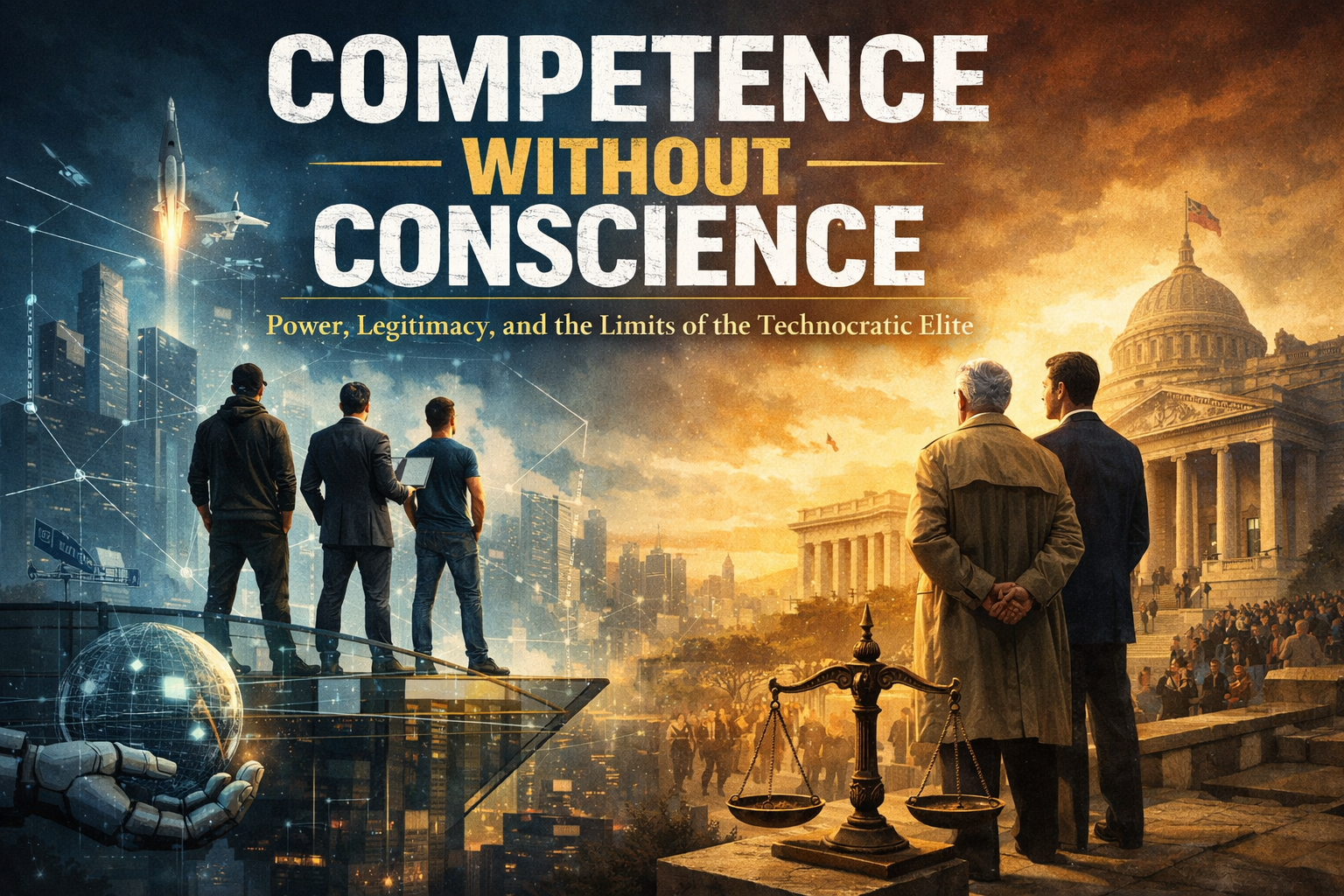
Competence Without Conscience
The Dangerous Seduction of Pure Competence
We are living through a period in which competence has become almost a moral category. Faced with political dysfunction, economic volatility, and technological transformation, many citizens understandably long for leaders who appear technically capable, decisive, and efficient. In an age where artificial intelligence can optimize logistics, diagnose disease, and generate complex analysis at extraordinary speed, the temptation grows stronger: why not treat governance itself as an engineering problem? Why not replace messy democratic compromise with clean technical solutions?
But history offers a consistent warning. Competence is necessary for political power. It is not sufficient. Political authority has never rested solely on the ability to solve technical problems. It rests on moral legitimacy — the belief among citizens that power is exercised fairly, humanely, and within limits. The danger of our moment is that we are beginning to forget that political power is not merely about producing outcomes. It is about maintaining consent. And consent is moral, emotional, and cultural before it is technical.
The idea that highly competent individuals — whether technologists, financiers, or AI system designers — could simply replace traditional political leadership is deeply seductive. But it is also historically naive. Highly competent elites have often believed they could run societies more efficiently than democratic systems. They have sometimes been correct in narrow technical domains. But they have almost always failed to maintain long-term legitimacy.
The Historical Pattern: When Competence Replaces Legitimacy
History is full of societies that elevated technically brilliant elites during moments of crisis. Late imperial bureaucracies, colonial administrative states, and twentieth-century technocratic regimes all promised efficiency, rational planning, and expert governance. And many of them delivered impressive technical achievements. But they often failed to sustain political legitimacy.
The late Soviet Union, for example, produced remarkable scientific and engineering accomplishments. Yet it ultimately collapsed not because it lacked competence, but because it lacked legitimacy. Citizens no longer believed in the moral authority of the system. Similarly, colonial administrations often built highly efficient bureaucracies but were ultimately rejected because they lacked moral consent from the populations they governed.
The lesson is not that competence is unimportant. It is that competence detached from moral accountability is unstable. Political systems survive not because they are perfectly efficient, but because they are perceived as fundamentally fair.
The Rise of the Technological Elite and the New Power Question
The United States, and increasingly much of the world, is witnessing the rise of a new form of elite power. Technology leaders now control infrastructure that shapes communication, economic activity, and increasingly knowledge itself. Artificial intelligence will accelerate this dynamic. AI systems will increasingly shape hiring decisions, financial risk models, public information flows, and even elements of governance.
The individuals and institutions controlling these systems are extraordinarily competent. But they are not democratically accountable in traditional ways. The risk is not that these individuals are malicious. The risk is that societies begin to equate technical competence with moral authority.
Technological elites are uniquely powerful because they shape environments rather than laws. When platforms shape how people communicate, when AI shapes how decisions are made, and when private infrastructure shapes public capacity, political power becomes partially invisible. And invisible power is difficult to regulate democratically.
AI and the Temptation of Technocratic Rule
Artificial intelligence introduces a new and potentially dangerous temptation: the belief that complex political problems can be solved through optimization algorithms. AI can process vast amounts of information, identify patterns invisible to humans, and generate policy recommendations with extraordinary speed.
But political decisions are not simply optimization problems. They involve competing values that cannot be reduced to data. How do we balance efficiency with fairness? Growth with equality? Security with freedom? These are moral questions. AI can inform them. It cannot resolve them.
The risk is that societies will increasingly outsource political judgment to technical systems, and in doing so, slowly erode the role of human moral judgment in governance.
Populism and the Collapse of Institutional Trust
At the same time, we are witnessing a global rise in populism driven largely by institutional distrust. Citizens increasingly believe that traditional political institutions are captured, incompetent, or disconnected from lived reality. Populism often emerges when citizens feel that decision-making power has moved beyond democratic control.
Ironically, technological elite power and populist distrust feed each other. As technological systems become more powerful and less visible, citizens feel less control. As citizens feel less control, they turn toward populist narratives promising restoration of sovereignty. The result is political instability — not because either side is entirely wrong, but because neither side alone can sustain legitimacy.
Economic and Political Instability as Force Multipliers
Economic volatility and geopolitical instability accelerate the temptation toward technocratic governance. In crisis, societies often prioritize competence over process. During wars, pandemics, and economic collapses, populations often accept centralized decision-making in exchange for stability.
But emergency governance often becomes normalized. Crisis-era technical authority can become permanent structural power. History shows that powers granted in crisis are rarely fully surrendered afterward.
The Meaning of “The Adults in the Room”
The phrase “the adults in the room” is often misunderstood as simply meaning experienced or competent leaders. In reality, it refers to something deeper: individuals who understand the moral weight of power. Adults in governance recognize that decisions affect real lives in unpredictable ways. They understand uncertainty. They accept limits. They resist ideological purity. They respect institutions not because institutions are perfect, but because they are necessary for legitimacy.
Adults in governance tend to prioritize stability over spectacle. They often appear cautious, sometimes frustratingly slow. But they maintain systems that citizens trust enough to function over long periods.
Why Morality Is Strategic, Not Sentimental
Moral leadership is often dismissed as naive or idealistic. In reality, it is strategic. Systems perceived as morally legitimate require less enforcement. Citizens comply voluntarily. Social cooperation increases. Economic productivity increases. Crisis resilience increases.
The most stable societies in history were not those with the most efficient bureaucracies, but those with the highest perceived fairness. Moral legitimacy is not decoration layered on top of competence. It is the foundation that allows competence to function.
The Risk of the New Oligarchic Drift
If technological power continues concentrating while democratic legitimacy erodes, societies may drift toward a new form of oligarchy — not visible authoritarian rule, but infrastructure-based elite influence. Democratic institutions may remain formally intact, but real power may shift toward those controlling data systems, AI infrastructure, and communication platforms.
Such systems may function efficiently for a time. But history suggests they will eventually face legitimacy crises if citizens feel excluded from real decision-making power.
The Moral Role of Political Leadership in the AI Age
The political leaders of the future must be technically literate enough to understand technological systems but morally grounded enough to regulate them. They must resist the temptation to outsource moral judgment to technical optimization. They must preserve democratic legitimacy even while governing increasingly complex societies.
The Return of Moral Realism
The future requires a return to a kind of moral realism in politics. This means recognizing that societies cannot be engineered purely through intelligence or efficiency. They must be governed through legitimacy, fairness, and shared narrative. Political leaders must be willing to say that some technically optimal solutions are morally unacceptable.
Conclusion: Competence and Conscience Must Rise Together
The twenty-first century will not be defined by whether societies can produce competent leaders. It will be defined by whether they can produce competent leaders who also possess moral seriousness. The adults in the room are not simply those who understand systems. They are those who understand people. And history suggests that power survives only when it respects both.
ADULTS IN THE ROOM
x


Bernie Sanders
Introduction — The Persistence of a Moral Voice
Few figures in modern American politics have occupied such a peculiar and persistent position as Bernie Sanders. For decades, Sanders existed on the margins of mainstream political life, viewed as ideologically rigid, politically impractical, or historically out of step with the dominant market-oriented consensus that defined American politics after the Cold War. Yet over time, something unexpected happened. Ideas once dismissed as fringe entered mainstream policy debate. Younger voters increasingly saw Sanders not as radical but as morally consistent. His political longevity became less about electoral victories and more about narrative endurance. Sanders came to represent something many voters felt was disappearing from political life: a sense that politics should be about moral commitments as much as technical competence.
The significance of Sanders cannot be reduced to policy proposals or election outcomes. His deeper importance lies in what he symbolizes about public frustration with inequality, institutional distrust, and the perceived moral drift of democratic capitalism. In an era defined by technological acceleration, economic concentration, and political polarization, Sanders has come to represent a counter-narrative — that democracy must be anchored in economic fairness if it is to survive at all. Whether one agrees with his solutions or not, the moral argument he represents has become central to contemporary political discourse.
The Historical Context — From Post-War Social Democracy to Market Consensus
To understand Sanders, one must understand the long arc of post-war political economy. The mid-twentieth century was defined by a social democratic consensus across much of the Western world. Governments invested heavily in public infrastructure, education, labor protections, and social welfare systems. Economic growth was broadly distributed, and inequality, while present, was politically constrained.
Beginning in the late 1970s and accelerating through the 1980s and 1990s, this consensus shifted. Market liberalization, deregulation, financialization, and globalization became dominant policy frameworks. These policies produced significant global economic growth, technological innovation, and consumer prosperity. But they also produced new forms of inequality, regional economic decline, and increasing distance between financial markets and everyday economic life.
Sanders’ political worldview is rooted in this transition. His core argument has been that democratic capitalism cannot survive if economic systems produce persistent insecurity and concentrated wealth. In this sense, his politics are less revolutionary than restorative. He often frames his proposals as returning to a moral economic balance that he believes existed in earlier periods of American capitalism.
The Moral Economy — Fairness as Political Foundation
At the core of Sanders’ political philosophy is the concept of a moral economy. A moral economy is not simply about redistribution or social welfare. It is about the belief that economic systems must be perceived as fundamentally fair in order to remain politically legitimate. Sanders consistently argues that extreme inequality is not only economically inefficient but morally destabilizing. When citizens believe systems are rigged, democratic participation declines, political polarization increases, and populist movements gain strength.
His framing of economic inequality is often explicitly moral rather than purely technical. He speaks less about efficiency and more about dignity. This distinction is important. Technocratic economic debates often focus on productivity, growth, and market optimization. Sanders focuses on lived experience: healthcare access, wage stability, housing security, and student debt burden. In this sense, he represents a shift from macroeconomic abstraction to human-centered economic politics.
Authenticity and Political Trust
One of Sanders’ most distinctive political strengths has been perceived authenticity. In modern media environments, voters often evaluate politicians less on policy detail and more on perceived sincerity. Sanders’ decades-long consistency has produced a rare form of political credibility. His messaging has changed relatively little over time, and this stability functions as trust signal in a political culture characterized by rapid narrative shifts.
Authenticity in Sanders’ case is reinforced by rhetorical style. He does not typically speak in focus-grouped political language. His speeches often retain moral urgency and ideological clarity even when politically risky. This can limit coalition-building flexibility but strengthens core supporter loyalty. In low-trust political environments, consistency often becomes more valuable than tactical adaptability.
Populism Reframed — Structural Rather Than Cultural
Sanders represents a form of populism focused primarily on structural economic inequality rather than cultural or identity-based grievance. This distinction matters. Populism often emerges when citizens feel excluded from political decision-making or economic security. Sanders frames this exclusion primarily through economic systems — corporate concentration, financial sector influence, and campaign finance structures.
This structural framing differentiates his populism from more culturally oriented populist movements. His political messaging tends to emphasize cross-identity economic solidarity rather than identity-based political mobilization. Whether this model can sustain broad coalition politics remains debated, but it reflects a long tradition of labor-oriented democratic politics.
Anger, Moral Outrage, and Political Emotion
Sanders’ emotional tone is often misunderstood. His rhetoric frequently expresses anger, but it is typically framed as moral outrage rather than personal grievance. This distinction is psychologically important. Moral outrage signals perceived violation of shared norms rather than individual resentment. This framing allows supporters to interpret anger as ethical rather than reactionary.
Political emotion plays central role in democratic mobilization. Sanders’ emotional framing often emphasizes collective injustice rather than individual victimhood. This can produce stronger movement cohesion but can also generate resistance among voters who prefer more conciliatory political tones.
Movement Politics vs Institutional Politics
Sanders has consistently framed politics as movement-building rather than personality-driven leadership. This reflects a belief that structural change requires mass democratic pressure rather than elite negotiation alone. Historically, many major reforms in democratic societies have emerged through combined institutional and movement pressure.
However, movement politics carries risks. It can produce ideological rigidity and difficulty translating mass mobilization into incremental policy implementation. Sanders’ political career illustrates tension between moral clarity and coalition governance.
Economic Security and Democratic Stability
A central claim in Sanders’ worldview is that economic security is prerequisite for democratic stability. Economic precarity increases susceptibility to political extremism and institutional distrust. Research across political science and sociology often supports this claim. Societies with strong social safety systems tend to demonstrate higher institutional trust and lower political volatility.
Sanders often frames economic policy as democracy protection policy. Universal healthcare, student debt relief, and labor protections are presented not only as social programs but as democratic stability mechanisms.
Technology, AI, and the Future of Work
The emergence of artificial intelligence introduces new dimension to Sanders’ political framework. Automation threatens to separate productivity growth from wage growth even more dramatically than previous technological shifts. If AI concentrates wealth among capital owners and technology firms, democratic inequality could accelerate rapidly.
Sanders’ policy orientation emphasizes public investment, worker ownership models, and stronger social safety infrastructure as buffers against technological inequality. His framework assumes that technological progress must be politically governed rather than market-determined alone.
Criticism and Limits
Critics argue Sanders underestimates complexity of global capital markets and overestimates feasibility of large-scale redistribution within globalized economy. Others argue his policy frameworks risk slowing innovation or discouraging investment. Some critics argue his rhetorical framing oversimplifies structural economic dynamics.
These criticisms reflect real policy debates. But they also reflect deeper philosophical disagreement about role of markets in democratic society.
Generational Impact
One of Sanders’ most significant impacts may be generational. Younger voters exposed to post-2008 economic precarity and student debt burdens often view his policy framework as baseline rather than radical. This suggests long-term ideological shift regardless of individual electoral outcomes.
The Legacy Question
Political legacy is rarely determined by election victories alone. It is determined by idea normalization. Many policies once considered radical — universal healthcare expansion, wealth taxation, student debt reform — are now mainstream policy debates.
Sanders’ legacy may ultimately be ideological rather than institutional. He helped reintroduce moral language into economic debate.
Democracy and Moral Economy
Bernie Sanders represents a persistent argument within democratic history: that political systems must be morally anchored in economic fairness to remain legitimate. In an era defined by technological acceleration and economic concentration, this argument has regained urgency.
The long-term question is not whether Sanders’ specific policies will be implemented exactly as proposed. The question is whether democratic societies can maintain legitimacy if economic systems produce persistent insecurity and inequality. Sanders’ political career suggests many voters increasingly believe they cannot.
In this sense, Sanders represents less a political anomaly and more a recurring democratic corrective — the reassertion of moral economy during periods of structural imbalance. Whether future democracies will integrate this correction remains one of the defining political questions of the twenty-first century.

Magdalena Andersson
Introduction — Leadership Beyond Performance
Modern democratic politics often rewards visibility, emotional intensity, and rhetorical conflict. The media environment amplifies dramatic statements and punishes nuance. Yet, periodically, political systems produce leaders who appear to operate according to a different logic. These leaders are not primarily performers. They are managers of complex systems. They are less concerned with dominating headlines than with maintaining institutional continuity. Magdalena Andersson represents this tradition of leadership — one that prioritizes competence, credibility, and long-term system stability over spectacle.
Andersson’s rise to national leadership occurred during a period of unusual systemic pressure. European democracies were simultaneously confronting financial instability, migration pressures, geopolitical tension, technological transformation, and rising populism. In such conditions, political charisma often becomes less valuable than perceived seriousness. Andersson’s political persona — calm, economically literate, and institutionally grounded — reflects a broader shift in democratic expectations. In periods of uncertainty, voters often search for leaders who appear psychologically stable rather than emotionally mobilizing.
The Historical Context — Scandinavian Social Democracy as Governance Model
To understand Andersson’s political meaning, one must understand the Scandinavian political tradition from which she emerges. Scandinavian social democracy historically developed as a hybrid model: market capitalism combined with strong welfare states, high labor organization, and deep institutional trust. The system was not designed primarily to eliminate markets, but to stabilize them socially.
The core assumption behind Scandinavian social democracy is that markets are powerful engines of innovation and growth, but left entirely unregulated, they can produce inequality levels that destabilize democratic legitimacy. Andersson’s political philosophy reflects this balancing approach. She does not represent anti-market politics. Rather, she represents the belief that markets must exist within social contracts that preserve dignity and stability.
This tradition places unusual emphasis on institutional continuity. Unlike more adversarial political cultures, Scandinavian systems historically prioritize consensus-building and long-term policy planning. Andersson’s political style reflects this institutional culture — less ideological confrontation, more technocratic negotiation.
Competence as Political Legitimacy
In high-trust societies, competence itself becomes a form of moral signaling. Citizens interpret technical competence as evidence that leaders take responsibility seriously. Andersson’s background as an economist and finance minister contributed to her political identity as a systems manager rather than ideological crusader.
Competence in this context does not simply mean intelligence. It means predictability. It means demonstrating understanding of complex tradeoffs. It means resisting oversimplified solutions. In volatile political environments, competence can function psychologically as reassurance. Citizens facing uncertainty often prioritize leaders who appear deeply comfortable navigating complexity.
However, competence alone is never sufficient for legitimacy. Andersson’s political strength lies partly in how she combines technical expertise with a moral narrative of fairness and social responsibility. Her rhetoric consistently ties economic management to social stability and democratic legitimacy.
The Politics of Calm Authority
Andersson’s public communication style reflects what might be called calm authority. She rarely relies on dramatic emotional appeals. Instead, she often communicates through technical clarity and moral seriousness. In media environments dominated by performative conflict, this style can appear understated. Yet it can also generate trust among voters fatigued by political spectacle.
Calm authority is historically associated with crisis management leadership. During periods of systemic risk, populations often shift from valuing ideological excitement toward valuing psychological stability in leaders. Andersson’s leadership during economic and geopolitical uncertainty fits within this historical pattern.
Security, Freedom, and the Psychological Foundations of Democracy
Modern democracies constantly negotiate tradeoffs between security and freedom. Andersson’s political orientation reflects a belief that baseline social security — economic, healthcare, and institutional — enables meaningful freedom. This reflects a central social democratic assumption: freedom is not simply absence of government constraint. It is capacity to live with dignity and stability.
Psychologically, citizens experiencing chronic economic insecurity often display higher political anxiety and susceptibility to extremist narratives. Social democratic systems aim to reduce this baseline anxiety through welfare infrastructure. Andersson’s political rhetoric consistently frames social policy as stability policy.
Populism and the Challenge of Institutional Trust
Like many European leaders, Andersson operates within a political environment shaped by populist pressure. Populist movements often emerge when citizens believe institutions serve elites rather than the public. High-trust societies are paradoxically vulnerable to trust shocks. Once trust erodes, it can be difficult to rebuild.
Andersson’s political strategy often emphasizes transparency and competence as trust-repair mechanisms. However, technocratic leadership carries risk of appearing emotionally distant. Balancing expertise with democratic accessibility is central challenge for leaders in high-trust political systems.
Migration, Welfare, and Social Cohesion
One of the most difficult policy challenges facing Scandinavian social democracy involves balancing open economic systems, humanitarian migration commitments, and welfare state sustainability. Andersson’s political positioning reflects attempt to navigate these tensions without abandoning core social democratic principles.
Historically, welfare states depend on strong perception of reciprocity — that citizens both contribute and benefit from social systems. Managing migration while preserving public belief in fairness becomes central legitimacy challenge.
Fiscal Responsibility as Moral Commitment
In Andersson’s framework, fiscal discipline is not simply economic policy. It is moral commitment to future generations. High-debt governance can constrain future policy flexibility. Scandinavian political culture often treats fiscal sustainability as ethical obligation rather than ideological preference.
This framing reflects deeper philosophical view of intergenerational justice. Economic policy is treated as long-term stewardship rather than short-term political instrument.
Technology, AI, and the Future of Welfare States
Artificial intelligence introduces new questions for social democratic governance. Automation may reduce labor demand in some sectors while increasing productivity overall. Andersson’s political tradition generally assumes productivity gains should be socially distributed.
High-trust societies may be better positioned to implement AI transitions through public investment and retraining programs. However, AI also introduces new risks of labor market polarization and capital concentration.
The Optimistic Scenario — High-Tech, High-Trust Democracy
In optimistic scenarios, AI and automation increase productivity while welfare systems distribute gains broadly. This could reduce working hours, expand education access, and increase civic participation. Andersson’s political philosophy aligns with this possibility — technological progress combined with social protection.
Globalization and Strategic Economic Security
Post-2008 globalization has shifted toward resilience rather than pure efficiency. European political leadership increasingly emphasizes supply chain security, strategic autonomy, and industrial policy. Andersson’s economic thinking reflects this shift — markets remain central, but states must maintain capacity to manage systemic risk.
Climate Transition and Industrial Transformation
Climate transition requires unprecedented industrial transformation. Social democratic models often support strong state involvement in energy transition infrastructure. Andersson’s policy orientation reflects this — climate policy framed as economic modernization rather than purely environmental regulation.
Legacy — Leadership Without Theatrics
Andersson’s long-term historical significance may lie in normalization of pragmatic social democracy during systemic volatility. She represents leadership model focused on preserving democratic capitalism rather than replacing it.
Stability as Moral Project
The defining political challenge of the twenty-first century may be preserving democratic legitimacy during technological and economic transformation. Andersson’s leadership model suggests stability itself can be moral project. Competence, when combined with fairness, transparency, and restraint, can sustain democratic trust even during systemic stress.
The future of democratic governance may depend less on ideological purity and more on capacity to maintain functioning systems under pressure. In this sense, leaders like Andersson represent not political nostalgia, but political adaptation to complexity.
The long-term survival of democratic capitalism may depend not on dramatic transformation, but on careful stewardship. In an era of permanent crisis, seriousness itself may become the most radical political quality.

Kristrún Frostadóttir
Introduction — Leadership After Illusions of Stability
Modern political leadership is increasingly defined by how leaders respond to systemic shocks rather than how they manage periods of stability. The early twenty-first century has produced a sequence of disruptions — financial crises, pandemics, geopolitical realignments, technological transformations — that have fundamentally altered public expectations of government. Citizens no longer assume that markets are self-stabilizing or that global economic integration guarantees security. Instead, they increasingly expect political leaders to understand risk, communicate uncertainty honestly, and build systems resilient enough to withstand future shocks.
Kristrún Frostadóttir emerges from precisely this political and historical environment. She represents a generation shaped not by the triumphalism of globalization but by its vulnerabilities. Her political identity is deeply linked to the memory of systemic financial failure and the long process of rebuilding public trust afterward. In many ways, she symbolizes a broader shift in democratic leadership toward what might be called post-crisis governance — leadership that prioritizes resilience, transparency, and social legitimacy over rapid expansion or ideological purity.
The Historical Context — Small Economies and Global Exposure
Small advanced economies occupy a uniquely fragile position in the global economic system. Unlike large diversified economies, they cannot easily absorb external shocks through domestic demand alone. Currency volatility, capital flight, commodity price shifts, and global credit conditions can rapidly reshape national economic conditions. Iceland’s experience during the global financial crisis demonstrated this vulnerability dramatically. The collapse of major financial institutions revealed how quickly global capital integration could transform into systemic risk.
For political leaders emerging from such environments, economic policy is rarely abstract. It is existential. Economic mismanagement can threaten not only growth but national stability. Frostadóttir’s political thinking reflects this structural reality. Economic policy, in her framework, is not simply about maximizing growth or efficiency. It is about protecting social cohesion and national sovereignty in a world where financial systems can destabilize societies faster than democratic processes can respond.
The Generational Impact of Financial Crisis
The global financial crisis functioned as generational moral shock for many young economists and policy professionals. It shattered assumptions that financial innovation automatically produced stability and prosperity. It revealed how regulatory gaps, misaligned incentives, and global financial interdependence could produce catastrophic outcomes.
For Frostadóttir’s generation, economics became inseparable from ethics. The crisis demonstrated that economic policy is not morally neutral. It determines who bears risk, who absorbs losses, and who benefits from recovery. This experience produced a cohort of leaders who approach economic policy with heightened sensitivity to systemic fragility and social consequences.
This generational shift is significant. Earlier waves of globalization often framed markets as self-correcting systems. Post-crisis leaders are more likely to see markets as powerful but unstable systems requiring active governance and ethical guardrails.
Economics as Public Service
Frostadóttir’s career trajectory reflects a broader shift in how economic expertise is deployed in democratic societies. Increasingly, economic literacy is being reframed as public service rather than purely private-sector skill. The boundary between technical economic knowledge and democratic governance is becoming more porous.
Modern political leadership requires understanding global financial flows, monetary policy constraints, and technological economic disruption. But it also requires translating technical policy into human terms. Citizens rarely evaluate policy based on macroeconomic theory. They evaluate it based on lived economic experience.
Technocratic empathy — the ability to connect economic policy to everyday life — may become one of the defining leadership traits of the twenty-first century.
Symbolism — Post-Crisis Responsibility
Frostadóttir’s political symbolism is deeply tied to responsibility. She represents a generation that saw systemic failure early in its professional life. This produces political psychology oriented toward risk management rather than risk celebration.
Her relatively young leadership profile combined with economic expertise produces a political signal of renewal without recklessness. In many democracies, younger leaders are associated with disruption. Frostadóttir instead represents controlled renewal — updating systems while preserving institutional stability.
In volatile times, competence becomes reassurance. Citizens facing economic uncertainty often prioritize leaders who appear deeply comfortable navigating complexity. Competence, when combined with transparency, becomes emotional as well as technical signal.
Trust as Economic Infrastructure
Trust is not simply political asset. It is economic infrastructure. High-trust societies experience lower transaction costs, higher regulatory compliance, and stronger social cooperation. Iceland, like other Nordic-adjacent systems, historically benefited from high institutional trust.
Post-crisis governance must rebuild trust actively. Trust is not restored through rhetoric. It is restored through consistent policy outcomes, transparent decision-making, and visible accountability. Frostadóttir’s political positioning reflects understanding that trust repair is long-term political project rather than short-term messaging strategy.
Psychology of Economic Security
Economic security plays profound role in political psychology. Citizens experiencing chronic economic precarity often exhibit higher anxiety, lower institutional trust, and higher susceptibility to populist narratives. Social democratic economic frameworks historically aim to reduce baseline insecurity to preserve democratic stability.
The moral foundation of modern social democracy rests on fairness, reciprocity, and shared contribution. Citizens are more willing to support social systems when they believe contributions and benefits are distributed fairly.
Populism and Post-Crisis Political Risk
Financial crises often produce populist waves because they create narrative that systems are rigged. Populism thrives when citizens feel excluded from economic decision-making. Post-crisis leaders must address this narrative directly.
Economic transparency can function as anti-populist strategy. When citizens understand tradeoffs and risks, they are less vulnerable to simplistic conspiracy narratives. However, technocratic communication must remain emotionally accessible. Expertise without empathy risks reinforcing populist distrust.
Moral Commitment and Fiscal Policy
Fiscal discipline in post-crisis leadership often becomes moral commitment to future generations. Debt accumulation can constrain future policy flexibility. Intergenerational justice becomes central framework.
Social protection systems also function as civic infrastructure. They preserve baseline stability required for democratic participation and social trust.
AI and Small Advanced Economies
Artificial intelligence introduces new challenges for small advanced economies. Automation could disproportionately affect specialized labor markets. Data sovereignty becomes national security issue. Human capital becomes primary national asset.
Public-private cooperation will likely become essential for managing AI transition without social disruption.
Optimistic AI Scenario — Stability Through Productivity
If productivity gains from AI are distributed broadly, technological transition could strengthen welfare systems. High-trust societies may be uniquely positioned to manage AI transitions through collective bargaining and public investment.
Digital public infrastructure may become extension of welfare state.
Political Economy in Fragmented Globalization
Post-hyper-globalization economic models emphasize resilience over efficiency. Climate transition requires industrial policy coordination. Financial regulation must adapt to digital capital flows.
Democratic oversight of algorithmic financial systems may become essential to preserving economic fairness.
Legacy — The Post-Crisis Leadership Generation
Frostadóttir may represent new leadership archetype shaped by systemic failure awareness. This generation emphasizes resilience, transparency, and long-term legitimacy over rapid expansion.
Social democracy after financialization may shift toward stability-first economic policy.
Conclusion — Stability Without Stagnation
The greatest challenge of post-crisis governance is maintaining stability without preventing innovation. Frostadóttir’s leadership model suggests economic policy can function as moral infrastructure — preserving trust while allowing controlled adaptation to technological change.
The future of democratic capitalism may depend on whether societies can produce leaders capable of balancing global economic complexity with national social trust. Post-crisis leadership requires humility about markets, seriousness about regulation, and deep commitment to social legitimacy.
The defining political task of the coming decades may be rebuilding public belief that economic systems exist to support democratic societies — not the other way around. Leaders emerging from post-crisis generations may be uniquely positioned to pursue this balance, not because they are more ideological, but because they understand how fragile economic trust can be once it breaks.

António José Seguro
Introduction — The Quiet Politics of Democratic Stewardship
Modern politics often privileges dramatic personalities, ideological confrontation, and rapid narrative shifts. In such an environment, leaders whose political style emphasizes moderation, institutional continuity, and incremental reform can appear almost anachronistic. Yet historically, democratic systems have often depended on precisely these types of leaders — figures whose primary contribution lies not in revolutionary transformation but in stabilizing democratic legitimacy during periods of systemic stress.
António José Seguro represents this tradition of democratic stewardship. His political career unfolded during a period of deep economic crisis, European institutional transformation, and rising populist pressure across Southern Europe. While he never cultivated the image of a charismatic insurgent, his political identity reflects a different form of leadership: one grounded in institutional trust, social responsibility, and the belief that democratic legitimacy requires both economic competence and moral seriousness.
Seguro’s significance lies less in individual policy victories and more in what he represents within the broader evolution of European center-left politics. He embodies a tradition of social democratic moderation attempting to navigate globalization, European integration, austerity pressures, and rising public distrust without abandoning democratic institutional frameworks.
Historical Context — Portugal, Europe, and the Post-Crisis Democratic Challenge
Portugal’s modern political identity is inseparable from its late twentieth-century democratic transition and its integration into European economic and political structures. European Union membership brought economic development, infrastructure investment, and access to global markets. But it also tied national economic policy to broader European fiscal frameworks and monetary constraints.
The European sovereign debt crisis fundamentally altered the political landscape across Southern Europe. For many citizens, the crisis produced a perception that democratic governments had lost economic sovereignty to global markets and supranational institutions. Political leaders operating in this environment faced an extremely difficult task: implementing fiscal discipline while maintaining democratic legitimacy.
Seguro’s leadership within the Portuguese center-left unfolded in precisely this environment. He was part of a generation of leaders attempting to maintain social democratic principles while operating within new economic constraints imposed by globalization and European integration.
The Center-Left After Financialization
The late twentieth century saw many center-left parties shift toward market-friendly economic frameworks. This shift was partly strategic and partly structural. Global capital mobility made traditional redistribution policies more difficult to implement without risking investment flight or financial instability.
Seguro’s political positioning reflects a transitional phase in center-left politics — one attempting to maintain social protection commitments while acknowledging global economic realities. This balancing act is one of the defining political tensions of modern European social democracy.
Rather than advocating radical economic transformation, Seguro’s political philosophy often emphasized restoring economic credibility as prerequisite for social policy. In this framework, fiscal sustainability is not ideological concession but necessary condition for long-term social protection.
Moderation as Political Strategy
In polarized political environments, moderation often appears politically weak. Yet moderation can function as long-term democratic stabilization strategy. Moderation signals willingness to negotiate, compromise, and preserve institutional continuity.
Seguro’s political style reflects belief that democratic legitimacy emerges not from ideological purity but from procedural fairness and institutional stability. In periods of political fragmentation, moderate leaders often serve as institutional anchors even if they struggle to mobilize emotional political enthusiasm.
Democratic Legitimacy and Economic Credibility
One of the defining challenges of post-crisis European politics has been rebuilding public trust in democratic economic governance. Citizens must believe that political leaders both understand economic constraints and are committed to protecting social welfare.
Seguro’s political messaging often emphasized responsibility and credibility. In post-crisis environments, credibility becomes political capital. Citizens often prefer leaders who acknowledge economic tradeoffs rather than promise unrealistic solutions.
The Moral Dimension of Fiscal Policy
Fiscal policy debates are often framed in purely technical terms. But in democratic societies, fiscal policy is also moral statement about intergenerational responsibility and social fairness. High debt burdens can constrain future democratic choice. But excessive austerity can undermine social cohesion.
Seguro’s political positioning reflects attempt to navigate this moral tension. Fiscal discipline, in this framework, is not anti-social policy. It is foundation for sustainable social protection systems.
Populism and the Crisis of Representation
Across Europe, populist movements have grown partly because many citizens feel economically insecure and politically unheard. Populism often frames political elites as disconnected from everyday economic realities.
Seguro’s political style attempts to respond to populism not through rhetorical confrontation but through institutional repair. His approach assumes that rebuilding trust requires demonstrating that democratic institutions can still deliver stability and fairness.
Psychology of Institutional Trust
Institutional trust is built slowly and lost quickly. High-trust societies experience higher compliance with laws, lower political volatility, and stronger social cooperation. Post-crisis governance must actively rebuild trust through consistent policy and transparency.
Seguro’s political philosophy aligns with view that democratic stability requires visible fairness in economic outcomes and political process.
European Integration and Democratic Complexity
European integration has created unprecedented political complexity. National governments must balance domestic democratic demands with supranational economic frameworks. This creates perception of democratic distance.
Seguro represents political tradition attempting to reconcile European integration with national democratic legitimacy. This remains one of the central unresolved challenges of modern European politics.
Social Protection and Democratic Stability
Social protection systems function not only as welfare policy but as democratic stabilization mechanisms. Economic insecurity increases political volatility and institutional distrust. Seguro’s political orientation reflects belief that social protection is core democratic infrastructure.
Technology, Globalization, and New Inequality
Technological change and globalization are producing new forms of inequality based on education, geography, and digital access. Center-left political traditions face challenge of updating social protection frameworks for knowledge economy.
Seguro’s broader political generation operates within this transition — from industrial social democracy to knowledge-economy social protection.
Criticism and Political Limits
Moderate center-left leaders often face criticism from both sides. Progressive critics may view moderation as insufficiently transformative. Conservative critics may view social protection frameworks as economically unsustainable.
Seguro’s political career illustrates structural difficulty of moderate leadership in polarized political environments.
The Generational Question
European politics is undergoing generational transition. Younger voters often express stronger demand for structural reform, climate policy, and economic fairness. Moderate leaders must adapt to new political expectations without abandoning institutional continuity.
Legacy — The Politics of Democratic Maintenance
Some political leaders are remembered as transformers. Others are remembered as preservers. Seguro’s potential historical significance may lie in preserving democratic legitimacy during period of systemic stress rather than producing dramatic policy transformation.
Democratic systems often depend more on maintainers than disruptors.
Democracy as Moral System
At its core, Seguro’s political philosophy reflects belief that democratic governance must be morally credible to survive. Citizens must believe systems are fair. Economic growth alone cannot sustain democratic legitimacy if inequality becomes politically visible and persistent.
Conclusion — The Value of Serious Moderation
The twenty-first century political environment rewards emotional intensity and ideological clarity. Yet democratic survival may depend increasingly on leaders capable of navigating complexity without oversimplifying reality.
Seguro represents tradition of political leadership focused on democratic maintenance — preserving institutional legitimacy, balancing economic responsibility with social protection, and resisting both populist simplification and technocratic detachment.
In an era of rapid technological change, economic uncertainty, and political fragmentation, the quiet politics of democratic responsibility may become increasingly valuable. Stability is not political stagnation. It is the condition that allows democratic societies to adapt without fracturing.
The future of European democracy may depend not only on visionary reformers but on leaders capable of maintaining legitimacy during periods when citizens feel least certain about their political and economic futures. Seguro’s political career reflects this quieter but essential democratic role: not reshaping society overnight, but helping ensure it continues to function at all.

Lina Khan
The Return of the Monopoly Question
For much of the late twentieth century, antitrust law in the United States appeared settled. The dominant philosophy — often called the “consumer welfare standard” — focused narrowly on prices and short-term consumer outcomes. If products were cheap or free, market concentration was often treated as economically efficient and therefore acceptable. For decades, this framework shaped how regulators, courts, and economists understood competition.
Then the digital platform economy emerged. Suddenly, the largest and most powerful firms in the world were offering services that cost nothing, while simultaneously accumulating unprecedented economic, informational, and infrastructural power. These companies did not always raise prices. Instead, they shaped markets themselves. They controlled access to commerce, data flows, communications networks, and increasingly, digital infrastructure.
Into this intellectual and regulatory vacuum stepped Lina Khan. Her work helped catalyze a shift in how policymakers, academics, and regulators think about monopoly power. She became a central figure in what is often described as the “New Brandeisian” movement — a revival of older American antitrust traditions focused not only on prices, but on market structure, democratic accountability, and the dangers of concentrated private power.
Khan’s rise reflects something larger than an individual career. It reflects a broader reawakening of the question that defined earlier eras of American economic policy: not simply how markets produce efficiency, but how markets shape democracy itself.
The Historical Arc — From Trust-Busting to Consumer Welfare
American antitrust law was not originally designed around consumer prices alone. The original antitrust tradition, emerging in the late nineteenth and early twentieth centuries, was deeply political. Lawmakers feared concentrated economic power because they believed it threatened democratic governance. Monopolies were seen not only as economic distortions but as political threats.
The mid-twentieth century antitrust framework often focused on market structure — preventing excessive concentration regardless of short-term price effects. However, beginning in the 1970s and accelerating through the 1980s, a new intellectual framework emerged. Influenced by Chicago School economics, antitrust enforcement shifted toward efficiency metrics and consumer prices.
This framework made sense in many industrial markets. But it struggled to explain digital platform power. Platform companies often lower prices or eliminate them entirely. Their dominance comes not from price increases but from network effects, data accumulation, and control over digital ecosystems.
The Amazon Moment — Rethinking Platform Power
Khan first gained widespread attention through her analysis of Amazon’s business model and its implications for competition law. Her core insight was deceptively simple: traditional antitrust frameworks struggle to regulate companies that prioritize growth and market dominance over short-term profits.
Platform companies often operate using cross-subsidization strategies. One part of the business may lose money to capture market share, while another part generates profits. This can produce market structures where competitors cannot survive long enough to challenge dominance.
More importantly, platforms can function simultaneously as market participants and market regulators. When a company both hosts third-party sellers and competes with them, traditional competition models break down. The platform becomes a private rule-making authority.
Market Power as Infrastructure Power
One of the most important intellectual shifts associated with Khan’s work is the idea that large technology firms increasingly function as infrastructure. When companies control digital marketplaces, cloud computing infrastructure, or search discovery, they shape economic participation itself.
Infrastructure power differs from traditional monopoly power. It is less visible. It operates through architecture rather than direct coercion. It determines which businesses can reach customers and which cannot. In this sense, platform dominance can shape entire sectors without raising prices at all.
Antitrust and Democratic Legitimacy
Khan’s broader intellectual framework reconnects antitrust law to democratic theory. Concentrated economic power can translate into political influence through lobbying, regulatory capture, and information control. When economic power concentrates, democratic accountability can weaken.
The original American antitrust movement was motivated partly by fear that concentrated corporate power would undermine democratic self-government. The modern platform economy has revived this concern in new form.
The Psychological Dimension — Trust, Fairness, and Market Legitimacy
Markets function not only through price signals but through public trust. Citizens must believe that economic systems are fundamentally fair. When markets appear rigged, political stability declines.
Digital platforms create new fairness challenges. Algorithmic ranking systems, opaque pricing models, and data asymmetries can create perception of invisible manipulation. Even if markets remain technically competitive, perceived unfairness can undermine legitimacy.
Khan’s work reflects awareness that market legitimacy is psychological as well as economic.
The Political Economy of Platform Capitalism
Platform capitalism differs from earlier industrial capitalism in several ways. It often produces winner-take-most outcomes. Network effects reinforce market dominance. Data advantages compound over time. Switching costs can be high even when services appear free.
This produces economic concentration without traditional monopoly pricing. It also produces structural barriers to entry that are difficult to regulate using traditional antitrust tools.
Global Context — Antitrust in a Geopolitical Economy
Antitrust is increasingly geopolitical. Governments must balance domestic competition policy with global technological competition. Breaking up or regulating domestic tech giants can create strategic vulnerabilities if foreign competitors face fewer restrictions.
This creates difficult policy tradeoffs. Governments must balance competition, innovation, and national security considerations simultaneously.
Criticism and Debate
Critics of Khan argue that aggressive antitrust enforcement could slow innovation or weaken American technological leadership. Others argue her framework expands antitrust law beyond manageable legal boundaries.
Supporters argue traditional antitrust tools are inadequate for digital platform markets and must evolve.
Technology, AI, and the Next Antitrust Frontier
Artificial intelligence may amplify existing platform concentration. AI systems benefit from data scale, compute scale, and engineering scale. This could create even more concentrated technological power.
Future antitrust frameworks may need to address data access, compute infrastructure, and AI model dominance.
The New Role of the State
Khan’s broader intellectual movement reflects re-expansion of state role in market governance. Not state ownership, but state rule-setting. The question is shifting from whether markets should be regulated to how.
The Cultural Meaning of the New Antitrust Movement
The revival of antitrust reflects broader cultural shift. Citizens increasingly question whether concentrated corporate power is compatible with democratic equality. The New Antitrust movement represents broader rethinking of relationship between markets and democracy.
Legacy and Historical Placement
Khan may ultimately be remembered as transitional figure — helping shift antitrust thinking from industrial-era frameworks to digital-era frameworks. Her long-term influence may be intellectual rather than institutional.
Conclusion — Markets, Power, and Democratic Futures
The central question raised by Lina Khan’s work is simple but profound: Can democratic societies maintain political equality in economies dominated by concentrated digital infrastructure power?
The answer will shape not only antitrust law but the future of democratic capitalism itself. Markets require legitimacy. Legitimacy requires fairness. And fairness requires political systems capable of regulating concentrated power.
The platform age has reopened questions many believed settled. Khan’s work represents attempt to update democratic market governance for a world where economic power increasingly flows through digital infrastructure rather than physical capital.
The future of antitrust will likely determine not only how markets function, but how democratic societies distribute power in the digital century.

Jonas Gahr Støre
Introduction — Leadership in the Era of Structural Complexity
The twenty-first century is defined not by single crises but by overlapping structural transformations. Climate transition, geopolitical realignment, technological acceleration, demographic pressure, and economic inequality now interact simultaneously. Political leadership in this environment demands a different set of skills than those required during periods of relative stability. Leaders must be capable not only of policy design but of managing systemic complexity, balancing competing moral claims, and maintaining democratic legitimacy while navigating forces far beyond national control.
Jonas Gahr Støre represents a form of leadership particularly suited to this environment: internationally literate, institutionally grounded, and deeply shaped by the social democratic tradition of balancing markets with social responsibility. His political career spans diplomacy, humanitarian engagement, economic governance, and party leadership, reflecting the increasingly hybrid nature of modern political authority. In an era where many leaders position themselves as disruptors, Støre’s significance lies in his commitment to stewardship — the maintenance of social trust, economic stability, and international cooperation during a period of profound global transition.
Norway and the Paradox of Managed Wealth
To understand Støre’s political meaning, one must understand Norway’s unique political economy. Norway occupies an unusual position among advanced democracies. It is both a high-trust welfare state and a major energy exporter. It combines market capitalism with strong labor organization and expansive social protection. Its sovereign wealth fund represents one of the largest collective national savings mechanisms in modern history.
This creates a governing paradox. Norway must simultaneously maintain global competitiveness in energy markets while leading climate transition efforts. It must manage resource wealth without producing domestic inequality or political corruption. It must participate in global markets while preserving strong national social contracts.
Støre’s leadership reflects constant negotiation of this paradox. Norwegian governance is not simply about domestic policy. It is about balancing global market participation with domestic social legitimacy.
The Social Democratic Tradition — Markets Within Moral Frameworks
The Nordic social democratic tradition is often misunderstood outside Northern Europe. It is not anti-market. It is market-stabilizing. It assumes markets are powerful engines of innovation and productivity, but require institutional guardrails to preserve social cohesion and democratic legitimacy.
Støre’s political philosophy reflects this tradition. Economic growth is not rejected. But it is embedded within a framework of social fairness, labor representation, and long-term fiscal stewardship. This model relies heavily on institutional trust and social cooperation.
The success of Nordic systems depends on citizen belief that economic gains are broadly shared and political institutions operate fairly. Støre’s leadership must constantly reinforce this legitimacy.
Diplomacy and the Psychology of International Cooperation
Støre’s background in diplomacy shapes his political worldview significantly. Diplomatic thinking prioritizes negotiation, long-term relationship management, and incremental progress over dramatic confrontation. In an increasingly multipolar world, these skills are becoming more valuable.
Modern geopolitical competition is less about direct military confrontation and more about economic networks, technological standards, and energy flows. Støre’s political orientation reflects recognition that national prosperity increasingly depends on stable international cooperation.
Energy, Climate, and the Politics of Transition
Norway’s energy position places Støre at the center of one of the most difficult moral and economic dilemmas of modern governance. Fossil fuel production provides national wealth and funds social welfare systems. But climate transition demands eventual reduction of fossil fuel dependence.
This produces tension between short-term economic stability and long-term environmental responsibility. Støre’s leadership reflects attempt to manage transition gradually — maintaining economic stability while investing in renewable technologies and green industrial policy.
This approach reflects broader social democratic climate strategy: transition rather than rupture.
Geopolitical Instability and European Security
The war in Ukraine fundamentally altered European security assumptions. Energy security, supply chain resilience, and defense spending have returned as central political issues. Norway’s role as energy supplier to Europe has increased geopolitical importance.
Støre’s leadership must balance national energy policy with European solidarity and global climate commitments. This requires complex diplomatic and economic coordination.
The Psychology of High-Trust Societies
Norway is one of the highest-trust societies in the world. High-trust societies enjoy lower corruption, higher regulatory compliance, and stronger social cooperation. But they are fragile. Trust is slow to build and fast to erode.
Støre’s leadership must maintain institutional credibility during global instability. Economic shocks, migration pressures, or corruption scandals can rapidly damage high-trust systems.
Populism and Nordic Political Stability
Nordic countries have experienced populist pressure, though often less dramatically than other regions. Populism often emerges when citizens feel excluded from economic security or cultural identity narratives.
Støre’s political strategy emphasizes maintaining material stability and social fairness to reduce populist appeal. Nordic political models rely heavily on perceived fairness to maintain legitimacy.
Fiscal Responsibility and Intergenerational Ethics
Norway’s sovereign wealth fund reflects long-term intergenerational thinking. Resource wealth is converted into financial assets for future generations. This reflects deeply moral economic philosophy — that natural resource wealth belongs not only to current citizens but future citizens.
Støre’s leadership must preserve this long-term stewardship model.
Technology, AI, and the Future of Welfare States
AI presents both opportunity and risk for welfare states. Increased productivity could strengthen social systems if gains are distributed. But automation could increase inequality if capital ownership concentrates.
Nordic models may be uniquely positioned to manage AI transitions through collective bargaining, education investment, and public-private coordination.
Globalization After Hyper-Globalization
The post-2008 world has shifted from hyper-globalization toward strategic resilience. Governments increasingly prioritize supply chain security and domestic industrial capacity. Støre’s policy orientation reflects this shift.
Criticism and Political Constraints
Critics argue Nordic social democratic models rely on unique cultural and historical conditions. Others argue gradual transition strategies may be insufficient for climate urgency. Others argue high taxation models may face pressure in global capital mobility environment.
Støre’s leadership exists within these constraints.
Legacy — The Stewardship Model of Leadership
Støre may be remembered less as transformative leader and more as steward of stable democratic capitalism during period of global instability. Political systems often depend more on maintainers than revolutionaries.
Democracy, Markets, and Moral Legitimacy
At its core, Støre’s political philosophy reflects belief that markets must operate within democratic legitimacy frameworks. Economic growth alone cannot sustain democratic systems if inequality or instability becomes politically visible.
Conclusion — Responsible Power in an Unstable World
The defining challenge of the twenty-first century is managing complexity without losing democratic legitimacy. Støre represents leadership model focused on responsible power — balancing economic growth, social protection, international cooperation, and climate transition.
In an era of technological acceleration and geopolitical instability, democratic survival may depend on leaders capable of managing systems rather than disrupting them. Støre’s political model suggests that stability itself can be form of progress — not resistance to change, but protection of democratic continuity during periods of transformation.
The future of advanced democracies may depend less on ideological purity and more on leaders capable of navigating moral tradeoffs in complex systems. Støre’s leadership represents this emerging political archetype: not revolutionary, not nostalgic, but adaptive — preserving social trust while managing inevitable change.
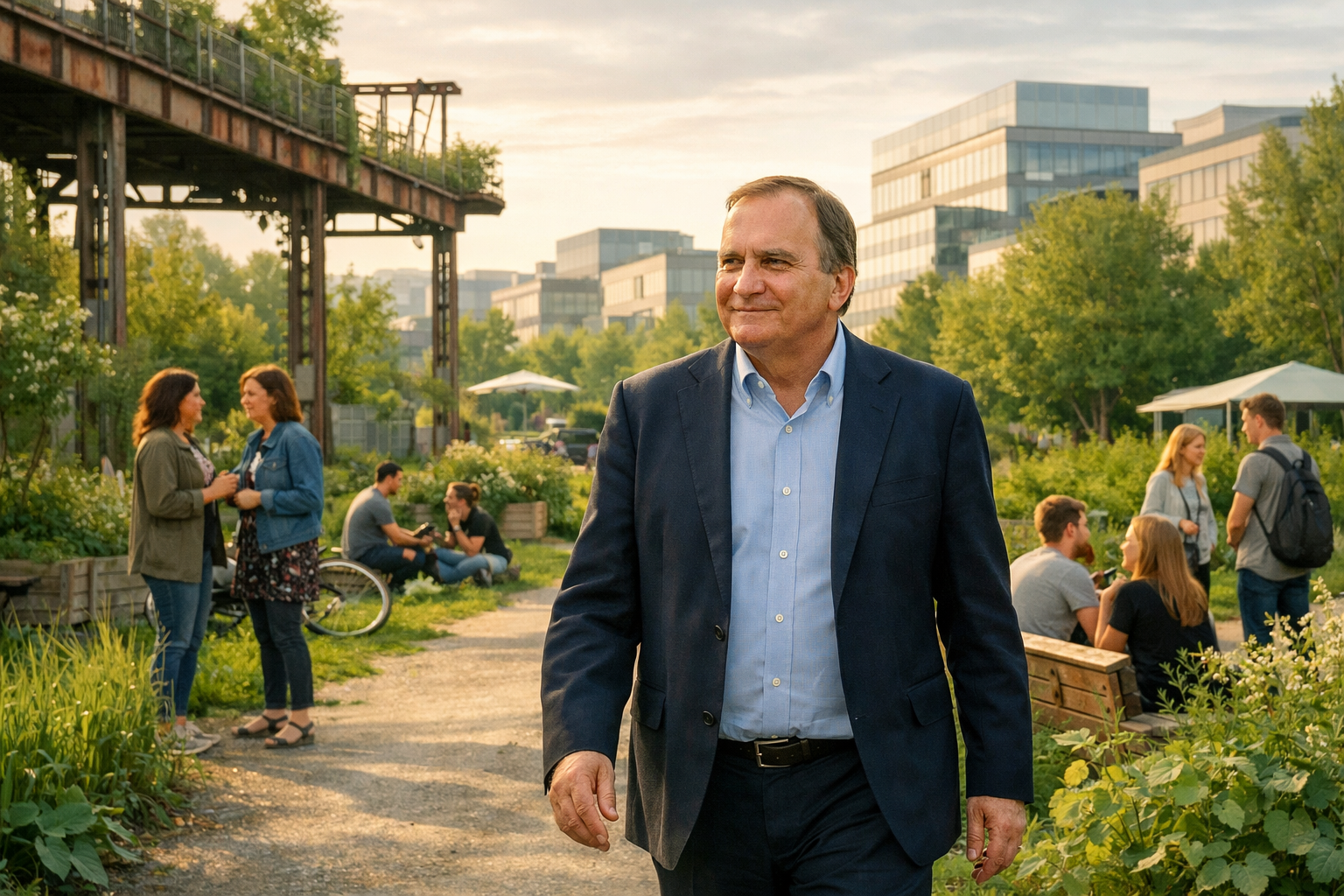
Stefan Löfven
Introduction — The Unlikely Leader of a Transitional Era
Political history often remembers charismatic reformers, ideological revolutionaries, and national crisis figures. Yet modern democratic societies are frequently shaped just as profoundly by leaders whose primary contribution lies in preserving stability during periods of structural change. Stefan Löfven represents this latter category. Rising not from traditional elite political pipelines but from trade union leadership, Löfven embodied a distinct model of modern social democratic leadership — one rooted in negotiation, institutional trust, and incremental system maintenance rather than ideological spectacle.
Löfven’s tenure as Sweden’s prime minister unfolded during one of the most complex transitional periods in modern European history. The country faced pressures from globalization, migration debates, digital economic transformation, rising populism, and shifting geopolitical realities. His leadership style reflected a belief that democratic stability depends not on dramatic policy ruptures but on continuous negotiation between competing social interests. In a political era increasingly dominated by polarization and media-driven conflict, Löfven’s leadership represented a quieter but historically vital form of democratic governance: the politics of social cohesion.
The Swedish Model — Social Democracy as Institutional Culture
To understand Löfven’s leadership, one must understand the Swedish political model from which he emerged. Swedish social democracy historically developed not as revolutionary socialism but as negotiated capitalism. The Swedish model rests on several core principles: strong labor unions, coordinated wage bargaining, high taxation combined with expansive public services, and deep institutional trust between government, labor, and business.
Unlike more adversarial capitalist systems, the Swedish model assumes economic conflict can be mediated through institutions rather than pure market competition. This model requires high levels of social trust and institutional legitimacy. Löfven’s background as a trade union leader positioned him naturally within this tradition of negotiated economic governance.
From Industrial Labor to National Leadership
Löfven’s rise from industrial labor union leadership to national political leadership was symbolically significant. It reinforced the Swedish social democratic narrative that political authority can emerge from labor representation rather than elite technocratic or financial backgrounds. This background shaped his governing philosophy. He approached politics less as ideological battle and more as structured negotiation.
Union leadership trains individuals to manage complex multi-stakeholder negotiations. Leaders must balance worker demands, employer constraints, and broader economic realities. Löfven carried this negotiation-centered leadership model into national governance.
Leadership in the Age of Populism
Löfven governed during a period of rising populist pressure across Europe. Populist movements often emerge when citizens perceive institutions as disconnected from everyday economic or cultural concerns. Sweden, like many European democracies, experienced political tensions around migration, economic globalization, and cultural identity.
Löfven’s response to populism reflected a classic social democratic approach: reinforce social stability through material security and institutional fairness. His political messaging often emphasized that strong welfare systems reduce social anxiety and limit populist appeal.
However, governing during populist rise requires balancing institutional defense with responsiveness to citizen concerns. Ignoring populist grievances risks strengthening anti-institutional movements. Overreacting risks undermining core democratic principles. Löfven’s leadership attempted to navigate this narrow path.
Migration, Integration, and the Limits of High-Trust Systems
The European migration crisis tested the limits of high-trust welfare states. Sweden faced intense political debate about how to balance humanitarian commitments with welfare system sustainability and social cohesion. These debates exposed tensions within the social democratic project.
High-trust welfare systems depend heavily on perceived fairness and reciprocity. When citizens believe social benefits are distributed unfairly, institutional trust can erode quickly. Löfven’s leadership required navigating these tensions without abandoning Sweden’s humanitarian identity.
The Psychology of Social Cohesion
Social democratic systems rely heavily on psychological foundations of cooperation. Citizens must believe that institutions are fair, corruption is low, and economic opportunities are broadly accessible. Löfven’s political rhetoric often emphasized solidarity and shared responsibility — core psychological components of social democratic legitimacy.
Economic inequality has psychological effects beyond material deprivation. It can increase social mistrust and political polarization. The Swedish model historically minimized visible inequality to preserve social cohesion.
Economic Globalization and Industrial Transition
Löfven governed during period of accelerating industrial transition driven by automation, digitalization, and global supply chain restructuring. Sweden’s economy required continuous adaptation to remain competitive in high-skill global markets.
Social democratic responses to globalization often emphasize education investment, labor retraining, and public-private cooperation. Löfven’s policy orientation reflected this — preparing workforce for technological change rather than attempting to block globalization.
Technology, Automation, and the Future of Labor
Automation challenges traditional labor-based political identities. If automation reduces industrial labor demand, social democratic parties must adapt to represent broader economic coalitions. Löfven’s leadership reflected early stage of this transition.
The future of labor politics may depend on ability to represent knowledge workers, service workers, and gig economy workers alongside traditional industrial labor.
The Pandemic and Crisis Governance
The COVID-19 pandemic introduced new dimension to democratic governance. Leaders had to balance public health restrictions with economic stability and civil liberties. Sweden’s pandemic response attracted international attention for its unique strategy compared to other European nations.
The crisis highlighted central challenge of democratic leadership: managing scientific uncertainty while maintaining public trust. Löfven’s leadership style emphasized institutional coordination and expert consultation.
Climate Transition and Industrial Policy
Climate transition represents major industrial transformation. Sweden’s climate policy strategy emphasizes green industrial development rather than purely regulatory approaches. Löfven supported policies integrating environmental sustainability with economic competitiveness.
The Limits of Incrementalism
Critics argue incremental social democratic governance may be insufficient for addressing rapid climate change, technological inequality, or global financial instability. Supporters argue incrementalism preserves democratic legitimacy and prevents social backlash.
Löfven’s leadership reflects this tension. Incremental change can appear insufficient during crisis but may produce more stable long-term outcomes.
European Integration and National Sovereignty
Löfven governed within complex European institutional framework balancing national policy autonomy with EU economic coordination. European integration creates both economic stability and political complexity.
Legacy — The Negotiator Model of Leadership
Löfven may be remembered less for dramatic reforms and more for maintaining social democratic stability during period of global disruption. Democratic systems often rely on negotiator leaders during transitional eras.
Democracy, Labor, and Moral Economy
Löfven’s political philosophy reflects belief that democracy requires strong labor representation and economic fairness. Without material stability, democratic participation weakens.
Conclusion — Social Cohesion as Democratic Infrastructure
The defining political challenge of the twenty-first century may be preserving social cohesion during rapid technological and economic transformation. Löfven’s leadership model emphasizes negotiation, institutional trust, and incremental adaptation.
In an era of polarization and disruption narratives, leaders focused on system maintenance may become increasingly important. Democratic systems do not survive solely through reform. They survive through continuous maintenance of legitimacy.
Löfven’s career reflects a fundamental truth of democratic history: societies are often stabilized not by their most radical reformers but by their most patient negotiators. In an age of rapid change, this form of leadership may become more, not less, important.
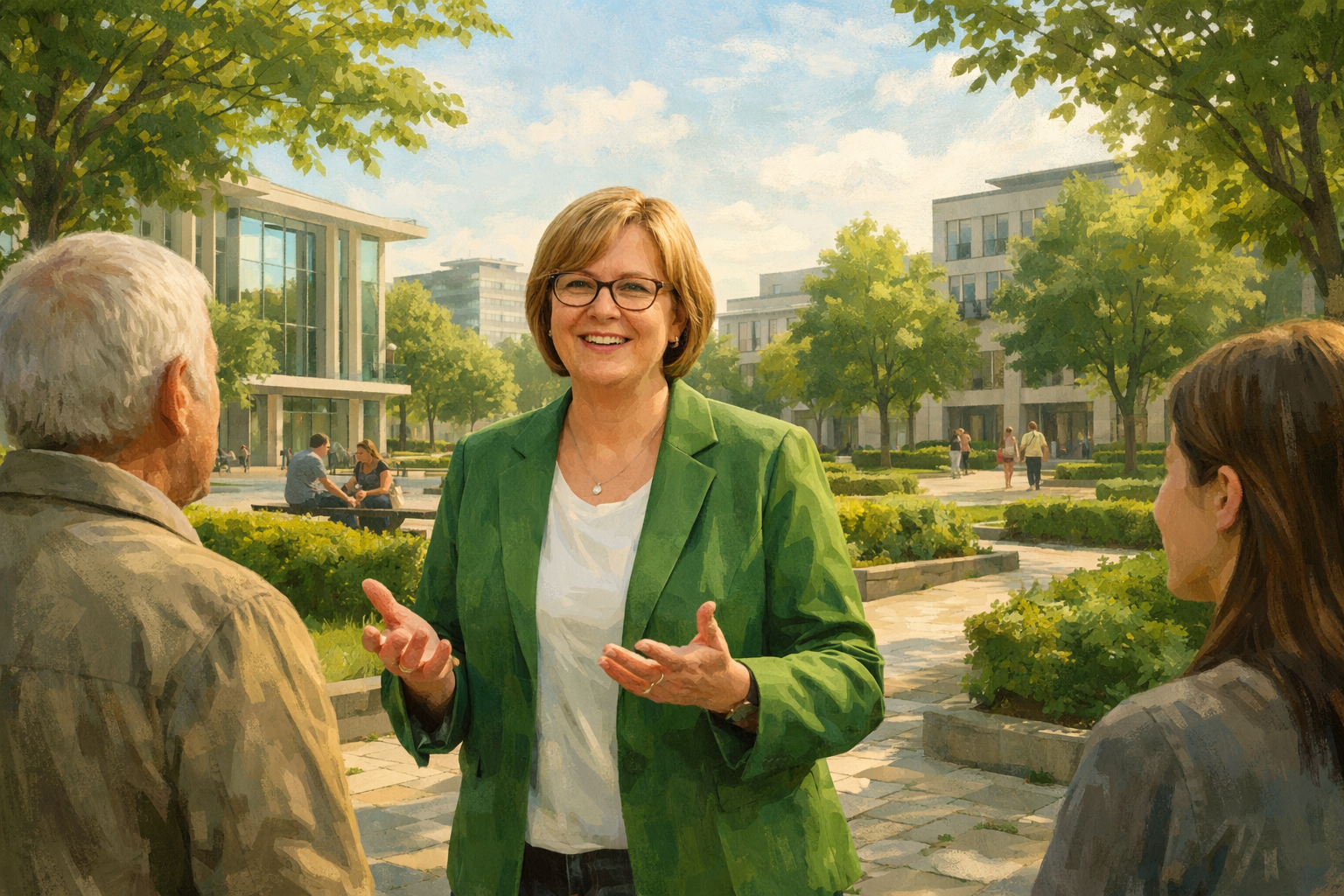
Bärbel Bas
Introduction — Democracy and the Return of Grounded Leadership
Across advanced democracies, a quiet but profound political anxiety has emerged: the fear that democratic institutions are slowly drifting away from the everyday lives of the citizens they are meant to represent. This anxiety is not always ideological. It is often sociological and emotional. Many citizens increasingly feel that political leadership is dominated by technocrats, media personalities, and professional political classes disconnected from lived economic reality. In this context, leaders whose biographies remain visibly rooted in ordinary social experience take on symbolic as well as institutional significance.
Bärbel Bas represents this type of leadership. Her rise to high institutional authority within German democracy is significant not only because of her policy positions or party affiliation, but because of what she represents symbolically: continuity between democratic institutions and working social reality. At a time when many voters fear that political elites have become socially and culturally distant, Bas represents a model of democratic legitimacy grounded in social recognizability — leadership that feels reachable rather than abstract.
Her political importance lies in a broader historical transition. European social democracy is moving from its industrial mass-party past toward a new era defined by fragmented labor markets, digital economies, and shifting class identities. In this transition, leaders who can maintain democratic legitimacy across social divides may become increasingly important.
Germany’s Post-War Democratic Architecture and the Role of Social Democracy
Germany’s modern political system was built deliberately after the Second World War to prevent both authoritarian concentration of power and destabilizing political fragmentation. The Federal Republic’s constitutional and political architecture emphasizes institutional stability, federalism, and coalition governance. Within this system, the Social Democratic tradition historically played a central role in embedding social welfare, labor representation, and economic fairness into democratic capitalism.
Unlike revolutionary socialist traditions, German social democracy evolved into a system-stabilizing force. It accepted market capitalism but insisted that markets operate within social guardrails. Bärbel Bas emerges from this tradition. Her political philosophy reflects a belief that democracy must not only function procedurally but must be experienced as fair in everyday life.
In post-industrial Europe, this mission has become more difficult. The decline of traditional industrial labor has weakened the old social democratic coalition. New social democratic leadership must represent more fragmented social constituencies: service workers, public sector workers, precarious workers, and knowledge economy professionals. Bas’s political profile reflects this transition from industrial labor representation to broader social dignity representation.
Working-Class Representation in a Post-Industrial Political Era
One of the defining political challenges of modern European democracy is maintaining working-class representation in an economy where traditional industrial labor is declining. In many countries, working-class political identity has fragmented. Some voters have moved toward populist movements. Others toward identity-based political coalitions. Others toward political disengagement.
Bas represents a form of working-class political continuity. Her public presence signals that democratic institutions remain open to leaders who understand the everyday experience of wage labor, social insecurity, and public service systems. This symbolic function is politically important. Democracies depend not only on procedural fairness but on perceived representational authenticity.
When citizens believe that political institutions are populated exclusively by elite professional classes, democratic legitimacy can weaken even if policy outcomes remain socially protective. Representation is psychological as well as institutional.
Institutional Leadership and the Meaning of Parliamentary Authority
Bas’s role in parliamentary leadership represents a particular form of democratic authority — not executive charisma but procedural legitimacy. Parliamentary systems depend heavily on procedural trust. Citizens must believe that debate rules are fair, opposition voices are protected, and institutional processes operate without corruption or manipulation.
In modern media environments, procedural leadership is often undervalued. It lacks spectacle. Yet historically, parliamentary procedural authority is one of the foundations of democratic stability. Leaders who protect institutional fairness perform invisible but essential democratic labor.
Bas’s leadership reflects a political philosophy in which democracy is not primarily about personality dominance but about maintaining fair institutional frameworks within which competing political visions can operate peacefully.
The Psychology of Dignity and Democratic Participation
Democratic stability is deeply connected to psychological perceptions of dignity. Citizens are more likely to participate in democratic systems when they feel socially respected and economically visible. Economic inequality alone does not destabilize democracies. Visible social humiliation does.
Social democratic political traditions historically focus heavily on dignity. Welfare systems, labor protections, and public services all function partly as dignity-preserving institutions. Bas’s political rhetoric often emphasizes respect for ordinary work and public service labor. This is not merely symbolic. It reinforces psychological foundations of democratic legitimacy.
Populism and the Crisis of Social Recognition
Populist movements often gain traction not only through economic grievance but through perceived social invisibility. Many voters feel culturally ignored by political elites. Leaders like Bas can function as bridges between institutional politics and socially marginalized groups.
However, representation alone cannot defeat populism. Material security and visible fairness must accompany symbolic inclusion. Bas’s political orientation reflects a belief that social policy must remain central to democratic stability.
Migration, Diversity, and Social Cohesion
Germany faces ongoing challenges balancing immigration, labor market needs, and social cohesion. High-functioning welfare states depend heavily on perceived fairness and reciprocity. Maintaining social cohesion requires careful policy communication and social integration strategies.
Leaders like Bas play important role in framing integration not as zero-sum competition but as shared social project. This framing is essential for maintaining high-trust democratic societies.
Technology, Automation, and the Future of Social Representation
Automation and AI are reshaping labor identity. Traditional class politics based on industrial labor may become less politically central. New forms of labor insecurity — gig work, algorithmic management, digital surveillance labor — are emerging.
Future social democratic leadership must represent workers whose labor relationships are fragmented and technologically mediated. Bas represents early phase of this transition — maintaining dignity politics in rapidly changing labor landscape.
The Welfare State as Democratic Infrastructure
Modern welfare states function not only as economic redistribution systems but as democratic infrastructure. They maintain baseline social stability required for democratic participation. Leaders like Bas emphasize protecting these systems not as ideological project but as democratic necessity.
The Challenge of Political Communication in Fragmented Media
Modern political communication environments reward conflict, outrage, and polarization. Institutional leadership styles emphasizing procedure and stability often struggle for media visibility. Bas’s political model challenges assumption that effective leadership must be media-dominant leadership.
European Integration and Social Democracy’s Future
European integration complicates national social democratic policy autonomy. Leaders must balance EU economic frameworks with domestic social expectations. Bas operates within this multi-layered governance environment.
Criticism and Political Constraints
Critics may argue working-class symbolic representation is insufficient without structural economic transformation. Others argue strong welfare states may face fiscal pressure under demographic aging and global capital mobility. Bas’s political generation must navigate these structural constraints.
Gender, Leadership, and Institutional Authority
Bas’s leadership also contributes to long-term normalization of female institutional authority in European democratic systems. Representation of leadership diversity contributes to institutional legitimacy over time.
Legacy — Democratic Grounding in an Abstract Age
Bas may be historically remembered less for ideological transformation and more for reinforcing democratic grounding during period of increasing political abstraction. Modern governance increasingly involves digital policy, global finance, and technical regulatory frameworks. Leaders who maintain visible social grounding may become increasingly valuable.
Democracy as Lived Experience
Bas’s political symbolism reinforces idea that democracy must be lived experience, not abstract structure. Citizens must feel seen within democratic systems. Representation, dignity, and fairness remain foundational to democratic legitimacy.
Conclusion — The Future of Grounded Democratic Leadership
The defining challenge of twenty-first century democracy may be maintaining legitimacy in systems that are becoming increasingly complex, technical, and globalized. Leaders like Bärbel Bas represent emerging model of democratic grounding — leadership that maintains connection between institutional authority and everyday social reality.
Democratic systems cannot survive on technocratic competence alone. They require emotional legitimacy. They require representation that feels socially authentic. They require leaders who remind citizens that democratic institutions remain rooted in the lives of ordinary people.
In an era of algorithmic governance, global capital flows, and geopolitical instability, grounded democratic leadership may become increasingly essential. The future of democratic legitimacy may depend not only on policy outcomes but on whether citizens continue to see themselves reflected inside democratic institutions. Leaders like Bas represent an attempt to preserve that reflection — and with it, the psychological foundation of democracy itself.

Luís Montenegro
Introduction — The Return of Credibility Politics
Modern European politics has entered a phase defined less by ideological grand narratives and more by the search for credibility. After the global financial crisis, the eurozone sovereign debt crisis, the pandemic shock, and renewed geopolitical instability, many voters have become less interested in sweeping ideological transformation and more focused on whether governments can maintain stability, growth, and institutional reliability. In this environment, center-right leadership has increasingly framed itself around a concept that might be called credibility politics — the idea that democratic legitimacy depends on governments demonstrating fiscal seriousness, administrative competence, and economic predictability.
Luís Montenegro’s political trajectory reflects this shift. He represents a generation of center-right leadership emerging after the crisis years, operating in political environments shaped by economic trauma, populist pressure, and European institutional complexity. His political positioning is less ideological than structural. It is built around restoring confidence in governance systems — confidence among voters, financial markets, European partners, and domestic institutions. In the contemporary European political context, credibility itself has become political ideology.
Portugal’s Democratic Evolution and the Burden of Economic Memory
Portugal’s modern democratic identity cannot be separated from its economic and political transitions since the late twentieth century. Integration into the European Union brought economic modernization, infrastructure development, and increased global market integration. However, it also created structural dependency on global capital flows and European fiscal frameworks. The sovereign debt crisis left a deep imprint on Portuguese political psychology. For many citizens, the crisis demonstrated that national economic sovereignty was more limited than previously believed.
Leaders emerging after this period must operate in a political environment shaped by economic memory. Voters remember austerity, unemployment spikes, and the feeling that external financial actors could influence domestic political choices. Montenegro’s political messaging reflects awareness of this context. Center-right economic policy must now be framed not simply as market-friendly but as socially stabilizing. Fiscal discipline must be presented not as ideological purity but as protection against future crisis vulnerability.
Center-Right Politics After Globalization Optimism
The late twentieth century center-right political tradition was often built on globalization optimism. Free trade, financial liberalization, and market deregulation were framed as engines of growth and prosperity. However, post-2008 politics forced reevaluation of this narrative. Many center-right parties now emphasize economic resilience alongside market openness.
Montenegro’s political orientation reflects this shift. Rather than advocating pure market liberalization, contemporary European center-right leadership often emphasizes balanced growth: encouraging private sector dynamism while maintaining fiscal sustainability and social stability. This reflects broader ideological transition across European conservatism — from pure market expansion toward managed market globalization.
Credibility as Political Currency
In post-crisis democracies, credibility functions as political currency. Citizens want to believe governments understand economic constraints and will not pursue policies that risk systemic instability. Financial markets similarly evaluate political stability through credibility signals — fiscal discipline, predictable regulatory frameworks, and institutional continuity.
Montenegro’s political style often emphasizes seriousness and predictability. This is not accidental. In volatile political environments, emotional political mobilization can generate short-term support but long-term economic instability. Credibility politics attempts to align democratic legitimacy with economic stability.
The Moral Dimension of Fiscal Governance
Fiscal policy debates are often framed in technical terms — debt ratios, budget deficits, growth projections. But democratic fiscal policy is also moral statement about intergenerational responsibility. High debt burdens can limit future democratic policy flexibility. However, excessive fiscal austerity can undermine social cohesion and long-term economic productivity.
Modern center-right governance increasingly frames fiscal discipline as stewardship. Governments are not only managing present economic conditions but protecting future economic sovereignty. Montenegro’s political messaging often reflects this moral framing of fiscal responsibility.
Populism and the Challenge of Democratic Moderation
Populism presents major challenge to moderate center-right governance. Populist movements often frame mainstream political parties as disconnected elites prioritizing financial markets over citizens. Center-right parties must respond without abandoning economic credibility.
Montenegro operates within this political tension. If center-right leadership appears too technocratic, it risks reinforcing populist narratives of elite detachment. If it adopts populist economic rhetoric, it risks undermining financial credibility. Balancing these pressures is one of the defining challenges of modern European center-right leadership.
The Psychology of Economic Stability
Economic stability produces psychological stability. Citizens who feel economically secure are more likely to trust institutions, participate in democratic systems, and resist extremist narratives. Center-right political traditions historically emphasize stability as foundation for social order.
Montenegro’s political positioning reflects this belief. Economic growth and fiscal stability are framed not only as economic outcomes but as social stabilizers.
European Integration and National Policy Constraints
Portugal operates within complex European economic governance framework. Eurozone membership limits monetary policy autonomy. Fiscal rules constrain national budget flexibility. At the same time, European integration provides economic stability and market access.
Montenegro’s leadership must navigate this structural reality. European cooperation must be balanced with domestic democratic legitimacy. European political leadership increasingly requires multi-level governance competence.
Technology, AI, and Economic Competitiveness
Artificial intelligence and automation are reshaping global economic competition. European economies face pressure from American and Asian technology sectors. Center-right economic policy increasingly emphasizes innovation ecosystems, digital infrastructure investment, and workforce education.
Montenegro’s broader political generation operates within this technological transition. Economic competitiveness is no longer purely industrial. It is increasingly digital and knowledge-based.
Energy, Climate, and Industrial Transition
Climate transition is reshaping European industrial policy. Center-right climate strategies increasingly emphasize green industrial competitiveness rather than purely regulatory environmental policy. Montenegro’s political context reflects this broader European shift — climate transition as economic modernization strategy.
Criticism and Structural Constraints
Critics argue center-right credibility politics can drift toward technocratic detachment. Others argue fiscal discipline frameworks may limit public investment in long-term economic transformation. Others argue global capital mobility constrains national economic policy more than political rhetoric acknowledges.
Montenegro’s political generation must operate within these structural realities.
Generational Political Transition
European center-right politics is undergoing generational transition. Younger voters often prioritize climate policy, economic fairness, and technological regulation alongside traditional center-right economic priorities. Montenegro’s leadership exists within this evolving political landscape.
Legacy — The Credibility Steward Model
Montenegro may be remembered less as ideological transformer and more as steward of economic credibility during politically volatile period. Democratic systems often depend on leaders capable of maintaining institutional and economic stability during transition phases.
Democratic Capitalism and Legitimacy
Modern democratic capitalism requires balance between market efficiency and social legitimacy. Economic growth alone cannot sustain democratic stability if inequality or insecurity becomes politically visible. Center-right political traditions increasingly acknowledge this balance.
Conclusion — Stability, Credibility, and Democratic Continuity
The defining political challenge of the twenty-first century may be maintaining democratic legitimacy during rapid economic, technological, and geopolitical change. Montenegro’s leadership model reflects attempt to preserve democratic capitalism through credibility, fiscal stewardship, and institutional continuity.
In an era where political discourse often rewards ideological extremity and emotional mobilization, credibility politics may appear unexciting. Yet historically, democratic survival has often depended on leaders capable of maintaining stability during periods of structural uncertainty.
Montenegro’s political significance lies in representing this quieter form of leadership — one focused less on transforming democratic systems and more on ensuring they continue to function. In an age of fragmentation, credibility itself may become one of the most valuable political resources.
The future of European democracy may depend not only on visionary reform but on leaders capable of preserving institutional trust, economic predictability, and democratic legitimacy in a world defined increasingly by uncertainty. Montenegro’s political career reflects this emerging political reality: that stability, when paired with legitimacy, is not political stagnation but democratic preservation.
Sorin-Mihai Grindeanu
Introduction — Governing in the Shadow of Transition
To understand contemporary Romanian politics, one must first understand that Romania is still living in the long shadow of systemic transition. The fall of state socialism in Eastern Europe did not simply replace one political system with another. It initiated decades of institutional rebuilding, economic restructuring, and identity renegotiation. The transition to democratic capitalism created opportunities for growth and European integration, but it also produced structural inequalities, governance challenges, and persistent public skepticism toward political institutions.
Sorin-Mihai Grindeanu represents a generation of Romanian political leadership operating within this transitional legacy. His political career unfolded during a period when Romania was no longer an emerging democracy but not yet a fully stabilized high-trust Western European state. The political task facing leaders like Grindeanu has been less about ideological transformation and more about strengthening state capacity — the ability of the state to deliver infrastructure, public services, and economic development in a way that citizens perceive as fair and effective.
In this context, Romanian politics cannot be understood purely through ideological categories like left and right. It must be understood through the lens of institutional development. The central political question is not only who governs, but whether governance itself functions reliably.
Romania’s Post-Communist Political Economy — Growth Without Full Convergence
Romania’s economic trajectory since European Union accession has been paradoxical. The country has experienced strong GDP growth, rapid integration into European supply chains, and increasing foreign investment. Yet convergence with Western European living standards remains incomplete. Regional inequality remains pronounced. Infrastructure gaps persist. Public service quality varies significantly across regions.
This creates political environment in which development politics dominates ideological politics. Citizens are less concerned with abstract economic philosophy and more concerned with visible outcomes: roads, hospitals, digital services, and job stability. Grindeanu’s political positioning reflects this reality. His governance approach has often emphasized infrastructure development, transport policy, and administrative capacity.
In developing or semi-converging economies, infrastructure policy becomes political legitimacy policy. Citizens evaluate the state based on whether it visibly improves daily life.
The Politics of Infrastructure and Material Legitimacy
Infrastructure is not simply economic investment. It is symbolic proof that the state functions. Roads, rail networks, and digital infrastructure signal national modernization and European integration. In post-transition states, infrastructure gaps are often interpreted as evidence of institutional weakness or corruption.
Grindeanu’s policy focus on infrastructure and transport reflects understanding that development politics is central to democratic legitimacy in Romania. Citizens who see visible improvements in infrastructure are more likely to trust state institutions. Infrastructure becomes physical representation of democratic progress.
This form of legitimacy is particularly important in post-communist societies, where historical memory includes both state overreach and state failure. Modern democratic states must demonstrate effectiveness without reproducing authoritarian patterns.
The Legacy of Institutional Distrust
Romania’s political culture has been shaped by historical experiences of centralized authoritarian governance followed by chaotic transitional liberalization. This history produces persistent institutional skepticism. Citizens often assume political institutions are inefficient or corrupt unless proven otherwise.
Leaders like Grindeanu operate within this trust deficit environment. Policy success alone is insufficient. Governance must also appear transparent and accountable. Trust must be built through visible outcomes rather than rhetorical promises.
Institutional trust in post-transition democracies often grows through cumulative demonstration of competence rather than ideological persuasion.
European Integration and the Sovereignty Paradox
European Union membership has transformed Romania’s economic and political trajectory. EU integration has provided regulatory frameworks, infrastructure funding, and market access. But it has also created sovereignty tensions. National governments must implement European regulatory standards while maintaining domestic democratic legitimacy.
Grindeanu’s political generation must navigate this sovereignty paradox. EU integration provides development resources but can also produce perception of external constraint on domestic policy choice. Successful political leadership in this environment requires translating EU policy frameworks into visible national development outcomes.
Corruption, Anti-Corruption, and Political Polarization
Romania’s political environment has been shaped significantly by anti-corruption politics. Anti-corruption campaigns have played essential role in strengthening rule of law. But they have also contributed to political polarization and institutional conflict.
Leaders like Grindeanu must navigate complex terrain where anti-corruption enforcement, political competition, and institutional stability intersect. The challenge is maintaining rule of law while avoiding permanent institutional warfare that can undermine governance capacity.
Post-transition democracies often struggle to balance anti-corruption reform with administrative stability. Excessive politicization of anti-corruption can weaken governance if it creates permanent institutional crisis.
Populism and Post-Transition Political Identity
Populism in Eastern Europe often differs from Western European populism. It is frequently linked to economic transition trauma, regional inequality, and perceived uneven distribution of EU integration benefits. Populist narratives often frame political elites as beneficiaries of transition while ordinary citizens bore costs.
Grindeanu’s political environment reflects this structural tension. Development policy becomes central anti-populist strategy. If economic convergence visibly improves living standards, populist narratives lose traction. If convergence stalls, populism strengthens.
The Psychology of Development and Democratic Legitimacy
Economic development has powerful psychological effects. Citizens in developing economies often measure democratic success through material improvement rather than procedural democracy alone. Infrastructure expansion, wage growth, and public service improvement reinforce democratic legitimacy.
Grindeanu’s political focus reflects this developmental legitimacy model. In such systems, democratic stability depends on continuous material progress.
Technology, Digitalization, and State Modernization
Romania’s rapid digital sector growth creates both opportunity and political challenge. Technology sectors can accelerate economic convergence. But they can also create internal inequality between high-skill digital workers and traditional labor sectors.
Modern state capacity increasingly requires digital governance infrastructure. Public administration digitalization becomes central to reducing corruption risk and increasing service efficiency.
Grindeanu’s political generation operates during transition from industrial development politics to digital development politics.
Geopolitics and Eastern European Security Context
Romania’s geopolitical position places it on frontline of European security concerns. Regional instability, NATO commitments, and EU security integration shape domestic political priorities. National security increasingly intersects with economic and infrastructure policy.
Transport infrastructure and energy networks have both economic and security implications. Development policy becomes partially geopolitical policy.
The Limits of Catch-Up Development
Romania faces structural limits common to middle-income convergence economies. Rapid early growth can slow as economies approach higher-income status. Maintaining convergence requires moving into higher value-added sectors and improving institutional quality.
Leaders like Grindeanu must manage transition from growth-through-integration to growth-through-innovation.
Criticism and Political Constraints
Critics argue development-focused governance can underemphasize institutional reform. Others argue infrastructure politics can be vulnerable to patronage or inefficient investment. Others argue convergence depends more on EU structural conditions than domestic political leadership.
Grindeanu’s political career exists within these structural constraints.
Legacy — The State Capacity Builder Archetype
Grindeanu may ultimately be remembered as part of political generation focused on strengthening state capacity rather than ideological transformation. Post-transition democracies often require decades of capacity-building leadership before ideological politics becomes dominant.
Democracy as Delivery System
In post-transition political environments, democracy is evaluated partly as delivery system. Citizens judge democracy by whether it improves material life. This differs from mature high-trust democracies where legitimacy may rely more on procedural norms.
Grindeanu’s political environment reflects this delivery-legitimacy model.
Conclusion — Development, Legitimacy, and the Future of Post-Transition Democracy
Romania’s long-term democratic stability will depend on successful completion of institutional and economic convergence with Western Europe. Leaders like Sorin-Mihai Grindeanu represent transitional leadership phase focused on strengthening state capacity, infrastructure delivery, and economic modernization.
The political challenge facing post-transition democracies is balancing rapid development with democratic accountability. Too much focus on development risks institutional weakness. Too much focus on procedural politics risks economic stagnation.
The future of Romanian democracy may depend on leaders capable of integrating development policy with institutional legitimacy. In this sense, Grindeanu represents broader political archetype emerging across post-transition Europe: the state capacity builder. Not revolutionary. Not purely ideological. But essential to long-term democratic consolidation.
In a world increasingly defined by geopolitical competition, technological disruption, and economic volatility, state capacity itself may become one of the most important democratic assets. Leaders operating in post-transition systems will be judged not only by political rhetoric but by their ability to build states that function reliably, deliver growth sustainably, and maintain democratic legitimacy simultaneously.

Gabriel Boric
In the early decades of the twenty-first century, many democracies entered a phase defined by generational turnover and ideological reevaluation. The political frameworks that dominated the late twentieth century — particularly market liberalization and globalization optimism — began to face growing public skepticism. Rising inequality, housing crises, precarious labor markets, and declining institutional trust produced new political movements demanding structural reform. In this context, Gabriel Boric emerged as a symbol of generational political transition — a leader shaped not by Cold War ideological divisions but by post-financial crisis inequality politics and student-led social movements.
Boric’s presidency represents more than a national political shift. It reflects a broader global trend: the rise of leaders whose political legitimacy comes from social movement roots rather than traditional party machines. His leadership illustrates both the promise and the difficulty of translating protest legitimacy into governing legitimacy. Modern protest movements often excel at diagnosing systemic injustice. Governing requires negotiating institutional constraints, economic realities, and geopolitical pressures.
Boric’s political career exists at the intersection of moral ambition and structural limitation. He represents a generation determined to address inequality more aggressively, but operating within global economic systems that constrain national policy autonomy.
Chile’s Economic Model — Success and Discontent
Chile has long been viewed as one of Latin America’s most economically stable and globally integrated economies. Market reforms implemented during the late twentieth century produced strong growth, export competitiveness, and macroeconomic stability. However, these reforms also produced high inequality, expensive privatized social services, and strong perception of economic unfairness.
For decades, Chile functioned as a model of market-driven development combined with democratic governance. But beneath macroeconomic success, social tensions grew. High education costs, pension insecurity, healthcare inequality, and housing affordability pressures generated widespread frustration.
The social protests that preceded Boric’s rise were not purely economic. They were moral. Protesters were not simply demanding redistribution. They were demanding recognition — recognition that economic systems should provide dignity as well as growth.
The Protest Generation and Political Transformation
Boric emerged from student protest movements that challenged the cost and structure of higher education in Chile. These movements reflected broader generational political shift. Younger voters increasingly rejected the idea that economic growth alone justified inequality. They demanded structural reform to education, pensions, and healthcare.
This generational political shift mirrors similar movements globally. Younger voters exposed to post-2008 economic precarity often prioritize fairness, social protection, and structural reform more strongly than previous generations shaped by Cold War ideological competition.
Boric’s political legitimacy was initially rooted in protest authenticity — perceived alignment with everyday social struggles rather than elite political negotiation.
From Protest Legitimacy to Governing Legitimacy
One of the most difficult transitions in modern democratic politics is moving from protest leadership to governing leadership. Protest politics rewards moral clarity, ideological consistency, and confrontation with power structures. Governing requires compromise, incremental policy design, and coalition negotiation.
Boric’s presidency has reflected this tension. He must maintain movement legitimacy while demonstrating governing competence. This balancing act defines modern movement-based leadership globally.
Inequality as Democratic Risk
Chile’s political transformation reflects broader global recognition that inequality is not only economic issue but democratic stability issue. High inequality increases political polarization, reduces institutional trust, and increases populist vulnerability.
Boric’s political framework treats inequality as systemic democratic threat rather than purely social justice issue. His policy agenda attempts to rebalance economic growth and social fairness.
The Moral Economy of Post-Neoliberal Politics
Post-neoliberal political movements do not necessarily reject markets entirely. Instead, they attempt to re-embed markets within stronger social protection systems. Boric’s political philosophy reflects this approach — markets remain important, but social services must be more universal and accessible.
This reflects global shift toward mixed economic models combining market competition with stronger social regulation.
The Constitutional Moment and Democratic Legitimacy
Chile’s constitutional reform process reflected deep national attempt to renegotiate social contract. Constitutional politics often emerge during periods when citizens believe existing institutional frameworks no longer reflect social reality.
Although constitutional reform outcomes have been contested, the process itself reflects deeper democratic renewal effort — citizens demanding greater participation in defining economic and political structures.
Populism, Reform, and Democratic Stability
Latin American political history includes cycles of reform movements followed by populist backlash or institutional instability. Boric’s political challenge is achieving structural reform without triggering economic instability or institutional crisis.
Balancing reform ambition with macroeconomic credibility is central challenge of modern progressive governance in globalized economies.
The Psychology of Dignity and Recognition
Many political scientists increasingly argue that modern political conflict is driven as much by dignity and recognition as by income inequality. Citizens want systems that recognize their contribution and provide security.
Boric’s political rhetoric often emphasizes dignity — particularly labor dignity, student dignity, and social citizenship dignity.
Climate Policy and Resource Economics
Chile’s resource economy and renewable energy potential place Boric at center of global climate transition politics. Climate policy in resource-exporting economies must balance environmental responsibility with economic stability.
Globalization After Neoliberalism
Chile’s future economic model likely involves balancing export competitiveness with stronger domestic social protection. Boric represents attempt to redefine globalization relationship — maintaining openness while strengthening domestic social contract.
Technology, Automation, and Future Inequality
Automation and AI could reshape Latin American labor markets dramatically. If productivity gains concentrate among capital owners, inequality could increase further. Boric’s political generation must confront this technological inequality risk.
Geopolitical Position and Strategic Autonomy
Chile must navigate economic relationships with the United States, China, and global commodity markets. Middle-power states must balance economic integration with strategic autonomy.
Criticism and Structural Constraints
Critics argue reform ambitions may exceed fiscal capacity. Others argue reform speed risks capital flight or economic instability. Others argue movement-based leadership can struggle with institutional governance complexity.
Boric’s presidency exists within these constraints.
Legacy — The Post-Neoliberal Transition Leader
Boric may be historically remembered as transitional leader helping shift Chile from pure market development model toward hybrid social market model.
Democracy, Markets, and Social Legitimacy
The central question of Boric’s political project is whether democratic capitalism can remain legitimate if it fails to provide broad social security. This question defines political debates across the world.
Conclusion — Renewal Without Collapse
The defining challenge of Boric’s presidency is achieving structural reform without destabilizing democratic institutions or economic stability. His leadership represents attempt to update democratic capitalism rather than replace it.
Boric represents new generation of leaders attempting to reconcile economic globalization, social justice, and democratic legitimacy. Whether this project succeeds will shape not only Chile’s future but broader global debates about inequality, democracy, and market governance.
The long-term political significance of Boric may lie less in specific policies and more in whether democratic systems can adapt to inequality without collapsing into either populist authoritarianism or technocratic oligarchy. His political project represents attempt to build third path — democratic reform grounded in social legitimacy and economic realism.

Gustavo Petro
Introduction — A Presidency That Represents a Historical Turn
Gustavo Petro’s rise to the presidency of Colombia represents one of the most symbolically significant political transitions in modern Latin American history. For decades, Colombia’s political system was dominated by centrist and center-right coalitions, shaped heavily by internal armed conflict, elite political continuity, and security-focused governance. Petro’s election marked the first time a left-wing leader with roots in insurgent political history — later transformed into democratic institutional politics — assumed national executive power.
Yet Petro’s significance is not simply ideological. It represents a deeper historical moment in Colombia’s political evolution: the attempt to transition from conflict-centered governance toward inequality-centered governance. Colombia’s long internal conflict shaped state institutions, military priorities, and political discourse. Petro’s presidency signals a shift toward confronting structural inequality, land distribution, social exclusion, and historical marginalization as central political questions.
Petro’s political project exists at the intersection of historical memory and future transformation. He represents both the unfinished business of Colombia’s past and the uncertain direction of its democratic future.
Colombia’s Historical Context — Conflict, Inequality, and State Fragmentation
Colombia’s political system cannot be understood without recognizing the interplay between inequality, geography, and armed conflict. For decades, rural inequality, weak state presence in peripheral regions, and drug trafficking economies created conditions for insurgency and paramilitary violence. The Colombian state historically exercised uneven territorial control, creating zones of institutional absence and parallel power structures.
The peace process fundamentally altered Colombia’s political landscape. It opened political space for leaders focused less on security militarization and more on structural reform. Petro’s political rise is inseparable from this post-conflict opening.
However, post-conflict governance introduces new challenges. When armed conflict recedes, citizens shift attention to inequality, corruption, and economic opportunity. Governments must transition from security legitimacy to social legitimacy.
From Insurgent Politics to Institutional Leadership
Petro’s political biography reflects Colombia’s broader historical transition. His early involvement in insurgent politics placed him within radical opposition to state power. His later transition into democratic institutional politics mirrors Colombia’s broader political transformation toward negotiated conflict resolution and democratic inclusion.
This transition is psychologically and politically significant. Leaders emerging from conflict backgrounds often carry deep awareness of state violence, inequality, and marginalization. But they must also adapt to institutional constraints of democratic governance.
Petro’s presidency reflects tension between movement-based political energy and institutional governance requirements — a challenge faced by many post-conflict leaders globally.
Inequality as Structural Political Risk
Colombia is one of the most unequal countries in Latin America. Land concentration, rural underdevelopment, and urban inequality have produced persistent political tension. Petro’s political framework treats inequality not only as social injustice but as structural democratic risk.
High inequality often correlates with political instability, populist cycles, and weak institutional trust. Petro’s policy agenda attempts to reduce inequality through tax reform, land reform, and expanded social programs.
The Moral Economy of Post-Conflict Governance
Post-conflict societies often face moral imperative to address historical injustice. Economic reform becomes part of national reconciliation process. Petro’s rhetoric often frames economic policy as historical correction — addressing legacies of exclusion and marginalization.
However, moral economic framing can create tension with global financial markets and domestic business sectors. Governments must balance moral legitimacy with economic credibility.
Energy Transition and Resource Economy Dilemmas
Colombia’s economy depends heavily on fossil fuel exports. Petro’s climate policy framework emphasizes energy transition away from fossil fuel dependence. This creates fundamental economic dilemma. Resource revenues fund social programs. Rapid transition risks fiscal instability.
Petro’s political project attempts to balance environmental responsibility with economic sustainability. This reflects broader global challenge for resource-exporting economies navigating climate transition.
Populism, Reform, and Institutional Stability
Petro’s political style contains populist elements — direct appeals to marginalized groups, strong moral rhetoric against elite concentration of power. However, he operates within democratic institutional framework.
Left populism often attempts to expand democratic participation rather than restrict it. However, populist governance always carries institutional stability risks if executive authority expands too rapidly.
The Psychology of Historical Recognition
Post-conflict societies often demand recognition as much as redistribution. Citizens want acknowledgment of past suffering and structural exclusion. Petro’s political rhetoric often emphasizes historical recognition — recognizing marginalized communities as full political participants.
Recognition politics can strengthen democratic inclusion but can also intensify political polarization if perceived as exclusionary by other groups.
State Capacity and Reform Constraints
One of the central challenges facing Petro’s presidency is state capacity. Ambitious social reform requires strong administrative capacity. Post-conflict states often struggle with uneven institutional strength.
Tax reform, land reform, and social program expansion all require administrative infrastructure. Political ambition often exceeds administrative capacity in transitional democracies.
Technology, Inequality, and Future Labor Markets
Colombia faces dual economic transformation: industrial modernization and digital economy growth. Automation and AI could increase inequality if education and workforce training lag technological change.
Petro’s political generation must confront risk of technological inequality compounding historical inequality.
Geopolitics and Regional Leadership
Colombia plays important role in Latin American geopolitical balance. Relations with the United States, regional integration efforts, and migration dynamics all shape domestic policy constraints.
Petro’s foreign policy attempts to balance regional autonomy with global economic integration.
Criticism and Political Polarization
Critics argue Petro’s policies risk fiscal instability or investor confidence. Others argue reform pace is insufficient to address structural inequality. Colombia’s political polarization reflects deep structural divisions.
The Post-Conflict Democratic Experiment
Petro’s presidency represents broader experiment: Can post-conflict societies transition from security-focused governance to inequality-focused governance without destabilizing democratic institutions?
Legacy — The Historical Transition Leader
Petro may be remembered as transitional figure representing Colombia’s shift from conflict politics to social justice politics. Whether this transition produces stable democratic reform or political volatility remains open question.
Democracy and Structural Inclusion
Petro’s political project raises fundamental democratic question: Can democracies remain stable if large populations feel permanently excluded from economic opportunity?
Conclusion — Transformation Without Collapse
Petro’s presidency represents attempt to address historical inequality within democratic framework. His success or failure will shape Colombia’s political trajectory and broader Latin American debates about inequality, democracy, and development.
The central challenge facing Petro — and many global leaders — is whether democratic systems can deliver structural reform fast enough to maintain legitimacy without destabilizing economic systems. This balancing act defines twenty-first century democratic governance.
Petro’s political legacy may ultimately depend not on ideological victories but on whether Colombia can achieve more inclusive development while preserving democratic institutional stability. His presidency represents a broader global question: Can democracies transform themselves structurally without collapsing into either authoritarian reaction or institutional paralysis?

Margrethe Vestager
Introduction — The Regulator as Political Actor
For much of the late twentieth century, economic regulation was treated as a technical activity rather than a political one. Regulators were expected to operate quietly, enforcing rules created by legislators and interpreted by courts. But the rise of global digital platforms fundamentally altered this dynamic. Today, regulatory decisions about competition law, data privacy, and platform governance shape global economic power, democratic communication, and geopolitical technological competition. In this new environment, regulators have become central political actors, even if they do not operate through electoral politics.
Margrethe Vestager represents one of the most prominent examples of this transformation. As European Commissioner for Competition and later Executive Vice President for digital and competition policy, she became a central figure in global debates about the power of large technology firms. Her work reflects a broader shift in European political philosophy: the belief that democratic states must actively shape markets rather than passively respond to them.
Vestager’s political significance lies not only in specific regulatory decisions but in redefining the role of democratic governance in global capitalism. In an era where multinational corporations often possess resources and data power exceeding many nation-states, regulatory authority has become one of the primary tools through which democracies assert sovereignty over economic systems.
The European Political Tradition — Markets Embedded in Law
To understand Vestager’s approach to regulation, one must understand the European tradition of market governance. Unlike the United States’ historically more market-permissive regulatory philosophy, the European Union has long treated markets as legal constructs rather than natural systems. Markets, in this tradition, exist because legal frameworks allow them to exist. Therefore, democratic governments retain responsibility for shaping market outcomes to preserve fairness and competition.
European competition law historically focused not only on consumer prices but on market structure and competitive access. This tradition proved particularly relevant in the digital era, where platform companies often provide free services while accumulating structural market dominance.
Vestager’s regulatory philosophy reflects this European tradition. Competition is not simply economic outcome. It is democratic value. When markets become structurally closed, democratic opportunity narrows.
The Platform Economy and the Return of Structural Competition
Digital platforms introduced new forms of economic concentration that traditional regulatory frameworks struggled to address. Platforms often operate through network effects — the more users they attract, the more valuable they become. Data accumulation compounds this advantage. Infrastructure control creates barriers to entry that are difficult for new competitors to overcome.
Vestager’s regulatory agenda focused on these structural dynamics. Rather than focusing solely on pricing behavior, European regulators increasingly examine how platforms control digital ecosystems. Search engines, app stores, cloud infrastructure, and digital advertising networks can shape entire economic sectors.
This reflects broader intellectual shift in competition law — from transactional competition to structural competition.
Regulation as Democratic Sovereignty
Vestager’s work reflects deeper philosophical argument: economic sovereignty is increasingly tied to regulatory sovereignty. In global digital markets, governments cannot easily control production or capital flows. But they can still control market access rules, competition standards, and data governance frameworks.
European regulatory strategy has increasingly focused on using regulatory power as geopolitical economic tool. By setting global regulatory standards, the EU can shape global market behavior even without dominating technology production itself.
Vestager’s regulatory leadership helped position Europe as global rule-setter in digital market governance.
The Psychology of Fair Markets
Market legitimacy is psychological as well as economic. Citizens must believe markets are fair to trust capitalism. When large technology platforms appear untouchable or structurally dominant, public trust declines.
Vestager’s regulatory approach often emphasizes fairness narratives — that no company should be so powerful it can dictate market access conditions. This framing reinforces democratic legitimacy of market capitalism.
Technology, Power, and the New Industrial Structure
The digital economy is creating new industrial structure dominated by a small number of global firms controlling key digital infrastructure. Cloud computing, AI development, and digital platforms increasingly function as economic infrastructure rather than simple companies.
Vestager’s regulatory approach reflects recognition that infrastructure power carries systemic economic and political implications.
Antitrust, Innovation, and the Regulation Debate
Critics argue aggressive regulation risks slowing innovation and weakening European competitiveness. Supporters argue failure to regulate allows monopolistic structures that eventually reduce innovation and concentrate political power.
Vestager’s policy approach attempts to balance competition enforcement with innovation incentives.
Data, Privacy, and Digital Citizenship
European digital policy increasingly frames data governance as human rights issue rather than purely commercial issue. Privacy regulation reflects European political culture emphasizing individual dignity and autonomy.
Vestager’s policy environment integrates competition policy with digital rights frameworks.
AI and the Future of Digital Regulation
Artificial intelligence presents new regulatory challenges. AI development benefits from data scale and computational scale. This could reinforce platform concentration. Future competition policy may need to address access to data, compute infrastructure, and training resources.
Vestager’s regulatory philosophy anticipates these challenges by emphasizing structural competition frameworks.
Geopolitics — Europe Between Tech Superpowers
Europe occupies unique position between American platform dominance and Chinese state-tech integration model. European strategy attempts to create third model — regulated digital capitalism.
Vestager’s regulatory leadership is central to this geopolitical positioning.
Criticism and Political Constraints
Critics argue regulation alone cannot create European tech champions. Others argue global tech competition requires scale advantages that regulation may fragment. Others argue EU regulatory processes move too slowly for digital market speed.
Vestager’s leadership exists within these constraints.
The Liberal Technocratic Leadership Model
Vestager represents liberal technocratic leadership tradition — combining market support with strong regulatory oversight. This model reflects belief that capitalism must be shaped to preserve democratic legitimacy.
Legacy — The Regulatory Power Architect
Vestager may be remembered as architect of modern digital regulatory governance. Her influence extends beyond specific cases into broader global regulatory philosophy shift.
Democracy, Markets, and Power Balance
The central question of Vestager’s work is whether democratic societies can maintain control over markets dominated by global digital infrastructure firms. This question will shape future of democratic capitalism.
Conclusion — The Future of Democratic Market Governance
The twenty-first century may be defined by struggle to maintain democratic control over global economic systems. Vestager’s work represents attempt to update regulatory frameworks for platform capitalism and AI-driven economic structures.
Her legacy may lie in redefining regulation not as constraint on capitalism but as necessary condition for capitalism’s democratic legitimacy. If markets concentrate too much power, democratic institutions weaken. If democratic institutions cannot regulate markets, political sovereignty erodes.
Vestager represents emerging political archetype: the democratic market architect — leaders who shape economic systems through regulatory power rather than direct state ownership or laissez-faire market passivity.
The future of democratic capitalism may depend on whether regulatory governance can keep pace with technological and corporate power concentration. Vestager’s career represents one of the most significant attempts to answer this question in real time.

LILY COLE
Introduction — From Muse to Moral Actor
In the late twentieth century, fashion models were largely symbolic figures — embodiments of aesthetic ideals projected through commercial media. Their public role was visual rather than intellectual. Their economic function was aspirational rather than structural. But the early twenty-first century has fundamentally altered this cultural dynamic. Celebrity has become not merely a vehicle for selling products but a platform for moral positioning, political engagement, and social entrepreneurship.
Lily Cole represents one of the most distinctive examples of this transformation. Her career trajectory — from global fashion icon to intellectual activist, environmental advocate, and ethical business founder — reflects broader cultural shifts in how influence operates. Cole’s public identity is less about reinvention than about expansion. She has used the visibility created by traditional beauty-industry success to interrogate the very systems that created that visibility.
Her significance lies not only in her activism or entrepreneurship, but in what she symbolizes: the possibility that individuals emerging from commercial celebrity systems can reorient their public role toward moral and ecological critique. In a period when climate change, digital capitalism, and global inequality are reshaping public consciousness, figures like Cole represent emerging hybrid category — part cultural icon, part intellectual voice, part moral entrepreneur.
The Cultural Economy of Beauty — Visibility as Currency
Modern fashion operates as one of the most powerful symbolic industries in global capitalism. It shapes aesthetic standards, consumer aspiration, and cultural narratives about identity and status. Models, particularly at the highest levels, become visual carriers of economic fantasy. They represent the possibility of transformation — social, economic, and personal.
Cole emerged at a moment when global fashion was still closely tied to traditional luxury consumption narratives. Yet her distinctive aesthetic presence — often described as unconventional within high-fashion norms — allowed her to occupy space between traditional commercial beauty and artistic symbolism. This positioning subtly foreshadowed her later transition into intellectual and ethical public life.
Visibility in modern capitalism functions as a form of capital itself. The ability to direct attention can be converted into cultural influence, economic opportunity, and political voice. Cole’s career illustrates what happens when this visibility capital is redirected toward structural critique rather than consumption reinforcement.
Education and the Intellectual Turn
One of the defining features of Cole’s public evolution was her decision to pursue academic study at a time when her modeling career was at its peak. This decision was culturally significant. The fashion industry historically discouraged intellectual self-positioning among models. Models were expected to embody aesthetics, not interrogate systems.
Cole’s engagement with intellectual life reflected broader generational shift in celebrity culture. Younger public figures increasingly resist being defined purely by commercial function. They seek to integrate public visibility with intellectual or ethical frameworks.
Her academic work helped shape her later focus on sustainability, ethical production, and environmental systems thinking. It also contributed to her credibility within activist and policy-oriented spaces, allowing her to operate beyond purely symbolic celebrity advocacy.
The Fashion Industry and Ecological Consciousness
The global fashion industry is one of the largest contributors to environmental degradation. Fast fashion production cycles produce enormous waste, water consumption, and carbon emissions. The industry also reflects global labor inequality patterns, with production often outsourced to low-wage regions.
Cole’s activism increasingly focused on exposing these structural realities. Rather than simply advocating for ethical consumption at the individual level, her work often highlights systemic production dynamics. This represents important shift in sustainability discourse — from consumer responsibility toward production accountability.
Ethical Entrepreneurship — Rethinking Consumption Systems
Cole’s entrepreneurial work reflects broader shift toward ethical capitalism — the attempt to create business models that align profit generation with social and environmental responsibility. Ethical entrepreneurship attempts to redefine success metrics beyond pure financial return.
This movement remains controversial. Critics argue ethical capitalism can function as branding rather than structural change. Supporters argue market systems must be transformed from within because they are too globally embedded to be replaced entirely.
Cole’s work operates within this tension. She does not present ethical business as complete solution, but as experimentation within existing systems.
The Psychology of Ethical Consumption
Modern consumers increasingly seek moral alignment between identity and consumption. Ethical consumption reflects psychological need for coherence — the desire for lifestyle choices to reflect personal values.
However, ethical consumption also faces structural limits. Individual purchasing choices cannot easily transform global supply chains. Cole’s work often acknowledges this tension, emphasizing both systemic change and cultural shift.
Digital Capitalism and Influence Economies
Social media transformed celebrity from top-down broadcast model into networked influence economy. Public figures now operate as micro-media institutions. This allows celebrities like Cole to directly shape discourse around sustainability and ethics.
However, digital influence economies also reinforce attention capitalism. Ethical messaging must compete with entertainment-driven algorithms.
Climate Crisis and Moral Urgency
Cole’s activism increasingly reflects recognition that climate change is not only environmental issue but civilizational systems challenge. Climate crisis forces reevaluation of growth, consumption, and economic organization itself.
The climate movement increasingly intersects with social justice movements, emphasizing unequal distribution of climate risk and environmental harm.
Feminism, Representation, and Bodily Politics
Cole’s career also intersects with broader feminist debates about beauty standards, objectification, and agency. Her transition into intellectual activism challenges simplistic narratives about modeling as purely exploitative or purely empowering.
Modern feminist analysis increasingly recognizes complexity of agency within capitalist cultural systems.
Post-Celebrity Identity — The Moral Public Figure
Cole represents emerging model of post-celebrity identity — public figures whose primary influence comes not from aesthetic representation but from moral and intellectual positioning.
This reflects broader shift in public culture. Younger audiences often expect public figures to express social and political values explicitly.
Criticism and Structural Limits
Critics argue celebrity activism risks superficial engagement with structural issues. Others argue ethical business models cannot scale enough to counter global industrial production systems. Others argue individual activism cannot substitute for state policy.
These criticisms reflect real structural limits of influence-based activism.
The Cultural Meaning of Ethical Influence
Cole’s broader significance lies in cultural narrative shift. She represents possibility that visibility itself can be reoriented toward systemic critique rather than system reinforcement.
Legacy — Moral Entrepreneurship as Cultural Category
Cole may be remembered as early figure in transition from celebrity consumerism to celebrity ethical advocacy. This shift reflects broader generational transformation in public expectations of influence.
Capitalism, Ecology, and Moral Imagination
The deepest question underlying Cole’s work is whether capitalism can be reconciled with ecological sustainability. This remains unresolved global political question.
Conclusion — Influence in an Age of Limits
Lily Cole’s public life reflects emerging reality of twenty-first century influence: visibility without moral positioning increasingly feels insufficient. Climate crisis, inequality, and digital capitalism force public figures to confront systemic questions.
Cole represents attempt to redefine public success not as accumulation of attention, but as redirection of attention toward structural moral questions. Whether ethical capitalism and moral entrepreneurship can meaningfully transform global economic systems remains uncertain. But figures like Cole contribute to reshaping cultural expectations about what influence should be used for.
In an era increasingly defined by ecological limits and moral complexity, the cultural shift from aspirational consumption to ethical reflection may become one of the defining transformations of public life. Cole’s career represents one of the earliest and most visible examples of this transition — from symbol of beauty to advocate for systemic sustainability.