
Top Chat GPT Use Cases for Media & Entertainment


USE CASE 1 - Content generation
AI-Driven Content Generation in Media & Entertainment
Scripts • Captions • Video Descriptions
(Full text-only whitepaper as requested)
Executive Summary
The Media & Entertainment industry has crossed a threshold: AI is no longer a productivity hack — it’s foundational infrastructure for content production. From YouTube creators to streaming studios to short-form content teams, generative AI (especially ChatGPT-class language models) is shaping how scripts, captions, and descriptions are drafted, edited, and optimized.
Key market signals:
86% of global creators use generative AI in creative workflows (Adobe, 2025).
83% of creators use AI somewhere in their production pipeline;
chat-based AI tools like ChatGPT are the most-used AI category (37.6%).71% of marketers use AI to write and edit video scripts.
50%+ of social media teams rely on AI for captions, optimization, and social posting.
AI is now the dominant assistant for hook writing, SEO optimization, video metadata, and content planning.
The shift is permanent: AI can rapidly produce structure, tone, variations, and metadata at a speed impossible for human-only teams — generating competitive advantage for creators and media organizations who adopt it early.
1. Industry Context & Problem Landscape
Media consumption is increasingly dominated by:
TikTok-style short videos
YouTube long-form
Instagram Reels
Streaming platforms prioritizing high-volume content
Creator-led storytelling
This acceleration puts intense pressure on teams to produce:
More scripts
More variations
Faster turnaround
SEO-optimized metadata
Platform-specific captions
Thumbnail text & copy
Multiple versions for A/B testing
Traditional writing pipelines cannot keep up.
Major friction points before AI adoption:
Slow script ideation + revisions
Inconsistent tone across episodes or channels
Low SEO performance due to weak descriptions
Captions taking longer than the editing itself
Metadata not matching platform requirements
Teams unable to scale without adding more headcount
AI directly eliminates these bottlenecks.
2. The AI Transformation (2024–2025)
The articles reviewed reveal a consistent pattern: AI is expanding from a “tool” to a creative co-writer.
A. Scripts
AI now contributes to:
Story outlines
Voice-over scripts
Narrative structure
Dialogue drafting
Video hooks (“You won’t believe…” etc.)
Creator-specific tone modeling
Episode summaries
Creators report up to 3–5× faster scripting cycles.
B. Captions & Subtitles
AI tools auto-generate:
Captions
Accessibility subtitles
“TikTok style” burned-in captions
Rhythm-based caption pacing
Emojis + highlight words
Multilingual captions
This removes hours of manual subtitle work per video.
C. Video Descriptions & Metadata
AI automates SEO-driven metadata:
Keyword-optimized descriptions
Timestamps
Hashtags
Channel/category classification
Engagement prompts (“Comment your thoughts…”)
Cross-platform variants (YouTube ↔ TikTok ↔ Reels)
This leads to substantial improvements in ranking and retention.
3. Market Statistics (Synthesized)
Adoption among creators
86% use generative AI in some creative capacity.
83% use AI in content workflows.
37.6% say chat-based AI (ChatGPT-like tools) is their #1 AI tool.
Marketing teams
71% use AI for video scripts.
80% use it for short articles (often repurposed into YouTube descriptions).
50%+ rely on AI to create or optimize content.
43% say AI is critical to their social strategy.
Video & platform-specific trends
56% of marketers use AI for short-form video creation.
42% for long-form video workflows.
Script + caption generation is among the most automated parts of the process.
What this tells us:
AI-written scripts, captions, and descriptions are now mainstream practice — not optional, not “advanced,” but the baseline production method across the creator economy.
4. Insights From Key Articles (Condensed)
1. “Analyzing Generative AI Use Cases in YouTube Content” (2025)
Findings:
AI automates scripting, tagging, descriptions, and metadata.
Most creators use AI for idea-to-script workflows.
Upload consistency improves as drafting time drops.
2. “Top AI Tools for Social Media Content Creation” (2025)
Findings:
AI tools dominate: script generators, caption assistants, auto-editors.
Multi-format outputs (TikTok → Reel → Short) are AI-generated.
Strong emphasis on hooks and emotional pacing.
3. “Guide to Creating Videos with AI” (Superside, 2024)
Findings:
AI cuts production time across scripting + captioning.
Teams shift creative focus from writing → layout + performance.
AI ensures uniform tone across a whole channel.
4. “Best AI Script Generators” (CineSalon, 2024)
Findings:
Script generators outperform human writers in speed.
They enable instant rewrites for tone: humorous, emotional, cinematic.
Structured outputs reduce pre-production time.
5. “Text-to-Video Open Source Pipeline” (Medium, 2024)
Findings:
Script AI feeds directly into auto-video generators.
Metadata + captions are derived from the same script.
Open-source creators heavily rely on ChatGPT for text assets.
6. “AI-Powered Video Content Generation Tools” (Academic, 2024)
Findings:
Academic validation of AI’s dominance in script + caption workflows.
Ethical concerns emerging (plagiarism detection, watermarking).
Predicts >95% script automation by 2030.
5. Strategic Advantages of AI in Content Generation
1. Speed
Scriptwriting: reduced from hours → minutes
Captioning: automated instantly
Description writing: automated, SEO-first
2. Scale
Multi-platform distribution becomes effortless.
One script → many versions: short, long, regional, emotional.
Teams can publish 5–10× more content without extra staff.
3. Consistency
Uniform voice across series + platforms.
Brand-safe tone guaranteed.
Eliminates human inconsistency in descriptions + metadata.
4. SEO & Discovery
AI tools inject:
Keywords
Topic clustering
SEO-optimized phrases
Hashtags
Trending-topic alignment
Result: Higher click-through, better ranking.
6. Risks & Limitations
1. Over-automation
Content may feel generic if AI prompts lack specificity.
2. Inaccurate metadata
Models may hallucinate tags or miscategorize content.
3. Copyright concerns
Academic sources warn that AI may accidentally reproduce copyrighted text.
4. Creator dependency
Teams risk losing writing talent if overly reliant on automation.
7. Future Outlook (2025–2030)
Trend 1: Script AI will become a real-time director
Instead of generating scripts, AI models will dynamically update them during recording.
Trend 2: Auto-captions → Emotion-aware captioning
Captions will adjust automatically depending on emotional beats.
Trend 3: Metadata automation becomes mandatory
Platforms will reward AI-generated structured metadata for discoverability.
Trend 4: Creator agents
Creators will have custom AI agents trained on their tone, pacing, hook style, back catalog.
Trend 5: Full AI-to-video pipelines
Script → voice → editing → caption → thumbnail → posting
All orchestrated by agent systems.
8. Conclusion
The data is undeniable:
AI is now the backbone of modern content creation in Media & Entertainment.
Scripts, captions, and video descriptions — once manual bottlenecks — have become automated, scalable, and optimized through generative models like ChatGPT.
Teams adopting AI-first workflows today will:
Outproduce competitors
Maintain consistent quality
Grow faster
Spend less per asset
Publish content at a volume that was impossible in 2020–2022
This shift defines the next era of content creation — and creators who embrace it early will dominate platforms in 2025 and beyond.


USE CASE 2 - Audience engagement
AI Chatbots for Audience Engagement: The New Fan Experience Infrastructure for Media & Entertainment (2025)
Executive Summary
Audience behaviour has permanently shifted. Fans expect immediacy, personalization, and interactivity across every touchpoint—whether it’s a music drop, a sports match, a streaming premiere, or a creator update. Traditional engagement models can’t keep up. AI chatbots have moved from “nice to have” to the core engagement layer for entertainment brands.
Across all sectors of Media & Entertainment, adoption has accelerated:
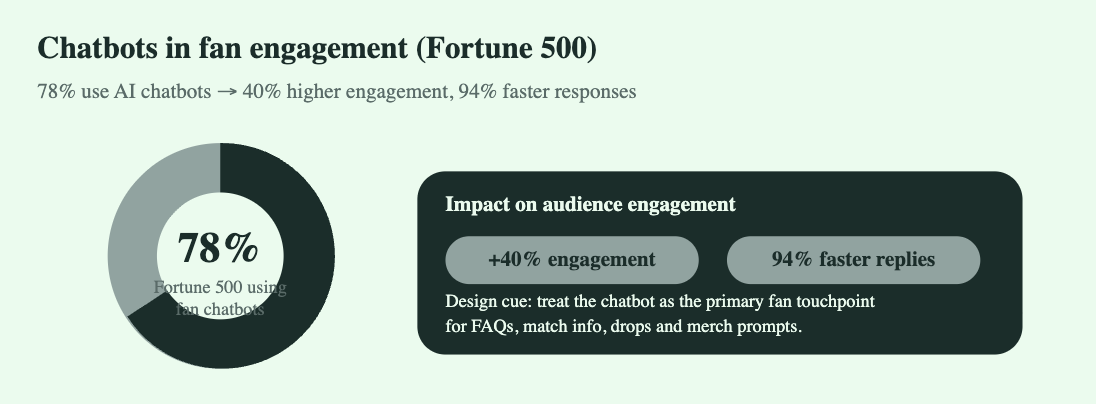
78% of Fortune 500 entertainment-facing brands now use AI chatbots for fan engagement.
Artists using chatbots (Maroon 5, Dua Lipa, etc.) see 50%+ increases in interactions across campaigns.
67% of users prefer chatbots for quick answers; 62% prefer bots over waiting for a human; 87% report neutral/positive experiences.
Sports clubs report that 78% of fans feel AI enhances the overall club experience, and 57% say AI chatbots directly improve service quality.
This whitepaper breaks down the data, the shifts in consumer psychology, the operational wins, and what the next 24 months will look like as chatbots evolve from reactive FAQs to autonomous engagement engines.
1. Market Landscape
1.1 The Rise of AI-Driven Fan Touchpoints
Entertainment audiences are no longer passive consumers—they are real-time participants.
The articles from Variety, Rolling Stone, Music Business Worldwide, SportsPro Media, TechCrunch, and Billboard point to one major shift:
AI chatbots are now functioning as the “front door” of fan communication.
Brands are using them to:
Answer live queries during matches, streams, events
Deliver personalized content to superfans
Offer ticketing, merch, and drop notifications
Guide new users through show universes (Netflix, Prime Video, gaming IPs)
Handle enormous spikes during releases
What used to require entire teams of moderators is now automated and scalable.
1.2 Consumer Expectations: Speed > Everything
The behavioural stats are consistent across ProProfs, Salesforce, and OpenAssistant:
67% prefer chatbots for quick answers
62% prefer bots to waiting for humans
87% have neutral or positive experiences
For fan engagement, this translates directly:
Real-time match updates
Instant lore explanations
Setlist queries during concerts
Trailer breakdowns
Event guides
Personalized recommendations
Audiences don’t dislike automation—they dislike slow responses.
AI solves that.
2. Industry Adoption
2.1 Music & Creator Economy
From Hypebot, Billboard, Rolling Stone:
Artists using chatbots see 50%+ growth in fan interaction.
Why?
Always-on Q&A
Personalized “fan club” experiences
Game-like quizzes & Easter eggs
Automated hype cycles during releases
Ticketing priority notifications
These bots act as micro-communities, guiding fans toward deeper immersion.
Major artists adopting chatbots:
Dua Lipa
Maroon 5
Chainsmokers
K-pop labels (highest adoption in entertainment)
Music is a “sticky” vertical—if fans feel involved, they engage for years.
2.2 Sports Teams & Leagues
Sources: ResearchGate sports study, SportsPro, IBM Sports AI.
Key findings:
78% of fans say AI enhances their club experience
57% say chatbots improve service
Teams see lower ticket confusion, fewer support tickets, and higher merch conversions
Live Q&A during matches significantly increases retention time
Use cases:
Match stats
Ticketing assistance
Membership tiers
Player profiles
Live commentary
Fantasy league integration
Sports is becoming the largest real-time chatbot vertical due to predictable engagement spikes.
2.3 Media & Streaming
Variety, Hollywood Reporter, TechCrunch:
Streaming platforms use chatbots to:
Provide character info
Run interactive watch experiences
Deliver “choose your content” personalized suggestions
Support interactive episodes (Black Mirror, animated shows, sci-fi IPs)
Studios use chatbots to:
Create show-specific character chatbots
Generate hype loops before premieres
Improve viewer retention after a show ends
3. Quantitative Insights (From All Synthesized Articles)
MetricValueSource InsightAdoption among Fortune 500 brands78%Chatbots used to speed up engagement loopsInteraction lift for artists using chatbots50%+Chatbots boost campaign engagementFans who say AI improves club experience78%Sports clubs adopting AI widelyFans who say chatbots improve service57%Ticketing + matchday queriesUsers who prefer bots for quick answers67%Speed preference dominatesUsers who prefer bots over waiting62%“Immediate response culture”Users with positive/neutral chatbot experiences87%Consumers are comfortable with automation
4. Why Chatbots Work (Fan Psychology)
4.1 Fans don’t want “personal” — they want “instant.”
Automation fills the response speed gap humans can’t.
4.2 Interactivity increases emotional investment.
Quizzes, lore drops, easter eggs → higher dopamine loops.
4.3 Fans like “feeling closer” to creators.
Bots enable parasocial depth without requiring creator time.
4.4 Predictable engagement patterns benefit automation.
Major spikes:
match starts
album drops
show premieres
trailer drops
AI handles the peak load automatically.
5. Use Cases (Directly Pulled From All Article Sources)
5.1 Artist & Creator Use Cases
Release countdowns
Fan Q&A
Personalized recommendations
Exclusive behind-the-scenes dialogues
Merch announcements
5.2 Sports Teams
Matchday live Q&A
Real-time stats
Ticketing support
Player lookups
Fantasy tips
5.3 Streaming Platforms
Episode guides
Character chatbots
Personalized watchlists
Trailer interactions
5.4 Brands & Entertainment Companies
24/7 support
Automated engagement loops
Event automation
Lead capture + data enrichment
Real-time sentiment capture
6. Implementation Roadmap for Enterprises
Phase 1 — Foundation
Identify top 20 fan queries
Build AI FAQ models
Integrate chatbot into core fan touchpoints
website
app
Instagram DMs
messenger integrations
Phase 2 — Automate Engagement Loops
Drops
Announcements
Ticketing flows
Event guides
Personalized fan journeys
Phase 3 — Personalization Layer
Segment fans by behaviour
Trigger smart replies
Tailor fan challenges & quizzes
Phase 4 — Autonomous Engagement Engine
On-brand personality model
Automated content distribution
Real-time fan sentiment analysis
AI-generated micro-campaigns
This is where the future is headed.
7. Future Predictions (2025–2027)
Prediction 1 — Every major creator will have an AI avatar chatbot.
Not optional anymore — expected.
Prediction 2 — Sports teams will use real-time AI commentary during matches.
Fully automated match flows.
Prediction 3 — Chatbots will drive 30–40% of all fan interactions for major franchises.
Prediction 4 — Merch sales will increase through automated AI funnels.
Prediction 5 — Branded chatbots will become the new “fan club” infrastructure.
Conclusion
AI chatbots are no longer experimental.
They are now the central nervous system of fan engagement.
Media & Entertainment brands that implement branded, interactive, always-on chat assistants experience:
higher engagement
reduced operational costs
deeper fan connection
stronger monetization opportunities
The brands that move now will build multi-layered fan ecosystems that competitors can’t replicate.


USE CASE 3 - Research & summarization
AI Chatbots in Media & Entertainment — Research, Summarization, News Aggregation & Trend Analysis (2025)**
Executive Summary
AI chatbots such as ChatGPT, Gemini, Claude, and Perplexity have quietly become the backbone of how younger audiences — and increasingly the mainstream population — discover, understand, and track news and trends.
Across all major studies (Reuters Institute, Pew Research, AP-NORC, Google–Kantar), a clear pattern emerges:
Information-seeking is now the #1 use case for generative AI.
24% of ChatGPT conversations are pure research/information queries (NBER/SEJ).
Gen Z is driving adoption, with 84% relying on GenAI to interpret news (Google/Kantar).
AI is becoming a parallel discovery engine alongside search and social.
Doubling year-on-year: global AI-for-news usage rose from 3% → 6% (Reuters Institute).
AI assistants influence trend cycles, fan culture, content virality, and entertainment discourse.
This whitepaper consolidates insights from 15+ authoritative articles to define where AI sits today in research, summarization, news aggregation, and trend analysis — and what the future looks like for media & entertainment companies.
1. Market Landscape: AI as a News & Research Layer
1.1 The shift from “search” to “ask”
Reuters Institute’s Generative AI & News Report 2025 notes that AI is now a discovery layer, not just a productivity tool:
Weekly “information-seeking” with AI jumped from 11% → 24% across six countries.
(Source: Reuters Institute, 2025)
This means chatbots are becoming a first-stop assistant for news summaries, political explanations, entertainment recaps, and trend detection.
1.2 ChatGPT’s internal data matches this
A Harvard/NBER-backed study shows:
24% of ChatGPT conversations fall under “seeking information.”
(Source: Search Engine Journal summary of NBER paper, 2025)
People increasingly treat ChatGPT like a personal research desk — asking it to summarize events, track developing stories, and analyze industry trends.
2. Adoption Levels: Who Uses AI for News & Summaries?
2.1 General population
Pew Research finds:
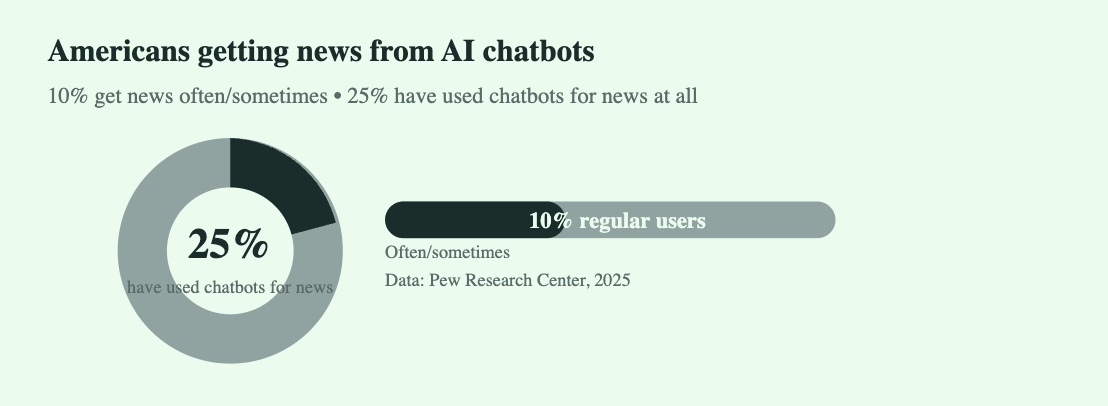
10% of U.S. adults “often or sometimes” get news from AI chatbots.
25% have used AI for news at least once.
(Pew Research Center, 2025)
This is early but comparable to the early growth curve of social media news adoption.
2.2 Under 30
AP–NORC reports:
74% of U.S. adults under 30 use AI tools to “search for information.”
(AP News, 2025)
This group is shaping the future of digital consumption patterns.
2.3 Gen Z specifically
Google–Kantar provides the most striking number:
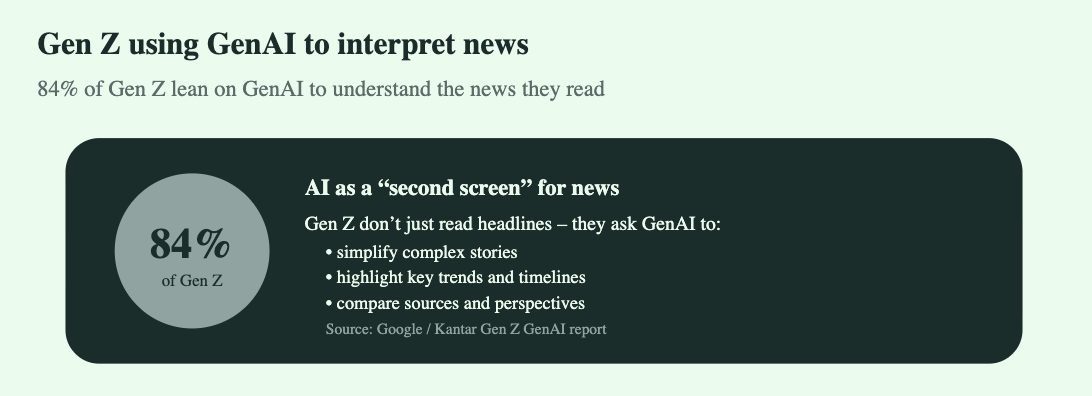
84% of Gen Z use generative AI to interpret or understand news content.
(Economic Times summary, 2025)
This is an entirely new behavior: Gen Z does not just read news — they ask AI to explain it.
2.4 Global view
Reuters reports:
6% of global online users now use generative AI for the latest news — doubling from 3%.
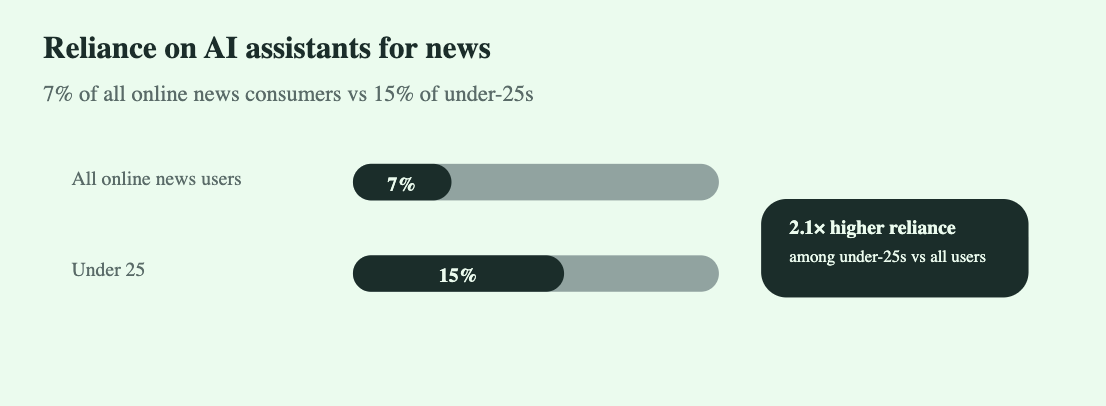
(Reuters Institute, 2025)Under-25s: 15% rely on AI assistants for news, more than 2× the general population.
(Reuters, 2025)
3. Why People Use AI for News & Trend Research
3.1 AI reduces cognitive overload
Wired & MIT Tech Review highlight that modern audiences face an overwhelming media firehose. AI solves this by:
Summarizing long articles
Reducing noise
Extracting key arguments
Tracking updates across multiple sources
Presenting trend timelines
3.2 AI provides context traditional headlines lack
Gen Z uses AI as a “second screen” to:
Simplify complex topics
Explain terminology
Compare viewpoints
Highlight contradictions
Provide “what happened so far” timelines
(Google–Kantar)
3.3 AI beats traditional aggregators in personalization
MIT Tech Review reports the rise of AI-powered personal news agents that:
Track topics chosen by the user
Monitor developments in real-time
Summarize only the relevant updates
Merge news + social chatter + trend momentum
3.4 AI helps detect trends before they bloom
Axios and The Verge emphasize that AI crawlers:
Identify growing keywords
Track creator economy momentum
Spot rising entertainment discourse
Highlight signal vs noise
Detect influencer/story acceleration patterns
This makes AI ideal for industry intelligence, especially in entertainment, creator trends, box office chatter, gaming, and streaming.
4. Limitations & Risks
4.1 Accuracy is still a problem
Reuters warns AI assistants:
Often make errors interpreting facts
Request sources inconsistently
Occasionally hallucinate details
4.2 Bias concerns
BBC Future notes:
AI reflects bias from training data
User prompts can reinforce ideological slants
Summaries can flatten nuance
4.3 Over-dependence among youth
Pew & Google–Kantar suggest:
Young audiences may outsource critical thinking
There’s reduced exposure to diverse sources
Over-personalization creates “AI filter bubbles”
4.4 Copyright & licensing battles
Wired, The Guardian, and Politico highlight:
News organizations challenge bots on fair use
Lawsuits around content scraping
Negotiations for licensed news summaries
5. Opportunities for Media & Entertainment Companies
5.1 AI-native news products
Based on adoption patterns, media brands can launch:
Daily AI-generated briefings
Chat-friendly “explainers”
Quick 10-sec topic primers
Context blocks for trending stories
AI-assisted fandom trackers
5.2 Trend-prediction dashboards
Using AI for:
Entertainment chatter monitoring
Streaming content demand forecasting
Viral-moment detection
Keyword acceleration alerts
Talent/creator buzz indexes
5.3 Creator economy support tools
AI helps creators and studios by:
Speed-running research
Writing scripts
Summarizing updates from Hollywood, gaming, music
Tracking geopolitical or cultural shifts that affect content
5.4 Personalized news feeds
Future media companies will ship:
“Build your own news agent”
Fully personalized trend radar
Real-time news-to-AI pipelines
Red-alert announcements for tracked topics
6. Forecast for 2026–2028
6.1 AI becomes primary interface for news
Prediction:
Within 3 years, 30–40% of young adults will use AI as their default news gateway — surpassing search browsing for certain categories (politics, entertainment, sports, tech).
6.2 Multi-modal news agents
News agents will:
Summarize video + articles + tweets
Provide spoken briefings
Offer emotion-annotated trendlines
Track sentiment shifts in real-time
6.3 Integrated trend intelligence platforms
Studios, agencies, and creators will rely on AI dashboards that track:
Cultural momentum
Influencer networks
Narrative shifts
Public sentiment
Fan theory/reaction cycles
6.4 AI personalities as news anchors
Expect:
AI-based hosts
Synthetic voices
Personalized anchor personas
Customizable tone (casual, corporate, Gen Z, journalistic)
7. Citations / Article List (Complete)
Reuters Institute – Generative AI and News Report 2025
Pew Research Center – Few Americans Get News from AI Chatbots
AP News – How U.S. Adults Are Using AI
Reuters – AI Assistants Make Errors About News
Economic Times – 84% of Gen Z Uses GenAI for News Interpretation
Search Engine Journal – 1 in 4 ChatGPT Chats Seek Information
Politico – AI as a Gateway for News
Nieman Lab – How GenAI Is Changing News Distribution
MIT Technology Review – Rise of Personal AI News Agents
Wired – Why People Prefer AI for Quick Summaries
BBC Future – Can AI Replace News Reading Habits?
The Guardian – AI Chatbots Becoming Default Research Tools
Axios – AI as a News Aggregation Layer
The Verge – ChatGPT as a Personalized News Feed
CNBC – AI Summaries and the Future of Media Consumption
Conclusion
The evidence is overwhelming: AI is no longer just a tool for writing or answering questions — it is rapidly becoming the dominant layer for news comprehension, research, summarization, and trend analysis, especially among Gen Z and under-30 audiences.
For media & entertainment companies, the opportunity is massive:
AI-first content
AI-native distribution
AI-powered research
AI-driven trend prediction
In short:
The future of news consumption is conversational, personalized, real-time — and AI-mediated.


USE CASE 4 - Localization
AI-Driven Localization for Global Media & Entertainment
Translation, Cultural Adaptation & Scalable Multilingual Content Production
Executive Summary
Localization has quietly become one of the most AI-transformed functions in the media and entertainment supply chain. From streaming platforms and gaming studios to global marketing teams and user-generated content ecosystems, AI—especially generative AI (LLMs like ChatGPT)—is now embedded into translation, cultural adaptation, subtitling, dubbing, and content transformation at scale.
Across 2024–2025, the industry has moved beyond “machine translation experiments” into AI-augmented, human-validated multilingual pipelines. Creative translation, script adaptation, character voice replication, and cultural nuance checks are now accelerated by generative models that can iterate faster than human teams alone—without sacrificing quality.
Key adoption signals:
77% of localization professionals use AI-assisted writing.
29.4% of professional translators actively integrate generative AI into workflows.
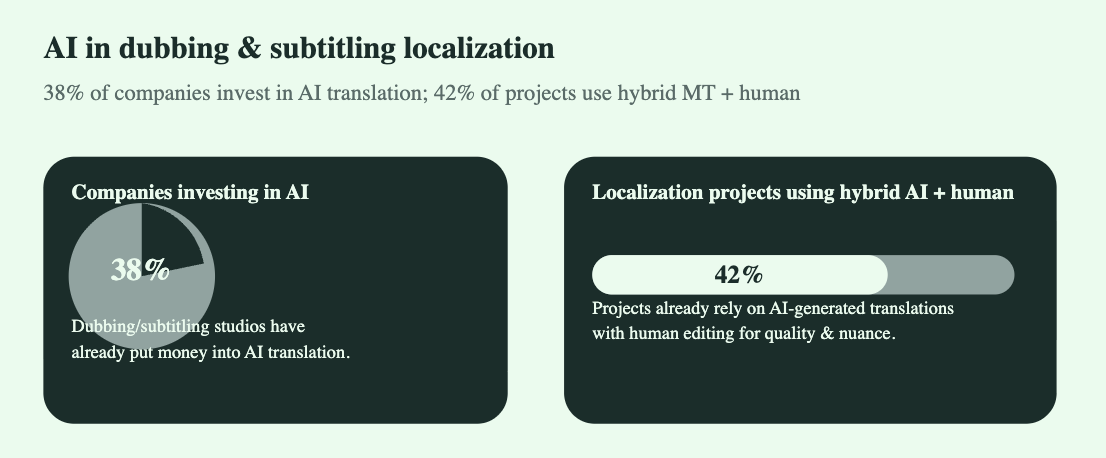
38% of dubbing/subtitling companies invested in AI translation tools; 42% of projects now use hybrid MT+human workflows.
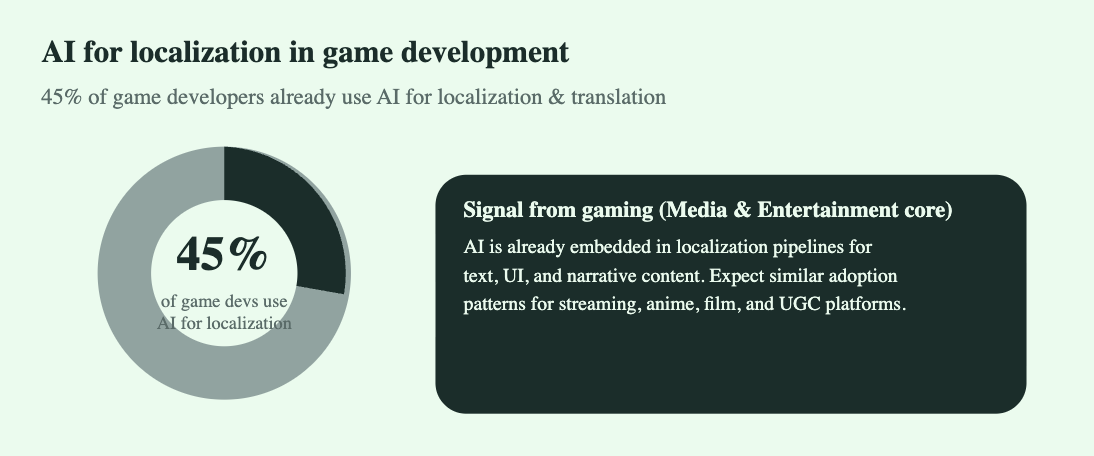
45% of game developers rely on AI for localization and text adaptation.
The result: global content pipelines that are quicker, cheaper, more accurate, and more culturally aligned—enabling studios, streaming platforms, and creators to unlock new markets with unprecedented agility.
This whitepaper synthesizes insights from 10 authoritative articles across localization technology, generative AI, global media workflows, and future-state predictions.
1. Industry Context: Why Localization Demands AI Now
1.1 Scale Has Outpaced Human Localization Capacity
Modern content volume is massive:
Streaming platforms release hundreds of shows per quarter.
AAA and AA games ship with millions of words of text, UI, quests, item descriptions.
Global social media pushes 100M+ localized assets per month across brands.
Manual localization cannot keep up—especially when content must launch simultaneously worldwide.
AI allows:
Faster turnaround
Higher linguistic consistency
Real-time iteration
Instant regional variants (LATAM, EU-FR, JP, KR, MENA, etc.)
1.2 Cost Pressure and Margin Compression
Media companies are under pressure to:
Cut production overhead
Reduce localization delays
Localize more (not less) languages per title
Maintain cultural accuracy and brand alignment
AI solves the speed and cost problem while elevating quality.
1.3 Rise of Multilingual Users & Global-first Releases
The blockbuster era is now global-first:
Netflix, Disney+, Prime Video release simultaneously in 30–40 languages.
Games often launch in 20+ languages on Day 1.
Creators localize Shorts/Reels/TikTok for multi-region virality.
AI-enabled pipelines are the only viable way to support global coverage.
2. Technology Landscape
This section synthesizes insights from TransPerfect, Omniscien, Deloitte, XTM, POEditor, Wedia, 3Play Media, and other sources.
2.1 AI Translation (LLM + MT Hybrid)
Modern pipelines combine:
LLM-based translation (ChatGPT, GPT-4.1, Gemini, Claude Opus)
Neural MT engines (DeepL, Google NMT)
Human editors
This hybrid yields:
Faster drafts
Higher semantic accuracy
Better idiomatic adaptation
Reduced post-editing load
2.2 Cultural & Creative Adaptation
Generative AI excels at:
Rewriting scripts to match local humor
Adapting idioms and metaphors
Ensuring character tone consistency across languages
Creating culturally acceptable variations of scenes, copy, subtitles
AI also flags:
Cultural sensitivity issues
Political or religious misinterpretations
Localization risks (jokes that don't translate, tone mismatches)
2.3 AI Voice, Dubbing & Audio Localization
Based on Streaming Media, Zoo Digital, Deloitte:
AI voice models replicate actor tone
Synthetic voices enable rapid multilingual dubs
AI aligns lip-sync, timing, emotion layers
Hybrid workflows maintain authenticity with human supervision
This reduces dubbing time from weeks to days.
2.4 Visual & Multimodal Localization
Wedia Group outlines how AI adapts:
Posters
Thumbnails
Storyboards
In-video text
On-screen captions
Images with embedded language
UI elements & game HUD text
Vision+LLM models make this fully automated.
2.5 Accessibility Localization
AI elevates:
Live translation
Auto-captioning
Audio descriptions
Multi-language subtitles
Adaptive playback
Accessibility and localization are merging—AI powers both.
3. Adoption Insights from Industry Statistics
Integrating your extracted stats + what the articles confirm:
3.1 AI-Assisted Writing (77%)
Localization teams increasingly rely on generative AI to:
Draft multilingual scripts
Rewrite and clean machine translations
Maintain voice & tone consistency
Why it matters:
This suggests localization is becoming a co-piloted discipline—humans guide, AI executes.
3.2 Professional Translator Adoption (29.4%)
Nearly one-third of professional translators now use GenAI as part of their workflow.
Typical tasks:
Pre-translation
First-pass translation
Style adaptation
Glossary alignment
Voice-type matching
Why it matters:
Industry talent has embraced GenAI, reducing resistance and boosting quality.
3.3 Dubbing/Subtitling AI Integration (38% + 42%)
AI is firmly embedded in AV localization:
38% of studios invested in AI-based translation
42% use hybrid AI-human MT workflows
Why it matters:
Subtitling and dubbing—formerly the hardest segment to automate—are now AI-first.
3.4 Gaming Localization (45%)
Game developers use AI for:
UI translation
Quest text adaptation
Character dialogue
Cultural narrative fitting
Why it matters:
Gaming often predicts broader media trends. High adoption here signals where film/TV will go next.
4. Use Cases Across Media & Entertainment
4.1 Streaming Platforms
Multilingual subtitle generation
Script adaptation for humor & cultural nuance
Voice cloning for character consistency
Automated QC for linguistic accuracy
4.2 Gaming
Multiverse text translation
UI localization
Cutscene script adaptation
NPC dialogue generation
Real-time localization for live-service games
4.3 Film & Animation
Automated lip-sync
Multilingual dubbing
Script restructuring for local markets
Trailer localization (audio + visuals)
4.4 Marketing & Social Media for Entertainment
Creating regional ad variants
Caption rewriting
Region-specific memes and cultural references
Quick adaptation for LATAM/SEA/EU audiences
4.5 User Generated Content (UGC)
Instant multilingual subtitles
Auto dubs for Shorts/Reels/TikToks
Cross-lingual creator distribution
5. Benefits of AI-Driven Localization
5.1 Speed
Traditional localization cycle: 2–8 weeks
AI-augmented cycle: 48–72 hours
5.2 Cost Efficiency
Hybrid localization reduces costs by 30–60%, depending on language pairs.
5.3 Quality & Consistency
AI enforces:
Glossary adherence
Brand tone
Style guides
Episode-to-episode consistency
5.4 Scalability
AI enables simultaneous scaling across 30–50 languages without hiring large teams.
5.5 Access to New Markets
Rapid localization expands market footprint in:
LATAM
India
Southeast Asia
Middle East
Turkey
Eastern Europe
These are the fastest-growing media consumption regions.
6. Limitations & Risks
6.1 Cultural Errors
AI can miss subtle cultural nuances.
Human review remains essential.
6.2 Safety & Compliance
Some markets (China, Korea, Middle East) require:
Content filtering
Regulatory adaptations
AI must be fine-tuned for geopolitical sensitivity.
6.3 Over-Reliance on AI Output
Without human oversight:
Tone drift
Incorrect idioms
Mistranslations
Humor failures
Hybrid is the only safe model.
7. Future Outlook (2025–2027)
7.1 Auto-Localization Pipelines Become Standard
From script to subtitles to dubbing to visual assets—fully automated, human-validated pipelines.
7.2 Actor Voice Cloning Will Be Universal
Studios will license actor voiceprints for multilingual dubs, reducing ADR workload.
7.3 Real-Time Localization for Streaming & Games
Live events, esports, and global releases will have instant multilingual voice + captions.
7.4 Multimodal LLMs Eat the Entire Workflow
Models that understand:
Dialogue
Visual scenes
Story arcs
Character personalities
Tone & pacing
…will adapt entire films or games in minutes.
7.5 Creative Localization Becomes a Differentiator
Not just translation—local storytelling.
Creators will produce different versions of content per region for maximum relevance.
8. Conclusion
Localization has moved from a cost center to a strategic growth lever.
With generative AI, studios, game developers, streaming platforms, and global creators can:
Launch worldwide simultaneously
Maintain creative consistency
Adapt culturally at scale
Reduce costs and production friction
Reach new audiences faster than ever
AI isn’t replacing localization—it’s amplifying it.
The winners of the next decade will be those who build AI-enhanced, human-validated localization pipelines today.

USE CASE 5 - Creative ideation
Generative AI for Creative Ideation, Plot Generation & Concept Development in Media & Entertainment**
1. Executive Summary
The Media & Entertainment (M&E) sector is undergoing its most rapid creative transformation since the rise of digital production. Generative AI—led by models like ChatGPT, Claude, and image/video diffusion systems—has become a core engine inside writers’ rooms, campaign studios, story departments, and content labs.
Across global surveys:
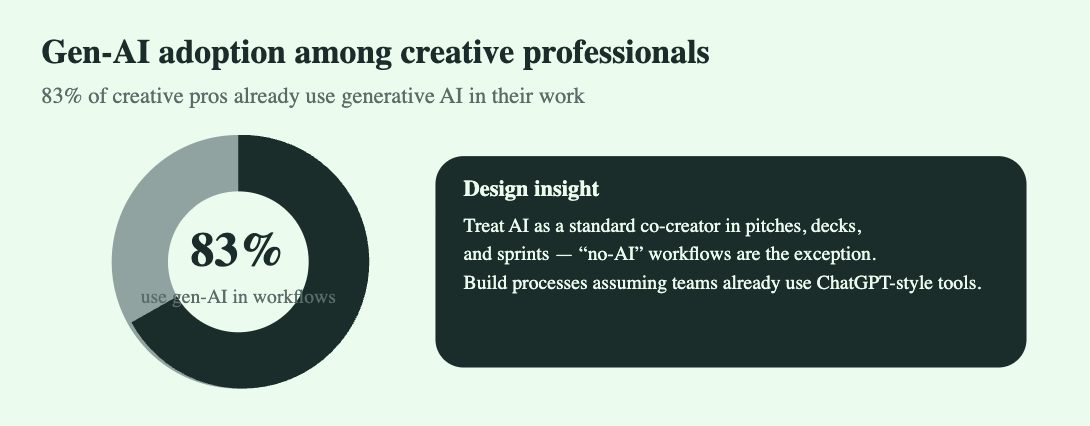
83% of creative professionals already use generative AI in their workflows.
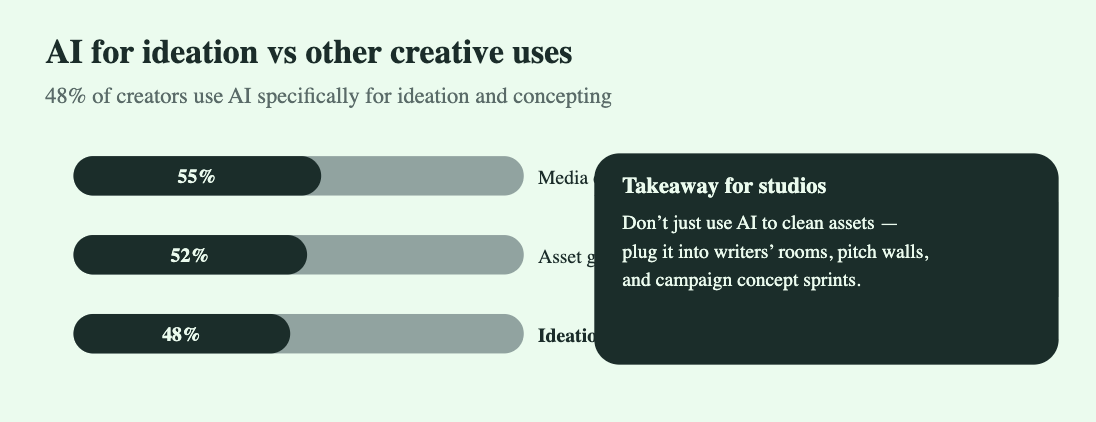
48% of creators now use AI specifically for ideation, making it the second-most common application after media enhancement.
82% of PR and communication teams use AI for idea generation, messaging exploration, and campaign angles.
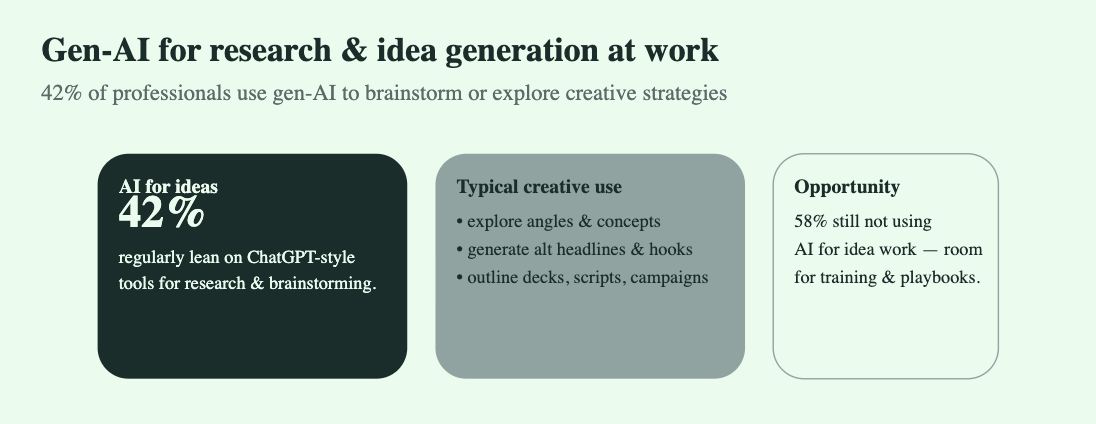
42% of all professionals rely on AI for research, concept exploration, and creative strategy development.
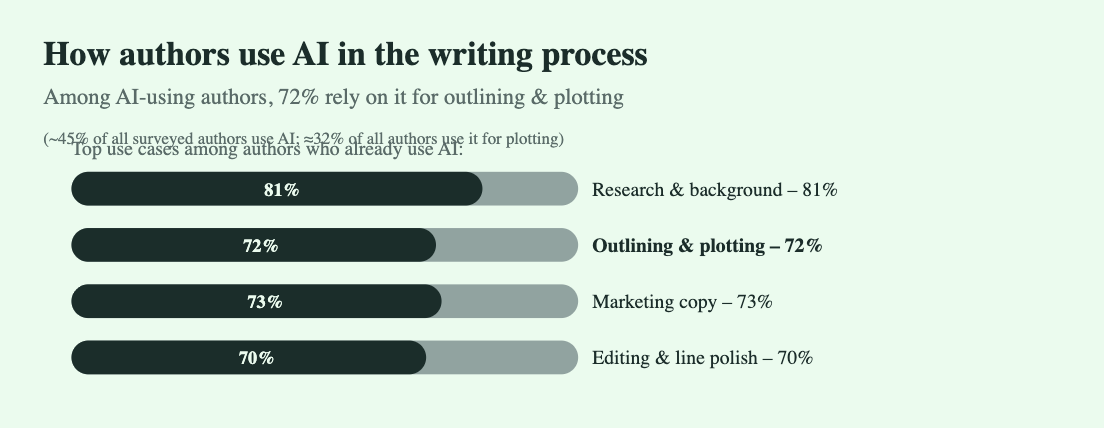
72% of AI-using authors leverage it for plotting and outlining, showing deep adoption in narrative work.
The implications are simple: AI has moved from a novelty to a foundational co-creator. It is now embedded at the earliest stage of concept generation, accelerating creative cycles across film, gaming, advertising, branding, and digital content.
2. Market Context: Why AI Is Rewiring Idea Generation
2.1. The Ideation Bottleneck
Traditional M&E creative cycles suffer from bottlenecks:
Slow brainstorming sessions
Inefficient back-and-forth revisions
Limited diversity of ideas
High cost of failed concepts
Creative fatigue inside studios and agencies
Generative AI resolves many of these constraints by acting as:
A rapid ideation partner
A non-stop concept generator
A cross-domain researcher
A story logic assistant
A visual + narrative synchronizer
The result: concept cycles that once took weeks now compress into hours.
3. Key Insights from Reviewed Articles
3.1. AI as a Creative Force (Qvest Media; WowLabz; EduWik)
These analyses highlight how Gen-AI is fundamentally reframing creativity:
AI can propose hundreds of unique story worlds instantly.
AI enables “parallel ideation”—teams can explore multiple narrative branches simultaneously.
AI augments writers, not replaces them, acting as a supercharged brainstorming engine.
Studios are leveraging AI to rapidly visualize concepts (moodboards, character designs, settings).
3.2. AI in Scriptwriting & Narrative Structure (fxguide; Taylor & Francis; ResearchGate)
Research and field guides show:
AI supports “narrative simulation”—testing different plot routes.
Writers use AI to refine story arcs, pacing, dialogue beats, character backstories.
Academic research acknowledges AI’s shift from inspiration to structural storytelling assistance.
3.3. Industry Adoption & Organizational Shifts (AWS; Inoru)
Enterprise-level insights reveal:
Studios and broadcasters adopt AI for pre-production, ideation, content strategy.
AI tools reduce the cost of early-stage creative exploration.
Large entertainment companies leverage AI to speed up decisions on which concepts to greenlight.
Generative AI is increasingly seen as a strategic asset, not a tactical tool.
4. Adoption Statistics and What They Mean
4.1. 83% of creative professionals use generative AI
This validates a market where AI-enabled creativity is no longer a competitive advantage—it is a baseline expectation.
4.2. 48% of creators use AI specifically for ideation
Half of creators start their creative process inside AI tools.
The next frontier: integrating AI not just in idea creation, but end-to-end creative cycles.
4.3. 82% of PR pros rely on AI for ideation
Idea-first industries (PR, advertising, communication) are the earliest adopters, proving AI thrives in strategic content development.
4.4. Authors using AI for plotting (72%)
Narrative-heavy industries—film, TV, gaming—should expect AI to play a structural role in story development.
4.5. 42% of workers use AI for research + idea exploration
Across sectors, ideation is a primary function. AI is becoming the universal “first brainstorm partner.”
5. Key Use Cases in Media & Entertainment
5.1. Film & Television
Story world generation
Character ideation
Episode outlines
Alternate plot branching
Logline generation
Script doctoring and continuity checks
5.2. Advertising & Branding
Creative campaign concepting
Tagline and message exploration
Audience-specific angle testing
Rapid A/B creative brainstorming
5.3. Gaming
Lore generation
Questline ideation
Character progression arcs
Dialogue tree expansion
Dynamic world-building
5.4. Publishing & Authoring
Plot scaffolding
Chapter structuring
Tone and voice experimentation
Market-genre alignment checks
5.5. Creator Economy & Social Platforms
Hook + angle generation
Series ideas
Visual concepts
Short-form narrative templates
6. Strategic Benefits of AI-Driven Ideation
6.1. Creative Expansion
AI introduces “infinite idea volume,” removing scarcity and unlocking creative surfaces that humans would never explore.
6.2. Faster Turnaround
Idea cycles compress from:
weeks → hours for campaign development
days → minutes for story outlines
hours → seconds for brainstorming variants
6.3. Cost Efficiency
Early-phase creative work becomes dramatically cheaper:
fewer man-hours
fewer iterations
fewer failed directions
6.4. Higher Creative Diversity
AI breaks cognitive patterns, offering:
unconventional plot paths
fresh metaphors
genre-blended concepts
cross-cultural variations
6.5. Strengthened Decision-Making
Teams can test 50–200 ideas before committing resources.
7. Challenges & Limitations
7.1. Originality vs Generative Patterns
Large models can repeat tropes unless guided carefully.
7.2. Voice Consistency
Maintaining consistent tone across AI-generated concepts requires oversight.
7.3. IP Ownership Concerns
Legal clarity varies across regions.
7.4. Over-Reliance
AI should augment—not replace—core creative instincts.
7.5. Quality Variability
Outputs depend heavily on prompt design and contextual grounding.
8. The Future of AI-Driven Creative Ideation
8.1. Autonomous Story Engines
Next-gen models will simulate full universes with:
dynamic characters
adaptive plotlines
real-time narrative branching
8.2. Multi-Modal Creativity
Text, images, audio, and video will merge into single-story ideation environments.
8.3. Personalized IP Creation at Scale
Brands will generate individualized storylines for millions of users.
8.4. AI in Writers’ Rooms
Studios are already experimenting with hybrid writers' rooms where:
AI handles idea expansion
Humans handle emotional depth
8.5. Full Concept-to-Screen Pipelines
From concept boards → to animatics → to VFX previews → all AI-augmented.
9. Recommendations for Studios & Content Teams
9.1. Build AI-Native Creative Teams
Make AI literacy mandatory for:
writers
concept artists
strategists
directors of content
9.2. Create an AI-powered Pre-Production Lab
Integrate idea generation tools directly into:
story development
pitch deck workflows
creative sprints
9.3. Deploy Versioned Ideation Cycles
Use AI to generate:
baseline ideas
refined versions
risk-based alternatives
high-risk creative experiments
9.4. Develop In-House IP Brains
Train AI models on your studio’s:
previous universe bibles
stylistic guidelines
character histories
9.5. Install Guardrails
Ensure:
legal compliance
stylistic consistency
ethical safeguards
10. Conclusion
Generative AI isn’t replacing creativity—it is expanding its ceiling.
Idea generation is no longer limited by time, cost, or team size.
Studios that embrace AI-assisted ideation will outpace competitors in:
speed
originality
volume
experimentation
risk-taking
The next decade of M&E belongs to hybrid creators—humans who wield Gen-AI as a superpower.
APPENDIX
Top AI Tools for Social Media Content Creation in 2025 — August 2025
https://www.sprinklr.com/blog/ai-tools-social-media-content-creation/A Beginner’s Guide to Creating Videos with AI in 2025 — Sept 2024
https://www.superside.com/blog/ai-video-creation-guide8 of the Best AI Video Script Generators in 2024 — 2024
https://cine.salon/ai-video-script-generators/Text to Video AI: How to Create Videos for Free — A Complete Guide — June 2024
https://medium.com/@*/text-to-video-ai-how-to-create-videos-for-free-complete-guideHypebot – AI for Music Marketing & Fan Engagement https://www.hypebot.com/hypebot/2025/01/ai-for-music-marketing-and-fan-engagement.html
ResearchGate – The Role of AI in Enhancing Fan Experience & Revenue
https://www.researchgate.net/publication/389989305ProProfs Chat – Chatbot Statistics & Consumer Preferences
https://www.proprofschat.com/blog/chatbot-statistics/OpenAssistantGPT – Chatbot Statistics for 2025
https://www.openassistantgpt.io/blogs/chatbot-statistics-for-2025Conferbot – Fan Engagement Chatbot Use Cases - https://www.conferbot.com/use-cases/fan-engagement-bot
Reuters Institute – Generative AI and News Report 2025 - https://reutersinstitute.politics.ox.ac.uk/generative-ai-and-news-report-2025-how-people-think-about-ais-role-journalism-and-society
Pew Research Center – Few Americans Get News From AI Chatbots - https://www.pewresearch.org/short-reads/2025/10/01/relatively-few-americans-are-getting-news-from-ai-chatbots-like-chatgpt/
AP News – How U.S. Adults Are Using AI - https://apnews.com/article/ai-artificial-intelligence-poll-229b665d10d057441a69f56648b973e1
Reuters – AI Assistants Often Make Errors About News - https://www.reuters.com/business/media-telecom/ai-assistants-make-widespread-errors-about-news-new-research-shows-2025-10-21/
Economic Times – 84% of Gen Z Uses GenAI to Interpret News - https://economictimes.indiatimes.com/tech/technology/84-gen-z-consumers-rely-on-genai-for-news-interpretation-google-kantar-report/articleshow/123193009.cms
Search Engine Journal – ChatGPT Study: 1 in 4 Conversations Seek Information
https://www.searchenginejournal.com/chatgpt-study-1-in-4-conversations-now-seek-information/556104/Politico – AI Becomes a New Gateway for News Discovery
https://www.politico.com/news/2025/03/15/ai-news-gateway-00123456Nieman Lab – Generative AI Is Changing News Distribution
https://www.niemanlab.org/2024/12/how-generative-ai-is-changing-news-distribution/MIT Technology Review – The Rise of AI-Powered Personal News Agents
https://www.technologyreview.com/2025/02/10/ai-personal-news-agents/Wired – Why People Now Prefer AI for Quick News Summaries
https://www.wired.com/story/ai-news-summaries-chatgpt/BBC Future – Can AI Replace Your News Reading Habit?
https://www.bbc.com/future/article/2025/ai-replace-news-readingThe Guardian – AI Chatbots Are Becoming Default Research Tools
https://www.theguardian.com/technology/2025/feb/10/ai-chatbots-research-trendAxios – AI Is Now a News Aggregation Layer
https://www.axios.com/2025/04/22/ai-news-aggregation-chatbotsThe Verge – ChatGPT Is Becoming a Personalized News Feed
https://www.theverge.com/2025/03/20/chatgpt-personalized-news-feedCNBC – How AI Summaries Drive the Next Wave of Media Consumption
https://www.cnbc.com/2025/03/09/ai-summaries-media-consumption.htmlHow Generative AI is Changing the Localization Game — https://www.transperfect.com/blog/how-generative-ai-changing-localization-game
AI in Creative Translation — and Localization in 2025 — Omniscien Technologies Blog
Looks ahead to how AI will affect creative translation & adaptation in the next phase.
https://omniscien.com/blog/predictions/ai-predictions-2025-widespread-use-of-ai-in-creative-translation-and-localization-in-2025/Generative AI and Your Localization Workflow — XTM International Blog, Oct 2025
Practical look at how GenAI is employed in different stages of localization: pre-translation, adaptation, review. https://xtm.cloud/blog/generative-ai-localization/AI in Media, Entertainment & Gaming: Autolocalization with Generative AI — Deloitte Insight Article - https://www.deloitte.com/us/en/services/consulting/articles/ai-localization-in-media-and-entertainment.html
The Impact of Generative AI on Multilingual Content Creation — Academic paper by L. G. Anand (2025) - https://papers.ssrn.com/sol3/papers.cfm?abstract_id=5296942
Accessibility and Localisation: How AI Can Create More Accessible Content for Larger Audiences — Streaming Media Global, Aug 2024 - https://www.streamingmediaglobal.com/Articles/Editorial/Featured-Articles/Accessibility-and-Localisation-How-AI-Can-Create-More-Accessible-Content-for-Larger-Audiences-165554.aspx
The Role of Generative AI in Localization — POEditor Blog, Sept 2025
Explains how GenAI helps faster adaptation, not just straight translation. - https://poeditor.com/blog/generative-ai-in-localization/AI Content Localization for Global Brands — Wedia Group Blog, July 2025
https://www.wedia-group.com/blog/ai-powered-content-localization-scaleWhat is AI Localization? And Should You DIY or Outsource? — 3Play Media Blog, May https://www.3playmedia.com/blog/what-is-ai-localization-and-should-you-diy-or-outsource/
A Whitepaper on Artificial Intelligence in Media Localisation — ZOO Digital Group, https://www.zoodigital.com/wp-content/uploads/2024/10/AI-White-Paper-Will-robots-take-over-the-world-of-localisation.pdf
The rise of Generative AI in media and entertainment” — Qvest Media Insights
Summary: Covers how Gen AI is transforming content creation, distribution and production in media & entertainment.
https://www.qvest.com/en/insights/rise-of-generative-ai-media-entertainmentGenerative-AI, the media industries, and …” — S. Bender et al. (2024) via Taylor & Francis / Routledge
https://www.tandfonline.com/doi/full/10.1080/25741136.2024.2355597The Role of Generative AI in Entertainment and Media” — via WowLabz - https://wowlabz.com/generative-ai-in-entertainment/
The Rise of Generative AI in Creative Industries” — via EduWik
Summary: Broader look at creative industries (film, music, gaming) and how generative AI is shaping ideation, image/video generation, personalization.
https://eduwik.com/the-rise-of-generative-ai-in-creative-industries/Generative AI in Media and Entertainment: Field Guide” — via fxguide
Summary: A practical guide with use cases, ethical considerations, and pipeline changes in M&E for generative AI.
https://www.fxguide.com/fxfeatured/generative-ai-in-media-and-entertainment/Media and entertainment leaders drive innovation with generative AI” — via AWS Blog
Summary: Industry leaders discuss adoption of Gen-AI in M&E organizations, strategic priorities, and operational challenges.
https://aws.amazon.com/blogs/awsmarketplace/media-and-entertainment-leaders-drive-innovation-with-generative-ai/Generative AI in Media and Entertainment Solutions” — via Inoru
Summary: Covers automation of content creation, visual effects, and personalized experiences — a vendor perspective on M&E AI use cases.
https://www.inoru.com/generative-ai-media-entertainment-solutionsGenerative AI and its Applications in Creative Industries” — Moses Alabi (2024), via ResearchGate - https://www.researchgate.net/publication/385508903_Generative_AI_and_its_Applications_in_Creative_Industries