
A Strategic Framework for Fairness and Transparency in AI-Enabled Medical Devices: Aligning with FDA Recommendations for the Total Product Life Cycle
1.0 Introduction: The Twin Imperatives of Innovation and Trust
The rapid integration of Artificial Intelligence (AI) into medical devices promises to revolutionize healthcare, offering unprecedented capabilities in diagnostics, treatment planning, and patient monitoring. Yet, in a crowded market where consumer trust is paramount, the successful adoption of these powerful technologies hinges on establishing profound and durable trust with clinicians, patients, and regulators. A demonstrable commitment to fairness and transparency is no longer a mere compliance exercise; it is a key differentiator and a core commercial asset. Recognizing this, the U.S. Food and Drug Administration (FDA) has placed a significant focus on ensuring transparency and mitigating the critical risks of algorithmic bias and AI-generated "hallucinations."
At the heart of this challenge are the "black box" characteristics of many AI models. Algorithmic bias, where a model produces systematically prejudiced results for a subset of the population, often arises when models inherit and amplify societal inequities from their training data. A recent study, "How Can We Diagnose and Treat Bias in Large Language Models for Clinical Decision-Making?", provides a stark example. Researchers found that GPT-4 exhibited a 9% lower likelihood of recommending advanced imaging for Black patients and an 8% lower likelihood of rating stress testing as highly important for female patients. This illustrates how unchecked AI can perpetuate harmful biases and exacerbate health disparities. Alongside bias, the risk of hallucinations—plausible-sounding inaccuracies generated by the model—poses a direct threat to patient safety. An AI model that confidently fabricates information in a clinical context could lead to devastating outcomes.
This white paper provides a strategic framework for medical technology product managers and compliance officers to proactively address these dual risks. Grounded in the FDA's official recommendations, it outlines a prescriptive blueprint for integrating fairness and clarity throughout the Total Product Life Cycle (TPLC) of AI-enabled medical devices. By embedding these principles from concept to post-market surveillance, manufacturers can build market-leading, trustworthy products that are fundamentally safer, more effective, and more equitable.
To achieve this, manufacturers must adopt a lifecycle-oriented perspective. The FDA's TPLC approach provides the foundational concept for managing the unique complexities of AI devices from initial design through to decommissioning.
2.0 The Regulatory Foundation: The FDA's Total Product Life Cycle (TPLC) Approach
For AI-enabled medical devices, the strategic importance of a Total Product Life Cycle (TPLC) framework cannot be overstated. Unlike static software with fixed logic, AI models can change or degrade in performance over time, particularly when exposed to real-world data that differs from their training sets—a phenomenon known as "data drift." The FDA mandates a TPLC approach as essential for ensuring the ongoing safety and effectiveness of these dynamic devices. This lifecycle perspective moves beyond a one-time, pre-market assessment to a continuous process of governance and oversight that is integral to building a trustworthy product.
As described in its guidance, the FDA’s TPLC approach encompasses the entire lifespan of a device, from its initial conception and design through development, deployment, ongoing maintenance, and eventual decommissioning. This comprehensive view ensures that considerations for safety, effectiveness, and quality are embedded in every phase, rather than being treated as a final validation checkpoint. It provides a structured methodology for managing risks not just before a product launches, but long after it is in clinical use.
The FDA’s current thinking on AI/ML devices crystallizes around two interconnected core principles that must be woven into the TPLC from its inception: AI bias and transparency. The agency makes it clear that these are not separate, siloed issues but deeply related considerations. A lack of transparency can obscure underlying biases, while a failure to address bias undermines the trustworthiness and safety of the device for its entire intended use population. Therefore, manufacturers must design for fairness and transparency from the earliest stages of product development to secure regulatory approval and build market trust.
The following sections will deconstruct three foundational pillars of an FDA-aligned TPLC framework—representative data, subgroup validation, and user transparency—providing actionable guidance for integrating each into a robust product development and governance strategy.
3.0 Pillar 1: Building on a Fair Foundation with Representative Data
Data management is the cornerstone of building fair and equitable AI medical devices. The quality and representativeness of the data used for training, tuning, and testing an AI model directly determine its potential for both bias and hallucination. An algorithm can only be as reliable as the data it learns from. If the development data fails to reflect the full diversity of the intended patient population, the resulting device may perform unreliably or inequitably when deployed, compromising patient safety and exacerbating health disparities.
The challenge of unrepresentative data, as cited in the FDA guidance, arises when the development dataset does not adequately mirror the demographic and clinical diversity of the population the device is intended to serve. The U.S. patient landscape is a complex mosaic; for instance, a model trained predominantly on commercially insured populations, who often have high digital literacy, may fail when deployed to a Medicaid population with lower digital access and different language needs. To build a device that is robust across this reality, its data foundation must be intentionally diverse.
A proactive "safety by design" technique to mitigate both bias and hallucinations is Retrieval-Augmented Generation (RAG). This approach grounds a model’s outputs in a curated, external knowledge base of verified information, such as NICE guidelines or the British National Formulary (BNF). Instead of generating responses from its internal training data alone, a RAG-enabled system retrieves relevant, factual information from a trusted source and uses it to construct the answer. This strategy directly addresses Pillar 1 by ensuring outputs are anchored to a fair and validated foundation, strengthening a pre-market submission by proactively mitigating the risk of AI-generated misinformation.
To address the foundational challenge of data quality, the FDA recommends that sponsors provide comprehensive documentation justifying the representativeness of their datasets. Key elements to include in a marketing submission are:
• Data Sources and Collection: Document the source of the data (e.g., clinical trials, real-world data) and the time period of acquisition. This context helps regulators assess the data's relevance and potential for temporal bias.
• Population Characteristics: Describe the distribution of data across all relevant clinical variables (e.g., disease severity, subtypes) and crucial patient demographics such as sex, age, race, and ethnicity.
• Data Acquisition Diversity: Detail the variety of equipment and conditions under which data were collected. This includes different clinical sites, models of imaging devices, or varying acquisition protocols, as these factors can significantly impact model performance.
• Justification: Provide a clear and compelling justification for why the chosen dataset is considered adequately representative of the intended use population and clinical environment.
Building a device on a foundation of truly representative and well-managed data is the first and most critical step. However, while necessary, it is not sufficient. A model's performance must also be rigorously validated across key population subgroups to unmask any hidden performance disparities.
4.0 Pillar 2: Rigorous Validation Through Subgroup Performance Analysis
Even a model trained on a representative dataset can learn spurious correlations that lead to differential performance across demographic groups. The inherent opacity of complex AI models makes it difficult to understand their internal reasoning, creating a significant risk that a model may achieve high overall accuracy while relying on biased logic. Rigorous validation through subgroup performance analysis is therefore an essential pillar for unmasking hidden biases and ensuring a device is safe and effective for all patients in the intended use population.
The FDA's rationale for requiring subgroup testing is rooted in the unique nature of complex AI models, which are susceptible to unexpected performance differences. This concern is powerfully reinforced by academic research. The paper "How Can We Diagnose and Treat Bias in Large Language Models for Clinical Decision-Making?" reveals a critical insight: evaluating both MCQ response and explanation processes is crucial, as correct responses can be based on biased reasoning. Merely achieving high accuracy on a validation set is insufficient. The reasoning behind the model's output must also be scrutinized for bias, which makes subgroup analysis not just a good practice, but a clinical necessity for ensuring equitable care.
To ensure this level of rigor, the FDA provides key recommendations for what sponsors must include in their marketing submissions regarding performance validation:
1. A Pre-Specified Subgroup Plan: The statistical analysis plan must include a pre-specified commitment to analyzing device performance in relevant subgroups. This plan must define the subgroups in advance, based on factors such as sex, age, race, and ethnicity, to ensure an objective assessment.
2. Comprehensive Performance Metrics: Sponsors are expected to report a comprehensive set of performance metrics for the overall dataset and for each pre-specified subgroup. This includes metrics like sensitivity, specificity, positive predictive value (PPV), and negative predictive value (NPV). All performance estimates must be provided with confidence intervals to convey the statistical uncertainty for each group.
3. Evaluation of the Human-AI Team: For devices that include a "human in the loop," the FDA emphasizes that validation should focus on the performance of the "Human-AI team," not just the model in isolation. Given that AI is already being used at scale for clinical documentation across millions of encounters (one study noted 2.58 million clinical encounters), this principle is paramount. Validation of the Human-AI team must account for real-world risks like automation bias and the potential for busy clinicians to miss AI-generated errors in high-volume workflows.
Rigorous internal validation provides the objective evidence needed for regulatory review. However, this evidence must also be communicated clearly to the device's end-users to foster trust and ensure safe operation, which leads to the final pillar: transparency.
5.0 Pillar 3: Fostering Trust Through User-Centric Transparency
For inherently opaque AI technologies, transparency is a fundamental component of safety and a prerequisite for building market trust. Clinicians and patients cannot be expected to effectively use a "black box" device. Clear, accessible, and contextually relevant communication about a device’s intended use, performance capabilities, and known limitations is critical for building user trust and ensuring the device is operated safely and effectively.
The FDA defines transparency as ensuring that important information is both "accessible and functionally comprehensible" to the appropriate user at the right time. This principle extends beyond traditional package inserts to encompass the entire user experience, from the device's on-screen interface to public-facing summaries that inform patients and the broader healthcare community. A user-centric approach to transparency empowers users to understand how a device works, how well it performs for different patient groups, and when to apply professional skepticism.
The FDA’s recommendations for user-facing transparency can be organized into three key components:
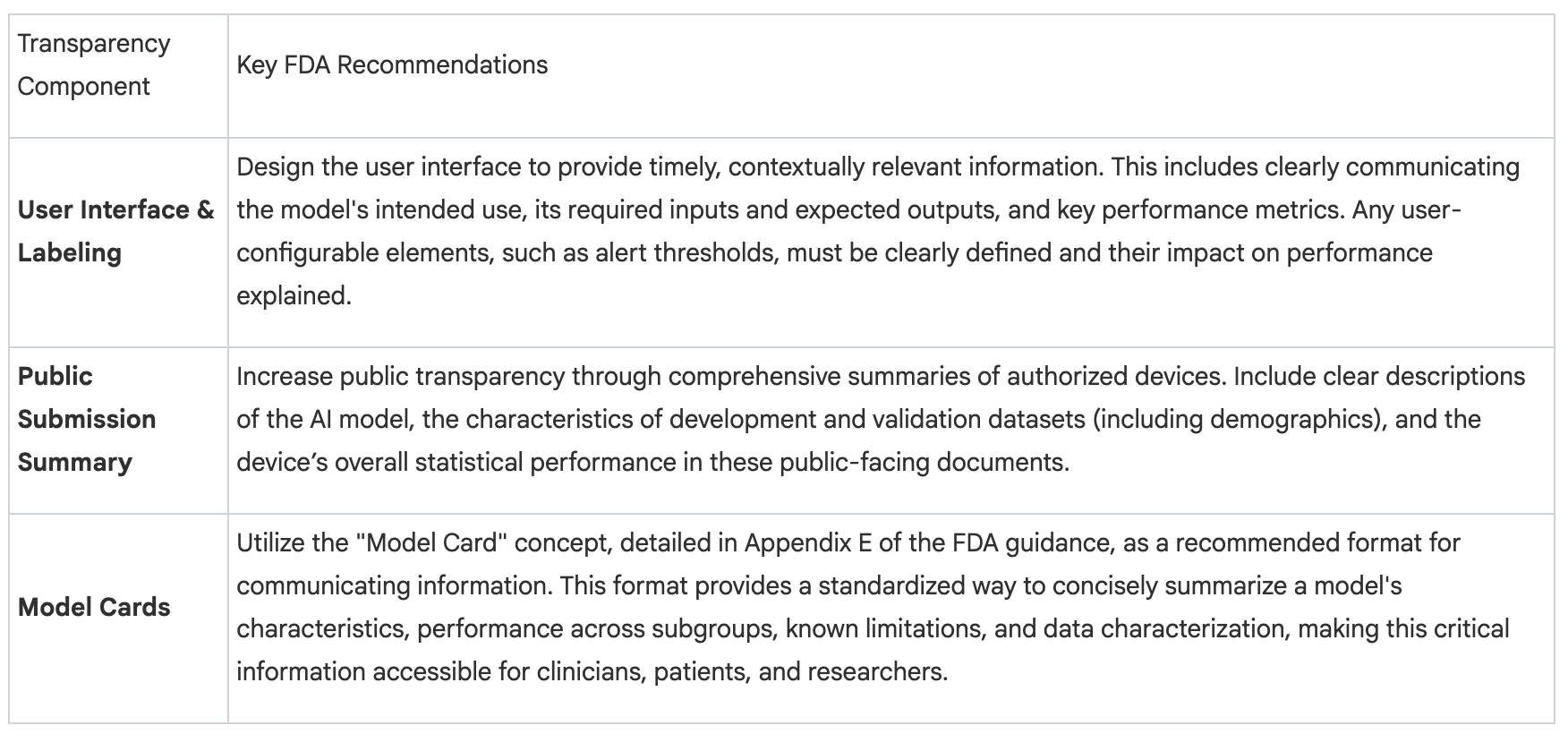
By prioritizing these components, manufacturers can create a holistic transparency strategy that addresses the needs of different stakeholders. This commitment to clear communication, combined with a foundation of representative data and rigorous subgroup validation, forms the basis of a comprehensive governance framework that spans the entire product lifecycle.
6.0 An Integrated Governance Framework for the AI Device Lifecycle
Ensuring fairness and transparency in AI-enabled medical devices requires a commitment to continuous governance that is integrated throughout the Total Product Life Cycle (TPLC). By systematically embedding the three pillars of representative data, subgroup validation, and user transparency into each phase of the device lifecycle, organizations can create a cohesive and proactive management process that translates principles into practice. This framework is not simply a compliance activity; it is a strategic feedback loop that drives innovation and builds market-leading products.
The following table maps actionable steps for each pillar to the key phases of the TPLC, providing a practical governance framework:
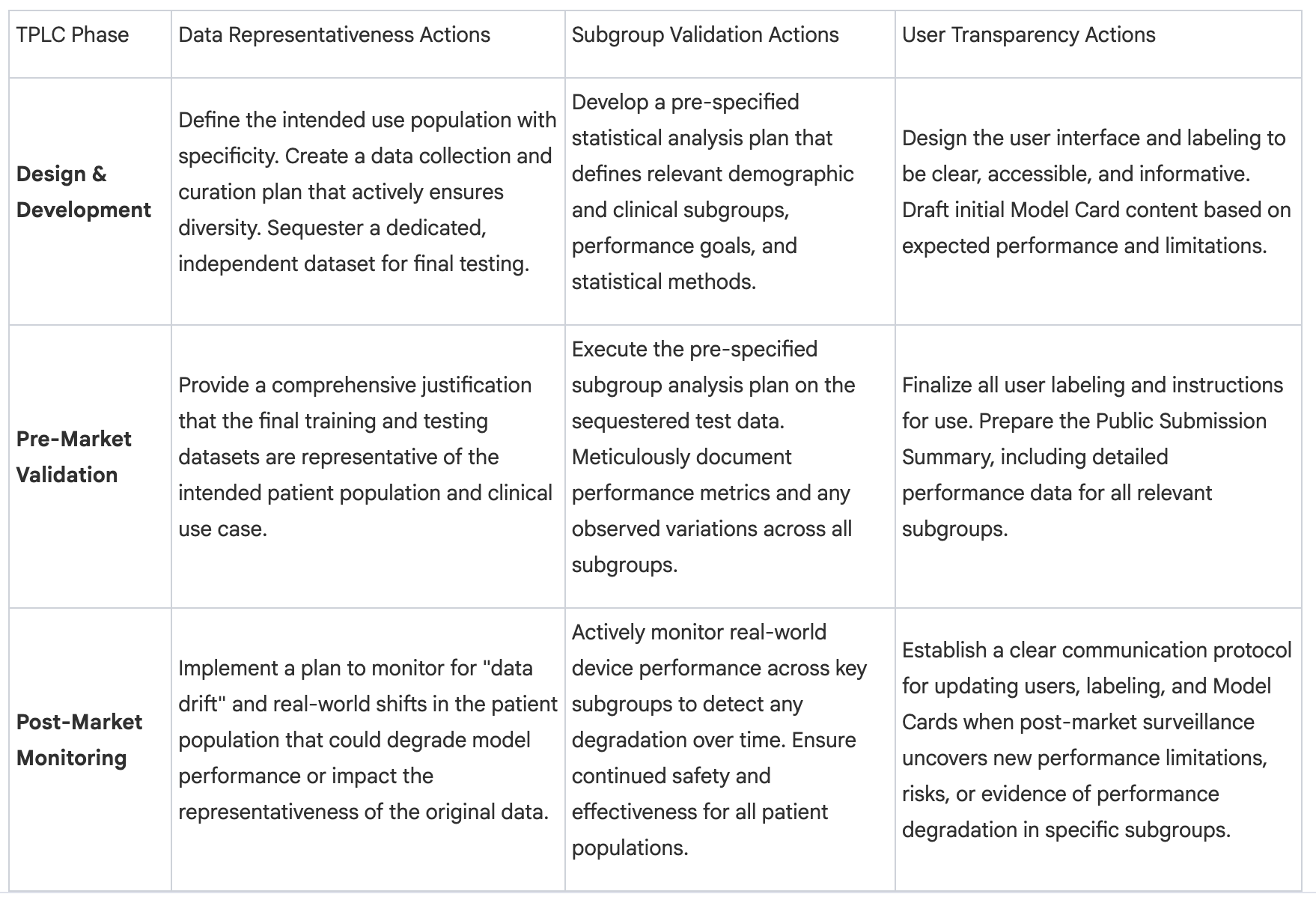
Actively monitor real-world device performance across key subgroups to detect any degradation over time. Ensure continued safety and effectiveness for all patient populations.
Establish a clear communication protocol for updating users, labeling, and Model Cards when post-market surveillance uncovers new performance limitations, risks, or evidence of performance degradation in specific subgroups.
A critical element of this framework is the emphasis on post-market performance monitoring. As the FDA guidance highlights, AI devices can be particularly sensitive to "data drift." The MHRA's "SmartGuideline" case study reveals a crucial trade-off: overly strict guardrails against hallucinations can lead to clinical risk from omissions, as "missing important information can be just as harmful." Therefore, a manufacturer’s post-market monitoring plan must define acceptable thresholds for both hallucinations and omissions and detail how this balance will be managed to ensure ongoing safety.
Furthermore, this continuous governance should be viewed as a strategic "executive insight pipeline." Every user interaction and real-world performance metric provides high-value behavioral data. This feedback loop can inform product strategy, marketing campaigns, and future R&D, turning a regulatory requirement into a powerful engine for innovation and competitive advantage.
This integrated approach ensures that fairness and transparency are not afterthoughts but are foundational to a device’s long-term success and trustworthiness.
7.0 Conclusion: Building the Future of Equitable AI in Medicine
Ensuring fairness and transparency in AI-enabled medical devices is a strategic and ethical necessity, not merely a regulatory burden. In a market where trust is the ultimate currency, a proactive commitment to mitigating bias and communicating with clarity is the most effective way to build innovative products that are not only powerful but also fundamentally safe, reliable, and equitable. This approach is the blueprint for creating market-leading devices that earn and maintain the confidence of physicians, patients, and regulators.
By aligning with the FDA's lifecycle-oriented approach, medical technology companies can build a robust governance framework founded on three core pillars. These pillars provide a clear and actionable path for development teams, product managers, and compliance officers:
• Start with Representative Data
• Validate Rigorously Across Subgroups
• Communicate with User-Centric Transparency
By embedding these principles throughout the Total Product Life Cycle, medical technology companies can confidently develop the next generation of AI-enabled devices. This approach will lead to products that are not only technologically advanced but also safe, effective, and equitable for all patient populations they are intended to serve. In doing so, manufacturers will not only meet regulatory expectations but will also secure the long-term trust and market success essential for leadership in the future of medicine.