
Multi-Agent Systems (MAS): Unit Economics, Margin Expansion, and Valuation Potential
Executive Thesis
Multi-Agent Systems (MAS) represent the transition from software as a tool to software as an autonomous labour layer. For investors, the core unlock is not model capability — it is unit economics leverage. MAS businesses, when designed correctly, combine SaaS-like recurring revenue with services-like outcome monetisation, while asymptotically driving marginal costs toward zero through automation, model optimisation, and economic routing.
The result is a potential new category of software companies capable of sustaining 70–90% long-term gross margins, expanding revenue per customer without linear headcount growth, and building durable competitive moats through data flywheels and workflow lock-in.
1. Why MAS Unit Economics Are Structurally Different
Traditional software monetises:
Seats
Licenses
API calls
Storage or compute
MAS monetises:
Decisions
Workflows
Outcomes
Automated labour hours
This changes the economic model from software productivity enhancement to software labour replacement and augmentation.
Key shift:
Legacy SaaSMASSeat-based valueOutcome-based valueFeature adoption growthWorkflow automation expansionHuman productivity multiplierHuman labour substitutionUsage cost = hostingUsage cost = reasoning + execution
2. Core MAS Unit Economics Drivers
Revenue Drivers
Platform subscription (infrastructure + governance + orchestration)
Workflow or automation transaction pricing
Outcome-based performance fees
Managed automation services
Cost Drivers
Model inference (tokens / reasoning loops)
Tool execution (APIs, RPA, data services)
Memory + retrieval infrastructure
Orchestration compute + telemetry
Human-in-the-loop oversight (declines over time)
3. The MAS Margin Expansion Flywheel
MAS companies have an unusually powerful margin flywheel:
Stage 1 — Early Deployment
Higher costs due to:
Premium model usage
Over-reasoning
Safety redundancy
Human review layers
Gross Margin: ~40–60%
Stage 2 — Optimisation
Costs drop via:
Model routing
Reasoning step pruning
Tool call optimisation
Caching and memory reuse
Gross Margin: ~60–75%
Stage 3 — Economic Autonomy
Agents actively optimise cost:
Cheapest viable model selection
Early exit decisioning
Cost-aware planning
Dynamic workflow path selection
Gross Margin: ~75–90%
4. The Most Important MAS Metric: Cost Per Outcome
Investors should focus on:
Cost Per Business Outcome Examples:
Cost per qualified lead
Cost per fraud case resolved
Cost per research report generated
Cost per compliance audit completed
This metric is superior to:
Token cost
Model cost
Infrastructure cost
Because customers buy outcomes, not compute.
5. MAS Revenue Expansion Dynamics
Unlike SaaS seat expansion, MAS expands via:
Horizontal Expansion
More workflows automated across departments.
Vertical Depth Expansion
More decision steps automated inside workflows.
Outcome Value Expansion
Higher value decisions shift from human → MAS.
This often produces net revenue retention > 130–160% in successful deployments.
6. MAS Cost Compression Mechanisms (Investor Moat)
Strong MAS companies build defensible cost advantages via:
Model Portfolio Optimisation
Dynamic routing across:
Premium reasoning models
Mid-tier task models
Cheap classification models
Workflow Intelligence
Learning optimal reasoning depth per task type.
Data & Memory Flywheels
More data → fewer reasoning steps → lower cost.
FinOps-Aware Planning
Agents choose lowest cost viable path automatically.
7. Why MAS Can Support Premium Valuation Multiples
A. Recurring + Consumption Hybrid Revenue
Combines SaaS predictability with usage upside.
B. High Switching Costs
MAS integrates deeply into:
Business workflows
Knowledge graphs
Internal systems
Compliance processes
C. Data Network Effects
More usage → better optimisation → lower cost → higher margin → price power.
D. Labour Market Arbitrage
MAS captures value from:
Replaced FTE cost
Reduced outsourcing cost
Faster decision cycles
8. Comparable Valuation Evolution (Forward Looking)
Market likely evolves:
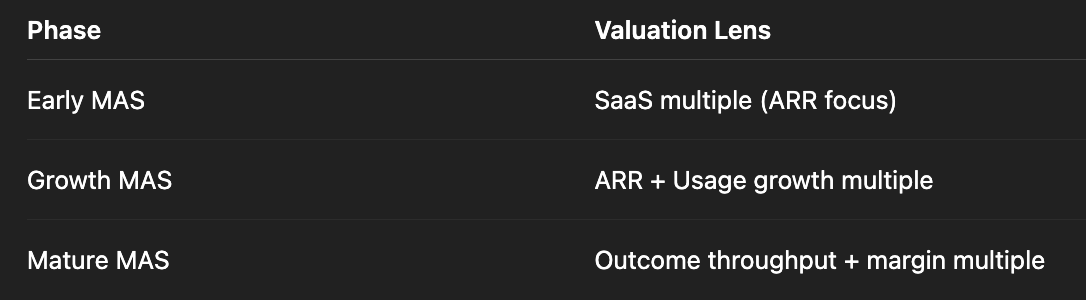
Long-term: MAS leaders likely trade closer to mission-critical infrastructure + workflow OS multiples.
9. Key Risks Investors Must Underwrite
Model Cost Volatility
Mitigated by multi-model routing and abstraction layers.
Over-Automation Risk
Poor governance → runaway cost or quality degradation.
Customer Cost Predictability Concerns
Requires strong FinOps + guardrails.
Vendor Dependency Risk
Solved via orchestration abstraction and model marketplaces.
10. The Most Attractive MAS Verticals (Near-Term)
Strongest economics occur where:
ROI is measurable
Decisions are repeatable
Labour cost baseline is high
Compliance burden is high
Top categories:
Compliance automation
Fraud detection and prevention
Revenue optimisation
Security operations
Procurement intelligence
Insurance claims processing
11. The Long-Term Strategic Upside
The highest-value MAS companies will become:
Decision infrastructure providers
Enterprise economic optimisation engines
Autonomous workflow operating systems
These companies will capture:
Software margin profiles
Services TAM scale
Data network effect defensibility
12. Investor Bottom Line
MAS is not just “AI SaaS.”
It is the first credible category where software:
Executes complex work
Improves economically over time
Expands margin as adoption increases
Scales revenue without linear labour growth
The winning MAS companies will be those that treat economics as a first-class system input, not just a financial output.
DM me to get access to MAS Economics, a lightweight application designed to provide real-time cost visibility, cost forecasting, and runtime budget guardrails for multi-agent workflows. It is intended to be the first deployable wedge product in a broader MAS economic control platform.
Platform Capabilities Overview
Our platform helps organisations understand, control, and optimise the economics of AI and multi-agent systems (MAS) — moving from simple cost visibility to fully autonomous economic optimisation.
Economic Visibility (Foundation)
Goal: Help you see exactly where AI money is going — and why.
At this stage, we connect to your AI systems, capture activity data, and turn it into clear financial insight.
What you get:
MAS Telemetry Ingestion Captures detailed activity and resource usage from every agent and model interaction.
Cost Attribution Engine Shows exactly which teams, agents, or workflows are driving cost — so you can bill accurately and optimise spend.
Unit Economics Dashboards Real-time visibility into metrics like cost per task, cost per customer outcome, and system financial health.
Cost Maturity Scoring Benchmarks your AI efficiency against industry standards and best practices.
Forecast Modeling Predicts future AI spend and resource demand based on historical patterns.
Pricing Simulation Lets you test “what-if” scenarios (e.g., model changes, workflow logic changes) before making decisions.
Customer Outcome: 👉 Full transparency into AI costs 👉 Ability to predict spend 👉 Confidence in financial reporting
Economic Control (Governance)
Goal: Move from insight to active cost management.
Once you can see costs clearly, this phase gives you real-time control and protection.
What you get:
Real-time Budget Enforcement Automatic stops or alerts when spending approaches limits.
Cost Guardrail Policies Rules that prevent inefficient agent behaviour or unnecessary expensive model usage.
Model Routing Optimisation Automatically selects the most cost-effective model for each task while maintaining quality.
Token Futures & Budget Pools Allocate reserved or prepaid AI capacity across teams and workloads.
Cost Pressure Signals Agents receive real-time signals when pricing conditions change — enabling instant adaptation.
Customer Outcome: 👉 Prevent runaway AI costs 👉 Automate financial governance 👉 Maintain performance while reducing spend
Economic Intelligence (Agent Autonomy)
Goal: Make AI systems financially intelligent — not just functional.
Here, agents start making decisions based on value vs. cost trade-offs.
What you get:
Economic Decision Scoring Measures how financially smart each agent action is.
Cost-aware Planning Algorithms Agents plan tasks while actively optimising for cost efficiency.
ROI-based Workflow Routing Workflows are prioritised based on expected return on investment.
Self-throttling MAS Low-priority work automatically slows or pauses during expensive periods.
Cost-aware Negotiation Agents can bid for resources or trade capacity internally.
Customer Outcome: 👉 AI that thinks economically 👉 Higher ROI per task 👉 Automatic cost-performance balancing
Economic Optimisation (Flagship / Advanced)
Goal: Turn your AI ecosystem into a self-optimising economic engine.
This is where the platform becomes a continuous profit optimisation layer across all AI operations.
What you get:
Self-optimising MAS Agents continuously learn how to reduce cost while maintaining or improving outcomes.
Margin Optimisation Loops System-level feedback loops that actively maximise profitability.
Profit-aware Workflow Design Simulate profitability before deploying new AI workflows.
Autonomous Pricing Recommendation Suggests optimal external pricing for AI services based on real internal costs.
Enterprise AI Cost Marketplaces Internal market where teams can trade AI capabilities based on supply, demand, and value.
Customer Outcome: 👉 Continuous margin improvement 👉 Data-driven pricing strategy 👉 Internal AI economy that allocates resources efficiently
See content credentials
AI FinOps & Unit Economics for CFOs
A working group for CFOs responsible for managing real-world AI spend, optimisation, and commercialisation.Focus areas:
* AI cost forecasting and variance control
* Token, inference, and orchestration cost governance
* AI workload profitability modelling
* Vendor concentration and model diversification risk
* Scaling AI without linear cost growthBuilt for finance teams deploying AI in production — not just evaluating it.